
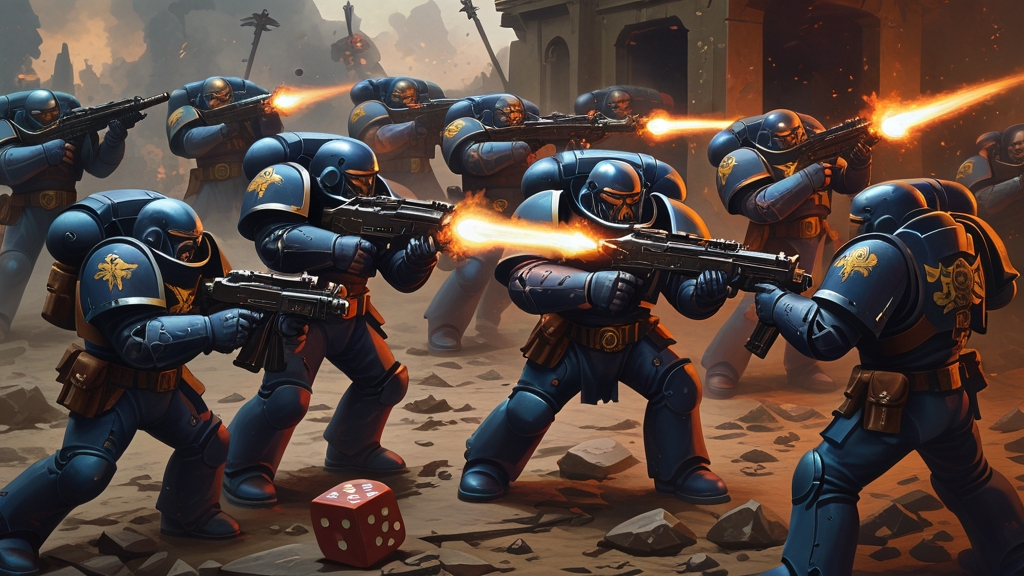
Combat in Warhammer 40k follows a clear, sequential process: roll to hit, roll to wound, the defender rolls saves, then damage is applied. This Hit, Wound, Save, Damage sequence is the core mechanic of the whole game and applies to both shooting and melee attacks. Every time a model fires a bolter, swings a chainsword or launches a missile, the same sequence decides whether the attack succeeds. Understanding it, and the modifiers and special rules that layer on top, is the key to understanding how Warhammer 40k plays.
This guide follows the 11th Edition core rules (June 2026). If you played 10th, most of the sequence will feel familiar, but a few things have changed: cover now worsens the attacker’s Ballistic Skill instead of improving your save, saves against an attached unit are rolled in allocation groups, engagement range is 2″, and charging units get Fights First. For the full list of differences see our 11th Edition rules changes, and keep the 11th Edition cheat sheet handy at the table.
Step 1: Roll to Hit
The first step in any attack is working out whether it connects. This is the Hit Roll: roll a D6 for each attack and compare it to one of two characteristics.
For shooting attacks, you use the weapon’s Ballistic Skill (BS). For melee attacks, you use the weapon’s Weapon Skill (WS). Both are written as a target number, such as 3+, and you need to roll that number or higher to hit. Elite troops such as Space Marines hit reliably; Orks, famously, are poor shots but much better in close combat. Check the current datasheet for each weapon’s exact value.
Important rules for hit rolls:
- An unmodified roll of 1 always fails, whatever the modifiers.
- An unmodified roll of 6 is a Critical Hit. It always hits, and it is what triggers abilities such as Lethal Hits and Sustained Hits.
- BS and WS have limits. However many bonuses or penalties apply, BS and WS can’t be improved past 2+ or worsened past 6+.
- Automatic hits (for example from Torrent weapons) skip the hit roll entirely and are never Critical Hits.
Example: A unit makes 10 ranged attacks with a BS of 3+. You roll 10 dice and count every 3, 4, 5 or 6 as a hit. Say you roll 1, 2, 3, 3, 4, 5, 5, 6, 6, 6: that’s 8 hits and 2 misses, and the three 6s are Critical Hits.
Step 2: Roll to Wound
Every hit moves on to the Wound Roll, which decides whether the attack is strong enough to hurt the target. Compare the weapon’s Strength (S) with the target’s Toughness (T):
- Strength is DOUBLE the Toughness or more: wound on 2+
- Strength is GREATER than Toughness: wound on 3+
- Strength EQUALS Toughness: wound on 4+
- Strength is LESS than Toughness: wound on 5+
- Strength is HALF the Toughness or less: wound on 6+
An unmodified 1 always fails, and an unmodified 6 is a Critical Wound, which triggers abilities such as Devastating Wounds. A high-Strength weapon wounds a low-Toughness target easily, while a weak weapon struggles against a tough one. This table drives almost every target-selection decision you make.
Example (continuing from above): Our 8 hits come from a Strength 4 weapon, and the target has Toughness 5. Strength 4 is less than Toughness 5, so we wound on 5+. We roll 8 dice: 1, 2, 3, 4, 5, 5, 6, 6. That’s 4 successful wounds.
Step 3: Allocate Attacks and Roll Saves
For each successful wound, the defending player makes a saving throw. The basic save uses the model’s Save characteristic (Sv), worsened by the weapon’s Armour Penetration (AP). AP is written as a negative number (AP -1, AP -2 and so on) and makes the save harder by that amount. Saves can never be improved to 1+.
11th Edition changed how saves are allocated. Instead of resolving one attack at a time, the defender:
- Creates groups. Each CHARACTER model gets its own group; all other models with identical Wounds, Save and invulnerable save form a group together.
- Declares the allocation order. A non-character group with a wounded model must come first, and no character group can come before a non-character group.
- Rolls all the saves at once, then resolves them from the lowest result to the highest. Each goes to the current group (to a wounded model in it if there is one), and when a group is wiped out the next group takes over.
For most simple units, with one group of identical models, this just means you roll your saves together and remove casualties as normal. It matters most for attached units, where characters are always last in line. [PRECISION] weapons are the main way round that. Our Leader rules guide walks through a full example.
Example: Our 4 wounds come from an AP -1 weapon. Against a target with a 6+ save, AP -1 makes it 7+, which is impossible on a D6, so all 4 saves fail. Against a 3+ save, AP -1 makes it 4+, which is still very achievable.
Invulnerable saves: Some models have an invulnerable save, which is rolled unmodified and ignores AP. If a model has both, the defender uses whichever is better after AP. A model with a 3+ save and a 5+ invulnerable save normally uses the 3+, but against AP -3 the armour save drops to 6+ and the 5+ invulnerable save becomes the better option.
Cover: In 11th Edition the Benefit of Cover no longer improves your save. Instead it worsens the attacker’s BS by 1 against ranged attacks, so it helps whatever the weapon’s AP. It applies to Infantry, Beasts and Swarms in a terrain area, or to units that aren’t fully visible because of intervening terrain. See line of sight in 40k for the details.
Step 4: Apply Damage
For each failed save, the weapon’s Damage (D) characteristic sets how many wounds the target model loses. Most small-arms deal 1 damage, so against single-wound models each failed save removes a casualty.
Heavier weapons deal multiple damage, sometimes a random amount such as D6 or D6+1. Against multi-wound models such as Terminators, monsters and vehicles, high-damage weapons are essential because they can remove a model with one failed save instead of several.
Important: Damage from a single attack does not spill over to other models. If an attack deals 6 damage to a model with 3 wounds left, the other 3 are lost. That’s why firing an anti-tank weapon at single-wound infantry wastes most of its potential.
Re-rolls
Many abilities let you re-roll dice. Depending on the ability, that can be hit rolls, wound rolls, damage rolls, saving throws or others. The most common versions are:
- Re-roll ones: only re-roll dice that show a natural 1.
- Re-roll failed rolls: re-roll any dice that failed.
- Full re-rolls: re-roll any or all of the dice, even successes, which is useful when you’re fishing for Critical Hits or Critical Wounds.
Many faction rules grant re-rolls against a chosen target, and the Command Re-roll Stratagem (1CP) lets you re-roll one die. Faction abilities change between codexes (the Space Marines’ Oath of Moment, for example, was replaced by Combat Doctrines in their 11th Edition codex), so check your current codex for exactly what they re-roll. Remember that in 11th Edition a unit can only benefit from one Stratagem per phase, and Command Re-roll counts. See what are Command Points.
A key rule: a dice can only be re-rolled once. If you re-roll a hit roll and get another 1, you can’t re-roll it again, even with a second source of re-rolls. Re-rolls happen before modifiers are applied.
Modifiers
Modifiers adjust rolls or characteristics up or down. For hit rolls, the important limit in 11th Edition is that BS and WS can never be better than 2+ or worse than 6+, and unmodified 1s always fail while unmodified 6s always hit. Common hit modifiers include cover (worsens the attacker’s BS by 1 against ranged attacks) and abilities such as Heavy and Plunging Fire. Our weapon abilities guide explains each one.
Save modifiers (AP) work differently: weapons can have AP -1, -2, -3 or more, making saves progressively harder. Invulnerable saves ignore AP entirely, which puts a floor under how bad a model’s save can get.
Feel No Pain (FNP)
Some models have Feel No Pain X+. Each time the model would lose a wound, you roll a D6, and on X+ that wound isn’t lost.
Feel No Pain stacks on top of everything else. A model with a 3+ save, a 4+ invulnerable save and a 5+ Feel No Pain is very hard to remove: the attacker has to get past the armour or invulnerable save and then the Feel No Pain roll. Feel No Pain isn’t affected by AP, and it works against mortal wounds too.
Mortal Wounds
Mortal wounds skip the save step entirely. No armour or invulnerable save can be taken against them (Feel No Pain still applies), each one inflicts 1 wound, and they’re resolved after normal damage. Because each mortal wound is worth exactly 1 damage, none of it is wasted on a model that’s already nearly dead.
Mortal wounds come from many sources: weapon abilities such as Devastating Wounds (triggered by Critical Wounds), failed Hazard rolls, Deadly Demise when a vehicle or monster explodes, and various faction abilities and Stratagems. For how criticals interact, see Lethal Hits vs Devastating Wounds.
Shooting vs. Melee: Key Differences
The Hit, Wound, Save, Damage sequence is the same for both, but the context differs.
Shooting happens in the Shooting phase. Each unit shoots using a shooting type (normal, assault, close-quarters or indirect), and its weapons need the target in range and, for most weapons, in line of sight. Things to watch include range, line of sight, cover on the target, and weapon abilities such as Heavy.
Melee happens in the Fight phase. In 11th Edition, engagement range is 2″ horizontally (5″ vertically), up from 1″ in 10th. The Fight phase runs in order: all pile-ins (up to 3″), then units with Fights First, then the remaining units, then consolidation (up to 3″). Charging units get Fights First that turn. Melee attacks use WS instead of BS and don’t need line of sight. Dedicated melee weapons often have higher Strength, better AP and more attacks than ranged weapons, but getting into combat means surviving the opponent’s shooting first.
Practical Tips for New Players
Target selection matters enormously. Match weapons to targets: high-Strength, high-AP, high-Damage weapons for vehicles and monsters, high-volume, low-Damage weapons for infantry hordes. An anti-tank shot at a lone Guardsman is wasted; a bolter fired at a Land Raider is pointless.
Understand your odds. A BS 3+ attack hits about 67% of the time. With Strength equal to Toughness, it wounds 50% of the time. Against an unmodified 3+ save, about 33% of wounds get through. Multiply them together: 0.67 × 0.50 × 0.33 ≈ 11% chance that each shot causes a failed save. Remember that cover in 11th Edition makes that first number worse rather than the last.
Volume vs. quality is the fundamental tension. Lots of cheap attacks can be as effective as a few powerful ones, depending on the target. The right choice depends on what you’re shooting at and what saves it has.
Frequently Asked Questions
Can a unit shoot and fight in the same turn?
Yes. A unit can shoot in the Shooting phase and then fight in the Fight phase if it is within engagement range of an enemy. Shooting while engaged is limited: in 11th Edition the old Pistol keyword has been replaced by Close-Quarters, and units use the close-quarters shooting type when they’re locked in combat. Check our weapon abilities guide for exactly which weapons can fire.
What happens if a weapon has a random number of attacks?
Some weapons list their Attacks characteristic as a random value (for example D6 or 2D6). You roll to find the number of attacks before making hit rolls. Sometimes your D6-shot flamer gets 6 attacks, sometimes it gets 1.
Do saves stack?
Armour saves and invulnerable saves don’t stack: you use the better one after AP is applied. Feel No Pain is separate and is rolled in addition. So the order is: save (or invulnerable save) first, then Feel No Pain for each wound that would be lost.
What is the difference between AP -1 and AP 0?
AP 0 means the weapon has no armour-piercing ability, so the target makes its save at full value. AP -1 worsens the save by 1 (a 3+ becomes 4+). AP -2 turns a 3+ save into 5+, AP -3 into 6+, and AP -4 makes a 3+ save impossible. Invulnerable saves ignore AP entirely.
Can you choose not to shoot?
Yes. Shooting is never mandatory. You can choose not to fire with some or all of your models, for example to avoid killing the models in a unit you plan to charge.
Is there a dice calculator for Warhammer 40k?
Yes. Mathhammer calculators work out the average hits, wounds and damage an attack will cause by multiplying the probability at each step of the Hit, Wound, Save and Damage sequence. You enter the number of attacks, Ballistic or Weapon Skill, Strength, AP and Damage against the target’s Toughness and Save. You can also do the maths by hand, as in this page’s odds example.
What is melee range in 40k?
Melee range in Warhammer 40k is called engagement range. In 11th Edition it is 2″ horizontally and 5″ vertically (it was 1″ in 10th). Models within engagement range can make melee attacks in the Fight phase, and a charging unit must finish its charge move within engagement range of its target. Pile-in and consolidation moves (up to 3″ each) help more of your models get into range.
Related Content
- How to Play Warhammer 40k — Complete Beginner’s Guide — beginner guide to Warhammer 40K
- What Are Command Points in Warhammer 40k? — related content on a similar topic
- How Does Morale Work in Warhammer 40k? — Battle-shock Explained — related content on a similar topic
- How Does Line of Sight Work in Warhammer 40k? — related content on a similar topic