
Part of our Aeldari hub: every Aeldari guide, lore page and painting tutorial in one place.
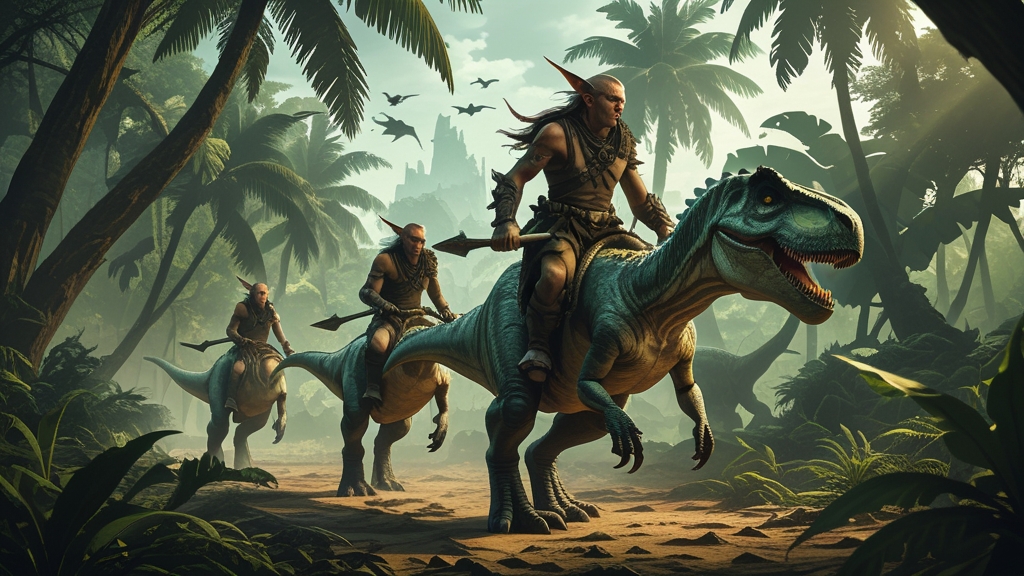
Exodites are Aeldari (Eldar) who abandoned the decadent Aeldari empire before its Fall and settled on remote, undeveloped worlds where they live in harmony with nature — and ride dinosaur-like megafauna into battle. They are the most reclusive and least technologically advanced branch of the Aeldari species, having deliberately chosen a simpler existence over the hedonistic excess that ultimately birthed Slaanesh. While they lack the sophisticated technology of their Craftworld kin, Exodites possess a deep connection to their planets’ World Spirits and can call upon prehistoric monsters as devastating war beasts.
The Exodites are one of Warhammer 40,000’s most tantalising factions — widely beloved in the lore but with minimal representation on the tabletop. They occupy a unique position in the Aeldari species’ story as the ones who got it right: they foresaw the catastrophe, left before it happened, and built a sustainable civilisation that has endured for millennia. For more on the Aeldari as a whole, see our Aeldari army guide.
Why Did the Exodites Leave the Aeldari Empire?
The Aeldari empire at its height was the most powerful civilisation in the galaxy. The Aeldari had defeated the Necrons, inherited the galaxy from the Old Ones, and achieved a level of technology and psychic mastery that made them virtually immortal. With no threats to face and no challenges to overcome, the Aeldari turned inward, pursuing ever more extreme forms of pleasure, art, and sensation.
This pursuit of excess grew darker over millennia. What began as aesthetic refinement became obsessive hedonism. Cults of pleasure sprang up across the empire, exploring pain, death, and every conceivable sensation without restraint. The Warp — which reflects the emotions of sentient beings — began to stir in response to this tide of excess. Something was forming in the Immaterium, feeding on the Aeldari’s unbridled passions.
The Exodites were among those who recognised the danger. While most Aeldari dismissed the warnings of seers and philosophers, the future Exodites chose to leave. They abandoned the empire’s core worlds and set out for the fringes of the galaxy, seeking planets far from civilisation where they could build a simpler, more disciplined existence. They rejected the technology and luxury that had enabled the empire’s decadence, choosing instead to live close to the land.
When the Fall came — when the accumulated excess of the Aeldari species birthed Slaanesh, the Chaos God of Pleasure, and the psychic shockwave destroyed the empire’s core worlds — the Exodites survived. They were far enough from the epicentre, and their disciplined lifestyle generated none of the psychic excess that fed Slaanesh. They watched from afar as their species’ civilisation was annihilated, knowing they had been right to leave.
What Are Exodite Worlds Like?
Exodite worlds are lush, wild planets teeming with life — often home to massive reptilian and saurian creatures that the Exodites have domesticated or formed bonds with. Unlike the refined artificial environments of the Craftworlds, Exodite settlements blend into the natural landscape. Villages are built among ancient forests, on clifftops overlooking vast plains, or nestled in valleys where rivers of crystal-clear water flow.
The Exodites deliberately maintain a pre-industrial level of visible technology. They do not build factories, cities, or the vast infrastructure that characterises other civilisations. This is not because they lack the knowledge — they are still Aeldari, and their understanding of technology and psychic science is profound — but because they have chosen simplicity as a philosophical and spiritual discipline.
However, Exodite worlds are not truly primitive. Beneath the pastoral surface, each world is connected by a World Spirit — a psychic network embedded in the planet itself, similar in concept to a Craftworld’s Infinity Circuit. When an Exodite dies, their spirit stone is placed within the World Spirit, adding their consciousness to the planet’s psychic reservoir. Over millennia, this accumulation of souls gives Exodite worlds a subtle sentience — the planet itself becomes aware, responsive to its Aeldari inhabitants.
The megafauna of Exodite worlds — creatures ranging from horse-sized raptor analogues to building-sized thunder lizards — are central to Exodite culture. Exodites form psychic bonds with these creatures, riding them as mounts, using them as beasts of burden, and deploying them in warfare. The image of elegant Aeldari riding dinosaurs into battle against Space Marines or Orks is one of the most distinctive in Warhammer 40,000’s visual imagination.
How Do Exodites Fight?
When threatened, Exodites fight with a combination of Aeldari technology, psychic power, and the brute force of their world’s megafauna. Dragon Knights — Exodite warriors mounted on massive reptilian creatures — form the backbone of their military, charging into enemy formations with devastating impact. These mounts are not merely animals; they are psychically bonded to their riders, responding to mental commands with the precision of a well-trained warhorse.
Exodite warriors also employ more conventional Aeldari weapons — shuriken catapults, laser lances, and psychic powers — but adapted to their mounted fighting style. A charge of Dragon Knights combining laser lance strikes with the crushing weight of their dinosaur mounts is one of the most terrifying sights on any battlefield.
The World Spirit itself can be weaponised in defence of an Exodite world. When the planet is threatened, the accumulated psychic energy of generations of dead Aeldari can be channelled through the World Spirit to create devastating psychic effects — storms of psychic energy, the animation of the land itself against invaders, or the empowerment of Exodite warriors fighting in defence of their home.
Exodite worlds are also defended by their Craftworld kin. Most Craftworlds maintain alliances with nearby Exodite settlements and will deploy military forces to defend them against invasion. Craftworld Biel-Tan, with its mission to reclaim the ancient Aeldari empire, is particularly committed to defending Exodite worlds, viewing them as the seeds of a future Aeldari renaissance.
What Is a World Spirit?
The World Spirit is the Exodite equivalent of a Craftworld’s Infinity Circuit — a psychic network that stores the souls of the dead. However, where the Infinity Circuit is embedded in the artificial wraithbone structure of a Craftworld, the World Spirit is woven into the living fabric of a planet. Tree roots, underground rivers, crystal formations, and the planet’s magnetic field all serve as conduits for the psychic energy of the World Spirit.
Over thousands of years, as more Exodite souls are added to the World Spirit, the network grows stronger and more complex. Ancient Exodite worlds may have World Spirits containing millions of souls accumulated over ten millennia since the Fall. These worlds are not merely planets — they are vast, slow consciousnesses that perceive the universe through the senses of every living thing upon their surface.
The World Spirit provides the Exodites with something no amount of technology can replicate: a guarantee that their souls will be safe from Slaanesh. Like the Infinity Circuit, the World Spirit shelters Aeldari souls from the Chaos God’s hunger. An Exodite who dies on their homeworld, with their spirit stone placed in the World Spirit, is as safe as any Aeldari can be in a universe where Slaanesh forever hunts their kind. For more on the spiritual threats facing the Aeldari, see our guide to the Eldar Gods.
How Do Exodites Relate to Other Aeldari?
Exodites are respected but sometimes pitied by their Craftworld cousins. Craftworld Aeldari acknowledge that the Exodites were right to leave the empire before the Fall, but many view the Exodite lifestyle as unnecessarily austere — a rejection of the beauty and sophistication that defines Aeldari culture. The Exodites, in turn, view Craftworld Aeldari as still too attached to the trappings of their fallen civilisation.
The relationship between Exodites and Drukhari (Dark Eldar) is far more hostile. The Drukhari, who inhabit the dark city of Commorragh within the Webway, occasionally raid Exodite worlds for slaves and sport. The Exodites view the Drukhari as embodying everything they rejected — the cruelty, excess, and spiritual corruption that destroyed the Aeldari empire.
Harlequins — the enigmatic servants of the Laughing God Cegorach — move freely between all Aeldari factions, including the Exodites. They are welcomed on Exodite worlds as storytellers and preservers of Aeldari myth, and their performances are among the few occasions when Exodite communities gather in large numbers.
The Ynnari movement — the followers of the death god Ynnead — has complicated Exodite relationships with other Aeldari. The Ynnari seek to unite all Aeldari factions behind the goal of defeating Slaanesh through the awakening of a new god. Some Exodites see the Ynnari as potential saviours; others view them as dangerous fanatics pursuing a goal that could destroy what the Exodites have carefully preserved.
Frequently Asked Questions
Do Exodites have tabletop models?
As of now, Exodites do not have their own dedicated tabletop range or army list. They appear in the lore and have been featured in Forge World products and fan conversions, but Games Workshop has not released a full Exodite army. They remain one of the most requested but unreleased factions among the fanbase.
Are Exodites actually riding dinosaurs?
The creatures on Exodite worlds are alien megafauna that resemble dinosaurs in size and general appearance, but they are not Earth dinosaurs. They evolved independently on alien worlds and have been domesticated by the Exodites over millennia. That said, “Eldar on dinosaurs” is the universally accepted shorthand, and Games Workshop leans into the comparison.
Why did the Exodites survive the Fall?
Two reasons: distance and discipline. The Exodites settled on worlds far from the empire’s core, putting physical distance between themselves and the psychic shockwave of Slaanesh’s birth. Their disciplined, simple lifestyle also meant they generated none of the psychic excess that fed Slaanesh’s creation.
Can Exodites use Craftworld technology?
Yes. Exodites have access to Aeldari technology and the knowledge to use it. Their simplicity is a choice, not a limitation. In times of extreme need, Exodites can and do employ advanced Aeldari weapons and equipment. Their Craftworld allies also supply them with technology when defending against major invasions.
How many Exodite worlds are there?
The exact number is unknown. Exodite worlds are scattered across the galaxy, many in remote regions that other species have not explored. There could be hundreds or thousands of Exodite settlements, ranging from major worlds with millions of inhabitants to small colonies of a few thousand. Their reclusive nature means the true number may never be known.
What does Exodite mean?
Exodite comes from ‘exodus’. It refers to the Aeldari who made an exodus from the heart of their empire before the Fall, abandoning its decadence to settle on distant, untamed worlds. The name sets them apart from the Craftworld Aeldari, who fled on world-ships as the catastrophe struck, and the Drukhari, who stayed in the Webway.
Is there a dinosaur army in Warhammer 40k?
The Exodites are the closest thing Warhammer 40,000 has to a dinosaur army. They are Aeldari who ride huge reptilian megafauna into battle, with Dragon Knights as their best-known warriors. If you want a full dinosaur army with a big model range, the Seraphon of Age of Sigmar are the dedicated choice.
Do Exodites follow the Path like Craftworld Aeldari?
No. The Path is a Craftworld discipline, where each Aeldari focuses on one calling at a time to keep their emotions under control. Exodites guard against Slaanesh with a simple, hard-working life on the land instead, and by placing their spirit stones in their world’s World Spirit when they die. Their restraint comes from lifestyle rather than the Path’s strict structure.
Related Content
- The Horus Heresy Explained — Complete Timeline & Guide — understand the pivotal Horus Heresy era
- Best Warhammer Books to Read — Fiction Guide — find great Warhammer novels to read
- Warhammer Etiquette Guide — Sportsmanship & Table Manners — explore more Warhammer content