
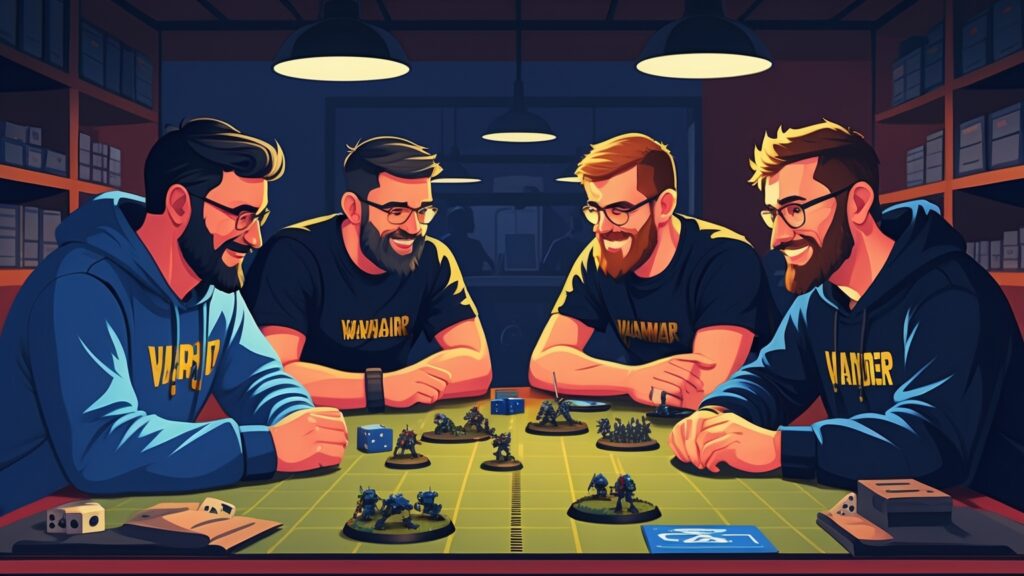
Doubles (2v2) Warhammer is played with two players per side, each bringing half an army — typically 1,000 points each for a standard 2,000-point game. Players take turns within the same team, coordination is key, and the social dynamic of playing with a partner adds an entirely new dimension to the game. Doubles is one of the most enjoyable ways to play Warhammer, combining the tactical depth of a full-size game with the collaborative fun of team play, and it is an excellent format for introducing new players to the game alongside experienced partners.
While Games Workshop does not publish comprehensive official doubles rules in the core rulebook, the format has a long history in the community and at events. Most gaming groups and tournament organisers have developed house rules that work well, and the basic framework is straightforward enough that any group can start playing doubles with minimal preparation. This guide covers everything you need to know to organise and play doubles games of both Warhammer 40,000 and Age of Sigmar.
Basic Rules for Doubles Play
The fundamental structure of a doubles game is simple: two teams of two players, each team fielding a combined army that meets the standard points limit for the game size. In a 2,000-point game, each player brings 1,000 points. In a 3,000-point game, each player brings 1,500 points. The combined army must meet all standard army construction requirements — detachments, unit selections, and any other restrictions that apply to the game system being played.
Each player builds their own 1,000-point force as a self-contained army. In Warhammer 40,000, each player selects their own detachment and faction, with their own Stratagems and abilities. In Age of Sigmar, each player selects their own army with its own battle traits and enhancements. The key rule is that each player’s force should be legal as a standalone army at its points level, even though it is fielded as part of a larger combined force.
Turn structure in doubles can be handled in several ways. The most common approach is alternating player activation — within a phase, players from the active team alternate activating units, with each player controlling only their own units. This keeps both players engaged throughout the turn and prevents one player from dominating the game while their partner watches. Some groups prefer to have each player take a complete turn with their own forces, alternating between the two players on a team — this is simpler but can leave one player idle for longer periods.
Army Construction for Doubles
Army construction for doubles raises several questions that your gaming group should agree on before playing. The most important is whether teammates can share faction abilities. Can an Ultramarines player’s aura abilities affect their partner’s Imperial Guard units? Can a Stormcast player’s command abilities benefit their partner’s Cities of Sigmar units? Different groups handle this differently, and there is no single correct answer.
The most common approach is to keep faction abilities separate — each player’s abilities only affect their own units. This is simpler to manage, prevents potentially overpowered cross-faction synergies, and ensures that each player’s army functions independently. However, some groups allow Grand Alliance-level abilities to cross between partners (e.g., Order abilities affect all Order units, regardless of which player controls them), which creates more synergy but requires more rules knowledge.
Command Points (in 40k) or similar resources should typically be tracked separately for each player. Each player generates and spends their own Command Points, using them on their own Stratagems. Sharing Command Points between partners creates balance issues and should generally be avoided unless your group specifically wants that level of coordination.
For army diversity, many doubles events require or encourage teammates to play different factions. This prevents the “two identical armies” approach and creates more interesting visual and tactical variety on the table. Some events go further, requiring teammates to play different Grand Alliances or even different game factions entirely (e.g., one player plays Space Marines while the other plays Aeldari).
Communication and Coordination
The social dynamic is what makes doubles special. You are not just playing against your opponents — you are playing with your partner, and the quality of your coordination directly affects your performance. Good doubles teams communicate constantly: discussing target priority, coordinating movement, planning combined charges, and adjusting strategy in response to the opponent’s actions.
A critical rule that most groups adopt is that all communication between teammates must be open — no secret discussions, no whispered plans, no hidden strategies. The opposing team has the right to hear everything you discuss with your partner. This prevents accusations of unfair advantage and keeps the game transparent and social. Some groups allow brief private huddles at the start of each battle round, but during play, all discussion should be audible to all players.
Deployment is an area where coordination is essential. Teammates need to agree on who deploys where, which flanks each player covers, and how their forces will interact during the game. A common mistake in doubles is treating your half of the army as independent — fighting your own separate battle on your side of the table while your partner fights theirs. The best doubles teams deploy and play as a unified force, with each player’s units complementing and supporting the other’s.
Scenarios and Objectives
Standard missions from the core rules work well for doubles with minimal modification. Objective placement, scoring, and victory conditions remain the same — the only difference is that two players share responsibility for achieving them. Some groups assign specific objectives to specific players, while others allow either player to score any objective. The latter approach is simpler and encourages more collaborative play.
Doubles-specific missions can add variety. Consider missions where each team has a “commander” model (one per team) whose survival is worth bonus victory points. Or missions where objectives in different table quarters are worth different amounts, forcing teams to decide how to allocate their resources. The team dynamic opens up mission design possibilities that do not exist in standard one-on-one play.
Time management is important in doubles. With four players and larger combined armies, games can take longer than standard one-on-one matches. Consider using a chess clock (60-90 minutes per team) to keep the game moving, or agree on a time limit before starting. Doubles games that run too long tend to lose energy, so keeping the pace up is essential for an enjoyable experience.
Tips for Running Doubles Events
If you are organising a doubles event at your local gaming store or club, several practical considerations will ensure a smooth experience. Require army lists to be submitted in advance so you can check for illegal builds and identify potential rules interactions that might cause confusion. Publish your doubles-specific house rules clearly and well in advance — nothing derails an event faster than rules disputes about fundamental mechanics.
Pairing can be done in several ways. Some events allow players to choose their own partners, which maximises social enjoyment. Others randomly assign partners each round (a “blind doubles” format), which creates a different challenge — adapting to a new partner and unfamiliar army every game. Both formats have their merits, and the choice depends on your community’s preferences.
Scoring for a doubles event should reward the team, not individual players. Both players on a team receive the same score for each round, win or lose together. This prevents situations where one player “carries” while the other disengages, and reinforces the collaborative nature of the format. Prizes for “best painted army” should consider the combined force, encouraging teammates to coordinate their painting themes.
Common Doubles Formats
Several established doubles formats exist in the community. The most common are the standard format described above (two players, 1,000 points each, combined army), the escalation format (starting at 500 points per player and increasing each round), and the narrative format (using Crusade or Path to Glory rules where each player’s force grows through the event).
The “allied factions” format restricts teammates to factions within the same Grand Alliance, creating thematic pairings like Space Marines and Imperial Guard or Stormcast Eternals and Cities of Sigmar. The “odd couples” format does the opposite, requiring teammates to play different Grand Alliances — forcing unlikely alliances like Orks and Aeldari or Death and Order. The latter creates hilarious thematic situations and challenging army synergy puzzles.
Frequently Asked Questions
Can I play doubles with different game systems?
Doubles works with both Warhammer 40,000 and Age of Sigmar, as well as smaller games like Kill Team and Warcry (though the smaller game formats may need more modification). The basic principles — split points, coordinate play, communicate openly — apply regardless of which system you are using.
What points level works best for doubles?
1,000 points per player (2,000 total per side) is the most popular format. It gives each player enough points to build a meaningful army while keeping the game at a manageable size. For shorter games, 750 per player works well. For epic games, 1,500 per player creates massive battles but requires significantly more time.
Should teammates play the same faction?
This is a matter of preference. Same-faction teams benefit from shared rules knowledge and thematic coherence, but they can feel limited in variety. Different-faction teams offer more tactical flexibility and visual diversity. Most events encourage or require different factions for variety and balance.
How long does a doubles game take?
Expect a 2,000-point doubles game (1,000 per player) to take 2.5 to 3.5 hours, depending on the players’ experience and the complexity of the armies involved. This is slightly longer than a standard 2,000-point one-on-one game due to the additional coordination and communication required.
What size table do you need for a doubles game?
A standard 2,000-point doubles game (1,000 points each) fits on a normal 44″ x 60″ battlefield, the same as a one-on-one Strike Force game. Many groups play on a 6 x 4 ft table for extra elbow room, space for four players’ dice and army cases. For 1,500 points each, use an Onslaught-sized 44″ x 90″ battlefield or two boards side by side.
Who goes first in a doubles game?
Usually the teams roll off, exactly as two players would in a normal game, with one player from each team rolling or the team using a single shared roll. The winning team then takes the first turn or picks deployment as the mission says. Agree before the game whether both teammates move in the same turn, which is the most common approach.
Related Content
- Grey Knights — Warhammer 40k Guide — apply this guide to a specific army
- How to Play Warhammer 40k — Complete Beginner’s Guide — learn the core rules of Warhammer 40K
- What Are Stratagems in Warhammer 40k? — Rules Guide — explore another helpful guide
- All Warhammer 40k Factions Ranked — Tier List — see which factions rank highest