
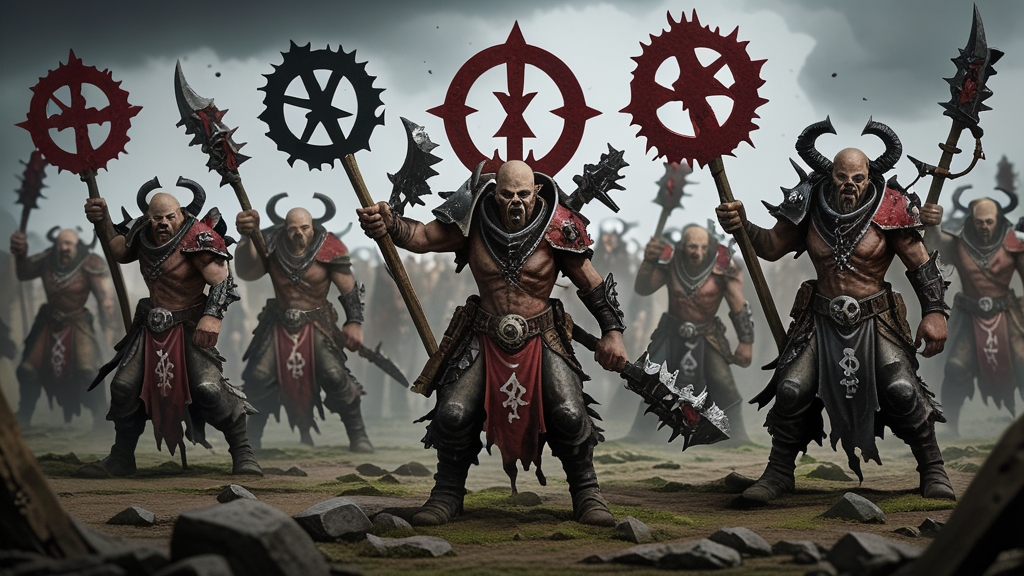
Chaos Cultists are ordinary humans who have been corrupted by the Ruinous Powers. They are the foot soldiers of Chaos — expendable fanatics who worship the Dark Gods, often secretly infiltrating Imperial society before rising up in rebellion. Every Chaos Space Marine warband, every daemonic incursion, and every dark uprising relies on the countless mortal followers who give their lives willingly for powers they barely understand.
In the grim darkness of the far future, the threat of Chaos Cultists is perhaps the most insidious danger the Imperium faces. While xenos invasions and daemonic incursions are dramatic and terrifying, the slow rot of cultist infiltration happens in the shadows — in underhive cells, in noble courts, in manufactorum break rooms, and in the very hearts of those sworn to defend humanity.
How Do Ordinary Humans Become Chaos Cultists?
The path to becoming a Chaos Cultist rarely begins with a conscious decision to worship dark gods. Instead, corruption takes root through desperation, ambition, ignorance, or simple human weakness. The Imperium is a brutal place where billions suffer in grinding poverty, work themselves to death in manufactorums, and live under the crushing weight of a theocratic regime that offers little comfort.
For many, the lure of Chaos begins as something seemingly benign. A secret society promising brotherhood and mutual aid. A charismatic preacher offering an alternative to the cold doctrines of the Ecclesiarchy. A whispered promise that there are powers willing to grant what the Emperor never will — relief from suffering, power over enemies, knowledge forbidden by the Administratum.
Some cultists are recruited through family traditions, born into households that have secretly worshipped the Dark Gods for generations. Others are corrupted by exposure to Chaos artefacts, tainted texts, or the psychic emanations of the Warp itself. Psykers who escape the Black Ships are particularly vulnerable, their untrained minds serving as beacons for daemonic entities eager to whisper seductive promises.
The process of corruption is gradual. What begins as attendance at clandestine meetings progresses to minor rituals, blood oaths, and eventually full-blown devotion to one or more of the Chaos Gods. By the time a cultist realises the true nature of what they serve, they are usually too deeply enmeshed — bound by dark pacts, addicted to the power Chaos grants, or simply terrified of the consequences of turning back.
What Role Do Chaos Cultists Play in the Forces of Chaos?
Chaos Cultists serve as the expendable masses that make larger Chaos operations possible. Their roles are varied and essential to the functioning of Chaos warbands and daemonic invasions.
Cannon fodder and human shields: The most basic function of cultists is to die in large numbers so that more valuable Chaos assets — Chaos Space Marines, daemons, and champions — can achieve their objectives. Cultist hordes absorb enemy fire, overwhelm defensive positions through sheer numbers, and force the enemy to expend ammunition on targets that cost Chaos nothing to replace.
Infiltration and sabotage: Before a Chaos incursion begins, cultists embedded within Imperial society perform critical preparatory work. They sabotage planetary defence networks, assassinate key officials, spread disinformation, poison water supplies, open sealed gates, and disable communication arrays. A single well-placed cultist in a planetary defence command centre can do more damage than an entire Chaos Space Marine squad.
Ritual participants: Many Chaos operations require rituals that demand mortal participants — either as celebrants or as sacrifices. Cultists provide both. Mass rituals can thin the barrier between realspace and the Warp, summon daemonic entities, empower Chaos sorcerers, or corrupt the very land itself into a hellscape hospitable to the forces of the Dark Gods.
Labour and logistics: Someone has to build the dark fortresses, maintain the war machines, grow the food, and handle the thousand mundane tasks that even a Chaos warband requires. Cultists fill these unglamorous but essential roles, serving as workers, servants, and functionaries for the forces of the Ruinous Powers.
Which Chaos Gods Do Cultists Worship?
Chaos Cultists may worship any of the four major Chaos Gods, or they may follow Chaos Undivided — venerating the Ruinous Powers as a pantheon rather than pledging to a single deity.
Khorne cultists are the most overtly violent. They form murder-gangs, fight pits, and blood cults that revel in slaughter. Their rituals involve combat and bloodletting, and they often mark themselves with the skull rune of the Blood God. These cults thrive in war zones, gladiatorial arenas, and among criminal gangs where violence is a way of life.
Tzeentch cultists are the most subtle and dangerous. They form secret cabals dedicated to the acquisition of forbidden knowledge, political manipulation, and sorcerous power. Tzeentch cults frequently infiltrate the upper echelons of Imperial society — noble houses, the Administratum, even the Inquisition itself. Their members are often educated, ambitious individuals who crave knowledge and influence above all else.
Nurgle cultists embrace disease, decay, and entropy. They form plague cults that deliberately spread contagion, viewing sickness as a blessing from their patron. Nurgle cults are particularly common in areas struck by plague or famine, where the desperate accept Nurgle’s promise that suffering will end once they embrace the Grandfather’s gifts.
Slaanesh cultists pursue sensation and excess in all its forms. They form pleasure cults, art collectives, and hedonistic circles that push every experience to its extreme. Slaanesh cults are common among the wealthy and privileged — those with the resources to indulge their every desire until mundane pleasures no longer satisfy.
How Are Chaos Cults Organised?
Chaos cults vary enormously in structure, from tiny cells of a handful of members to vast organisations with thousands of followers operating across multiple worlds. However, most share certain common organisational features.
At the top sits a cult leader — often a charismatic individual who may have direct contact with Chaos Space Marines, daemon princes, or daemonic entities. The cult leader receives instructions from their masters and translates them into actionable orders for the cult. Many cult leaders are low-level psykers whose abilities have been enhanced by their patron god.
Below the leader are inner circle members who understand the true nature of the cult and have undergone significant rituals of dedication. These individuals oversee cells of lower-ranking members, manage the cult’s resources, and serve as lieutenants in times of open warfare.
The bulk of any cult consists of rank-and-file members who may have limited understanding of the cult’s true nature. Many believe they are part of a mutual aid society, a political movement, or an alternative religious group. They are told only what they need to know and are gradually exposed to deeper truths as they prove their loyalty.
Most cults operate on a cell structure, with individual cells knowing little about each other. This makes the cult resistant to infiltration and investigation — even if the Inquisition discovers and destroys one cell, the broader cult survives to continue its work in darkness.
What Happens When a Chaos Cult Rises Up?
The ultimate purpose of most Chaos cults is to stage an uprising that supports a larger Chaos objective. This moment — when the cult abandons secrecy and takes up arms — is one of the most dangerous events a world can face.
A cult uprising typically begins with coordinated acts of sabotage: power grids failing, communications going dark, water supplies poisoned, key leaders assassinated. In the confusion that follows, cultists emerge from hiding armed with whatever weapons they have accumulated — autoguns, stub pistols, improvised explosives, industrial tools repurposed as weapons, and occasionally military-grade hardware stolen or smuggled over months or years of patient preparation.
The chaos of an uprising can paralyse a world’s defences long enough for the real threat to arrive — whether that is a Chaos Space Marine warband making planetfall, a daemonic incursion tearing through weakened reality, or a full-scale Black Crusade invasion fleet entering orbit.
Even without external support, a sufficiently large cult uprising can overwhelm a world’s defences. The Imperium has lost entire planets to cultist revolts that spiralled out of control before the Astra Militarum or Space Marines could respond in time.
How Does the Imperium Fight Chaos Cults?
Combating Chaos cults is primarily the responsibility of the Inquisition, specifically the Ordo Hereticus (which hunts heretics and witches) and the Ordo Malleus (which focuses on daemonic threats). Inquisitors employ vast networks of agents, informants, and acolytes to identify and root out cultist activity before it can reach critical mass.
The Adeptus Arbites — the Imperium’s law enforcement — also plays a key role, investigating suspicious activity on individual worlds. Local planetary defence forces, the Ecclesiarchy’s own enforcement arms, and even the Officio Assassinorum may be called upon when cult activity is discovered at high levels.
The problem is one of scale. The Imperium spans a million worlds, and Chaos cults can spring up anywhere. For every cult discovered and destroyed, dozens more operate undetected. The Imperium’s own oppressive nature — its intolerance, inequality, and brutality — creates the very conditions in which cults thrive, making the problem fundamentally unsolvable within the current Imperial system.
Chaos Cultists on the Tabletop
In Warhammer 40,000, Chaos Cultists serve as cheap, expendable troops in Chaos Space Marines armies. They fill the role of objective holders, screening units, and chaff that protects more valuable units from enemy fire and charges.
Cultist units are characterised by low stats — they are, after all, ordinary humans with minimal training — but they compensate with low points cost and the ability to be taken in large numbers. They can be armed with autoguns, autopistols, and brutal assault weapons, and are often led by a Cultist Champion who has earned slightly better gear through devotion to the Dark Gods.
Variants include Accursed Cultists, who have been mutated by Chaos exposure into twisted abominations that hit harder in melee, and Cultist Mobs that can be surprisingly effective when buffed by nearby Chaos characters. Dark Commune units represent the cult’s leadership — demagogues, psykers, and blessed blades who inspire the rabble to fight harder and hold objectives more stubbornly than their lowly stats would suggest.
Frequently Asked Questions
Are Chaos Cultists the same as Traitor Guard?
Not exactly. Chaos Cultists are civilians who have turned to Chaos worship, while Traitor Guard (now often called the Lost and the Damned) are former Astra Militarum soldiers who have betrayed the Imperium. Traitor Guard retain their military training and equipment, making them significantly more dangerous than typical cultists. However, the distinction can blur — cultists may include former soldiers, and traitor regiments often recruit civilian cultists into their ranks.
Can Chaos Cultists become Chaos Space Marines?
Rarely. The process of creating a Space Marine requires gene-seed implantation during adolescence, which cults themselves cannot perform, although some Chaos warbands take promising youths from their cultist followers as aspirants. However, exceptional cultists may be rewarded with daemonic gifts, mutations, or elevation to the rank of Chaos Champion. In extremely rare cases, a cultist who gains enough favour may eventually ascend to become a Daemon Prince — though this is vanishingly unlikely for an ordinary mortal.
Do all Chaos Cultists know they serve Chaos?
No. Many low-ranking cultists believe they serve a benevolent deity, a revolutionary cause, or a secret society dedicated to mutual improvement. The true nature of their worship is revealed gradually, and by the time most cultists understand what they have become part of, they are too deeply committed to escape. Some never learn the truth at all, going to their deaths believing they fought for a righteous cause.
What is the most famous Chaos Cult in Warhammer 40k lore?
Several cults have achieved infamy in the lore. The Word Bearers Legion established the first known Chaos cults during the Great Crusade, spreading worship of the Dark Gods on worlds they had supposedly brought to Imperial compliance. On a smaller scale, cults like the Stigmartus (who fought in the Sabbat Worlds Crusade) and the Sons of Sek have been major antagonists in Warhammer fiction, particularly in Dan Abnett’s Gaunt’s Ghosts series.
Are Genestealer Cults the same as Chaos Cults?
No. Genestealer Cults worship the Tyranids, whom they see as saviour ‘Star Children’, and are made up of the hybrid descendants of a Genestealer’s victims. Chaos Cults worship the Dark Gods of the Warp. Both secretly infiltrate Imperial worlds and then rise up in coordinated rebellions, which is why people confuse them, but their goals and masters are completely different.
What were the old Chaos Cultist models?
The older Chaos Cultists most players remember are the plastic models from the 2012 Dark Vengeance starter set, which were later sold in their own box. Games Workshop replaced them with a new Cultist Mob kit in 2022, alongside that year’s Chaos Space Marines release. The older sculpts still work perfectly well as cultists on the tabletop.
Are there Chaos Cults in Necromunda?
Yes. Necromunda has Chaos cult gangs, most notably the Helot Chaos Cults introduced in the Book of Ruin, along with Khorne’s Corpse Grinder Cult. They represent underhive dwellers who have turned to the Dark Gods. They play as fanatical gangs that can gain mutations and dark blessings over the course of a campaign.
Related Content
- The Horus Heresy Explained — Complete Timeline & Guide — understand the pivotal Horus Heresy era
- Best Warhammer Books to Read — Fiction Guide — find great Warhammer novels to read
- Warhammer Etiquette Guide — Sportsmanship & Table Manners — explore more Warhammer content