
Part of our Imperial Fists hub: every Imperial Fists guide, lore page and painting tutorial in one place.
Darnath Lysander is the Captain of the Imperial Fists 1st Company and one of the most resilient warriors in the Imperium. He was captured by the Iron Warriors, endured centuries of torture, escaped, and returned unchanged in his devotion to the Emperor. His story is one of absolute defiance — a warrior who refused to break no matter what was done to him.
Lysander embodies everything the Imperial Fists stand for: endurance, stubbornness, and unshakeable loyalty. He is a living fortress, armed with his legendary thunder hammer Fist of Dorn and clad in ancient Terminator armour that has been shattered and rebuilt more times than anyone can count. This article covers Lysander’s remarkable history, his combat abilities, his significance to the Imperial Fists, and why he is one of the most compelling characters in Warhammer 40,000 lore.
What Is Lysander’s Story?
Lysander’s story begins like that of many Space Marine heroes — as a promising warrior who rose through the ranks of the Imperial Fists through skill, determination, and an unbreakable will. He was elevated to the rank of 1st Company Captain, commanding the Chapter’s elite Terminators and earning a reputation as one of the finest siege warriors in the Imperium. Under his leadership, the 1st Company became the Chapter’s hardest-hitting formation, renowned for breaching the most formidable enemy fortifications.
Everything changed during the battle of Malodrax. Lysander and his warriors were fighting the Iron Warriors — the Imperial Fists’ most hated rivals, traitors who had turned to Chaos during the Horus Heresy. During the engagement, Lysander was separated from his company, overwhelmed by superior numbers, and captured by the Iron Warriors’ Warsmith. What followed was centuries of captivity within the Eye of Terror, where time flows differently than in realspace.
The Iron Warriors subjected Lysander to every torment their twisted imaginations could devise. Physical torture, psychological warfare, exposure to daemonic corruption — all designed to break his will, force him to renounce the Emperor, and turn him into a weapon against his own Chapter. The Iron Warriors are master siege engineers, and they approached Lysander’s resistance as they would a fortress wall: systematically, patiently, applying pressure at every weak point.
They failed. Lysander endured everything. He did not bend. He did not compromise. He did not despair. When an opportunity came — the details are unclear, as Lysander rarely speaks of his captivity — he fought his way free and escaped from the Eye of Terror. He emerged into realspace to discover that centuries had passed in his absence, and the Chapter had long since declared him dead.
What Happened When Lysander Returned?
Lysander’s return to the Imperial Fists was not a simple homecoming. He arrived at the Phalanx — the Imperial Fists’ massive fortress-monastery — as a stranger. Centuries had passed. Every battle-brother he had served with was dead. The Chapter’s leadership, doctrine, and even its culture had evolved in his absence. To the current Chapter, Lysander was a relic of a previous age.
More troubling were the questions about his time in captivity. How had he survived centuries of Iron Warriors torture without being corrupted by Chaos? Was his mind truly intact, or had the enemy planted something — a compulsion, a weakness, a hidden agenda — that would activate at a critical moment? The Chaplains and Librarians of the Chapter subjected Lysander to exhaustive examinations, searching for any trace of corruption or compromise.
They found nothing. Lysander was exactly what he appeared to be: an Imperial Fist, unchanged in faith and purpose, who had simply outlasted everything the enemy had thrown at him. His body bore the scars of his ordeal, but his mind and soul were untouched. The Chapter Master, convinced of Lysander’s purity, restored him to his former rank as Captain of the 1st Company.
This decision was not without controversy. Some within the Chapter questioned whether any warrior could truly emerge from centuries in the Eye of Terror unchanged. But Lysander silenced his doubters the only way he knew how — by leading from the front, crushing the Emperor’s enemies with the same implacable determination that had sustained him through captivity. His subsequent record of victories proved that whatever the Iron Warriors had done to him, they had only made him stronger.
What Are Lysander’s Weapons and Wargear?
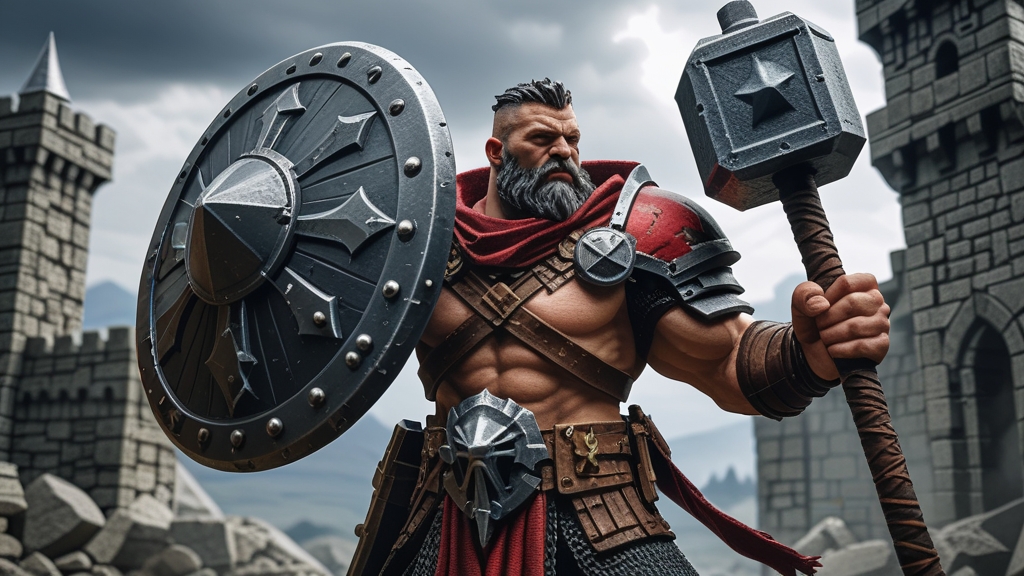
Lysander wields the Fist of Dorn, a master-crafted thunder hammer of extraordinary power. Named after Rogal Dorn, the Primarch of the Imperial Fists, this weapon strikes with enough force to crack open a battle tank’s hull or shatter a Chaos champion’s corrupted armour. The thunder hammer generates a devastating energy field on impact, and in Lysander’s superhuman grip, it becomes one of the most destructive melee weapons carried by any Space Marine in the Imperium.
His storm shield provides near-invulnerable defence, generating an energy field that can deflect lascannon blasts and power weapon strikes alike. The shield has been shattered and rebuilt countless times, each repair adding another layer of history and resilience. Combined with his Terminator armour, the storm shield makes Lysander almost impossible to kill in close combat — enemies must overwhelm his defences through sheer volume of attacks or bring weapons of truly exceptional power.
His Terminator armour is an ancient suit of Tactical Dreadnought Armour that has served the Imperial Fists for millennia. Like all Terminator armour, it provides protection comparable to a light vehicle, incorporates a built-in teleport homer for tactical insertion, and enhances the wearer’s strength through powered exoskeletal systems. Lysander’s particular suit has been modified and repaired so many times that it is essentially a unique artefact, irreplaceable and invaluable.
What Is Lysander’s Combat Record?
Even before his capture, Lysander had compiled an impressive record of victories. As 1st Company Captain, he led the Imperial Fists’ Terminators into the most dangerous engagements the Chapter faced, specialising in fortress assault and boarding actions. His tactical acumen and personal combat prowess made him one of the most feared warriors in the Imperium.
After his return, Lysander fought with a ferocity that even his battle-brothers found remarkable. He led the assault on the Iron Warriors fortress on Malodrax, returning to the world where he had been captured to settle his debt. The battle was savage — the Iron Warriors had fortified Malodrax into a death trap — but Lysander’s personal fury and tactical brilliance carried the day. The fortress fell, and its Warsmith died beneath the Fist of Dorn.
He has faced virtually every enemy the Imperium contends with: Ork Waaaghs, Tyranid hive fleets, Necron tomb awakenings, Chaos incursions, and Eldar raids. In each engagement, Lysander has proven that his centuries of captivity did not diminish his abilities — if anything, his time with the Iron Warriors gave him an intimate understanding of Chaos warfare that makes him an even more effective opponent of the Ruinous Powers.
His most celebrated quality is his ability to hold ground. Lysander does not retreat. He plants himself and his Terminators on an objective and dares the enemy to move him. This is not reckless bravado — it is cold, calculated stubbornness backed by the tactical awareness to know which positions are worth dying for. Under Lysander’s command, the 1st Company has held positions that should have been overrun, buying time for counter-attacks that turned defeats into victories.
What Does Lysander Mean to the Imperial Fists?
To the Imperial Fists, Lysander is more than a captain — he is living proof of everything the Chapter believes in. The Imperial Fists define themselves by endurance. They are the sons of Dorn, the siege masters, the wall that does not break. Lysander’s survival in Iron Warriors captivity is the ultimate vindication of this identity. If a single Imperial Fist can withstand centuries of Chaos corruption through nothing but willpower and faith, then the Chapter’s philosophy is correct: the will of an Imperial Fist is the strongest fortress in the galaxy.
Lysander also represents the Chapter’s rivalry with the Iron Warriors in its most personal form. The Iron Warriors and Imperial Fists have hated each other since the Horus Heresy — attacker versus defender, siege breaker versus fortress builder. Lysander’s captivity and escape add a deeply personal dimension to this rivalry. He has seen the Iron Warriors at their worst and survived. He knows their methods, their weaknesses, and their nature better than any living Imperial Fist.
For younger battle-brothers, Lysander is an inspiration and a standard to measure themselves against. His story is taught in the Chapter’s training halls as an example of what the Imperial Fists aspire to be. When a neophyte struggles with the pain glove or questions his own resolve, the answer is always the same: “Lysander endured worse. Can you do less?”
How Does Lysander Compare to Other Space Marine Heroes?
Among Space Marine characters, Lysander stands out for his theme of endurance rather than aggression. Where characters like Marneus Calgar define themselves by their victories and tactical genius, and characters like Dante inspire through sacrifice and nobility, Lysander’s defining characteristic is simply that he does not stop. He does not fall. He does not break. He absorbs everything the galaxy throws at him and keeps fighting.
Compared to other Chapter champions, Lysander is perhaps the most “human” in his appeal. He is not a Primarch. He does not wield ancient artefacts of unimaginable power (the Fist of Dorn is exceptional but not unique). He is a Space Marine who survived something that should have destroyed him, and who came back to continue his duty. His heroism lies not in supernatural ability but in sheer, relentless determination.
This makes him the quintessential Imperial Fist and one of the best examples of what Space Marine character writing can achieve — a warrior defined not by what he can do, but by what he refuses to yield.
Frequently Asked Questions
How long was Lysander captured by the Iron Warriors?
The exact duration is unclear because time flows differently in the Eye of Terror. In realspace, centuries passed during Lysander’s captivity — long enough for the Chapter to declare him dead and appoint a successor. From Lysander’s subjective perspective, the duration may have been different. The ambiguity is deliberate, adding to the mystery of his survival.
Is Lysander corrupted by Chaos?
The Imperial Fists’ Chaplains and Librarians extensively tested Lysander upon his return and found no trace of Chaos corruption. His subsequent centuries of loyal service and unwavering faith further confirm his purity. While some within the Imperium maintain suspicions about anyone who has spent time in the Eye of Terror, Lysander’s record speaks for itself.
What is the Fist of Dorn?
The Fist of Dorn is Lysander’s master-crafted thunder hammer, named after Rogal Dorn, the Primarch of the Imperial Fists. It is an exceptionally powerful weapon capable of destroying vehicles and killing the most heavily armoured opponents in a single blow. On the tabletop, it has typically been represented as a strength 10 thunder hammer with additional rules for destroying fortifications.
Can Lysander be used in Warhammer 40k games?
Lysander has had rules in multiple editions of Warhammer 40,000 as a named character for the Imperial Fists Chapter. His availability depends on the current edition’s rules and any supplement or codex that covers Imperial Fists specifically. Check the latest Space Marines codex or supplement for his current rules and points cost.
Why do the Imperial Fists and Iron Warriors hate each other?
The rivalry between the Imperial Fists and Iron Warriors dates to before the Horus Heresy. Both Legions specialised in siege warfare — the Imperial Fists as defenders, the Iron Warriors as attackers. This professional rivalry turned to bitter hatred when the Iron Warriors turned traitor. The Iron Warriors’ assault on the Imperial Palace during the Siege of Terra, defended by the Imperial Fists, cemented an enmity that has lasted ten thousand years.
Is there a book about Lysander?
Yes. Malodrax by Rob Sanders tells the story of Lysander’s captivity on the daemon world of Malodrax and his escape from the Iron Warriors. It’s the main novel built around him, and a good read if you like grim survival stories. He also appears in other Imperial Fists fiction, but Malodrax is the one that centres on him.
Is Lysander a Primaris Space Marine?
No. Darnath Lysander is a Firstborn Space Marine, one of the original type, and he isn’t known to have crossed the Rubicon Primaris. He fights in Tactical Dreadnought (Terminator) armour with the Fist of Dorn and a storm shield. That fits his role as captain of the Imperial Fists 1st Company, the Chapter’s Terminator veterans.