
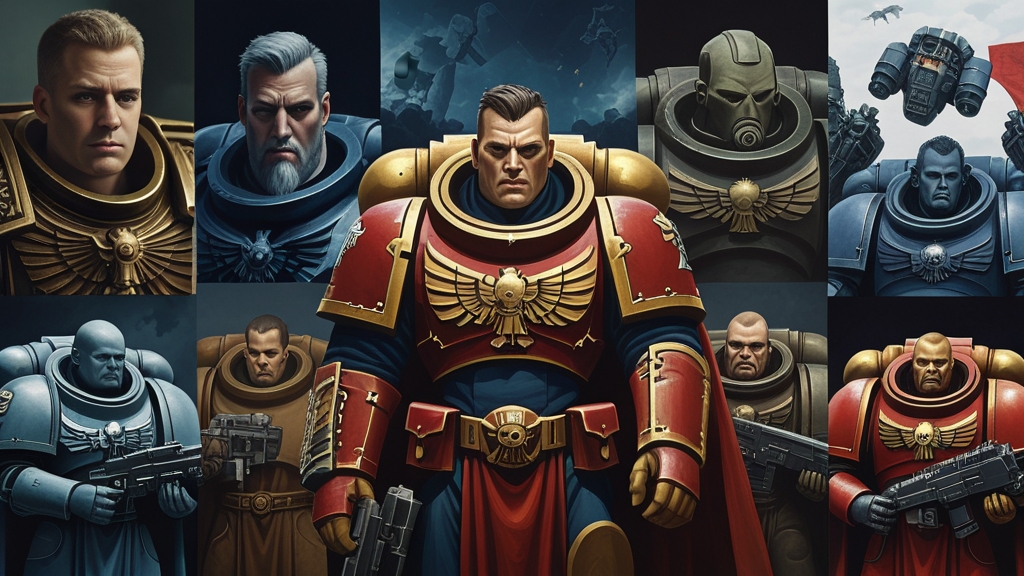
Warhammer 40k is set in the 41st millennium where a dying God-Emperor sits on the Golden Throne while humanity fights for survival against aliens, daemons, and traitors. The Imperium is the largest human civilisation ever built — and it is slowly collapsing under the weight of endless war, religious fanaticism, and bureaucratic decay.
This is the complete Warhammer 40,000 setting condensed into a five-minute read. Whether you have just discovered 40k through a video game, a YouTube video, or a friend’s recommendation, this summary covers everything you need to understand the universe — the Emperor, the Space Marines, the Horus Heresy, and the grim darkness of the far future where there is only war.
Who Is the Emperor of Mankind?
The Emperor of Mankind is the most powerful human being ever to exist. Born thousands of years before the current era, he is an immortal psychic of staggering power who guided humanity from the shadows throughout history. He is not a god — at least, he never claimed to be one — but his psychic abilities and lifespan are so far beyond normal human comprehension that the distinction is largely academic.
By the 30th millennium, the Emperor revealed himself to humanity during a period called the Age of Strife. Earth — known as Terra in 40k — had collapsed into techno-barbarism. Warp storms had cut off interstellar travel, alien races had enslaved human colonies, and civilisation was in ruins. The Emperor unified Terra through a combination of diplomacy, psychic domination, and outright military conquest. He created the Thunder Warriors to conquer Terra, then replaced them with the far more stable and powerful Space Marines — genetically engineered super-soldiers built from his own genetic template.
But the Emperor’s greatest creations were the Primarchs — twenty demigod sons, each one a towering genius of war, politics, science, or philosophy. The Primarchs were scattered across the galaxy by the Chaos Gods as infants, and the Emperor launched the Great Crusade to find them and unite humanity under a single banner. Each Primarch was given command of a Space Marine Legion created from their genetic material, and together they carved out the largest human empire in history.
What Was the Great Crusade?
The Great Crusade was humanity’s golden age — a two-century campaign to reunite every human world in the galaxy under the Imperium of Man. The Emperor led the crusade personally, accompanied by his Primarchs and their Space Marine Legions. They rediscovered lost human colonies, destroyed alien civilisations that had enslaved humans during the Age of Strife, and established the infrastructure for a galaxy-spanning empire.
The Great Crusade was staggeringly successful. Thousands of worlds were brought into compliance. The Imperial Truth — a secular, rationalist philosophy that denied the existence of gods and promoted science — was spread across the galaxy. The Emperor’s dream was a humanity united by reason, free from superstition, and protected by the greatest military force ever assembled.
But the Great Crusade carried the seeds of its own destruction. The Emperor’s methods were often brutal — worlds that resisted compliance were destroyed, alien civilisations that could have been allies were exterminated, and the Primarchs themselves were given conflicting orders and expectations that bred resentment. The Emperor was a brilliant strategist but a poor father, and his treatment of certain Primarchs — particularly Lorgar, who was publicly humiliated for worshipping the Emperor as a god — created fractures that the Chaos Gods would later exploit.
What Was the Horus Heresy?
The Horus Heresy was the civil war that destroyed the Emperor’s dream. Horus Lupercal, the Emperor’s most favoured son and Warmaster of the Imperium, was corrupted by the Chaos Gods and turned against his father. Fully half of the Space Marine Legions — nine out of eighteen — followed Horus into rebellion, along with vast portions of the Imperial Army, the Mechanicum, and the Titan Legions.
The Heresy lasted seven years and devastated the galaxy. Worlds burned, trillions died, and the Imperium’s infrastructure was shattered. Brother fought brother in the most bitter conflict imaginable. Some Primarchs who turned traitor did so out of genuine grievances against the Emperor — Magnus the Red was punished for using forbidden psychic powers to warn the Emperor of the betrayal, while Angron had been enslaved and lobotomised before the Emperor found him. Others were seduced by the promises of the Chaos Gods or simply chose ambition over loyalty.
The Heresy culminated in the Siege of Terra — a titanic assault on the Emperor’s own palace. Horus’s traitor forces besieged the Throneworld itself, and the fighting was apocalyptic in scale. In the final confrontation, the Emperor teleported aboard Horus’s flagship and faced his wayward son in single combat. The Emperor killed Horus but was mortally wounded in the process, his body broken beyond conventional healing.
What Is the Golden Throne?
After the Siege of Terra, the dying Emperor was interred upon the Golden Throne — a massive psychic life-support machine originally designed as a component of the Emperor’s secret Webway Project. The Throne sustains the Emperor’s shattered body in a state between life and death, allowing his immense psychic power to continue serving two critical functions.
First, the Emperor powers the Astronomican — a psychic beacon that shines across the galaxy and allows Imperial navigators to travel through the Warp. Without the Astronomican, faster-than-light travel becomes virtually impossible, and the Imperium would fragment into isolated, defenceless systems. Second, the Emperor’s psychic presence acts as a ward against the Chaos Gods, preventing daemonic entities from manifesting freely on Terra and throughout the wider Imperium.
The Golden Throne requires a daily sacrifice of one thousand psykers to function — their souls burned as fuel to sustain the Emperor’s fading power. The Throne itself is degrading, its technology poorly understood by the Mechanicus, and there are persistent rumours that it will eventually fail entirely. If the Emperor truly dies, the Astronomican goes dark, the Warp wards collapse, and humanity faces extinction.
What Is the Imperium Like in the 41st Millennium?
Ten thousand years after the Horus Heresy, the Imperium of Man is a decaying theocratic fascist state. The secular Imperial Truth has been replaced by the Imperial Cult — an oppressive state religion that worships the Emperor as a literal god. The Imperium is the most brutal, oppressive regime imaginable, but it is also the only thing standing between humanity and total annihilation by the alien horrors that surround it on every side.
The Imperium spans a million worlds but cannot effectively govern them. Communication between star systems takes weeks or months. Bureaucratic orders can take centuries to be processed. Entire planets have been forgotten by Imperial records. The Administratum — the Imperium’s civil service — employs billions of clerks who process paperwork without understanding what they are administrating. The Ecclesiarchy enforces religious conformity through Inquisitorial purges and witch-hunts. The Mechanicus hoards technology it does not understand and treats science as religious ritual.
Military threats are constant and existential. The Orks are a fungal species that lives only for war and reproduces through spores — they can never be permanently eradicated. The Tyranids are an extragalactic swarm of bio-engineered predators consuming everything in their path. The Necrons are ancient robotic beings awakening from sixty-million-year slumber with technology that makes the Imperium’s look primitive. The Aeldari (Elves) are a dying race of psychic warriors struggling to survive. The T’au are a young, expansionist empire that offers a genuinely better society than the Imperium — which makes them ideologically dangerous. And Chaos never sleeps, with the Traitor Legions launching Black Crusades from the Eye of Terror.
What Is the Great Rift and the Current Era?
The current era of 40k begins with the 13th Black Crusade — the largest Chaos invasion since the Horus Heresy. Abaddon the Despoiler, Warmaster of Chaos and successor to Horus, finally destroyed Cadia, the fortress world that had guarded the Eye of Terror for ten thousand years. Cadia’s fall triggered the Great Rift — a galaxy-spanning tear in reality that split the Imperium in half. The northern half, cut off from the Astronomican’s light, became known as the Imperium Nihilus — a region of darkness, isolation, and despair.
In response to this crisis, the Primarch Roboute Guilliman was resurrected from ten thousand years of stasis. Guilliman, the most administratively gifted of the Emperor’s sons, was horrified by what the Imperium had become — a superstitious, decaying theocracy that worshipped the Emperor as a god despite the Emperor’s explicit wishes. But with the galaxy burning, Guilliman had no time for reforms. He launched the Indomitus Crusade, deploying the new Primaris Space Marines — an upgraded generation of Space Marines developed in secret over ten millennia by the Mechanicus Archmagos Belisarius Cawl.
The Indomitus Crusade pushed back the tide of Chaos, reunited many isolated Imperial worlds, and reinforced the beleaguered Space Marine Chapters with Primaris reinforcements. But the Great Rift remains, the galaxy is still divided, and the threats facing humanity are greater than ever. Guilliman fights not just against external enemies but against the Imperium’s own institutional rot — a battle that may prove even harder to win than the war against Chaos.
What Are the Major Factions?
The Imperium of Man is the largest faction, encompassing Space Marines, the Imperial Guard (Astra Militarum), the Adeptus Mechanicus, the Adepta Sororitas (Sisters of Battle), the Inquisition, the Adeptus Custodes, and countless other organisations. It is humanity’s shield, however rusted and cracked that shield may be.
Chaos encompasses the four Chaos Gods — Khorne (war), Tzeentch (change), Nurgle (decay), and Slaanesh (excess) — along with the Traitor Legions, Chaos Space Marines, daemons, and mortal cultists. Chaos is 40k’s primary antagonist, a malevolent force born from the emotions of sentient beings and sustained by war, suffering, and despair.
The Xenos factions include the Orks (brutal, cheerful fungal warriors), the Aeldari (ancient, declining psychic civilisation), the Tyranids (extragalactic bio-swarm), the Necrons (ancient robotic overlords), the T’au (young expansionist empire), the Drukhari (dark eldar pirates), and the Genestealer Cults (infiltrators who prepare worlds for Tyranid consumption).
Why Is 40k So Popular?
Warhammer 40k endures because it combines absurd scale with genuine emotional depth. The setting is deliberately over-the-top — cathedral-ships miles long, chainsaw swords, skulls on literally everything — but beneath the excess lies a surprisingly nuanced exploration of fascism, religious extremism, duty, sacrifice, and the question of whether survival justifies any atrocity. The lore is deep enough to support thousands of novels, and the setting is broad enough that every kind of story — from political intrigue to horror to comedy — can find a home within it.
The tagline says it all: in the grim darkness of the far future, there is only war. But within that endless war, there are stories of heroism, tragedy, love, betrayal, and hope — however faint — that have captivated millions of fans for nearly four decades.
Want more than five minutes’ worth? These two illustrated DK books are the official next step.

Price details
Product prices and availability are accurate as of the date/time indicated and are subject to change. Any price and availability information displayed on Amazon.com at the time of purchase will apply to the purchase of this product.As an Amazon Associate, Warhammer Guild earns from qualifying purchases.
Frequently Asked Questions
Is Warhammer 40k the same as Warhammer Fantasy?
No. Warhammer 40k is a science fiction setting, while Warhammer Fantasy was a traditional fantasy setting. Warhammer Fantasy was replaced by Age of Sigmar in 2015. The two settings share some thematic DNA — Chaos Gods, for example, exist in both — but they are separate universes with separate rules and separate model ranges.
Is the Emperor alive or dead?
Neither, technically. The Emperor exists in a state between life and death on the Golden Throne. His body is a withered corpse, but his psychic consciousness remains active and immensely powerful. Whether he is truly aware, whether he could be healed, and whether he should be healed are among the most debated questions in the lore.
Where should I start with Warhammer 40k lore?
Start with the Horus Heresy novels, beginning with Horus Rising by Dan Abnett. Alternatively, watch introductory videos on YouTube from creators like Luetin09 or Adeptus Ridiculous. This article gives you the broad strokes — from here, pick a faction that interests you and explore its specific lore.
Can I enjoy 40k without buying models?
Absolutely. Millions of fans engage with 40k purely through books, video games, YouTube lore videos, and community discussion. The miniatures hobby is entirely optional. The lore stands on its own as one of the richest science fiction settings ever created.
How many Warhammer 40k books are there?
There are over 500 Warhammer 40k novels published by Black Library, plus hundreds of short stories, audio dramas, and graphic novels. The Horus Heresy series alone comprises 54 mainline novels plus the 8-book Siege of Terra finale. You do not need to read them all — pick a faction or character that interests you and start there.
What year is it in Warhammer 40k?
The current setting has moved into the 42nd millennium, a little over 10,000 years after the Horus Heresy. For decades the game was set in the late 41st millennium, which is where the name 40,000 comes from. The fall of Cadia and the opening of the Great Rift at the very end of M41 pushed the timeline forward into the era of Guilliman’s Indomitus Crusade.
How many Primarchs are there in Warhammer 40k?
There are twenty Primarchs, the Emperor’s genetically engineered sons. Only eighteen are known, because all records of the II and XI Primarchs and their Legions were deliberately erased before the Horus Heresy. Of the eighteen known Legions, nine stayed loyal and nine followed Horus. By the current era only a few Primarchs are active, such as Roboute Guilliman and Lion El’Jonson on the loyalist side.
When did Warhammer 40k first come out?
Warhammer 40,000 first came out in 1987 as Rogue Trader, a sci-fi spin-off of Warhammer Fantasy Battle. Since then it has gone through multiple editions of the tabletop game and grown into hundreds of novels, video games and animation. That near-forty-year history is a big part of why the lore is so deep and layered.