
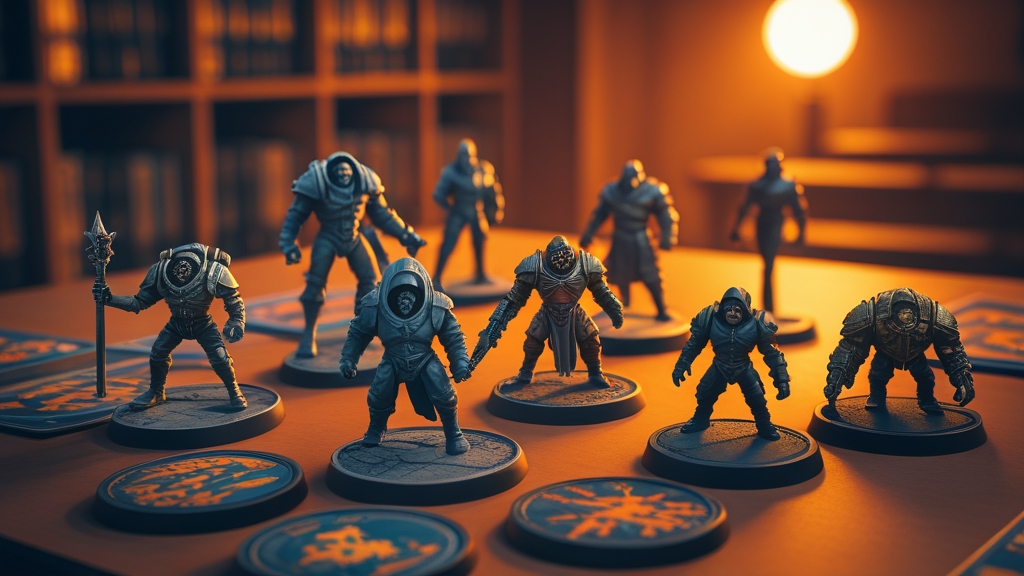
Games Workshop supports around ten distinct tabletop game systems, each offering a different way to experience the Warhammer settings. From the large army battles of Warhammer 40,000 to the small skirmishes of Kill Team, the fantasy sport of Blood Bowl to the gang warfare of Necromunda, there is a Warhammer game for most playstyles, budgets and time commitments. With so many options, choosing one can be overwhelming.
This guide compares every current Warhammer game system by scale, cost, time commitment, learning curve and appeal, to help you find the one that fits. Costs are given as relative tiers rather than exact prices, because Games Workshop prices change regularly and vary by country; check Warhammer.com or your local store for current figures.
The Game Systems at a Glance
| Game System | Setting | Scale | Models Needed | Avg. Game Time | Entry Cost | Complexity |
|---|---|---|---|---|---|---|
| Warhammer 40,000 | 40k Sci-fi | Army (28mm) | 30-80 | 2-3 hours | High | Medium |
| Age of Sigmar | Fantasy | Army (28mm) | 30-100 | 2-3 hours | High | Medium |
| Kill Team | 40k Sci-fi | Skirmish (28mm) | 5-14 | 45-90 min | Low-Medium | Medium-High |
| Warcry | Fantasy | Skirmish (28mm) | 8-15 | 45-60 min | Low-Medium | Low-Medium |
| Underworlds | Fantasy | Arena (28mm) | 3-7 | 30-45 min | Low | Medium |
| Horus Heresy | 30k Sci-fi | Army (28mm) | 40-100+ | 3-4 hours | Very High | High |
| The Old World | Fantasy | Army (28mm) | 60-150+ | 3-4 hours | Very High | High |
| Legions Imperialis | 30k Sci-fi | Army (Epic 8mm) | 100-300+ | 2-3 hours | Medium | Medium-High |
| Necromunda | 40k Sci-fi | Skirmish (28mm) | 5-15 | 1-2 hours | Medium | High |
| Blood Bowl | Fantasy Sports | Team (28mm) | 11-16 | 1.5-2.5 hours | Medium | Medium |
Warhammer 40,000 (11th Edition)
What it is: The flagship game. Large-scale sci-fi battles between armies in the 41st Millennium. 11th Edition launched on 20 June 2026 with the Armageddon starter set (Blood Angels vs Orks). Two players build armies to a points limit, most often 2,000 points (Strike Force) or 1,000 points (Incursion), and fight over objectives that are now terrain areas rather than circular markers.
Best for: Players who want the full Warhammer experience: big armies, a huge range of factions and miniatures, and the largest competitive scene in tabletop gaming.
Learning curve: Medium. Games Workshop describes 11th Edition as “an evolution, not a revolution” of the 10th Edition core rules, so the core game stays fairly lean. The main new layer is army building with Detachment Points: you get 2 DP at 1,000 points and 3 DP at 2,000 points, and spend them on one to three detachments costing 1-3 DP each. A unit can only benefit from one stratagem per phase, which cuts down on hidden combos. You can learn the basics in one game, but mastering your faction’s detachments and the mission structure takes many games.
Time commitment: High. Building, painting and playing a 2,000-point army is a significant investment, and a standard game takes 2-3 hours. Competitive players also follow regular balance updates and Munitorum Field Manual points changes.
Cost to start: Medium to high. A Combat Patrol box gives you a small, playable force for the streamlined Combat Patrol format, and the Armageddon launch box contains two starter forces. A full 2,000-point army is one of the more expensive hobby projects in the range. The core rules are available free.
Community size: By far the largest Warhammer community. Finding opponents is easy in most areas, and tournaments run every weekend across many countries.
Age of Sigmar (4th Edition)
What it is: Games Workshop’s fantasy battle game, set in the Mortal Realms, a high-fantasy setting of magical realms, gods and vast monsters. Like 40k, it features large army battles, with matched play designed around 1,000- and 2,000-point games.
Best for: Players who prefer fantasy over sci-fi. AoS armies tend to be visually spectacular, with large monsters and heavily themed forces.
Learning curve: Medium. 4th Edition has a clean attack sequence, no battleshock or Bravery, and battle tactics that guide new players towards good play. Armies are organised into regiments of one Hero plus up to three units. The priority roll from round two onwards makes the double turn possible, which adds depth but can frustrate newcomers.
Time commitment: Comparable to 40k. Standard games run 2-3 hours. Some armies, such as Ogor Mawtribes or Sons of Behemat, can be built from relatively few large models.
Cost to start: Similar to 40k. Spearhead boxes give you a self-contained force for Spearhead, the smaller and simpler way to learn the game. Full armies cost about as much as a 40k army. Core rules are free through the AoS app.
Community size: Large. Slightly smaller than 40k but very active, with its own tournament circuit.
Kill Team
What it is: Small-scale skirmish combat in the 40k universe. Two players each control a team of roughly 5-14 operatives (individual models, not squads) fighting over objectives on a densely terrained board. Each operative has its own abilities and equipment.
Best for: Players who want 40k flavour without the time and cost of full-scale battles. Kill Team suits busy adults, narrative gamers who want each model to matter, and hobbyists who want to paint a small number of models to a high standard. It is also a good introduction to the 40k setting.
Learning curve: Medium-High. Despite the small model count, Kill Team has deep tactical rules. Alternating activations (players take turns activating one operative at a time) create constant decisions, and line of sight, cover and positioning matter a great deal.
Time commitment: Low-Medium. Games take 45-90 minutes and you only need to paint a handful of models. New teams and terrain arrive in seasonal boxes. This is the best Warhammer game for people with limited hobby time.
Cost to start: Low to medium. A single kill team box is enough to play, and the seasonal boxes include two teams, terrain and the rules.
Community size: Medium and growing. Kill Team has grown a lot since its 2021 relaunch, and the current edition arrived in 2024. Online communities are very active and tournaments are increasingly common.
Warcry
What it is: Fast-paced fantasy skirmish combat in the Mortal Realms. The current edition is set in the Realm of Ghur. Two players control warbands of roughly 8-15 fighters in quick, brutal encounters, with an emphasis on speed, decisive combat and vertical terrain (climbing, jumping and falling).
Best for: Players who want a fast, fun fantasy skirmish game without the scale of full Age of Sigmar. Warcry is excellent for casual gaming nights, narrative campaigns and players who love small warbands with a strong identity. The terrain sets are among the most impressive GW produces.
Learning curve: Low-Medium. Warcry is one of the simplest GW games to learn. Each fighter has a simple profile, and special abilities are paid for with doubles, triples and quads rolled on the ability dice at the start of each round. Most people can learn the rules in their first game.
Time commitment: Low. Games take 45-60 minutes, and warbands are small and quick to paint. This is one of the fastest GW games to get into from zero.
Cost to start: Low to medium. A single warband box is enough to start, and many Age of Sigmar kits have Warcry rules. Terrain matters for Warcry but can be improvised.
Community size: Medium. Warcry has a dedicated following that values its accessibility and narrative potential. Finding opponents may need a local club.
Warhammer Underworlds
What it is: A competitive arena combat game that combines miniatures with cards. Two players field fixed warbands of 3-7 fighters on a small hex board, using decks of objective and power cards to score points and enhance their fighters. It sits between miniatures gaming and competitive card games.
Best for: Competitive gamers who love deck-building and optimisation, and pairs who want a quick, thinky two-player game. The miniatures are push-fit and easy to assemble.
Learning curve: Medium. The basic rules are simple: move, attack, score objectives. The depth comes from card choices and synergies.
Time commitment: Very Low. Games take 30-45 minutes and warbands are 3-7 models. You can go from opening a box to playing in under an hour.
Cost to start: Low. A core set contains two warbands and everything needed to play, and individual warbands are among the cheapest boxes GW sells.
Community size: Small but passionate, with a dedicated competitive community. The rotation of legal cards keeps the game fresh but can make it harder for casual players to keep up.
Horus Heresy
What it is: Large-scale battles set during the Horus Heresy, 10,000 years before 40k. Players field Space Marine Legions and allied forces such as the Mechanicum and Solar Auxilia, using rules designed to feel more traditional and detailed than modern 40k.
Best for: Lore enthusiasts who love the Horus Heresy novels and want to recreate those battles on the tabletop, and hobbyists who enjoy painting large Heresy-era Space Marine armies. The game has a strong narrative community.
Learning curve: High. Horus Heresy uses a more traditional ruleset with more detailed vehicle rules and army construction than 40k, and it rewards deep knowledge of Legion-specific rules. It is not the best game for absolute beginners.
Time commitment: Very High. Games run 3-4 hours. Armies are typically large and expensive, and many units are resin or specialist kits. The hobby commitment is substantial but rewarding.
Cost to start: Very high. A two-force launch box is the best-value way in, but a full army usually needs further purchases, often including specialist kits. Check which starter box and rules edition are current before buying, as the game’s range and rules have been refreshed since the original Age of Darkness launch.
Community size: Medium. Horus Heresy has a passionate community that tends towards the older, more experienced end of the hobby. Finding local players may mean seeking out a dedicated Heresy group.
Warhammer: The Old World
What it is: The return of rank-and-file fantasy battles in the classic Warhammer Fantasy Battles setting. The Old World uses large blocks of infantry on square bases, cavalry charges and a magic system inspired by earlier editions of Warhammer Fantasy. It is deliberately positioned as a nostalgic, hobby-forward game.
Best for: Veterans who loved Warhammer Fantasy Battles, players who prefer ranked infantry blocks to looser skirmish formations, and hobbyists who enjoy painting large matching regiments.
Learning curve: High. The Old World uses detailed rules for ranked movement, charge arcs, flanking and magic. Regiment facing, wheeling and charge reactions reward careful planning. It is more complex than either 40k or AoS.
Time commitment: Very High. Infantry regiments of 20-40 models are standard, and a full army might contain 100-150+ models. Games run 3-4 hours.
Cost to start: Very high, because of the high model counts. Army boxes (Tomb Kings of Khemri and Kingdom of Bretonnia launched the game) are the most economical starting point.
Community size: Growing. The Old World’s return has excited veteran players, and events are becoming more common as the range expands.
Legions Imperialis
What it is: Epic-scale (8mm) battles set during the Horus Heresy, where each player commands entire armies of Titans, tanks and infantry formations. It is the modern successor to GW’s earlier Epic games.
Best for: Players who want to command truly massive armies without assembling hundreds of 28mm models, and Heresy fans who want to play out whole Legion assaults with Titans striding across the battlefield.
Learning curve: Medium-High. The rules involve formations, orders and combined-arms tactics that differ significantly from 28mm wargames.
Time commitment: Medium. Armies contain many models, but 8mm miniatures are quick to batch-paint. Games run 2-3 hours.
Cost to start: Medium. The starter box contains two forces, and expansions are reasonably priced, so a full army is much cheaper than an equivalent-scale 28mm force.
Community size: Small but enthusiastic, drawing old Epic fans and new players attracted by the scale.
Necromunda
What it is: Gang warfare in the underhive of a 40k hive city. Players build gangs of 5-15 fighters who compete for territory, resources and reputation in a persistent campaign. Fighters gain experience, injuries and equipment over multiple games.
Best for: Narrative gamers who love character progression and emergent storytelling, and hobbyists who want to convert and personalise individual models.
Learning curve: High. Necromunda has detailed rules for terrain, injuries, trading, territory and gang progression, and the campaign adds management between games.
Time commitment: Medium. Individual games take 1-2 hours and gangs are small, but campaign play needs regular sessions over weeks or months.
Cost to start: Medium. A gang box plus the rulebook is enough to start, and starter sets bundle two gangs with terrain. Terrain adds to the expense.
Community size: Medium. Necromunda has a devoted community, and finding a consistent campaign group is key to the full experience.
Blood Bowl
What it is: Fantasy football. Two players field teams of fantasy races (Humans, Orcs, Elves, Dwarfs, Skaven and more) in a violent parody of American football, scoring touchdowns by carrying the ball into the opponent’s end zone while blocking, dodging and fouling past the opposition.
Best for: Players who want a self-contained competitive game with strong team-building, including sports fans and board gamers. It has a thriving league and tournament scene with its own culture.
Learning curve: Medium. The basic rules are straightforward. Strategic depth comes from team composition, positioning and risk management, since a failed action can cause a turnover that ends your turn.
Time commitment: Medium. Games run 1.5-2.5 hours. Teams are 11-16 models and can be painted quickly. League play usually means a game a week over a season.
Cost to start: Low to medium. A single team box gives you a complete team, and the starter set adds a second team, a pitch, dice and rules. Blood Bowl is one of the most affordable GW games.
Community size: Medium and extremely dedicated, with established leagues, international tournaments and a culture of fun and sportsmanship.
Which System Is Right for You?
If You Have Limited Time and Budget
Start with Kill Team or Warcry. Both offer a complete game with a small number of models, quick games and affordable entry costs. Kill Team is better for sci-fi fans and Warcry for fantasy fans. Both can be stepping stones to the larger systems.
If You Want the Biggest Community and Best Tournament Scene
Choose Warhammer 40,000. It has the largest player base, the most active tournament circuit and the easiest time finding opponents. Age of Sigmar is a strong second choice.
If You Love Narrative and Campaign Play
Choose Necromunda for a gritty, persistent campaign, or Horus Heresy for grand narrative battles. Both reward long-term investment in characters and storylines.
If You Want Something Completely Different
Try Blood Bowl for competitive sports with Warhammer flavour, or Underworlds for a cards-meets-miniatures hybrid.
If You Are Nostalgic for Classic Warhammer
Choose The Old World for classic rank-and-file Fantasy battles, or Horus Heresy for a more traditional, detailed ruleset. Both are aimed at veteran hobbyists.
If You Want to Command Massive Armies Affordably
Choose Legions Imperialis. The 8mm scale lets you field armies of Titans and tanks at a fraction of the cost and time of 28mm games.
Frequently Asked Questions
Can I use the same models across different game systems?
Some models cross over. 40k models work in Kill Team (many factions have Kill Team rules), and many Age of Sigmar kits have Warcry rules. Necromunda gangs use 28mm models from the 40k setting. Legions Imperialis uses a different scale entirely, and Blood Bowl and Underworlds have their own dedicated model ranges.
Which Warhammer game is best for beginners?
Warcry is the simplest to learn. Kill Team offers the best small-scale introduction to the 40k universe. Underworlds is the quickest to get playing. For full army games, 40k 11th Edition at Combat Patrol or Incursion size, or Age of Sigmar Spearhead, are the gentlest ways in. The best “beginner” game depends on what experience you want.
How do the costs compare across systems?
Roughly from cheapest to most expensive to get started: Underworlds, Warcry, Blood Bowl, Kill Team, Necromunda, Legions Imperialis, then 40k and Age of Sigmar, with Horus Heresy and The Old World the most expensive for a full army. The army games can start cheaply with a Combat Patrol or Spearhead box, but a full 2,000-point army costs far more. Exact costs vary by faction and change with GW’s pricing, so check current prices before you buy.
Can I play multiple game systems?
Absolutely. A common combination is 40k or AoS as a main game with Kill Team or Warcry for shorter sessions. Blood Bowl is a popular side game because it uses a completely different skill set. The main constraint is usually hobby time.
Are all these game systems actively supported by Games Workshop?
Yes. As of 2026, all ten systems in this guide receive new releases, rules updates or organised play support. 40k and AoS get the most attention as flagship games, while systems like Legions Imperialis and The Old World have a slower release cadence.
What are the different types of Warhammer games?
Warhammer games fall into a few broad types: big army battles (Warhammer 40,000, Age of Sigmar, Horus Heresy, The Old World), small skirmish games (Kill Team, Warcry, Necromunda), arena and card-driven games (Warhammer Underworlds), epic-scale battles at 8mm (Legions Imperialis) and sports (Blood Bowl). Each sits in either a sci-fi or a fantasy setting, so the first choice is usually setting, then scale.
How many Warhammer tabletop games are there?
Games Workshop currently supports around ten tabletop game systems. The ten covered here are Warhammer 40,000, Age of Sigmar, Kill Team, Warcry, Warhammer Underworlds, Horus Heresy, The Old World, Legions Imperialis, Necromunda and Blood Bowl. Several share models, so one collection can often cover more than one game.
What is the difference between Warhammer 40k, Age of Sigmar and Warhammer Fantasy?
Warhammer 40,000 is the science-fiction setting of the 41st Millennium. Age of Sigmar is the high-fantasy successor set in the Mortal Realms, and it replaced Warhammer Fantasy Battles in 2015. Warhammer Fantasy’s classic world now lives on in Warhammer: The Old World, which uses ranked-up regiments on square bases. 40k and Age of Sigmar are the two flagship army games.
What game sizes can you play in Warhammer 40k?
In 11th Edition, Warhammer 40,000 is usually played at Combat Patrol (a small, streamlined format with fixed forces), Incursion (1,000 points, 2 Detachment Points), Strike Force (2,000 points, 3 Detachment Points, the standard tournament size) and Onslaught (3,000 points). Players can also play narrative Crusade campaigns instead of one-off matched play games. Smaller sizes are the cheapest and quickest way to learn.