
Part of our Chaos Daemons hub: every Chaos Daemons guide, lore page and painting tutorial in one place.
What Is a Daemon Prince?
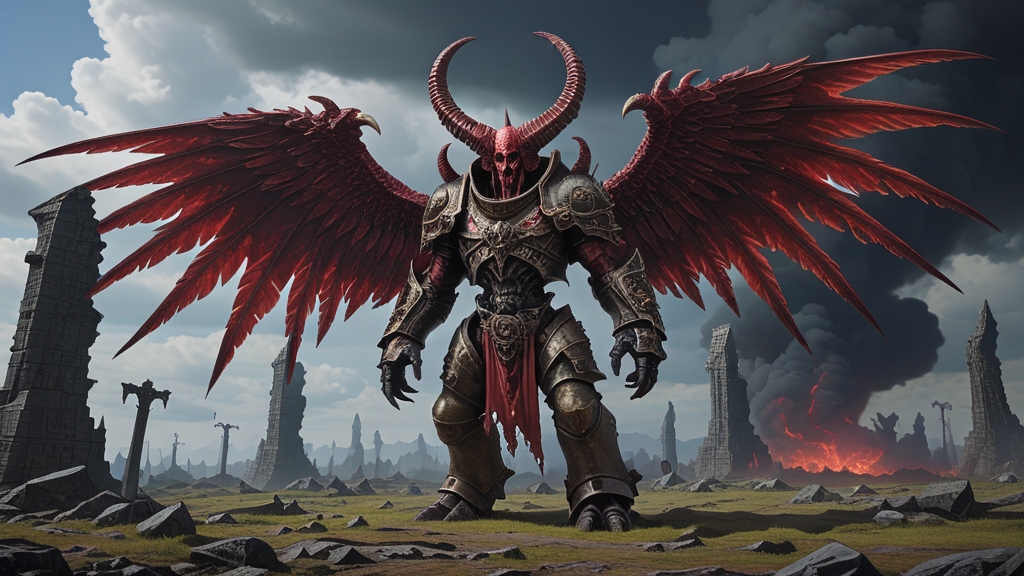
A Daemon Prince is a mortal champion who has earned the ultimate reward from their Chaos God patron: ascension to daemonhood. They have transcended their mortal flesh, becoming an immortal daemon bound to the material universe. Their body warps and grows into a towering monstrosity of muscle, horn and dark power, and their soul is irrevocably fused with the Warp.
In game terms, a Daemon Prince is one of the most versatile units available to Chaos armies. It’s a Monster Character that can hunt enemy characters, smash through infantry and threaten vehicles, all while being tough enough to weather serious firepower. Most Chaos factions can field one.
Daemon Princes are the aspirational endgame for every Chaos Lord, every sorcerer and every champion in the service of the Dark Gods. The alternative is far worse. Those who seek daemonic ascension and fall short are transformed into Chaos Spawn, mindless mutant beasts that shamble across the battlefield as a warning to others. The path to daemonhood is narrow, and the consequences of failure are horrifying.
Daemon Prince Lore
The process of becoming a Daemon Prince is both a reward and a transaction. A mortal champion serves their patron god for decades, centuries or even millennia, fighting, conquering, sacrificing and performing great deeds in their god’s name. If the god is pleased, they bestow the “gift” of daemonic ascension.
The transformation is violent and irreversible. The champion’s body tears itself apart and reforms as something far larger, far more powerful and entirely inhuman. Wings may burst from their back, horns crown their skull and their armour fuses with their flesh. Their mortal mind is subsumed into a daemonic consciousness that spans both the material universe and the Warp.
What Each God Demands
- Khorne: endless slaughter. Khorne’s Daemon Princes are warriors who have killed on a scale that impresses even the Blood God. They are massive, brutal and utterly focused on close combat.
- Tzeentch: grand schemes, manipulation and sorcery. Tzeentch’s Daemon Princes are master sorcerers whose plots have reshaped the fates of entire sectors.
- Nurgle: spreading disease and embracing despair. Nurgle’s Daemon Princes are bloated, rotting and horribly resilient, grotesque embodiments of entropy and decay.
- Slaanesh: excess in all things, from sensation and cruelty to perfection and indulgence. Slaanesh’s Daemon Princes are fast and graceful, carving through enemies before they can react.
Notable Daemon Princes
- Mortarion: Primarch of the Death Guard, ascended as a Daemon Prince of Nurgle. One of the most powerful Daemon Princes in existence.
- Magnus the Red: Primarch of the Thousand Sons, ascended as a Daemon Prince of Tzeentch. His sorcerous power is nearly unmatched.
- Angron: Primarch of the World Eaters, ascended as a Daemon Prince of Khorne. A being of pure, unstoppable rage.
- Fulgrim: Primarch of the Emperor’s Children, ascended as a Daemon Prince of Slaanesh. A serpentine abomination obsessed with twisted perfection.
- Be’lakor: the first Daemon Prince, who ascended long before the primarchs. A unique entity who serves no single god but is used by all four.
Daemon Prince on the Tabletop
The Daemon Prince is a Monster Character, and several Chaos factions have their own version: Chaos Space Marines, Death Guard, Thousand Sons, World Eaters, Emperor’s Children and Chaos Daemons. Most of these factions give the winged and non-winged Princes separate datasheets, and each faction’s version has different stats, abilities and weapon profiles. A Death Guard Daemon Prince is built for durability, while a World Eaters one is built for melee.
Because the stats vary by faction and change with balance updates, we don’t list a profile here. Check your faction’s current codex or the Warhammer 40,000 app for its datasheet, and the Munitorum Field Manual for its points. In 11th Edition your existing 10th Edition codex stays valid until your faction’s 11th Edition codex arrives, so the datasheet you use depends on where your faction is in that rollout.
Wargear and Wings
The plastic Daemon Prince kit comes with large daemonic melee weapons and talons, and can be built with or without wings. The exact weapon profiles and choices depend on the datasheet, so check yours before you glue anything.
The bigger decision is wings. The winged version trades some durability or points efficiency for much more mobility, letting it fly over terrain and other models to reach targets that a foot-slogging Prince can’t. The non-winged version is generally the sturdier, more grinding option. Which is better depends on your faction’s datasheets and your list, so if you’re unsure, magnetise the wings so you can try both.
Dedication to a Chaos God
A Daemon Prince is usually dedicated to one of the four Chaos Gods, and in factions that serve a single god (Death Guard, Thousand Sons, World Eaters, Emperor’s Children) that choice is made for you. Chaos Space Marines and Chaos Daemons have more flexibility. As a rough guide to the flavour of each:
- Khorne: the most melee-focused Princes, best in aggressive armies that want to charge early and keep fighting.
- Tzeentch: sorcerous Princes that mix melee threat with ranged and support abilities. A natural fit for Thousand Sons.
- Nurgle: the most durable Princes, slower but very hard to remove. A natural fit for Death Guard.
- Slaanesh: fast, precise Princes that are good at reaching and killing characters. A natural fit for Emperor’s Children.
The actual abilities each version gets come from your faction’s datasheets and detachment rules rather than a universal “mark” table, so read the specific rules for your army.
Tactics
Mobile Monster
The Daemon Prince’s main role is as a monster that applies pressure wherever it’s needed. A winged Prince in particular can threaten almost any part of the board. Use this aggressively: push the Prince toward the enemy’s weakest point and force them to deal with it.
The key tactical principle is that the Daemon Prince should always be threatening something. If it’s not in combat, it should be positioned to charge next turn. If it can’t charge, it should be contesting an objective. Never let it sit idle in your deployment zone.
Character Hunter
Daemon Princes hit hard in melee, which makes them good at hunting enemy characters. In 11th Edition, though, characters attached to a bodyguard unit are always last in the allocation order, so you usually have to chew through the bodyguards first unless you have Precision. The Epic Challenge Stratagem can give one character model’s melee weapons Precision for the phase, which is one way to get at a Leader directly. Lone support characters and small units are the easiest prey. See our how to play guide for the basics of the fight phase.
Cover and Positioning
In 11th Edition, Monsters no longer gain the benefit of cover just for standing in a terrain footprint. They only get it when intervening terrain genuinely obscures them. That makes positioning important: move your Prince up behind solid line-of-sight blocking terrain rather than parking it in the open next to a ruin.
Tying Up Enemy Units
Engagement range is 2″ in 11th Edition, so a big-based model like a Daemon Prince can catch more of an enemy unit in combat. Locking a shooting unit or a tank in combat stops it from shooting freely, and forces your opponent to deal with the Prince on your terms.
Stratagems
Remember that in 11th Edition a unit can only benefit from one Stratagem per phase, and Command Re-roll counts as a Stratagem. If you want to protect your Prince with a defensive Stratagem, you can’t also re-roll that unit’s dice in the same phase, so decide what matters more before you commit.
When to Be Aggressive vs Conservative
Against shooting-heavy armies (Astra Militarum, T’au), close the distance quickly using terrain to block line of sight, and get into combat where the Prince’s melee power counts.
Against melee-heavy armies (World Eaters, Tyranids), be more careful. Don’t charge into a unit you can’t kill or cripple in one fight, or you’ll be stuck in combat with something that can hit back. Use the Prince’s mobility to choose favourable engagements and avoid traps.
Which Army to Use It In
Chaos Space Marines
The most flexible option. A Chaos Space Marines Daemon Prince can be dedicated to any of the four gods and works alongside the army’s wide range of Stratagems, detachments and support characters.
Death Guard
A Nurgle Daemon Prince in a Death Guard army is all about durability. It suits the army’s slow, grinding playstyle, absorbing punishment while your Plague Marines advance.
Thousand Sons
A Tzeentch Daemon Prince gives Thousand Sons armies some of the melee punch they often lack, alongside the army’s sorcerous abilities.
World Eaters
A Khorne Daemon Prince in World Eaters is a blender. The army is built around getting into combat fast, and a Prince fits that plan perfectly.
Daemon Prince in Age of Sigmar
The Daemon Prince also exists in Age of Sigmar, as part of the Slaves to Darkness faction. It fills a similar role: a monstrous hero that hunts enemy heroes and applies pressure.
The current plastic kit is designed to work in both games, so if you play 40k and Age of Sigmar, one Daemon Prince model can serve in both. For its current warscroll, abilities and points, check the latest Slaves to Darkness battletome and Battle Profiles.
Frequently Asked Questions
Is the Daemon Prince worth taking?
In most Chaos armies, it’s a strong option. A Daemon Prince combines durability, mobility (especially with wings) and melee damage in one model, which makes it a threat opponents must respect. Whether it’s worth the points right now depends on your faction’s current datasheet and points, which change with balance updates.
Should I always take wings?
Not always. The winged version is faster and more flexible, while the non-winged version is usually the sturdier option. Compare your faction’s two datasheets and points, and think about whether your list needs a fast threat or a durable one. Magnetising the wings lets you switch.
Can a Daemon Prince be my Warlord?
Yes. A Daemon Prince is a Character, so it can be your Warlord. Just remember that putting your Warlord in the middle of combat makes it a tempting target, and some missions and secondary objectives reward killing enemy characters.
What’s the best god for a Daemon Prince?
It depends on your army and playstyle. Nurgle for durability, Khorne for melee damage, Tzeentch for sorcery and Slaanesh for speed. In single-god factions the choice is made for you; in Chaos Space Marines and Chaos Daemons, pick the one that best supports the rest of your army.
Can I run multiple Daemon Princes?
Usually, yes, within the normal army-building limits on how many copies of the same datasheet you can take. Check the current core rules and your faction’s codex and Munitorum Field Manual for any specific restrictions. Running two Daemon Princes can be very strong but is points-intensive.
What’s the difference between a Daemon Prince and a Greater Daemon?
A Daemon Prince is an ascended mortal: they were once human (or Space Marine) and earned daemonhood through service to Chaos. A Greater Daemon is a pure Warp entity, a fragment of a Chaos God given form. Greater Daemons are generally more powerful but also more expensive in points. Daemon Princes retain some of their mortal tactical intelligence, while Greater Daemons are more primal forces of destruction.
Can a Daemon Prince be killed?
Not permanently, in most cases. When a Daemon Prince is slain in realspace, its physical form is destroyed and its essence is banished back to the Warp, where it can eventually reform and return. Only rare means, such as powerful sanctified weapons or the displeasure of its own god, can end one for good, which is why the Imperium fears them so much.
What is the difference between a Daemon Prince and a Daemon Primarch?
A Daemon Primarch is a Primarch who has ascended to daemonhood, such as Angron, Magnus, Mortarion or Fulgrim. They are technically Daemon Princes, but their Primarch origins make them vastly more powerful than an ascended Chaos Lord or Sorcerer. On the tabletop they have their own huge models and datasheets rather than using the standard Daemon Prince kit.
Is there a Daemon Prince model for each Chaos god?
The standard plastic Daemon Prince kit can be built with or without wings and dedicated to any god, so it works for Chaos Space Marines, Thousand Sons, World Eaters and Age of Sigmar’s Slaves to Darkness. Death Guard also have their own Daemon Prince of Nurgle kit. Most players personalise a Prince to its god with paint, icons and spare bits from their army.
Related Content
- Chaos Daemons – Warhammer 40k Guide — apply this guide to a specific army
- How to Play Warhammer 40k — Complete Beginner’s Guide — learn the core rules of Warhammer 40K
- How to Play Doubles Warhammer — 2v2 Rules Guide — explore another helpful guide
- All Warhammer 40k Factions Ranked — Tier List — see which factions rank highest