
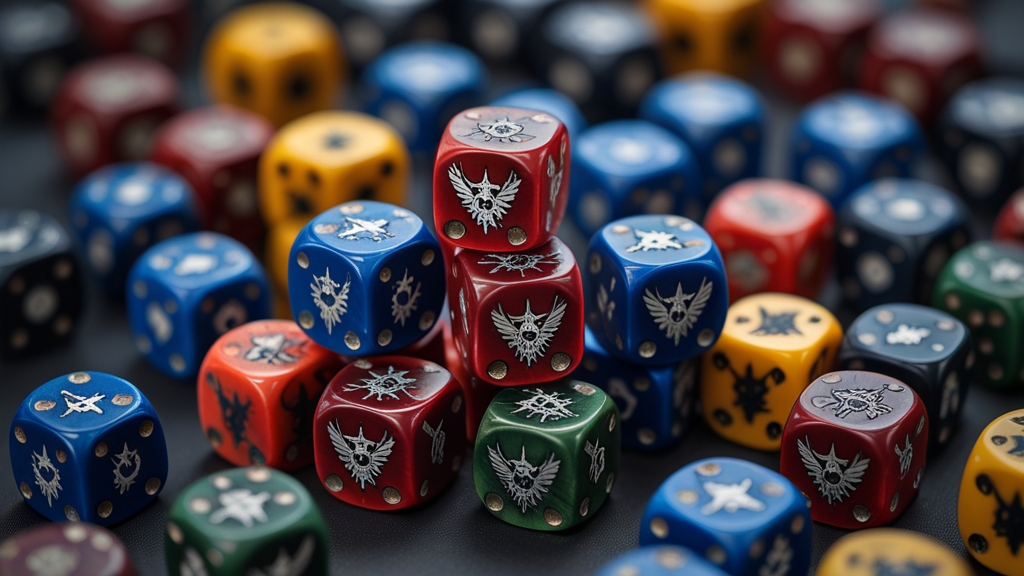
Warhammer 40,000 and Age of Sigmar use standard six-sided dice (D6). You need at least 20-30 dice to play comfortably, though 36 or more is ideal for rolling large volumes of attacks without re-rolling. Some rules reference D3 rolls (roll a D6, halve it rounding up), and older editions occasionally used scatter dice and artillery dice, though these are largely obsolete in current rules. The standard D6 is the only die you genuinely need to buy.
Dice are deceptively important to your Warhammer experience. Having enough dice speeds up the game dramatically, and using consistently manufactured dice ensures fair results. This guide covers exactly what you need, how many to buy, which dice are worth paying premium prices for, and the etiquette and rules around dice at tournaments.
What Types of Dice Does Warhammer Use?
D6 (Six-Sided Dice)
The D6 is the only die used in Warhammer 40,000 11th Edition and Age of Sigmar 4th Edition. Every roll in the game — hit rolls, wound rolls, save rolls, battle-shock tests in 40k, charge distances, rolling off for the first turn — uses D6s. The game is built entirely around the D6, which is why you need so many of them.
Standard D6s have pips (dots) or numerals from 1-6. Either format works for Warhammer, though numeral dice are slightly faster to read at a glance across a large dice pool.
D3 (Three-Sided Results)
Some abilities deal D3 damage or generate D3 attacks. There’s no physical three-sided die in standard use — instead, you roll a D6 and halve the result, rounding up: 1-2 = 1, 3-4 = 2, 5-6 = 3. This conversion becomes second nature after a few games. Some custom dice manufacturers produce actual D3s (either three-sided barrel shapes or D6s numbered 1-1-2-2-3-3), but these aren’t necessary.
Scatter Dice and Artillery Dice
Older editions of Warhammer 40k (7th edition and earlier) used scatter dice (with arrows and “hit” symbols) for determining blast weapon deviation, and artillery dice (numbered 2, 4, 6, 8, 10, Misfire) for scatter distance. These have been completely removed from current rules and are now collector’s items. If you’re playing 11th Edition 40k or 4th Edition AoS, you don’t need these.
D66 Rolls
Some campaign and narrative tables use D66 rolls — roll two D6s, one for the “tens” digit and one for the “ones” digit, generating results from 11-66. This uses standard D6s (ideally two different colours so you can designate tens and ones). D66 tables appear in some Kill Team, Necromunda, and Crusade campaign rules.
How Many Dice Do You Need for Warhammer?
The number of dice you need depends on your army and how efficiently you want to play:
Minimum (12-16 dice): Technically playable but frustrating. Many units in Warhammer 40k have 20+ attacks, and rolling them in batches of 12 is slow and easy to lose count. You’ll spend a lot of time re-rolling dice that could have been rolled all at once.
Comfortable (20-30 dice): Sufficient for most game situations. You can roll the attacks for most individual units in one or two rolls, and you’ll rarely need to batch more than once. This is the sweet spot for casual play.
Ideal (36+ dice): A 36-dice cube (the standard retail pack size) handles even the largest attack pools in a single roll. Ork Boyz, Tyranid Hormagaunts, and Imperial Guard infantry squads can generate 40+ attacks — having 36-40 dice means you can roll all or most of them at once. Tournament players typically bring 36-50 dice.
Horde armies (50+ dice): If you play Orks, Tyranids, Imperial Guard, or Skaven — armies that throw buckets of dice per phase — consider 50-60 dice. Rolling 60 attacks in one throw rather than three batches of 20 saves significant time over a full game.
As a practical recommendation, aim for around 36 dice. The cheapest way to get there is a single 36-dice block of 12mm dice. If you prefer the easier-to-read 16mm size, which comes in blocks of 12, buy three blocks instead. See the size section below for the trade-off.
What Makes Good Quality Dice?
Balance and fairness: Quality dice are manufactured to tight tolerances so each face has an equal probability of landing up. The main factors affecting fairness are consistent dimensions (all edges the same length, all corners the same radius), balanced weight distribution (the material drilled away for pips shouldn’t create bias), and accurate face angles (exactly 90°).
Casino-grade precision dice are machined to extremely tight tolerances but cost far more per die and are overkill for Warhammer. Standard Chessex or GW dice are manufactured to acceptable tolerances for gaming. Very cheap dice (bulk packs for pennies each) can have visible defects — rounded corners, uneven faces, misaligned pips — that may introduce slight bias.
Readability: Dice should be readable at arm’s length across a gaming table. High contrast between the face colour and the pip/numeral colour is essential. White dice with black pips, black dice with white numerals, and brightly coloured dice with contrasting numbers all work well. Avoid dice where the numbers blend into the face colour (dark blue on black, light yellow on white).
Size: 16mm D6s are the most common size for Warhammer and the easiest to read across a table. 12mm dice are cheaper per die and more fit in your hand, which helps when rolling big attack pools, but they are harder to read. Larger dice (20mm+) work but become unwieldy when rolling 30+ at once. A good set-up for many players is 16mm dice for everyday rolls plus a 12mm block for the occasional huge volley.
Are Custom Faction Dice Worth Buying?
Games Workshop sells custom dice sets for many factions — Space Marines, Necrons, Orks, Stormcast Eternals, and more. These typically replace the 6-pip face with a faction symbol. They’re visually impressive and thematically satisfying, but they come with caveats:
Readability concerns: Some faction dice replace the 6 with a symbol that’s not immediately recognisable as a 6, which can slow down play — especially for your opponent who needs to read your dice from across the table. Clear, well-designed faction symbols (like a crisp skull or chapter badge) are fine, but overly complex or ambiguous designs cause confusion.
Tournament legality: Most tournaments allow faction dice provided the 6-face symbol is clearly identifiable as a 6. Some stricter events require standard numeral or pip dice only. Check your event’s dice policy before bringing custom dice to a tournament.
Cost: GW faction dice cost noticeably more per die than standard blocks. A standard Chessex block (36 dice at 12mm or 12 at 16mm) is inexpensive by comparison. The premium is purely aesthetic.
Custom dice are a fun luxury and make your army feel more personal on the table. They’re not necessary and are rarely the most cost-effective way to get dice, but if you enjoy the thematics, they’re a worthwhile indulgence.
What Are the Best Dice Brands for Warhammer?
Chessex
Chessex is the default choice for tabletop gaming dice. Their dice blocks (36 dice at 12mm, or 12 larger 16mm dice) come in dozens of colour combinations and are consistently manufactured. Most gaming stores stock Chessex. For the lowest cost per die, the 36-dice 12mm block is the best value; for readability, the 12-dice 16mm block is the better buy, and two or three of them cover most games.
Games Workshop
GW’s own dice are well-made and sized appropriately for their games. The standard dice sets and faction-specific dice are high quality with good readability. The main complaint is price — GW dice usually cost noticeably more per die than equivalent Chessex dice. You’re paying for the Warhammer branding and faction-specific designs.
Dice from Board Games / Amazon Bulk Packs
Cheap bulk dice (large 100-die budget packs) are tempting but often have quality issues — rounded corners, inconsistent sizing, poor colour contrast, and dubious balance. For casual home games they’re acceptable, but for regular play and especially tournaments, investing in a Chessex or equivalent quality set is worthwhile.
Here are the Chessex blocks we mean: plain, high-contrast pipped d6s in the two sizes most Warhammer players use.

Price details
Product prices and availability are accurate as of the date/time indicated and are subject to change. Any price and availability information displayed on Amazon.com at the time of purchase will apply to the purchase of this product.As an Amazon Associate, Warhammer Guild earns from qualifying purchases.
What Are the Dice Rules and Etiquette at Tournaments?
Tournaments have established dice conventions that all players should follow:
Visible rolling: All dice must be rolled on the table in view of both players. Dice that fall off the table, land cocked (leaning against terrain or other objects), or land in inaccessible areas are re-rolled.
Dice sharing: Offering your dice to your opponent to use during their rolls is considered good sportsmanship, especially if they’ve brought fewer dice than needed. Some players prefer to use only their own dice.
Speed of play: Having enough dice to roll unit attacks in one batch rather than multiple small rolls is a courtesy to your opponent and helps keep the game on schedule. Tournament rounds are timed, and slow dice rolling eats into shared play time.
Dice cups and towers: Some events allow dice cups (you shake dice in a cup and pour them out) or dice towers (you drop dice in the top and they tumble out the bottom). These are considered fair randomisation methods and are sometimes recommended for players accused of “dice manipulation” through controlled throws.
Dice manipulation concerns: Placing dice with a specific face up before rolling, spinning dice rather than tumbling them, and other techniques that may influence results are considered poor sportsmanship or cheating. A proper dice roll involves picking up the dice and releasing them with enough energy that they tumble randomly.
Can You Use Dice Apps Instead of Physical Dice?
Dice-rolling apps exist for smartphones and tablets and can simulate any number of dice rolls instantly. However, they are generally not permitted at tournaments (check your event pack) and are often discouraged even in casual play. The reasons are:
Verification: Your opponent can see and verify physical dice results. App results require trust that the app is functioning correctly and hasn’t been tampered with.
Tradition and experience: Rolling physical dice is part of the tactile, social experience of tabletop gaming. The sound of dice rolling, the tension of watching them settle, and the communal experience of a dramatic roll are significant parts of what makes tabletop gaming enjoyable.
Speed: For small rolls (1-5 dice), physical dice are faster to pick up and roll than opening an app, inputting parameters, and reading results. For very large rolls (50+ dice), apps are faster but lose the drama.
Dice apps are useful for solo play, theory-crafting, and probability testing, but physical dice remain the standard for actual games of Warhammer.
Frequently Asked Questions
How many dice do I need for Warhammer 40k?
A minimum of 20 dice is needed for comfortable play, but around 36 is the recommended standard. A single 36-dice 12mm block is the cheapest way to get there; three 12-dice blocks of 16mm dice cost a little more but are easier to read. Horde armies like Orks or Tyranids may benefit from 50+ dice for rolling large attack pools efficiently.
Do I need special dice for Warhammer?
No. Standard six-sided dice (D6) are all you need for Warhammer 40k 11th Edition and Age of Sigmar 4th Edition. No special dice (scatter dice, artillery dice, custom faction dice) are required to play. Custom faction dice with a symbol replacing the 6 are optional cosmetic items.
What colour dice are easiest to read?
High-contrast combinations are easiest to read across a gaming table: white dice with black pips, black dice with white numbers, red dice with white numbers, or green dice with white numbers. Avoid low-contrast combinations (dark blue on black, silver on white) and translucent dice, which can be difficult to read under game-store lighting.
Are loaded or weighted dice a problem in Warhammer?
Intentionally loaded dice are extremely rare in the Warhammer community and constitute cheating. Cheaply manufactured dice may have slight unintentional bias due to imprecise manufacturing, but this is minor and averages out over the many hundreds of rolls in a typical game. Using standard-brand gaming dice (Chessex, GW) eliminates this concern for practical purposes.
Can I use 12mm dice instead of 16mm?
Yes, smaller 12mm dice are legal and some players prefer them for rolling large pools — more dice fit in your hand. However, they’re harder to read from across the table, which can slow down your opponent’s verification of results. 16mm remains the standard and most widely used size for Warhammer gaming.
What size are Warhammer dice?
Most Warhammer players use 16mm six-sided dice, which is the standard size of most Games Workshop dice sets and of most dice sold for wargaming. 12mm dice are also common and perfectly legal. More of them fit in your hand for big attack pools, but they are harder to read across the table. Dice of 20mm or more work too, but become unwieldy when rolling 30 or more at once.
What does D6 mean in Warhammer?
D6 means a six-sided die. Rules use it as shorthand: ‘roll a D6’ means roll one six-sided die, ‘2D6’ means roll two and add them together, and ‘D6+1’ means roll one die and add 1. ‘D3’ means roll a D6 and halve the result, rounding up. Every hit, wound and save roll in Warhammer 40k and Age of Sigmar uses D6s.
Related Content
- How to Play Warhammer 40k — Complete Beginner’s Guide — beginner guide to Warhammer 40K
- Can You Play Warhammer Solo? — Single Player Options — related content on a similar topic
- How Many Models Do I Need for Warhammer? — related content on a similar topic
- All Warhammer 40k Factions Ranked — Tier List — tier rankings of all Warhammer 40K factions