
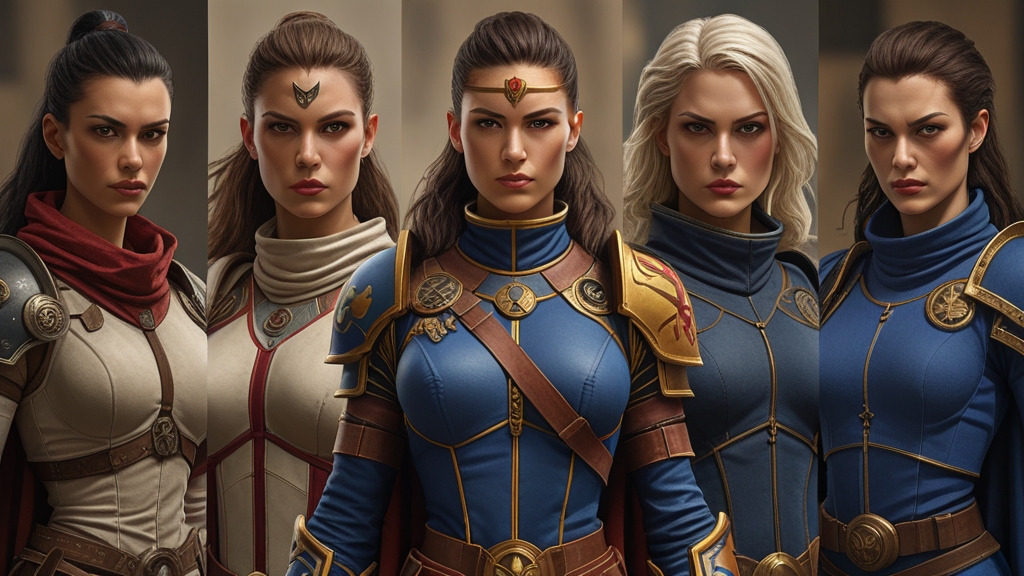
Warhammer 40k features many powerful female characters across its factions, from the warrior-saints of the Adepta Sororitas to xenos leaders like Commander Shadowsun and Yvraine. While Space Marines remain male-only in the lore, women hold positions of extraordinary power throughout the setting — as Inquisitors, Imperial Guard commanders, Rogue Traders, Tech-Priests, and more.
The question of female representation in Warhammer 40k is one that the community discusses frequently and sometimes contentiously. The setting has a complex relationship with gender — its most iconic faction, the Space Marines, is male-only, yet the wider setting features women in positions of extraordinary power, from living saints who channel the Emperor’s divine will to alien commanders who outmanoeuvre the Imperium’s finest generals. In 2024 Games Workshop also confirmed that the Adeptus Custodes, the Emperor’s own bodyguard, include women. This guide profiles the most notable women in the 40k setting and addresses the broader diversity question with the honesty it deserves.
Who Is Saint Celestine?
Saint Celestine is the most prominent Living Saint in the Warhammer 40k setting — a warrior who has been resurrected by the Emperor’s divine power so many times that she has become functionally immortal. She is the Imperium’s most visible miracle, a figure who appears at the darkest moments of the most desperate battles, wreathed in golden light and wielding the Ardent Blade, to turn the tide through faith made manifest.
Celestine’s story is remarkable even by 40k standards. She was originally a Sister of Battle — a member of the Adepta Sororitas — who was slain in battle and then returned as a Living Saint, through a power the faithful attribute to the Emperor. Since then she has fallen and risen again many times. She fought at the Fall of Cadia during the 13th Black Crusade, where her presence rallied the defenders and helped the survivors escape.
What makes Celestine particularly interesting is the ambiguity surrounding her nature. Is she truly a servant of the Emperor, resurrected by divine will? Is she a manifestation of the collective faith of humanity, given a form believers can rally behind? The lore deliberately leaves these questions open, making Celestine both a symbol of faith and a reminder that in 40k, even miracles cannot be trusted.
Who Is Yvraine?
Yvraine, the Emissary of Ynnead, is one of the most significant characters introduced in modern 40k lore. She is the prophet of Ynnead — the Aeldari god of the dead — and the leader of the Ynnari, a faction that seeks to fully awaken Ynnead as a means of destroying Slaanesh and saving the Aeldari species from extinction. Her actions directly led to the resurrection of Roboute Guilliman, making her one of the most consequential characters in the current era of the setting.
Yvraine’s background spans Aeldari society. She was born on Craftworld Biel-Tan, left it to wander, and eventually fought as a gladiatrix in the arenas of Commorragh, the Drukhari Dark City. She was slain there and reborn as the Emissary of Ynnead. That journey through both Craftworld and Drukhari life lets her draw followers from every branch of her people, and the Ynnari unite Asuryani, Drukhari and Harlequins under one cause.
Her alliance with Guilliman is one of the most fascinating political developments in current 40k. An Aeldari and a Primarch working together — however uneasily — represents a break from ten thousand years of mutual suspicion and hostility. Their relationship is pragmatic rather than friendly, but it represents a potential pathway to cooperation between humanity and the Aeldari that could reshape the galaxy if it endures.
Who Is Commander Shadowsun?
Commander Shadowsun (O’Shaserra) is the supreme military commander of the T’au Empire’s Fire Caste and one of the most tactically gifted characters in the 40k setting. She is a devoted student of the teachings of Commander Puretide, the T’au’s greatest military strategist, and spends long periods in stasis between campaigns so that her tactical genius is preserved for the T’au Empire’s most critical wars.
Shadowsun exemplifies the T’au’s approach to warfare — she is not a brute-force fighter but a master of manoeuvre, deception, and combined arms coordination. She commands from a XV22 Stalker Battlesuit, an advanced stealth platform that allows her to position herself precisely where she can observe and direct the battle. Her campaigns have consistently outmanoeuvred Imperial forces, earning her grudging respect from even the Imperium’s most xenophobic commanders.
What makes Shadowsun narratively interesting is her devotion to the Greater Good, and her rivalry with Commander Farsight, the renegade who broke away from the T’au Empire. Shadowsun represents the loyal, disciplined face of the Fire Caste, and her time in stasis means the empire she wakes to keeps changing around her.
Who Is Ephrael Stern?
Ephrael Stern is the Daemonifuge, a Sister of Battle whose story began in the classic Daemonifuge comics. She was the sole survivor of a daemonic attack that slaughtered her sisters, and she returned from it changed, carrying a mysterious power that is lethal to daemons.
Stern’s existence is a theological problem for the Imperium. The Ordo Hereticus suspected that anyone who survived such an ordeal must be tainted, and she was branded a heretic and hunted, even as her power proved itself again and again against the servants of Chaos. Whether that power is the Emperor’s grace or something else entirely is one of the questions at the heart of her story. Her alliance with Kyganil, an Aeldari outcast, adds another layer of heresy — a Sister of Battle fighting alongside an alien is as scandalous as it is effective.
Who Is Inquisitor Greyfax?
Katarinya Greyfax is an Inquisitor of the Ordo Hereticus — the branch of the Inquisition dedicated to hunting witches, heretics, and traitors within the Imperium. She is one of the most powerful and feared Inquisitors in the setting, a woman whose determination and ruthlessness have made her both invaluable and dangerous to the Imperium she serves.
Greyfax is one of the key characters of the Gathering Storm, fighting during the Fall of Cadia alongside Saint Celestine and Archmagos Belisarius Cawl. Her relationship with Celestine is fascinating: as a witch hunter, Greyfax is instinctively suspicious of anyone who wields miraculous power, yet she cannot deny the Living Saint’s effectiveness. Their uneasy partnership is one of the more memorable dynamics of that era of the story.
As an Inquisitor, Greyfax represents one of the most powerful positions a human can hold in the Imperium. Inquisitors carry near-unlimited authority, can requisition forces from across the Imperium, and can even sanction Exterminatus (planetary destruction) if they deem it necessary. Greyfax’s gender is irrelevant to her authority — the Inquisition has always included women in the lore, and female Inquisitors are as feared as their male counterparts.
Who Is Lotara Sarrin?
Lotara Sarrin is one of the most beloved female characters in the Horus Heresy novels — a mortal human who commanded the Conqueror, the flagship of the World Eaters Legion, during the Horus Heresy. She is remarkable because she is a baseline human who earned the respect and loyalty of the most violent, rage-driven Space Marine Legion in existence — a feat that would seem impossible given the World Eaters’ reputation for uncontrolled aggression.
Sarrin’s relationship with the World Eaters, particularly the Primarch Angron, humanises one of 40k’s most one-dimensional factions. She is no warrior — she commands from the bridge, using naval tactics and ship-to-ship combat skills to devastating effect. Her authority over the World Eaters comes not from physical power but from competence, courage, and a fiery personality that refuses to be intimidated by beings who could kill her with a casual backhand. She is a central character in Aaron Dembski-Bowden’s novel Betrayer, and her friendship with Khârn is one of its highlights.
What Role Do Women Play in the Adepta Sororitas?
The Adepta Sororitas — the Sisters of Battle — is the setting’s only major all-female military organisation (mirroring the all-male Space Marines). The Sororitas are the armed wing of the Ecclesiarchy, the Imperium’s state religion. They fight with bolters, flamers, and melta weapons, wearing power armour that is functionally similar to Space Marine armour (though not enhanced by gene-seed). Their faith is their greatest weapon — literally, in 40k terms, as Acts of Faith allow Sororitas units to perform miraculous feats through sheer devotion to the Emperor.
The Sororitas exist because of a historical loophole. After the Age of Apostasy, the Decree Passive forbade the Ecclesiarchy from maintaining “men under arms.” The Ecclesiarchy’s lawyers interpreted this literally — men under arms were forbidden, but women under arms were not mentioned. The Sororitas were thus created as the Ecclesiarchy’s military force, a legal technicality that became one of the Imperium’s most effective fighting forces.
Recent years have seen the Sororitas receive significant attention from Games Workshop, with a completely refreshed model range, new rules, and expanded lore. They are now one of the most popular 40k factions for both gaming and painting, and their combination of religious fanaticism, military effectiveness, and striking visual design has made them iconic within the setting.
How Does Warhammer 40k Handle Gender Diversity?
The honest answer is: imperfectly but improving. The Space Marines — 40k’s most popular and most marketed faction — remain male-only in the lore, which creates an inherent gender imbalance at the heart of the setting. The lore explains this through the gene-seed, which is said to be compatible only with male physiology. This is a position that some fans accept as internally consistent world-building and others criticise as an unnecessary limitation.
Outside of Space Marines, however, 40k’s gender representation has improved significantly. The clearest recent example came in 2024, when Games Workshop confirmed that there have always been female Adeptus Custodes — the Emperor’s personal guard, who are created through a different process from Space Marines. The Imperial Guard, Inquisition, Mechanicus, and Rogue Traders have always included women in the lore, and recent model releases have reflected this diversity more consistently. The T’au, Aeldari, and Drukhari factions feature prominent female characters in leadership positions. And the Sororitas provide an all-female faction that is as powerful and as narratively central as any Space Marine Chapter.
The setting’s grimdark nature creates a paradoxical form of equality — in the 41st millennium, everyone suffers equally. Gender is rarely presented as a barrier in the Imperium, which has far more pressing concerns than who fills its ranks. Women serve as Imperial Guard commanders, Inquisitors, Rogue Traders, Tech-Priests (who transcend gender through cybernetic augmentation), and every other role the Imperium requires.
Frequently Asked Questions
Will there ever be female Space Marines?
Space Marines remain male-only in the current lore, explained by gene-seed only working with male physiology, and Games Workshop has not changed that. However, the Adeptus Custodes — the Emperor’s even more elite bodyguard — were confirmed in 2024 to include women, so there are female transhuman warriors in the Imperium. In addition, the Adepta Sororitas occupy a similar narrative and tabletop role — power-armoured warriors fighting for the Imperium with bolters and faith. The Sororitas are not “female Space Marines” (they have distinct lore, abilities, and aesthetics), but they provide a comparable experience for players who want to field an all-female army.
Are there female Primarchs?
No. All twenty Primarchs were male. The two Lost Primarchs (II and XI) have never been described or named, leading to speculation that one or both might have been female, but Games Workshop has neither confirmed nor denied this. The Primarchs were engineered by the Emperor from his own genetic template, and their male physiology is tied to the gene-seed technology used to create Space Marines.
Are there female Chaos Space Marines?
No. Chaos Space Marines are traitors from the original all-male Legions or subsequent corrupted Marines. However, Chaos warbands include female mortal cultists, dark mechanicum adepts, and daemon allies. The Chaos Gods do not discriminate — mortal servants of Chaos include people of every gender, and daemonic entities transcend human gender categories entirely.
Which faction has the best female representation?
The T’au Empire arguably has the most integrated gender representation — female and male T’au serve equally across all castes, and Commander Shadowsun is the faction’s most prominent character regardless of gender. The Aeldari factions also feature strong female representation, with characters like Yvraine, Jain Zar, and various Farseers occupying central roles. Among Imperial factions, the Adepta Sororitas and the Inquisition feature the most prominent and powerful female characters.
Is the Warhammer 40k community welcoming to women?
The community has improved significantly and continues to do so. Women make up a growing percentage of the Warhammer hobby — as players, painters, lore fans, and content creators. While pockets of gatekeeping exist (as in any large fandom), the mainstream community and Games Workshop itself have made efforts to be more inclusive. Events like Warhammer Fest and local gaming nights actively welcome participants of all backgrounds.
What are the names of famous female characters in Warhammer 40k?
Well-known female characters include Saint Celestine, Morvenn Vahl and Junith Eruita of the Adepta Sororitas, Inquisitor Katarinya Greyfax, Ephrael Stern, Commander Shadowsun of the T’au, Yvraine of the Ynnari, Jain Zar the Phoenix Lord, and Lelith Hesperax of the Drukhari. From the Horus Heresy novels, Lotara Sarrin, shipmistress of the World Eaters’ flagship, is a fan favourite.
Are there female Adeptus Custodes?
Yes. In 2024 Games Workshop confirmed that the Adeptus Custodes include women, and that there have always been female Custodians in the lore. This doesn’t change Space Marines, who remain male-only, but it means the Emperor’s own genetically engineered bodyguard includes both men and women.