
Part of our White Scars hub: every White Scars guide, lore page and painting tutorial in one place.
Jaghatai Khan is the Primarch of the White Scars, the fifth Legion of the Adeptus Astartes. Known as the Warhawk of Chogoris and the Great Khan, Jaghatai is the master of lightning warfare — fast, devastating strikes that overwhelm the enemy before they can react. Inspired by the Mongol Empire and the steppe warriors of Central Asia, the White Scars under Jaghatai Khan are the fastest and most mobile legion in the Imperium’s history. His story is one of freedom, speed, and a restless spirit that ultimately led him to vanish into the alien Webway, where he remains to this day.
Who Is Jaghatai Khan?
Jaghatai Khan is one of the twenty Primarchs created by the Emperor of Mankind to lead His Great Crusade. Among his brothers, Jaghatai is often the most overlooked and underestimated — a status he has used to his advantage throughout his career. While Primarchs like Horus, Guilliman, and the Lion commanded attention and political influence, Jaghatai operated on the fringes, conquering worlds with blinding speed and moving on before anyone could fully appreciate what he had accomplished.
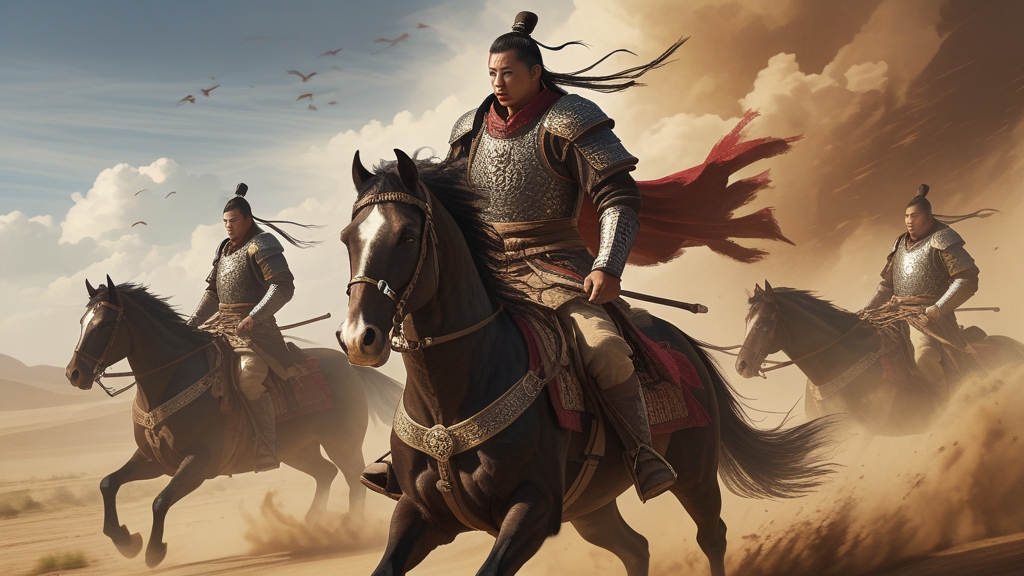
Physically, Jaghatai Khan bears the features of his adopted homeworld’s people. He has sharp, angular features, a lean and powerful build, and the bearing of a steppe warrior king. He wears his hair in topknots and braids in the Chogorian tradition, and his armour is decorated with the lightning bolt motifs that symbolise his legion’s approach to warfare. He carries a tulwar — a curved power sword in the tradition of Chogorian cavalry sabres — as his primary weapon.
Origins on Chogoris
Jaghatai Khan’s incubation pod landed on Chogoris, a world whose culture closely mirrors that of the Mongol Empire and the nomadic steppe peoples of Central Asian history. The world was divided between settled civilisations in fertile lowlands and nomadic tribes on the vast open steppes. The infant Primarch was found by one of the nomadic tribes and adopted by their chief.
Growing up among the steppe nomads shaped Jaghatai fundamentally. He learned to ride before he could walk, to fight from horseback, to live in the saddle, and to value speed and mobility above all else. The nomadic culture prized freedom, personal honour, and martial skill — qualities that became the foundation of the White Scars’ identity.
As Jaghatai grew to adulthood, his superhuman abilities became apparent. He unified the warring steppe tribes through a combination of military genius, personal charisma, and sheer martial prowess. In a series of brilliant campaigns, he defeated rival tribes and eventually turned his attention to the settled civilisations of Chogoris, conquering the entire planet. His campaigns were characterised by the speed and ferocity that would define his legion — lightning strikes, rapid encirclements, and the overwhelming application of mobile force.
By the time the Emperor arrived on Chogoris to reclaim His lost son, Jaghatai Khan was the undisputed ruler of the entire world. Unlike some Primarchs who resisted or tested the Emperor, Jaghatai recognised a kindred spirit — a conqueror with a vision that extended beyond a single world — and pledged himself to the Great Crusade willingly, eager to test himself against the wider galaxy.
The Great Khan
Jaghatai Khan’s approach to leadership was markedly different from most of his brothers. He was not a bureaucrat like Guilliman, a politician like Horus, or a philosopher like Lorgar. He was a warrior chief who led from the front and expected his sons to match his ferocity and speed. The White Scars under his command became the fastest-moving legion in the Imperium, specialising in rapid assault, hit-and-run tactics, and the use of bikes, jetbikes, and fast vehicles to maintain constant momentum.
The Khan valued freedom and independence in a way that made some of his brothers and the Imperial bureaucracy uncomfortable. He disliked rigid hierarchies, excessive rules, and the growing authoritarianism of the Imperium. He was not disloyal — his honour and sense of duty were absolute — but he chafed under restrictions and preferred to operate independently, far from the political centres of Imperial power.
This independent streak meant that Jaghatai was often underestimated by his brothers. They saw his preference for frontier warfare and his disdain for politics as signs of simplicity. This was a profound mistake. Jaghatai Khan was a deep thinker and a keen observer of human nature. He simply chose to express his intelligence through action rather than words, through conquest rather than council debate.
The Great Crusade
During the Great Crusade, the White Scars operated primarily on the fringes of Imperial expansion. While more politically connected legions fought in the core systems and competed for glory in high-profile campaigns, the Khan and his sons swept across the galactic frontiers, conquering worlds at a pace that few other legions could match.
The White Scars’ military doctrine was built entirely around speed. They used bikes, jetbikes, and fast attack vehicles as their primary combat platforms, supported by rapid-insertion infantry. Their battles were typically short, violent affairs — a devastating opening strike followed by relentless pursuit that gave the enemy no time to regroup. When the White Scars hit you, they hit you everywhere at once and never stopped moving.
Jaghatai’s relationship with his brother Primarchs was complex. He had a genuine friendship with Horus, who respected the Khan’s military abilities and independent nature. He also had a surprising philosophical connection with Magnus the Red, with whom he debated the nature of knowledge and freedom. His relationships with more rigid Primarchs like Rogal Dorn and Roboute Guilliman were respectful but distant — they found his methods too chaotic, and he found their methods too constrained.
The Horus Heresy: Initially Unknown Loyalty
When the Horus Heresy erupted, Jaghatai Khan’s loyalty was genuinely uncertain to both sides. The White Scars were operating far from Terra on the galactic fringe, and communication with the legion was difficult. Both loyalists and traitors sent emissaries to the Khan, trying to sway him to their cause.
This period of uncertainty is one of the most compelling narratives in the Heresy series. Jaghatai was genuinely torn — not between loyalty and treachery, but between his personal friendship with Horus and his duty to the Emperor. He also had to navigate a conspiracy within his own legion, as the lodge system had corrupted some of his warriors and they attempted to steer the White Scars toward the traitor cause.
Ultimately, Jaghatai chose loyalty to the Emperor. His decision was based not on blind obedience but on careful consideration of what Horus’s rebellion actually represented. The Khan saw that Horus had embraced Chaos, and whatever grievances the traitors had against the Emperor, allying with the Ruinous Powers was a line that could never be crossed. Once his decision was made, Jaghatai acted with characteristic speed and decisiveness, purging the traitor elements within his legion and racing to Terra’s defence.
The Siege of Terra
Jaghatai Khan and the White Scars reached Terra before the Siege began, and their contribution was decisive. While other defending forces held static positions around the Imperial Palace, the White Scars did what they did best — they launched lightning counterattacks, hit-and-run raids on traitor supply lines, and devastating fast assaults that disrupted enemy operations across the entire warzone.
The Khan personally led many of these attacks, riding into battle on his jetbike at the head of his honour guard. His speed and ferocity were critical in preventing the traitors from consolidating their positions and maintaining constant pressure that forced them to divert resources from the main assault. The White Scars’ contribution to the Siege of Terra is often underappreciated in the broader narrative, but military historians within the setting acknowledge that without the Khan’s lightning warfare, the defence may well have collapsed.
Disappearance into the Webway
After the Heresy ended and the Imperium began the long process of rebuilding, Jaghatai Khan led the White Scars in the Great Scouring — the campaign to drive the traitor legions into the Eye of Terror. During this period, the White Scars pursued a force of Dark Eldar raiders into the Webway, the extra-dimensional labyrinth that the Aeldari use for faster-than-light travel.
The Khan led the pursuit personally, unwilling to let the xenos escape justice. The White Scars followed the Dark Eldar deep into the Webway’s twisting corridors, and at some point, Jaghatai Khan became separated from his forces. He has not been seen since. His warriors eventually found their way back to realspace, but the Khan remained lost in the Webway.
For over ten thousand years, Jaghatai Khan has been missing within the Webway. The White Scars believe he is alive, still fighting, still racing through the impossible corridors of the Webway. Some believe he is a prisoner of the Dark Eldar in Commorragh. Others think he found something in the Webway — a truth or a threat — that compelled him to remain. Whatever the truth, the White Scars await his return with absolute faith.
Legacy
Jaghatai Khan’s legacy is written in the White Scars’ DNA. Every aspect of the chapter reflects his values — speed, freedom, honour, and the joy of battle. The White Scars remain the fastest Space Marine chapter, specialising in bike-mounted warfare and rapid assault tactics that mirror the steppe warfare of Chogoris.
The Khan’s influence extends beyond military doctrine. The White Scars maintain the traditions of Chogorian culture — poetry, calligraphy, falconry, and the oral tradition of storytelling. They are warriors and artists in equal measure, and this duality reflects Jaghatai’s own nature as both a fierce warrior and a contemplative thinker.
Among the loyalist Primarchs, Jaghatai Khan is one of the most popular with fans due to his compelling character arc and the depth of his personality. He is not simply a warrior — he is a philosopher who chose action, a free spirit who accepted duty, and a friend who chose principle over personal loyalty when it mattered most.
For more on the White Scars chapter, visit our White Scars army guide. For the broader Heresy context, see our Horus Heresy explained guide.
Frequently Asked Questions
Is Jaghatai Khan dead?
Jaghatai Khan is not confirmed dead. He disappeared into the Webway over ten thousand years ago and has not been seen since. The White Scars believe he is alive, and given that Primarchs are extraordinarily long-lived and durable, it is entirely plausible that he survives somewhere within the Webway. Games Workshop has kept his fate deliberately ambiguous to allow for a potential future return.
Could Jaghatai Khan return to the setting?
Yes, a return is very possible. Games Workshop has established a precedent for Primarch returns with Roboute Guilliman, and the Webway provides a natural mechanism for the Khan’s reappearance. The Dark Eldar connection could tie his return to a major Aeldari storyline, and the White Scars are a popular enough faction to warrant a centrepiece model. Many fans consider the Khan one of the most likely Primarchs to return next.
Why is Jaghatai Khan based on Genghis Khan?
The White Scars and Jaghatai Khan are heavily inspired by the Mongol Empire and its founder, Genghis Khan. The name “Jaghatai” is derived from Chagatai, one of Genghis Khan’s sons. The steppe culture of Chogoris, the emphasis on mounted warfare, the tribal organisation, and the lightning-fast military campaigns all draw directly from Mongol history. This cultural inspiration gives the White Scars a distinct identity that sets them apart from other Space Marine chapters.
What is the Webway?
The Webway is an ancient network of extra-dimensional tunnels that exists between realspace and the Warp. It was originally created by the Old Ones millions of years ago and is now primarily used by the Aeldari (Elves) for faster-than-light travel without needing to enter the dangerous Warp directly. The Webway is labyrinthine and vast, containing entire pocket dimensions, hidden cities, and countless unexplored passages. It is within this impossible maze that Jaghatai Khan was lost.
How does Jaghatai Khan compare to other Primarchs in combat?
Jaghatai Khan is one of the fastest Primarchs in direct combat, relying on speed and precision rather than brute force. He may not match the raw strength of Vulkan or the martial perfection of the Lion, but his speed makes him incredibly difficult to hit and allows him to strike weak points with surgical precision. In the Horus Heresy novels, he is depicted as a blur in combat, his tulwar striking faster than even Astartes eyes can follow. Against slower opponents, this speed advantage is decisive.
Did Jaghatai Khan ever consider joining Horus?
Jaghatai Khan genuinely considered his options during the Heresy, which is part of what makes his story compelling. He had personal grievances against the Emperor and a genuine friendship with Horus. However, he never seriously considered joining the traitors once he understood that Chaos was involved. His deliberation was about understanding the truth of the situation, not about being tempted by the dark side. Once he knew the full picture, his loyalty was absolute and immediate.
Which books feature Jaghatai Khan?
Chris Wraight’s Horus Heresy novels are the key reads. Scars covers the White Scars’ divided loyalties at the start of the Heresy, the novella Brotherhood of the Storm explores the Legion’s culture, and The Path of Heaven follows their fight to reach Terra. Warhawk, part of the Siege of Terra series, puts the Khan at the centre of the defence of the Imperial Palace.
Did Jaghatai Khan fight Mortarion?
Yes. In Warhawk, Jaghatai Khan duels Mortarion, Primarch of the Death Guard, at the Lion’s Gate space port during the Siege of Terra. The fight is brutal and the Khan is grievously wounded, but his stand plays a major part in breaking the traitor attack on that front. It is one of the defining Primarch duels of the Heresy.
What is Jaghatai Khan’s sword called?
His signature blade is the White Tiger Dao, a curved power sword in the style of a Chogorian cavalry sabre. It reflects his preference for speed and precise cuts over brute force. On the tabletop and in art, he is usually shown wielding it from the saddle of his jetbike at the head of his Legion’s fast-attack forces.
Related Content
- The Horus Heresy Explained — Complete Timeline & Guide — understand the pivotal Horus Heresy era
- Best Warhammer Books to Read — Fiction Guide — find great Warhammer novels to read
- Warhammer Etiquette Guide — Sportsmanship & Table Manners — explore more Warhammer content