
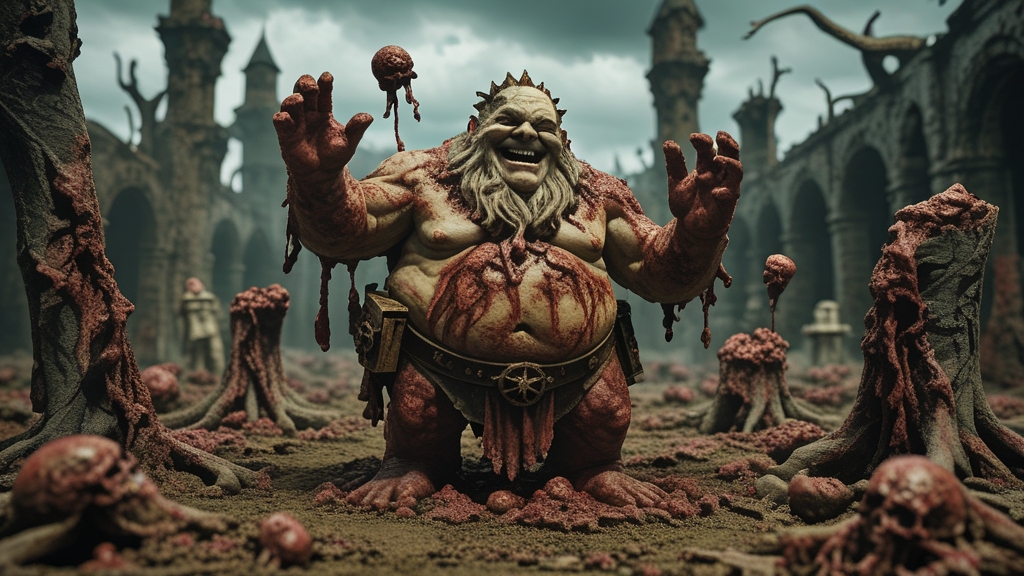
Nurgle is the Chaos God of plague, decay, entropy, and despair. Paradoxically, he is the most jovial and loving of the Chaos Gods — his plagues are gifts, and his followers embrace disease with gratitude and morbid joy.
Among the four Chaos Gods, Nurgle is the most paradoxical. He is the Lord of Decay, the Plague Father, the harbinger of entropy and the inevitability of death — and yet his followers are among the happiest beings in the Warhammer universe. Where other Chaos Gods demand sacrifice, suffering, or submission, Nurgle offers comfort. He embraces his followers — literally and figuratively — in his bloated, pestilent arms, and they love him for it. To serve Nurgle is to accept the fundamental truth that all things rot, all things die, and all things are reborn in new and fecund forms.
Nurgle is fuelled by despair, hopelessness, and the fear of mortality. Every plague that sweeps a world, every terminal diagnosis, every moment of existential dread at the inevitability of death feeds his power. Ironically, those who give themselves to Nurgle are freed from the very despair that created him. They no longer fear disease or death because they have embraced both completely. This is the gift of Grandfather Nurgle — liberation through acceptance of decay.
Who Is Grandfather Nurgle?
Nurgle’s followers call him Grandfather Nurgle, Papa Nurgle, or the Plague Father — terms of genuine affection that would be deeply disturbing to any outsider. Unlike the other Chaos Gods, who are distant, terrifying entities demanding worship through fear, Nurgle genuinely cares about his followers in his own revolting way.
Nurgle is described as an immense, bloated figure — a mountain of rotting flesh covered in sores, boils, and open wounds that weep with disease. His intestines spill from his distended belly, his skin is mottled green and brown with corruption, and clouds of flies surround him at all times. Despite this horrifying appearance, his expression is one of jovial good humour. He chuckles constantly, delighted by his own creations, and he takes genuine pleasure in crafting new plagues to unleash upon the universe.
This personality makes Nurgle unique among the Chaos Gods. Khorne is pure rage, Tzeentch is cold calculation, and Slaanesh is narcissistic obsession. Nurgle is warmth — a terrible, infectious, decomposing warmth, but warmth nonetheless. He considers every disease he creates to be a labour of love, a gift to be shared with the universe. His followers are his children, and he dotes upon them with the affection of a grandfather who has all eternity to spoil his descendants.
The relationship between Nurgle and his followers is genuinely reciprocal. They love him as sincerely as he loves them. Nurglings — the smallest of his daemons — are essentially physical manifestations of this affection, bouncing and giggling like grotesque infants. The entire cult of Nurgle operates more like an extremely dysfunctional family than a religious hierarchy, with Nurgle as the patriarch and his followers as grateful, disease-ridden children.
What Are Nurgle’s Daemons?
Nurgle’s daemonic legions are as diverse and teeming as the diseases they spread. Each daemon type embodies a different aspect of plague and decay, from the towering Greater Daemons to the tiniest, most cheerful Nurglings.
Great Unclean Ones are the Greater Daemons of Nurgle and among the most imposing creatures in Warhammer. These mountainous entities are shaped in Nurgle’s own image — enormously fat, covered in disease, with exposed entrails and permanently cheerful expressions. Despite their repulsive appearance, Great Unclean Ones are surprisingly jovial and even personable. They refer to their lesser daemons as “children” and often engage in philosophical conversations about the beauty of decay while simultaneously dissolving entire armies with their pestilent presence. In combat, they are extraordinarily durable, their bloated bodies absorbing damage that would destroy other daemons, and their every touch spreads virulent disease.
Plaguebearers are the rank-and-file daemons of Nurgle — emaciated, single-eyed humanoids who shuffle forward in endless, moaning ranks. Unlike Nurgle’s other daemons, Plaguebearers are not particularly happy. They are eternally tasked with counting Nurgle’s plagues and diseases — an impossible task, since Grandfather Nurgle is always creating new ones. This Sisyphean duty leaves them perpetually grumpy and dissatisfied, which contrasts dramatically with the general cheerfulness of Nurgle’s domain. They carry Plague Swords that infect anything they cut, and their mere presence causes disease and nausea in mortal beings.
Nurglings are perhaps the most distinctive and unexpectedly endearing daemons in all of Warhammer. These tiny, pot-bellied imps are miniature versions of Nurgle himself, complete with bloated bodies, cheerful expressions, and infectious diseases. They swarm in giggling hordes, crawling over everything and everyone, spreading disease with enthusiastic abandon. Nurglings are born from the boils and sores on Great Unclean Ones and even on Nurgle himself, popping forth fully formed and immediately beginning their gleeful, plague-spreading existence. On the tabletop, they are treated as swarm units — individually weak but collectively dangerous and surprisingly difficult to remove.
Beasts of Nurgle are slug-like daemon beasts that behave like enormous, overly enthusiastic puppies. They bound toward the enemy with genuine excitement, wanting nothing more than to play with their new friends. Unfortunately, their touch is lethally toxic, and their playmates tend to dissolve into puddles of diseased slime within moments. The Beasts of Nurgle are genuinely confused and saddened when this happens, which only makes them seek out new friends more eagerly. This tragic-comic cycle makes them one of the most characterful units in the Warhammer range.
Plague Drones are Plaguebearers mounted on enormous Rot Flies — daemonic insects that buzz through the air on tattered wings, dripping disease in their wake. They serve as Nurgle’s fast-attack forces, spreading plague across wide areas and engaging enemies that try to flee the shambling advance of Nurgle’s infantry.
Who Are Nurgle’s Mortal Followers?
Nurgle’s mortal followers are found across both Warhammer settings, united by their acceptance of disease and their gratitude for Grandfather Nurgle’s gifts.
In Warhammer 40,000, the Death Guard are the most prominent followers of Nurgle. Originally the XIV Legion of Space Marines led by the Primarch Mortarion, the Death Guard were trapped in the Warp during the Horus Heresy and subjected to a devastating plague that even their superhuman constitutions could not resist. In their agony, Mortarion surrendered to Nurgle, and the entire Legion was transformed into Plague Marines — diseased, rotting warriors encased in corroded power armour, their bodies host to every disease imaginable yet utterly immune to pain and death.
The Death Guard are terrifyingly effective fighters. Their decayed bodies are almost impossible to destroy permanently — they feel no pain, they regenerate from wounds that would kill any normal being, and their weapons and ammunition are laced with virulent plagues that eat through armour and flesh alike. Led by Mortarion, now a towering Daemon Primarch, the Death Guard wage a slow, inexorable war against the Imperium, spreading Nurgle’s plagues to every world they touch.
In Age of Sigmar, the Maggotkin of Nurgle represent the Plague Father’s forces in the Mortal Realms. These armies combine mortal Rotbringer warriors — heavily armoured champions whose bodies are riddled with disease and mutation — with Nurgle’s daemonic legions. The Maggotkin spread the Garden of Nurgle across the Mortal Realms, transforming verdant lands into festering swamps and corrupting everything they touch. Key characters include Bloab Rotspawned, who rides a massive Rot Fly into battle, and Gutrot Spume, a pirate lord of Nurgle who sails seas of pus and bile.
Beyond these organised forces, Nurgle has countless mortal cults across both settings. These range from desperate plague victims who turn to Nurgle for relief from their suffering to ambitious physicians who seek to understand disease at its deepest level. Many of Nurgle’s mortal followers begin their path to corruption not through evil intent but through despair — a terminally ill person who prays for relief, a healer who delves too deep into the nature of disease, a survivor of a plague who begins to see beauty in the cycle of decay and rebirth.
What Is Nurgle’s Garden?
Nurgle’s Garden is the Plague Father’s domain in the Realm of Chaos, and it is one of the most vividly described locations in all of Warhammer lore. Unlike the blood-soaked wastelands of Khorne or the impossible geometries of Tzeentch, Nurgle’s Garden is paradoxically beautiful — in a deeply unsettling way.
The Garden is an endless expanse of diseased vegetation, stagnant pools, and rotting growth that stretches beyond mortal comprehension. Enormous fungi tower like trees, their caps dripping with luminescent spores. Rivers of pus wind between hillocks of composting matter. The air is thick with the buzz of daemon-flies and the sweet, cloying stench of decay. Everything is in a constant state of decomposition and regrowth — plants rot into mulch that feeds new, even more diseased growth, in an eternal cycle that mirrors Nurgle’s philosophy.
At the heart of the Garden sits Nurgle’s Manse — a vast, decrepit mansion where the Plague Father works at his cauldron, brewing new diseases with the enthusiasm of a master chef creating a new recipe. The cauldron bubbles with the essences of every plague ever conceived, and Nurgle stirs it constantly, testing new combinations and cackling with delight when he creates something particularly virulent. His Nurglings assist him in this work, fetching ingredients and sampling the results with squeals of delight.
The Garden is also home to countless daemon servants who tend its diseased flora and fauna. Plaguebearers shuffle through the undergrowth, cataloguing every new strain of disease. Beasts of Nurgle frolic in the stagnant ponds. And somewhere in the deepest reaches of the Garden, according to ancient Aeldari legend, the goddess Isha is imprisoned — kept alive by Nurgle as a test subject for his latest plagues, eternally whispering the cures to mortals even as Nurgle devises new afflictions.
What Is Nurgle’s Sacred Number?
Nurgle’s sacred number is seven. This number pervades his worship, his daemonic legions, and his plagues. Seven is associated with Nurgle for several thematic reasons — it is traditionally linked to cycles and completion (seven days in a week, seven stages of grief), which aligns with Nurgle’s domain over the cycle of decay and rebirth.
His daemonic hosts are organised in groups of seven. Rituals to summon Nurgle’s daemons require seven participants, seven offerings, or seven repetitions. The most powerful of Nurgle’s plagues are said to work in seven stages, each more debilitating than the last. Even his Plaguebearers count in sevens, their eternal tallying reflecting the sacred number of their patron.
Nurgle’s colours are sickly green, brown, and pale yellow — the colours of decay, rot, and infection. His symbol is the tri-lobe or three-circle mark, representing the three stages of disease: infection, decay, and rebirth. This symbol is often depicted as three circles overlapping, creating a shape that is both organic and unsettling.
Why Does Nurgle Rival Tzeentch?
Nurgle’s greatest rival among the Chaos Gods is Tzeentch, the Changer of Ways. Their opposition is fundamental and philosophical — Nurgle represents stagnation, acceptance, and the inevitable end of all things, while Tzeentch represents change, ambition, and the belief that anything can be altered through sufficient will and cunning.
Nurgle’s message is one of acceptance: everything decays, everything dies, and the only peace comes from embracing this truth. Tzeentch’s message is the opposite: nothing is fixed, everything can be changed, and the universe can be reshaped through scheming and sorcery. These philosophies are fundamentally incompatible. Nurgle sees Tzeentch as a deluded fool who refuses to accept the inevitable, while Tzeentch sees Nurgle as a stagnant, complacent mass that represents everything he seeks to overcome.
This rivalry plays out in the Great Game, where Nurgle’s slow, inexorable advance is constantly disrupted by Tzeentch’s unpredictable schemes. Nurgle’s forces are patient and enduring, grinding forward like a glacier of rot, while Tzeentch’s forces are mercurial and ever-changing, striking from unexpected angles and retreating before Nurgle can bring his full weight to bear. Neither can ever fully defeat the other, as their opposition is built into the fundamental fabric of the Warp.
Does Nurgle Hold Isha Captive?
One of the most intriguing pieces of Warhammer lore concerns the Aeldari goddess Isha and her imprisonment in Nurgle’s Garden. According to the mythology, when Slaanesh was born from the Fall of the Aeldari and consumed most of the Aeldari gods, Nurgle intervened to save Isha — not out of altruism, but because he desired a test subject for his plagues.
Nurgle keeps Isha imprisoned in a cage within his Garden, using her as the ultimate guinea pig. He tests each new disease on her, observing its effects with fascination. Isha, being a goddess of healing and fertility, cannot die from these plagues — she suffers each one to its fullest extent before her divine nature purges it. Nurgle finds this endlessly entertaining and considers Isha his greatest treasure.
What makes this story compelling is the detail that Isha, even in her imprisonment, continues to serve her nature as a goddess of healing. She whispers the cures to Nurgle’s plagues into the universe, hoping that mortals will hear her and find ways to combat the Plague Father’s creations. Nurgle is either unaware of this or considers it a charming quirk of his favourite captive — another layer of the strange, twisted affection that characterises everything in Nurgle’s domain.
Frequently Asked Questions
Why do Nurgle’s followers seem happy?
Nurgle’s followers have accepted the fundamental truth that all things decay and die. This acceptance frees them from the fear and anxiety that plague ordinary mortals. Combined with Nurgle’s genuine affection for his followers — he truly considers them his beloved children — this creates a community of grotesquely cheerful disease-carriers who have found peace through embracing entropy. Their diseases also numb them to pain, further contributing to their unsettling contentment.
Is Nurgle the most powerful Chaos God?
Nurgle is often considered the second most powerful Chaos God after Khorne, though the balance of power shifts constantly. Nurgle draws strength from despair, disease, and the inevitability of death — emotions and realities that are universal across all mortal civilisations. During times of great plague or widespread hopelessness, Nurgle’s power swells enormously. His strength lies not in sudden surges but in patient, inexorable accumulation — like the diseases he creates.
What happens if you refuse Nurgle’s gifts?
Refusing Nurgle’s gifts is both possible and extremely dangerous. Those who resist Nurgle’s plagues without accepting his patronage face the full, unmitigated effects of supernatural disease. Nurgle does not punish refusal with anger — he simply shrugs and moves on, confident that eventually, everyone comes to Grandfather Nurgle. The plague continues regardless, and without Nurgle’s blessing to make it bearable, the suffering is absolute.
Can Nurgle’s plagues affect Space Marines?
Yes. While Space Marines are highly resistant to disease thanks to their enhanced biology, Nurgle’s plagues are supernatural in nature and can overwhelm even their formidable immune systems. The Death Guard are proof of this — an entire Legion of Space Marines fell to Nurgle’s Destroyer Plague during the Horus Heresy. Only the most potent diseases crafted by Nurgle himself can reliably afflict Space Marines, but when they do, the results are devastating.
What is the difference between Nurgle in 40k and Age of Sigmar?
Nurgle is fundamentally the same entity in both settings, as the Chaos Gods exist in the Warp, which transcends individual realities. However, his mortal followers differ significantly. In 40k, the Death Guard and Plague Marines are his primary champions — corrupted Space Marines in power armour. In Age of Sigmar, the Maggotkin of Nurgle include mortal Rotbringers and various daemon hosts. The themes, personality, and daemonic legions are identical across both settings, only the mortal contexts change.
Is Nurgle evil?
Yes. However kindly he seems, Nurgle is a Chaos God who wants every living thing infected, rotting and bound to his cycle of decay. His ‘love’ is the comfort of giving in to disease and despair, and the worlds his followers touch become plague-ridden ruins. The warmth is what makes him so insidious, not a sign that he is harmless.
What is Nurgle’s Rot?
Nurgle’s Rot is the Plague Father’s most infamous disease, said to be the deadliest he has ever brewed. It is incurable and slowly rots the victim’s body while corrupting the soul, so those who die of it are drawn into Nurgle’s Garden. Plaguebearers are said to be the souls of those who perished from the Rot.
Who are Nurgle’s most famous champions?
In Warhammer 40,000, the best known are Mortarion, Daemon Primarch of the Death Guard, and Typhus, Herald of Nurgle. Among his daemons, Ku’gath Plaguefather and Rotigus are famous Great Unclean Ones, and Epidemius tallies plagues for him. In Age of Sigmar, his champions include Bloab Rotspawned, Gutrot Spume, Festus the Leechlord and Orghotts Daemonspew.