
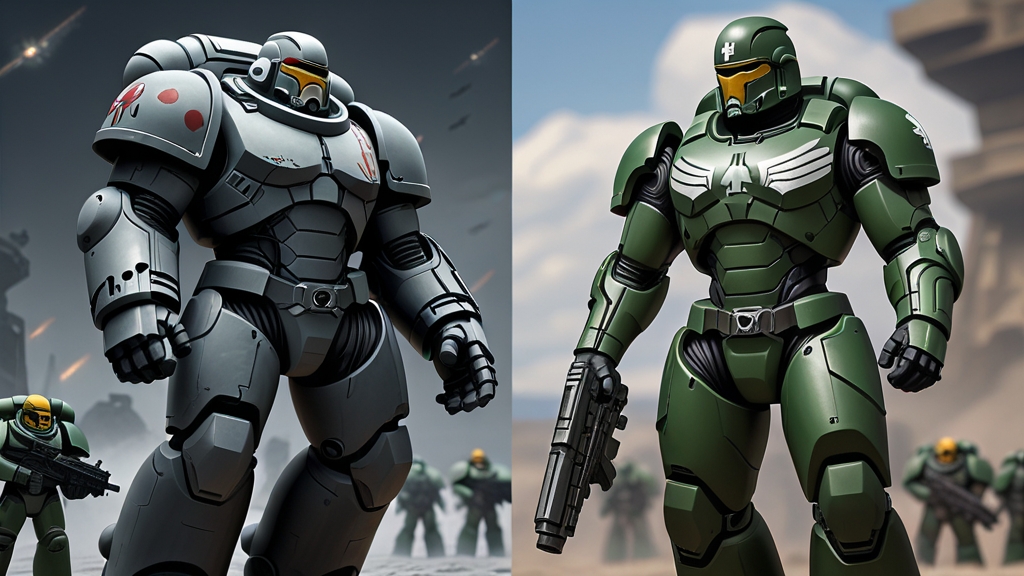
Space Marines vs Spartans (Halo) — Who Would Win?
A Space Marine would defeat a Spartan in most scenarios. While both are superhuman soldiers, Space Marines are significantly larger, tougher, and equipped with more advanced and destructive technology. However, Spartans possess advantages in speed, agility, and AI integration that could make specific engagements closer than the raw stats suggest.
The Space Marine versus Spartan debate is one of the most popular cross-franchise matchups in science fiction fandom. Both represent the pinnacle of superhuman military engineering in their respective universes, but they were designed with very different philosophies and face very different threats. A fair comparison requires examining every dimension of their capabilities.
How Do Their Physical Abilities Compare?
Space Marines are substantially larger and physically stronger than Spartans. A standard Space Marine stands approximately 7 feet tall (2.13 metres) without armour, while a Spartan-II like Master Chief stands approximately 6 feet 10 inches (2.08 metres) without armour — close but noticeably shorter. In armour, the gap widens: a Space Marine in Mark VII power armour reaches around 7.5 to 8 feet, while Master Chief in MJOLNIR Mark VI stands about 7 feet 2 inches as well, though the Space Marine is significantly bulkier.
In terms of raw strength, the Space Marine has a clear advantage. Space Marines can flip vehicles, tear through bulkheads with their bare hands, and exert forces measured in tons. Spartans are also superhumanly strong — Master Chief can flip a Warthog (approximately 3 tonnes) and has demonstrated comparable feats — but Space Marine strength feats in the lore consistently exceed Spartan equivalents by a significant margin.
Space Marines possess numerous biological enhancements that Spartans lack entirely. Two hearts provide redundancy and increased blood flow. A fused ribcage acts as natural body armour. The Larraman’s Organ produces super-clotting cells that seal wounds almost instantly. The Sus-an Membrane allows suspended animation when critically injured. The Catalepsean Node eliminates the need for conventional sleep. These biological systems make Space Marines extraordinarily resilient even without their armour.
Spartans have their own augmentations — carbide ceramic ossification strengthens bones, muscular enhancement injections increase strength and reflexes, and a thyroid implant boosts growth. However, these augmentations are less extensive and less extreme than the Space Marine’s nineteen gene-seed organs. The Spartan process makes a very powerful human; the Space Marine process creates something that is arguably no longer human at all.
How Do Their Reaction Times and Speed Compare?
This is where Spartans close the gap significantly. Spartan-IIs have reaction times measured at approximately 20 milliseconds without armour and potentially faster with neural interface enhancements. They can perceive and react to events at speeds that appear superhuman to normal observers, and their MJOLNIR armour’s neural lace amplifies this further.
Space Marines also have superhuman reaction times, but the lore is less precise about exact figures. They can track and engage targets moving at extreme speeds, dodge gunfire in certain circumstances, and process battlefield information faster than any unaugmented human. However, Space Marines are generally portrayed as more ponderous than Spartans — their greater bulk and heavier armour make them less agile despite their superior strength.
In pure speed and agility, the Spartan likely has an advantage. Master Chief’s movements in the Halo games and novels emphasise fluid, acrobatic combat — sprinting, sliding, and engaging enemies with rapid precision. Space Marines, while fast for their size, fight with a more deliberate, overwhelming style that relies on durability and firepower rather than evasion.
How Does Their Armour Compare?
Both Space Marines and Spartans wear powered armour, but the two systems differ significantly in design philosophy and capability.
Space Marine power armour is a masterwork of Imperial engineering (or ancient technology, depending on the mark). It is made of ceramite, a material that provides exceptional protection against both kinetic and energy weapons. The armour interfaces directly with the Space Marine through the Black Carapace — a sub-dermal implant that makes the armour an extension of the Marine’s own body. This means the armour responds to the Marine’s thoughts and movements with zero lag, effectively making it a second skin rather than an exoskeleton.
The armour includes auto-senses (a heads-up display with threat detection, night vision, and targeting systems), a sealed environment system (allowing operation in vacuum, underwater, or toxic atmospheres), magnetic boots, and an internal power supply that can function for extended periods without recharging. It is extraordinarily tough — capable of shrugging off small arms fire, shrapnel, and many anti-vehicle weapons.
MJOLNIR armour is also a remarkable piece of technology. It amplifies the wearer’s strength and speed through a reactive metal liquid crystal layer, includes energy shielding that can absorb multiple hits before failing, and integrates an AI housing port that allows a smart AI (like Cortana) to operate within the armour’s systems. The energy shields are a significant advantage — they provide an additional layer of protection that regenerates when not taking damage, something Space Marine armour does not have in its standard configuration.
The key armour comparison favours Space Marines in raw durability (ceramite is tougher than MJOLNIR’s base armour) but favours Spartans in the energy shield system. A Spartan’s shields can absorb hits that would damage the underlying armour, effectively giving them more total protection against burst damage. However, once the shields fail, the Spartan is significantly more vulnerable than a Space Marine in ceramite.
How Do Their Weapons Compare?
The standard Space Marine weapon — the boltgun (or bolter) — is a .75 calibre automatic rocket-propelled grenade launcher. Each bolt round is a miniature rocket that accelerates after leaving the barrel and detonates inside the target, causing catastrophic internal damage. The bolter is devastating against infantry and light vehicles, and a single hit from a bolt round would kill or critically wound almost any Halo-universe infantry target.
The Spartan’s standard weapons vary, but the MA5 assault rifle fires 7.62mm rounds that are effective against conventional targets but are significantly less powerful than bolt rounds. The Spartan’s weapon advantage lies in versatility and volume of fire — UNSC weapons are generally lighter, more accurate at range, and available in greater variety than standard Space Marine weapons.
The Spartan’s energy weapons — particularly the M6 Spartan Laser and various Covenant weapons — represent more interesting comparisons. A Spartan Laser could potentially threaten a Space Marine’s armour, and plasma-based weapons might have effects comparable to 40k’s own plasma and melta technology, though generally at lower power levels.
In melee combat, the Space Marine has a decisive weapon advantage. A chainsword — a sword with motorised diamond-toothed teeth — can cut through most armour materials. A power sword generates a disruption field that allows it to slice through virtually anything. Spartans have access to energy swords (Covenant technology) that could compete with chainswords but are not standard equipment.
How Does AI Integration Change the Balance?
The Spartans’ ability to integrate with smart AIs like Cortana is an advantage that Space Marines simply do not have an equivalent for. A smart AI can process battlefield data in real time, hack enemy systems, coordinate with other units, predict enemy movements, and provide tactical recommendations faster than any biological mind.
In the Halo universe, the Spartan-AI partnership has proven decisive in numerous engagements. Cortana’s ability to manipulate Covenant and Forerunner technology, provide real-time tactical analysis, and even override enemy systems gives a Spartan capabilities that extend far beyond their personal combat ability.
Space Marines do not use AI (artificial intelligence is forbidden in the Imperium following the Men of Iron rebellion). Their armour’s machine spirit provides some automated functions, but nothing approaching the capabilities of a Halo-era smart AI. In a technology-rich environment where hacking, electronic warfare, and information dominance matter, the Spartan’s AI partnership would be a significant advantage.
What Does Their Training Look Like?
Both Space Marines and Spartans undergo brutal training from childhood, but the programs differ in philosophy and outcome.
Space Marine aspirants are selected around age 10-14 and undergo years of physical transformation (gene-seed implantation), psycho-indoctrination (hypnotherapy and mental conditioning), and combat training. The process kills a significant percentage of aspirants. Survivors serve as Scouts before becoming full battle-brothers. A Space Marine’s training is continuous throughout his centuries-long life — they drill, practice, and fight constantly.
Spartan-IIs were abducted at age six and subjected to rigorous military training for years before receiving their augmentations at age fourteen. The augmentation process killed or crippled roughly half the candidates. The survivors were trained in squad tactics, vehicle operation, infiltration, and unconventional warfare. Spartan training emphasises adaptability and thinking under pressure — qualities that make them effective across a wider range of scenarios than their raw stats might suggest.
Space Marine training produces warriors optimised for direct combat at the highest intensity levels. Spartan training produces warriors optimised for flexibility, operating behind enemy lines, and achieving objectives through a combination of force and cunning. In a straight fight, the Space Marine’s training is more applicable. In a complex mission environment, the Spartan’s broader skill set could be more valuable.
Where Would a Spartan Have the Advantage?
Despite the Space Marine’s overall superiority, there are specific scenarios where a Spartan’s capabilities would give them an edge. Speed and agility favour the Spartan in environments where manoeuvrability matters more than raw durability — urban environments with cover, zero-gravity combat, or situations requiring rapid repositioning. The Spartan’s AI integration provides a massive advantage in any scenario involving electronic warfare, hacking, or technology manipulation.
Spartans are also arguably better at operating independently for extended periods. While Space Marines are trained to operate in squads and Chapters, Spartans are specifically designed for deep-infiltration missions where they must survive, adapt, and complete objectives without support. A Spartan behind enemy lines is one of the most dangerous operatives in the Halo universe precisely because of this self-sufficiency.
In a ranged engagement at extreme distance, the Spartan’s superior accuracy and lighter, faster weapons might give them an initial advantage before the Space Marine could close to effective range. And the energy shield system provides a buffer that allows the Spartan to absorb an initial hit that might otherwise be immediately lethal.
What Would the Actual Fight Look Like?
In a one-on-one engagement on neutral ground, the most likely outcome is a Space Marine victory, but not an easy one. The Spartan’s shields would absorb the first bolt round, giving them a brief window to respond. The Spartan would need to use their superior speed and agility to avoid the Space Marine’s firepower while landing hits on the Marine’s armour — a difficult proposition given ceramite’s resilience.
If the fight moved to close quarters, the Space Marine’s greater size, strength, and melee weapons would become decisive. A Spartan could not match a Space Marine in a grapple, and a chainsword or power fist would be devastating against MJOLNIR armour once the shields were down.
The Spartan’s best strategy would be to maintain distance, use mobility to avoid engagement on the Space Marine’s terms, and exploit any technological advantages (AI hacking, environmental manipulation) to create asymmetric opportunities. This approach reflects the Spartans’ actual combat doctrine — they are trained to fight smarter, not harder, and to use their intelligence and adaptability to overcome physically superior opponents.
What Does This Comparison Tell Us About Both Franchises?
The Space Marine versus Spartan comparison ultimately reveals the different philosophies of their respective universes. Halo’s Spartans are the ultimate expression of human potential — ordinary humans pushed to extraordinary levels through technology and training, but still recognisably human. They have personalities, relationships, moral dilemmas, and emotional depth.
Warhammer 40k’s Space Marines are something else entirely — post-human weapons who have sacrificed their humanity in service to a dying empire. They are stronger than Spartans because they have given up more to become what they are. Their superiority in combat comes at the cost of everything that makes a person a person.
In this light, the comparison is not really about who would win a fight. It is about what each franchise values. Halo values human resilience, adaptability, and the triumph of the human spirit against overwhelming odds. Warhammer 40k questions whether the human spirit can survive the cost of its own survival. Both perspectives are valid, both produce compelling stories, and both deserve the passionate fanbases they have earned.
Frequently Asked Questions
Are Space Marines stronger than Spartans?
Yes. A Space Marine is physically stronger than a Spartan-II like Master Chief. Spartans can flip a Warthog, but Space Marine strength feats in the lore routinely go further, and the Marine’s nineteen gene-seed organs, two hearts and fused ribcage make him far more resilient. Spartans make up some of the gap with speed, reflexes and energy shields.
Could Master Chief beat a Space Marine?
He could in the right situation, but a Space Marine would win most one-on-one fights. Master Chief’s best chance is to use his shields, speed and Cortana’s hacking to fight at range and avoid close quarters. Once the shields drop or the fight turns to melee, a bolter, chainsword or power fist would be decisive against MJOLNIR armour.
Could a Spartan beat a Primaris Space Marine?
It is even less likely than against a standard Marine. Primaris Space Marines carry extra gene-seed organs on top of the original nineteen, making them taller, stronger and tougher than the Firstborn Marines discussed here. A Spartan’s speed, energy shields and AI support would still matter in specific scenarios, but the physical gap would be wider.
Related Content
- Space Marine Biology — Learn about Space Marine enhancements in detail
- How Tall Are Space Marines — See how Space Marines compare in size
- What Is a Primaris Marine — Discover the upgraded Primaris Space Marines
- Space Marine 2 Guide — Play as a Space Marine in this acclaimed video game