
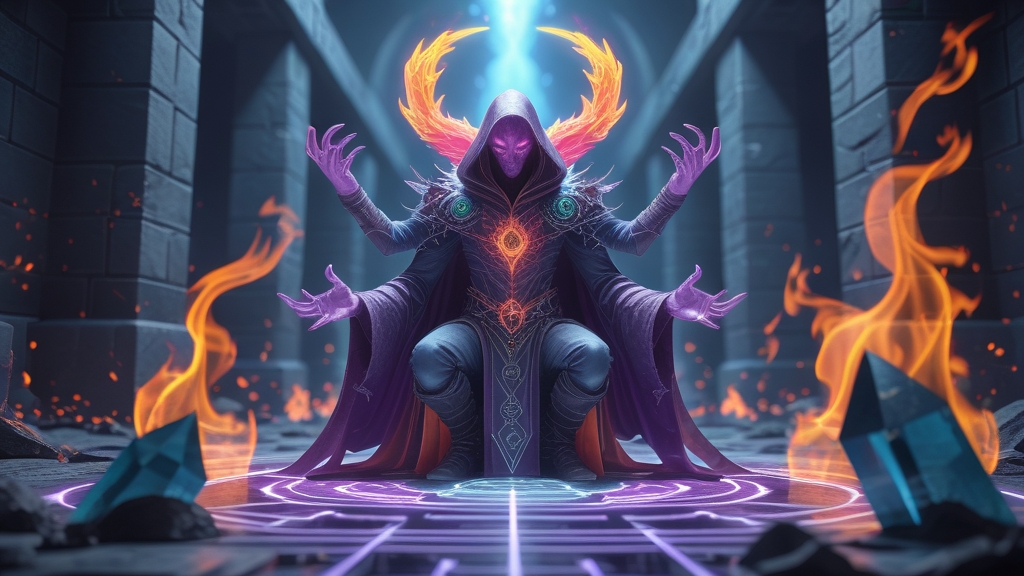
Tzeentch is the Chaos God of change, ambition, sorcery, and manipulation. He is the master of schemes within schemes, and the most powerful sorcerer in existence. Every plan, plot, and mutation in the universe feeds him.
Among the four Chaos Gods, Tzeentch is the most intellectually formidable and the most difficult to comprehend. Where Khorne is rage, Nurgle is entropy, and Slaanesh is sensation, Tzeentch is pure ambition — the drive to change, to grow, to become something other than what one is. He is the architect of fate, the weaver of destiny, and the lord of every plot, conspiracy, and magical working in the universe. Nothing happens by accident in Tzeentch’s domain, and every event — no matter how seemingly random — is a thread in his unfathomably complex web of plans.
Tzeentch feeds on hope, ambition, and the desire for change. Every mortal who dreams of a better tomorrow, every scholar who seeks forbidden knowledge, every politician who schemes for power, every mutant whose body twists into new forms — all feed Tzeentch. This makes him paradoxically fuelled by some of the most positive human emotions. Hope itself is Tzeentch’s sustenance, which creates a deeply unsettling philosophical question: is hope itself a form of Chaos corruption?
What Is Tzeentch’s Domain and Personality?
Tzeentch’s nature is change itself. He does not merely embrace change — he is change, the fundamental force of transformation that drives evolution, mutation, revolution, and progress. Without Tzeentch, the universe would be static, unchanging, and dead. With him, it is in constant flux, endlessly mutating and reforming in new and unpredictable patterns.
Tzeentch’s personality, insofar as an entity of pure change can be said to have one, is characterised by boundless curiosity, compulsive scheming, and a deep fascination with knowledge in all its forms. He is constantly plotting — not toward any single goal, but for the sheer joy of plotting itself. His plans are layered infinitely deep, each scheme containing counter-schemes, backup plans, contingencies, and deliberate failures that serve larger purposes.
The most unsettling aspect of Tzeentch’s nature is that even he may not fully understand his own plans. His schemes are so complex, so layered, and so self-contradictory that they take on a life of their own, evolving beyond even their creator’s comprehension. Some scholars in Warhammer lore suggest that Tzeentch is as much a prisoner of his own scheming nature as his followers are — doomed to plot forever, never reaching a final goal because reaching a goal would mean the end of change, which would mean the end of Tzeentch himself.
Tzeentch’s appearance is impossible to pin down. He is described as a constantly shifting entity — sometimes a towering figure of swirling colours and arcane fire, sometimes a mass of eyes and mouths, sometimes a being of pure light and energy. His form changes with every moment, reflecting his nature as the embodiment of transformation. The only constant in his appearance is his eyes — countless glowing orbs that see everything, know everything, and plot the manipulation of everything they observe.
What Are Tzeentch’s Daemons?
Tzeentch’s daemons are the most sorcerously powerful of any Chaos God’s servants, reflecting their master’s dominion over magic and transformation.
Lords of Change are the Greater Daemons of Tzeentch and among the most intelligent beings in the Warhammer universe. These enormous, avian entities possess vast feathered wings, serpentine necks, and eyes that burn with arcane knowledge. Unlike the Bloodthirsters of Khorne, who rely on brute force, Lords of Change wage war through sorcery and manipulation. They can reshape reality with a gesture, see the future across multiple timelines, and weave illusions so convincing that, it is said, whole armies have fought enemies that were never there. Each Lord of Change maintains its own web of schemes, often working at cross purposes with other Lords of Change — a situation that Tzeentch finds endlessly amusing.
Pink Horrors are the primary infantry daemons of Tzeentch, and they embody his nature of constant change in the most literal way possible. These gibbering, capering daemons are wreathed in pink warpfire and attack by hurling bolts of magical flame. When a Pink Horror is slain, it does not simply die — it splits into two Blue Horrors, smaller, sulkier daemons that continue fighting with cold, bitter determination. When Blue Horrors are destroyed, they in turn split into pairs of Brimstone Horrors — tiny, cackling beings of living flame. This cascading transformation makes Tzeentch’s infantry uniquely difficult to eliminate, as killing them only creates more enemies.
Flamers of Tzeentch are bizarre, fungoid daemons that float through the air on jets of warpfire. Their bodies end in multiple tube-like appendages that spray multicoloured flames capable of mutating anything they touch. Flamers are Tzeentch’s shock troops, used to sow chaos and transformation among enemy ranks. Those struck by their flames may find their armour melting, their flesh rearranging, or their minds suddenly flooded with forbidden knowledge that drives them insane.
Screamers of Tzeentch are ray-like daemons that glide through both the Warp and realspace, slicing through anything in their path with razor-sharp fins. They are predators of the immaterium, hunting in packs through the currents of magical energy. In battle, they make swooping attacks on enemy units before soaring away, their passage leaving trails of mutating energy that distort reality in their wake.
The Changeling is one of Tzeentch’s most unique daemons — a shapeshifter of such supreme skill that it can perfectly mimic any being in existence. The Changeling has infiltrated every major faction in Warhammer lore at various times, sowing discord and paranoia wherever it goes. It is said that even Tzeentch himself has occasionally been fooled by the Changeling’s disguises, though whether this is true or merely another layer of Tzeentch’s own scheming is impossible to determine.
Who Are Tzeentch’s Mortal Followers?
Tzeentch attracts followers who crave knowledge, power, change, or simply the ability to control their own destiny. His mortal servants include sorcerers, scholars, mutants, revolutionaries, and ambitious politicians.
In Warhammer 40,000, the Thousand Sons are the foremost mortal servants of Tzeentch. Originally the XV Legion of Space Marines led by the Primarch Magnus the Red, the Thousand Sons were a Legion of scholars and psykers who valued knowledge above all else. After Magnus’s warning to the Emperor about Horus’s treachery broke through the Webway project beneath Terra, the Space Wolves were sent against Prospero — the infamous Burning of Prospero — and Magnus turned to Tzeentch to save what remained of his Legion. Tzeentch spirited the survivors away to the Planet of the Sorcerers in the Eye of Terror, but the flesh-change that had long plagued the Legion returned. Ahzek Ahriman’s answer was the Rubric, a spell meant to end the mutations for good, which instead turned most of the Legion into empty suits of armour filled with dust, animated only by sorcery. These Rubric Marines now march in silent ranks, guided by the will of the surviving Sorcerers who command them.
The surviving Thousand Sons Sorcerers are among the most powerful psykers in the galaxy, wielding Tzeentch’s arcane gifts with devastating effect. Magnus the Red himself was transformed into a Daemon Primarch of immense power — a one-eyed colossus of psychic energy who can reshape reality with a thought.
In Age of Sigmar, the Disciples of Tzeentch represent the Changer of Ways in the Mortal Realms. This faction includes mortal Arcanite cultists — sorcerers, acolytes, and mutants who serve Tzeentch in secret — and the daemonic legions of the Crystal Labyrinth. The Disciples operate through hidden cults and cabals, infiltrating the cities of Order and manipulating events from the shadows. Their armies combine mortal spellcasters with daemonic entities, creating forces that are as unpredictable as Tzeentch himself.
Beyond these organised forces, Tzeentch has countless individual followers scattered across both settings. Rogue psykers who seek to master their powers, mutants who embrace their transformations, scholars who seek forbidden lore, and ambitious individuals who will trade anything for the power to reshape their fate — all may find themselves drawn into Tzeentch’s orbit. Many do not even realise they serve a Chaos God until they are too deeply entangled to escape.
What Is the Crystal Labyrinth?
The Crystal Labyrinth is Tzeentch’s domain in the Realm of Chaos — a realm of impossible geometry, shifting pathways, and crystalline structures that rearrange themselves constantly. It is perhaps the most dangerous environment in all of Warhammer lore, because its very nature is designed to trap, confuse, and ultimately consume anyone who enters it.
The Labyrinth is built from what appears to be crystal, but the material is actually solidified magical energy — each facet reflecting not light but possibilities, alternate futures, and forbidden knowledge. Walking through the Labyrinth means being bombarded with visions of what could be, what might have been, and what will never happen. Most mortals who enter go mad within moments, their minds unable to process the infinite potential realities reflected in every surface.
The pathways of the Labyrinth shift constantly. A corridor that leads forward one moment may lead backward the next, or may open into an entirely different dimension. Dead ends become passages, passages become traps, and traps become doorways to other parts of the Labyrinth. Navigation is impossible through conventional means — only those with powerful psychic abilities or Tzeentch’s explicit guidance can hope to find their way.
At the theoretical centre of the Labyrinth sits the Impossible Fortress — Tzeentch’s seat of power. The Fortress is a structure that defies physics, geometry, and sanity. Its towers extend in dimensions that mortal minds cannot perceive, and in most accounts no mortal who has entered it has come out unchanged. Within the Fortress, Tzeentch watches the countless threads of fate and weaves his plans.
What Is Tzeentch’s Sacred Number?
Tzeentch’s sacred number is nine. This number appears throughout his worship, his daemonic organisation, and his magical workings. Nine is symbolically associated with completion and cyclical return — the last single digit before the cycle begins again at ten — which resonates with Tzeentch’s nature as the god of change and transformation.
The number turns up across Tzeentch’s lore and imagery: in the way his cults, rituals and daemons are described. Just as Khorne favours eight, Nurgle seven and Slaanesh six, nine is Tzeentch’s mark.
Tzeentch’s colours are blue, pink, and gold — vibrant, shifting colours that reflect his nature as a being of constant transformation. His symbol is a complex, interlocking design that appears to shift and change when viewed from different angles, representing the impossibility of pinning down Tzeentch’s true nature or intentions.
Why Does Tzeentch Rival Nurgle?
Tzeentch’s greatest rival among the Chaos Gods is Nurgle, the Lord of Decay. Their opposition is philosophical and fundamental — Tzeentch embodies change, evolution, and the belief that anything can be transformed, while Nurgle represents stagnation, acceptance, and the inevitability of entropy.
Tzeentch views Nurgle with contempt. Where Tzeentch sees infinite possibility, Nurgle sees only the final destination — decay and death. Where Tzeentch drives ambition and progress, Nurgle encourages his followers to accept their fate and stop struggling. To Tzeentch, Nurgle represents the death of hope, the end of ambition, and the ultimate enemy of everything Tzeentch values.
Nurgle, for his part, sees Tzeentch as a deluded fool who cannot accept the fundamental truth of existence: that everything eventually rots and returns to nothing. Tzeentch’s constant scheming and changing are, from Nurgle’s perspective, merely delaying the inevitable. No matter how cleverly Tzeentch plots, entropy always wins in the end.
In the Great Game, this rivalry manifests as Tzeentch’s forces constantly disrupting Nurgle’s slow, inexorable advances, while Nurgle’s legions absorb and corrupt Tzeentch’s most carefully laid plans. Neither can defeat the other permanently, as their opposition is woven into the fundamental nature of reality itself.
How Does Tzeentch Play on the Tabletop?
In Warhammer 40,000, the Thousand Sons are a sorcery-heavy army built around tough Rubric Marines and Scarab Occult Terminators, led by Sorcerers who boost the units they lead and throw psychic attacks. There has been no separate psychic phase since 10th Edition: psychic attacks are made as ranged attacks in the Shooting phase, and other psychic abilities trigger in the normal phases of the turn. Rubric Marines are durable objective holders with good anti-infantry shooting, and Magnus the Red is one of the most powerful single models in the game. Tzeentch daemons from the Chaos Daemons range, such as Pink Horrors and the Lord of Change, can also take the field; check the current codexes for how daemons can be included in a Thousand Sons army.
In Age of Sigmar, the Disciples of Tzeentch are one of the strongest magic armies in the game, packed with Wizards who cast spells in the hero phase and rules that let them bend fate in their favour. The army combines mortal Arcanite units with Tzeentch’s daemons, offering varied list-building options. It tends to win through magic and ranged damage and can struggle in a long melee against dedicated assault armies. Check the current battletome for the army’s 4th Edition rules.
Both armies reward strategic, cerebral play. Tzeentch players need to plan several turns ahead, managing resources and positioning carefully to maximise their magical output while keeping their relatively fragile units out of harm’s way. This makes Tzeentch armies a favourite among experienced players who enjoy outsmarting their opponents rather than simply overpowering them.
Frequently Asked Questions
Is Tzeentch the most intelligent Chaos God?
Yes. Tzeentch is consistently depicted as the most intellectually formidable of the Chaos Gods. His understanding of magic, fate, and the interconnected nature of reality is unmatched. However, his intelligence is also his weakness — he is so obsessed with scheming that his plans often work at cross purposes, and his inability to stop plotting sometimes prevents him from achieving goals he could easily reach through direct action.
Can anyone resist Tzeentch’s manipulation?
Resisting Tzeentch is extremely difficult because his manipulations are often invisible. Many of Tzeentch’s pawns do not realise they are being manipulated until it is far too late. Even those who know they are being used may find that their attempts to resist are themselves part of Tzeentch’s plan. The Chaos God has planned for resistance, planned for betrayal, and planned for plans that fail — making true escape from his web nearly impossible.
What is the Rubric of Ahriman?
The Rubric of Ahriman was a powerful spell cast by Ahzek Ahriman, Chief Librarian of the Thousand Sons, in an attempt to stop the rampant mutations afflicting his Legion. The spell succeeded in halting the mutations but at a catastrophic cost — every Thousand Sons marine who lacked sufficient psychic ability was reduced to dust, their spirits trapped inside their power armour for eternity. These Rubric Marines are now soulless automatons, controlled by the will of Tzeentch’s Sorcerers.
Does Tzeentch ever achieve his goals?
This is one of the great philosophical questions of Warhammer lore. Tzeentch’s ultimate goal — if he has one — appears to be the perpetuation of change itself. Since achieving any final victory would mean the end of change, it would also mean the end of Tzeentch. Therefore, his true purpose may be to ensure that the game never ends, that no scheme ever reaches its final conclusion, and that change continues forever. In this sense, Tzeentch is always achieving his goal — and never achieving it.
Why is Tzeentch associated with birds?
Tzeentch’s avian imagery — his Lords of Change resemble enormous birds of prey, and many of his symbols incorporate feathers and wings — is linked to the symbolism of birds as creatures of the sky, representing vision, knowledge, and the ability to see the bigger picture from above. Birds also represent transformation (from egg to chick to adult), which aligns with Tzeentch’s nature as the god of change. In many mythological traditions, birds serve as messengers and omens, further connecting them to Tzeentch’s role as the manipulator of fate.
What does Tzeentch look like?
Tzeentch has no fixed appearance: his form changes constantly. He is usually described as a shifting mass of colour and warpfire covered in eyes, often with faces forming, speaking and dissolving across his skin. Mortals who glimpse him tend to see something different each time, which suits a god whose nature is change itself.
What mutations does Tzeentch give his followers?
Tzeentch’s gifts are the most varied of any Chaos God: feathers, beaks and bird-like heads, extra eyes, shifting or crystalline flesh, pink and blue skin, and limbs that twist into tentacles or mouths. Followers who receive too many gifts can collapse into a mindless Chaos Spawn. The Thousand Sons’ flesh-change, which led to the Rubric of Ahriman, is the best-known example.
Which Chaos God is blue?
Tzeentch is the blue Chaos God. His colours are blue, pink and gold, which is why Thousand Sons wear blue and gold armour and his Horrors are bright pink and blue. By convention the other gods have their own colours: red and brass for Khorne, sickly green for Nurgle, and pink and purple for Slaanesh.
What are Tzeentch’s other names?
Tzeentch is known as the Changer of Ways, the Architect of Fate, the Great Conspirator and the Master of Fortune, among other titles. Each name reflects one side of his domain: change, destiny, endless scheming and luck. Mortal worshippers often call him by these titles rather than risk speaking his true name.