
Warhammer 40k Explained Simply — The Complete Beginner Summary
Warhammer 40k is set in the year 40,000 where a decaying human empire fights for survival against aliens, daemons, and traitors. It is simultaneously a tabletop miniatures game, a vast fictional universe with thousands of novels and video games, and a creative hobby involving building and painting detailed models.
If you have heard people talking about Warhammer 40k and wondered what it actually is, this guide will explain everything you need to know in plain language, with no assumed knowledge. By the end, you will understand the setting, the factions, the game, and the hobby. It is up to date for 2026 and the game’s current 11th Edition.
What Is the Setting of Warhammer 40k?
Imagine humanity forty thousand years in the future. We have spread across the entire Milky Way galaxy, colonising a million worlds. But this is not the bright, optimistic future of Star Trek. This is a future where everything has gone horribly wrong.
Humanity’s empire — called the Imperium of Man — is ruled by the Emperor of Mankind, a godlike figure who has been trapped on a life-support machine called the Golden Throne for ten thousand years. He is essentially a corpse kept alive by arcane technology and the daily sacrifice of psykers (psychically gifted humans) — usually cited as hundreds a day, and up to around a thousand in some accounts. The Imperium worships him as a god, but he cannot speak, move, or directly lead his people.
The Imperium is a totalitarian theocracy. There is no freedom of speech, no democracy, and no individual rights. Billions of humans live in grinding poverty, working in massive factory-cities to produce weapons and equipment for the endless wars that rage across the galaxy. The government is a nightmarish bureaucracy so vast and inefficient that worlds can be lost and forgotten for centuries.
Faster-than-light travel exists, but it requires travelling through a parallel dimension called the Warp — a hellish realm inhabited by malevolent entities called daemons. Travel is dangerous, unreliable, and sometimes fatal. Communication across the galaxy is slow and unreliable. Entire regions can be cut off from the rest of humanity for decades or centuries.
And the threats facing humanity are terrifying. Alien civilisations seek to destroy or enslave them. The daemons of the Warp want to corrupt and consume their souls. Traitors within the Imperium work to undermine it. And the Imperium itself is slowly decaying, its technology declining, its institutions failing, its enemies growing stronger. This is the core of Warhammer 40k: a civilisation fighting to survive against impossible odds, using terrible methods, in a universe that does not care whether it succeeds or fails.
Who Are the Main Factions?
Warhammer 40k features numerous factions, each with its own unique aesthetic, playstyle, and lore. Here are the most important ones, explained simply.
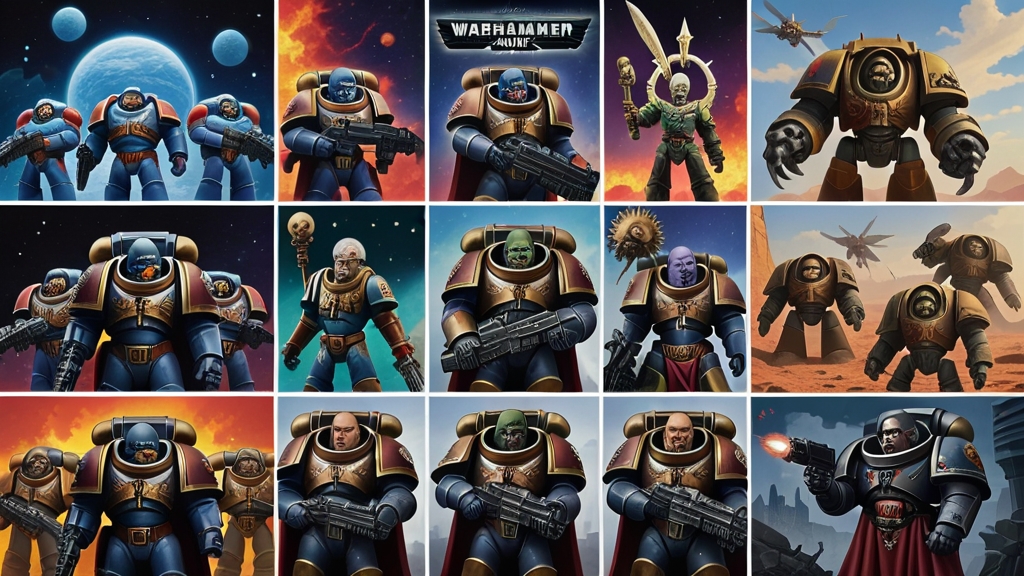
Space Marines: The poster boys of Warhammer 40k. Space Marines are genetically enhanced supersoldiers who stand seven feet tall, wear powered armour, and carry devastating weapons. They are organised into Chapters of approximately one thousand warriors each, and there are roughly one thousand Chapters across the galaxy. Each Chapter has its own culture, traditions, and fighting style. Famous Chapters include the Ultramarines (the default poster boys, disciplined and versatile), the Blood Angels (noble but cursed with a blood-drinking madness), the Space Wolves (Viking-themed warriors with wolf motifs), and the Dark Angels (secretive knights with a hidden shame).
Chaos Space Marines: Ten thousand years ago, half the Space Marine Legions betrayed the Emperor in a civil war called the Horus Heresy. These traitors fled into the Warp and have been waging war against the Imperium ever since, empowered by the dark gods of Chaos. They are twisted, corrupted versions of loyal Space Marines, combining superhuman abilities with daemonic power.
Imperial Guard (Astra Militarum): The Imperium’s regular army, composed of trillions of ordinary humans. What they lack in individual power compared to Space Marines, they make up for in numbers. Imperial Guard armies use tanks, artillery, and sheer weight of bodies to overwhelm their enemies. They represent the common person’s experience of the 40k universe — terrified, outgunned, but fighting anyway.
Orks: A race of green-skinned, fungus-based aliens who exist solely to fight. Orks are equal parts terrifying and hilarious — their technology works because they collectively believe it should (a psychic field effect), they grow bigger the more they fight, and they reproduce through spores they shed throughout their lives and release in great numbers when they die. They are one of the galaxy’s most numerous species and a constant threat to everyone.
Tyranids: Extragalactic predators that travel in massive living ships called Hive Fleets, consuming all biological matter on every world they encounter. They are the most alien of the alien factions — a hive mind with no individual consciousness, adapting to counter any defence. They represent the possibility that the galaxy is simply food for something coming from outside.
Eldar (Aeldari): An ancient, dying race of space elves. Once the dominant civilisation in the galaxy, the Eldar’s decadence led to the creation of a Chaos God (Slaanesh) that destroyed their empire and now hunts their souls. The survivors live on massive spacecraft called Craftworlds, practising extreme discipline to avoid the fate their ancestors brought upon themselves.
Necrons: Ancient machines that were once an organic species. Sixty million years ago, the Necrontyr transferred their consciousness into metal bodies, gaining immortality but losing their souls. They have been sleeping in tombs beneath worlds across the galaxy and are now waking up, bringing technology so advanced it might as well be magic.
Tau: A relatively young, technologically advanced species that believes in the “Greater Good” — a philosophy of cooperation and collective progress. They are the closest thing 40k has to a “good” faction, though their society has its own dark aspects, including rigid castes and hints that the Ethereals’ hold over the other castes may not be entirely natural. Their advanced weaponry makes up for their relatively small numbers.
How Does the Tabletop Game Work?
At its core, Warhammer 40k is a tabletop miniatures game. Two players assemble armies of detailed plastic miniatures, set up a battlefield with terrain, and play out a battle using dice and rulebooks.
Each player builds an army from their chosen faction by selecting units from a codex — a book specific to that faction that contains rules, point values, and special abilities. Armies are balanced using a points system: every unit costs a certain number of points, and both players agree on a total points limit before the game. This ensures roughly balanced matches regardless of faction.
Games are played in turns, with each player moving their models, shooting, and fighting in close combat according to the rules. Dice rolls determine whether attacks hit, wound, and kill. The game combines strategic positioning, army composition, and tactical decision-making with the random element of dice rolls.
A typical game takes two to four hours depending on army size and player experience. Games can be played casually between friends, at local gaming stores, or in organised tournaments. The current edition of the rules (11th Edition, launched in June 2026) has been streamlined compared to earlier versions, making the game more accessible to new players while maintaining strategic depth for veterans.
What Is the Hobby Side of Warhammer?
For many people, the hobby aspect of Warhammer 40k is as important — or more important — than actually playing the game. The hobby encompasses three main activities: building, painting, and collecting.
Building: Warhammer miniatures come as plastic model kits that must be assembled. Models range from single figures (a Space Marine, an Ork Boy) to large vehicles and monsters. Assembly requires clipping parts from plastic frames (sprues), cleaning mould lines, and gluing components together. More advanced hobbyists modify their models with conversions (kitbashing) — combining parts from different kits or sculpting new details with modelling putty.
Painting: Most hobbyists paint their miniatures using acrylic paints, brushes, and various techniques. Painting ranges from simple basecoating and washing (which can produce good results quickly) to advanced techniques like blending, freehand, and non-metallic metal effects that can take hours per model. Games Workshop’s own Citadel paint range is designed specifically for miniature painting, though many hobbyists use paints from other manufacturers.
Collecting: Many fans collect miniatures without playing the game at all, treating them as art objects or display pieces. Others collect for the building and painting experience. The range of available models is enormous, spanning hundreds of unique designs across all factions, and new releases are announced regularly.
The hobby is famously expensive — a full army can cost several hundred dollars, and paints, brushes, and tools add to the investment. However, starter sets provide an affordable entry point, and the hobby can be pursued at whatever pace and budget the individual prefers.
What About Books, Video Games, and Other Media?
Warhammer 40k extends far beyond the tabletop game. The franchise includes hundreds of novels published by Games Workshop’s Black Library imprint, covering everything from epic military campaigns to intimate character studies. The Horus Heresy series alone runs to more than fifty novels, followed by the Siege of Terra series, telling the story of the civil war that shaped the setting.
Video games based on Warhammer 40k span multiple genres. The Dawn of War series is a real-time strategy franchise. Space Marine (and its 2024 sequel, Space Marine 2) is a third-person action series. Darktide is a cooperative first-person shooter. Mechanicus is a turn-based tactical game. Rogue Trader is a role-playing game. New titles are released regularly across PC, console, and mobile platforms.
Hammer and Bolter, an animated anthology series made for the Warhammer+ subscription service, tells short stories set in the 40k universe. Amazon has also announced a live-action adaptation, with Henry Cavill — a well-known Warhammer fan — attached as a producer and star. The franchise’s cultural footprint continues to grow across every form of media.
How Do You Get Started With Warhammer 40k?
The easiest way to start is with a starter set, which gives you models for two factions in one box. 11th Edition launched in June 2026 with the Armageddon starter set, which pits the Blood Angels against the Orks. Check the Warhammer website for the current starter range and exactly what each box includes. If you only want one army, a Combat Patrol box gives you a small, ready-to-play force for a single faction.
For those more interested in the lore than the game, the novels are an excellent entry point. “Horus Rising” by Dan Abnett (the first Horus Heresy novel) and “Eisenhorn” by Dan Abnett (following an Inquisitor investigating heresy) are commonly recommended starting books. YouTube channels like Luetin09, Majorkill, and Bricky provide accessible video introductions to the lore.
For the hobby, Games Workshop stores offer free introductory painting sessions, and thousands of YouTube tutorials cover every aspect of building and painting miniatures. The Warhammer community is generally welcoming to newcomers, and local gaming stores often run beginner-friendly events.
Why Is Warhammer 40k So Popular?
Warhammer 40k’s enduring and growing popularity stems from the depth and richness of its universe. The setting is vast enough to contain any story — horror, comedy, tragedy, adventure, mystery, romance — while maintaining a consistent and compelling tone. The hobby provides a creative outlet that combines artistic expression with social gaming. And the lore rewards deep engagement, with layers of mystery, contradiction, and ambiguity that fuel endless discussion and debate.
The franchise has also benefited from the broader mainstreaming of geek culture. As comic books, fantasy novels, and video games have become mainstream entertainment, Warhammer 40k — once a niche hobby for dedicated enthusiasts — has found a much larger audience. Celebrity fans like Henry Cavill, mainstream media coverage, and accessible video game adaptations have all contributed to bringing Warhammer 40k to a wider audience than ever before.
At its core, Warhammer 40k works because it takes big ideas seriously. It asks what humanity would look like if pushed to its absolute extremes — what we would sacrifice to survive, what we would become if survival demanded the worst of us. The answers it provides are uncomfortable, provocative, and endlessly fascinating. That combination of creative ambition, intellectual depth, and sheer spectacle is why Warhammer 40k has endured for nearly four decades and shows no sign of slowing down.
Frequently Asked Questions
What year is it in Warhammer 40k?
The setting takes place at the end of the 41st millennium and the start of the 42nd, which is roughly the years 40,999 to 41,000 and beyond. The name Warhammer 40,000 is a rounded label rather than the exact date. The Imperium writes dates in a format like 999.M41, meaning the 999th year of the 41st millennium. The opening of the Great Rift marks the turn into M42.
Is Warhammer 40k hard to learn?
It is easier than it used to be. Recent editions have streamlined the core rules, and starter sets include a cut-down learning guide, so most people can play a small game within an evening. The depth comes later, from army building, faction rules and tactics. Starting with small games, such as Combat Patrol, makes learning much easier.
Do you have to paint your models to play Warhammer 40k?
No. You can play with unpainted, grey plastic models in casual games, and most groups welcome new players with unfinished armies. Painting is encouraged, and some tournaments and store events require painted armies or reward them with bonus points, but it is never a rule of the game itself. Plenty of people paint gradually as they play.
What does grimdark mean in Warhammer 40k?
Grimdark describes a setting that is bleak, violent and without real heroes, where every faction is compromised and the best outcome is survival. The word comes from 40k’s tagline, “In the grim darkness of the far future, there is only war”, and it is now used for any fiction with a similarly hopeless tone.
What is the difference between Warhammer 40k and Age of Sigmar?
Warhammer 40k is science fiction set in a war-torn galaxy far in the future. Warhammer Age of Sigmar is high fantasy set in the Mortal Realms, with gods, wizards, Stormcast Eternals and monsters. Both are Games Workshop tabletop wargames with their own rules, models and armies, but they share some themes, including the Chaos Gods.
Related Content
- The Horus Heresy Explained — Understand the pivotal war that shaped the setting
- What Is the Warp? — Learn about the nightmare dimension central to 40k
- Warhammer 40,000 Armies — Explore all Warhammer 40k armies
- How to Play Warhammer 40k — Start playing the tabletop game