
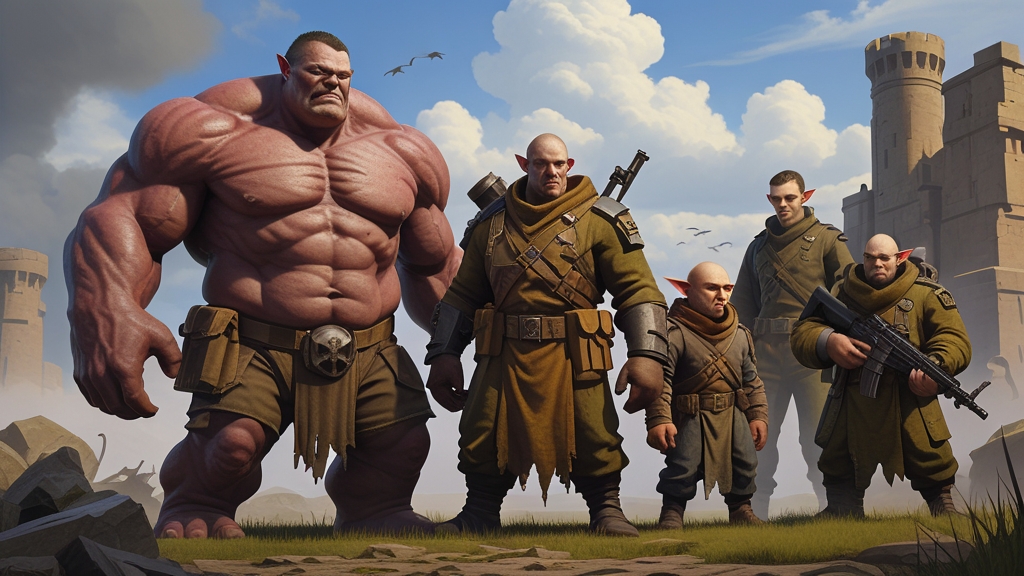
Abhumans are stable human mutations tolerated by the Imperium because they are useful. Ogryns (giants), Ratlings (halflings), and Squats (now Leagues of Votann) are the most common. They serve alongside regular humans but face discrimination, suspicion, and the ever-present threat of being reclassified as mutants and purged. Abhumans occupy an uneasy middle ground in Imperial society — too valuable to exterminate, too different to fully accept.
The Imperium of Man is defined by its hatred of the mutant. Imperial doctrine teaches that the human form is sacred, created in the Emperor’s image, and any deviation from that form is a mark of corruption. Yet the Imperium is also pragmatic when it needs to be, and certain stable mutations that have bred true across generations have been grudgingly accepted as useful tools in the Emperor’s service.
How Does the Imperium Define Abhumans?
The Imperium classifies human-derived species into several categories based on their degree of genetic deviation from baseline humanity. This classification system determines whether a population is considered human, abhuman, or mutant — a distinction that can mean the difference between citizenship and extermination.
Baseline humans (Homo sapiens sapiens) represent the standard against which all other populations are measured. They make up the vast majority of the Imperium’s population and are considered the Emperor’s true children.
Abhumans are populations that have diverged significantly from the baseline human genome but have stabilised — their mutations breed true across generations and do not continue to degrade. Critically, abhumans are classified as subspecies of humanity rather than separate species. This classification — determined by the Adeptus Biologis and ratified by the High Lords of Terra — is what allows them to exist within the Imperium rather than being purged as mutants.
Mutants are individuals or populations whose genetic deviation is unstable, continuing to degrade or producing unpredictable variations across generations. Mutants are considered abhorrent by Imperial doctrine and are subject to purging, enslavement, or exile depending on the severity of their mutations and the temperament of local authorities.
The line between abhuman and mutant is not always clear, and reclassification can occur in either direction. Populations previously considered abhuman have been reclassified as mutant and subjected to purges, while some mutant populations have been reclassified as abhuman when the Imperium found a use for their particular traits. This arbitrary nature of the classification system means that abhumans live under constant existential threat.
Who Are the Ogryn?
Ogryn (Homo sapiens gigantus) are massive, powerfully built abhumans who stand between seven and twelve feet tall and possess strength far beyond baseline humans. They evolved on high-gravity worlds where their enormous size and dense musculature were necessary for survival. Ogryn are characterised by their immense physical power, exceptional toughness, and unfortunately limited intelligence.
Ogryn are among the most widely used abhumans in the Imperial military. They serve in the Astra Militarum as shock troops, and their raw physical power makes them devastating in close combat. An Ogryn can tear through barricades, flip vehicles, and crush armoured opponents with their bare hands. Their thick hides and dense bone structure provide natural protection against weapons that would kill a baseline human outright.
However, Ogryn are famously slow-witted. Most have intellectual capabilities comparable to young children, understanding simple commands and recognising friends from enemies but struggling with anything more complex. This makes them difficult to command — Ogryn units require specially trained handlers (typically called Bone’eads, Ogryn who have received cranial surgery to boost their intelligence) or attached Commissars who can keep them focused on the task at hand.
Despite their low intelligence, Ogryn are renowned for their fierce loyalty. Once an Ogryn bonds with a commanding officer or unit, they will fight with absolute devotion, often refusing to retreat even when ordered to do so. This loyalty, combined with their physical power, makes them valued (if somewhat unpredictable) members of any regiment fortunate enough to have them.
Ogryn variants include Bullgryns, who are equipped with heavy armour and power mauls for an even more devastating close-combat role, and Bone’eads, who have undergone biochemical treatment to enhance their cognitive abilities to a level where they can serve as squad leaders.
Who Are the Ratlings?
Ratlings (Homo sapiens minimus) are small, rotund abhumans standing roughly three to four feet tall. They evolved on worlds with abundant food resources and low environmental threats, resulting in a subspecies characterised by small stature, keen senses, remarkable dexterity, and an insatiable appetite for food, drink, and creature comforts.
In the Astra Militarum, Ratlings serve primarily as snipers and scouts. Their small size makes them difficult targets, their keen eyesight allows for exceptional marksmanship at long range, and their natural stealth abilities make them excellent infiltrators. A Ratling sniper team can operate behind enemy lines for weeks, picking off officers, communications specialists, and other high-value targets with devastating accuracy.
Ratlings are not well-liked by their baseline human comrades. They have a reputation for thievery, cowardice, and selfishness that is partly deserved and partly the product of prejudice. Ratlings are survivors by nature — they avoid unnecessary risks, hoard supplies, and are perfectly willing to flee from a fight they cannot win. This pragmatic approach to warfare is at odds with the Imperial cult of sacrifice and duty, earning them contempt from more conventionally heroic soldiers.
However, experienced commanders recognise the value Ratlings bring to a regiment. Their sniping abilities can neutralise enemy leaders before a battle even begins, their scouting provides invaluable intelligence, and their talent for scrounging supplies keeps units fed and equipped in situations where official logistics have broken down. A good Ratling is worth his weight in gold — though he will certainly try to steal it if you are not watching.
Who Are the Squats (Leagues of Votann)?
Squats (Homo sapiens rotundus) were for many years one of the most well-known abhuman subspecies — stocky, resilient, and technologically sophisticated beings who lived in the galactic core. They were famously removed from the Warhammer 40,000 setting for decades before being reintroduced as the Leagues of Votann in a dramatic return to the tabletop.
The Leagues of Votann (as the Squats are now known) are a civilisation of abhuman clones who live in the hostile environment of the galactic core. They are shorter and stockier than baseline humans, with dense musculature and exceptional resilience adapted for high-gravity worlds and hostile environments. They are also significantly longer-lived than baseline humans, with lifespans measured in centuries.
Unlike Ogryn and Ratlings, who serve within the Imperial military, the Leagues of Votann are an independent civilisation with their own technology, culture, government, and military forces. They maintain their own armies (the Kinbands), their own spacecraft, and their own industrial base. Their relationship with the Imperium is complex — they are technically recognised as a human subspecies but operate independently, trading with the Imperium when convenient and ignoring it when not.
The Leagues of Votann are guided by the Votann — ancient artificial intelligences (though the Leagues would not use that forbidden term) that serve as repositories of knowledge, cultural guidance systems, and quasi-religious figures. The Votann are degrading over millennia, losing data and processing capacity, which is one of the driving forces behind the Leagues’ expansionist activities — they must find new resources and information to sustain their civilisation.
What Other Abhumans Exist?
Beyond the three most prominent abhuman subspecies, numerous other stable human mutations have been documented by the Adeptus Biologis.
Beastmen (Homo sapiens variatus) — Perhaps the most controversial abhuman classification, Beastmen are humans who exhibit bestial features such as horns, hooves, fur, and animal-like faces. Their classification as abhumans rather than mutants is hotly debated within the Imperium, and some sectors classify them as mutants subject to purging while others grudgingly accept them as abhumans fit for military service. Beastmen who serve in the Imperial military are typically sent to penal units or other formations where their high mortality rate is considered acceptable.
Nightsiders — Adapted for worlds with little or no visible light, Nightsiders have evolved enhanced hearing, echolocation abilities, and extremely sensitive eyes that can function in near-total darkness. They are valued as scouts and covert operatives in environments where visibility is limited.
Troths — Evolved on worlds with extremely cold climates, Troths have developed thick insulating layers of subcutaneous fat, dense fur, and metabolic adaptations that allow them to survive temperatures that would kill baseline humans in minutes.
Longshanks — Tall, thin abhumans adapted for low-gravity worlds, Longshanks have elongated limbs and reduced bone density. They are fragile by baseline human standards but excel in low-gravity environments where their adaptations provide significant advantages.
How Does the Imperium Treat Abhumans?
The Imperium’s treatment of abhumans is characterised by a tension between pragmatic utility and ideological hostility. On one hand, abhumans provide valuable military capabilities that baseline humans cannot match — Ogryn strength, Ratling marksmanship, Votann technology. On the other hand, Imperial doctrine teaches that the human form is sacred and any deviation from it is suspect.
In practice, abhumans face widespread discrimination, ranging from social prejudice to outright violence. They are typically segregated within military units, denied access to certain facilities and opportunities, and treated as second-class citizens at best. Many Imperial citizens view abhumans with the same suspicion and hostility they reserve for outright mutants, and abhuman communities on Imperial worlds often live in designated zones that are effectively ghettos.
The legal status of abhumans can change without warning. Populations that have been classified as abhuman for centuries can be reclassified as mutant by a new planetary governor, an overzealous Inquisitor, or a shift in political winds — leading to purges, forced sterilisation, or exile. This constant insecurity means that abhumans live in a state of permanent vulnerability, their very right to exist subject to the whims of an unaccountable bureaucracy.
Some Imperial organisations are more accepting of abhumans than others. The Astra Militarum makes the most use of abhuman soldiers, and many regiments have developed genuine camaraderie with their abhuman comrades through shared combat experience. The Adeptus Mechanicus, with its focus on function over form, is generally more accepting of biological variation. The Ecclesiarchy and the more puritanical branches of the Inquisition tend to be the most hostile toward abhumans.
Abhumans on the Tabletop
On the Warhammer 40,000 tabletop, abhumans are represented in several armies. Ogryn and Ratlings both have their own datasheets in the Astra Militarum army, providing melee punch and sniping capability. Bullgryns are a popular choice for players who want a durable melee unit in an army that traditionally excels at ranged warfare.
The Leagues of Votann have their own complete army with a full range of units, from infantry (Hearthkyn Warriors) to vehicles (Sagitaur, Hekaton Land Fortress) to characters (Kahl, Grimnyr). They play as a technologically advanced, resilient force with strong shooting and a judgement-based mechanic that makes them more effective against enemies they have identified as priority targets.
Frequently Asked Questions
Are Space Marines considered abhumans?
No. Space Marines are genetically modified baseline humans, not a naturally occurring subspecies. Their enhancements are the result of deliberate surgical and genetic intervention (gene-seed implantation) rather than natural evolutionary adaptation. They are classified as enhanced humans, not abhumans, and their legal status within the Imperium is entirely different — they are revered as the Emperor’s angels rather than tolerated as useful mutations.
Can abhumans become Chaos followers?
Yes. Abhumans are just as susceptible to Chaos corruption as baseline humans, and abhuman populations that have turned to Chaos worship are documented throughout Imperial history. The Imperium’s harsh treatment of abhumans can actually push them toward Chaos — when the only civilisation that will accept you treats you as subhuman, the promises of the Dark Gods can seem appealing by comparison.
Why were the Squats removed from Warhammer 40,000?
Games Workshop removed the Squats from the setting in the 1990s, officially stating that the army had been “eaten by Tyranids.” The real reason was that the original Squat models and background were considered too similar to Warhammer Fantasy Dwarfs, lacking a distinct identity within the science fiction setting. Their return as the Leagues of Votann in 2022 reimagined them with a unique aesthetic and background that gave them a proper identity within the Warhammer 40,000 universe.
Are there abhuman Space Marines?
No. Gene-seed implantation requires a baseline human genome to function correctly, and the process is incompatible with abhuman biology. An Ogryn cannot become a Space Marine, nor can a Ratling or Squat. Some have speculated about whether the Emperor or the Primarchs ever experimented with abhuman gene-seed compatibility, but if such experiments occurred, they have been thoroughly suppressed from Imperial records.
Can you play as an Ogryn in Darktide?
Yes. Ogryn is one of the playable classes in Warhammer 40,000: Darktide, the co-op shooter released in 2022. You play a huge, tough abhuman who fights with heavy guns, shields and enormous melee weapons, and the class captures the Ogryn’s simple but loyal personality that the lore describes.
Who is the most famous Ogryn?
Nork Deddog is the best-known Ogryn in Warhammer 40,000. He’s a veteran bodyguard to senior Imperial Guard commanders, famous for being sharper and more dependable than most of his kind. He has had his own miniature as a named character, and his story shows how fiercely loyal Ogryns can be to the officers they protect.
Related Content
- The Horus Heresy Explained — Complete Timeline & Guide — understand the pivotal Horus Heresy era
- Best Warhammer Books to Read — Fiction Guide — find great Warhammer novels to read
- Warhammer Etiquette Guide — Sportsmanship & Table Manners — explore more Warhammer content