
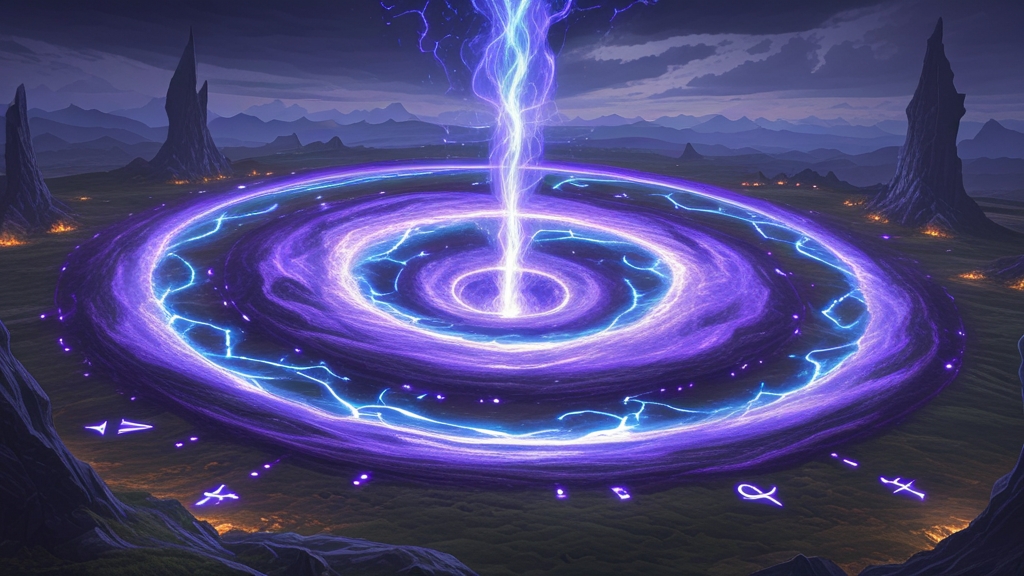
What Are Endless Spells in Age of Sigmar?
Endless Spells are persistent magical effects, represented by their own models, that stay on the battlefield after they are cast. Unlike normal spells that flash into existence and disappear, Endless Spells endure: they move, affect units around them and keep causing trouble until they are banished or destroyed, or the battle ends. They are one of the most distinctive features of Age of Sigmar, both as a gameplay mechanic and as a lore concept.
In Age of Sigmar 4th Edition, Endless Spells are part of a wider category called manifestations. Wizards summon Endless Spells, and Priests summon a similar kind of manifestation called invocations. Each army picks one manifestation lore when it is built, and its Wizards and Priests can summon the manifestations from that lore during the game.
In the lore of the Mortal Realms, Endless Spells are a consequence of the Necroquake, the magical cataclysm unleashed by Nagash’s great ritual. Before it, spells faded once their immediate effect was spent. Afterwards, the realms were so saturated with magic that some spells could sustain themselves, lingering long after their casting.
What Caused Endless Spells to Exist?
The emergence of Endless Spells is tied directly to the Necroquake — Nagash’s attempt to claim dominion over all death in the Mortal Realms. Nagash’s great ritual was meant to draw the realms’ death magic to his Black Pyramid in the Realm of Death, Shyish, giving him power over every soul. Sabotaged and only partly successful, it instead unleashed a vast wave of death magic that swept across the realms.
That wave transformed the magical landscape. Magic had always been abundant in the Mortal Realms, but the Necroquake supercharged it to new levels. The result was an environment so saturated with energy that certain spells could sustain themselves without a wizard’s ongoing will.
In the aftermath, wizards learned to create these self-sustaining spells deliberately, shaping the overabundant magic into weapons, barriers and tools that persist long after the casting. That discovery transformed magical warfare in the Mortal Realms and is why Endless Spells became a feature of the tabletop game too.
How Do Endless Spells Work in 4th Edition?
On the tabletop, Endless Spells are represented by dedicated models. In 4th Edition they work like this:
- Manifestation lores: When you build your army, you pick one manifestation lore, either from your faction’s battletome or one of the universal lores. Lores are free, so every army can bring manifestations.
- Summoning: A Wizard summons an Endless Spell by casting the spell that summons it, rolling 2D6 and equalling or beating its casting value. An enemy Wizard can try to unbind it like any other spell. Priests summon invocations through prayers instead.
- Warscrolls: Each manifestation has its own warscroll that sets out how it moves and what it does. In 4th Edition, manifestations are controlled by the player who summoned them.
- Removing them: A Wizard or Priest within range can banish an enemy manifestation by rolling equal to or above its banishment value. Manifestations can also be shot and fought like units and destroyed that way.
Because manifestations stay under their summoner’s control, the old worry about an opponent steering your spell back into your own lines no longer applies. Instead, the counter-play is about removing them: do you spend your Wizards’ and Priests’ actions summoning your own manifestations, or banishing your opponent’s? For the full magic rules, see Age of Sigmar magic explained.
Exact casting values, banishment values, abilities and which manifestations appear in which lore change with battletomes and the General’s Handbook, so always check the current warscrolls.
The Original Malign Sorcery Endless Spells
Endless Spells arrived on the tabletop in 2018 with the Malign Sorcery expansion, which introduced a set of Endless Spells that any wizard could use, and a split between predatory spells that moved around the battlefield and static ones that stayed where they were cast. Those older rules don’t apply in 4th Edition, where what a manifestation does is set by its current warscroll and lore, but many of the original models are still well known:
- Purple Sun of Shyish: A sphere of concentrated death magic, one of the most feared Endless Spells of earlier editions.
- Ravenak’s Gnashing Jaws: A huge spectral maw that tears through anything in its path.
- Umbral Spellportal: A pair of linked portals that let a wizard project spells across the battlefield.
- Soulsnare Shackles: Spectral chains that erupt from the ground to hold back enemy advances.
- Suffocating Gravetide: A wave of spectral earth and gravestones that sweeps across the battlefield.
- Quicksilver Swords: A whirling vortex of magical blades.
- Aethervoid Pendulum: A massive spectral blade that swings across the battlefield in a straight line.
- Chronomantic Cogs: A set of floating magical gears that manipulate the flow of time.
- Malevolent Maelstrom: A swirling vortex of dark energy that feeds on nearby magic.
The models remain some of the most striking in the Age of Sigmar range and are popular painting projects in their own right. Whether a particular one can be used in a 4th Edition game depends on whether it appears in a current manifestation lore, so check the General’s Handbook before you build around it.
Faction-Specific Endless Spells
Most factions in Age of Sigmar have their own manifestations that reflect their magical traditions and look. These are thematically tied to the army and often work well with the faction’s playstyle.
For example, the Nighthaunt have included the Shyish Reaper, a spectral scythe that harvests souls, and the Vault of Souls, which traps the spirits of the slain. The Fyreslayers can call on the Zharrgron Flame-spitter, which belches magical fire. The Sylvaneth have manifestations such as the Spiteswarm Hive, the Gladewyrm and the Vengeful Skullroot. Each faction’s manifestations add flavour and tactical options that reinforce its identity, and your battletome lists the ones currently available to your army.
Endless Spells in the Lore of the Mortal Realms
In the wider lore, Endless Spells changed life in the Mortal Realms. Some spells cast during or after the Necroquake were never dispelled and slipped free of their casters, roaming the realms like magical natural disasters and making dangerous regions even more so.
Endless Spells also fuelled a magical arms race. Factions across the realms have developed their own self-sustaining spells suited to their needs, while also seeking ways to banish those of their enemies.
Frequently Asked Questions
Can Endless Spells hurt the caster’s own army?
It depends on the warscroll. In 4th Edition each manifestation’s warscroll says which units its abilities affect, and some can affect any unit nearby while others only affect enemies. Read the warscroll before you place one close to your own troops. Unlike earlier editions, your opponent can’t take control of your manifestation and steer it into your lines, because manifestations are controlled by the player who summoned them.
Can non-wizard units interact with Endless Spells?
Units that are not Wizards cannot summon Endless Spells, and only Wizards and Priests can banish manifestations, but other units are still affected by them. In 4th Edition they can also attack manifestations and destroy them. That means every player has to account for manifestations in their movement and positioning, not just those fielding wizards.
Do Endless Spells last the entire game?
A manifestation stays on the battlefield until it is banished or destroyed, or the battle ends, unless its warscroll says otherwise. In practice, powerful manifestations often become priority targets and are removed quickly, while others last the whole game if the opponent can’t deal with them.
Can you have multiple Endless Spells on the battlefield at once?
Yes. Several manifestations from both armies can be on the battlefield at the same time, and games between wizard-heavy armies can be full of them. Your manifestation lore and the current rules set which ones you can summon and how often, so check the lore and the rules in the General’s Handbook.
Were there Endless Spells before the Necroquake?
No. In the lore, Endless Spells are a direct consequence of the Necroquake’s magical disruption. Before it, spells were transient and faded once their effect was spent. The Necroquake changed the nature of magic in the Mortal Realms, creating conditions that let spells sustain themselves.
Are Endless Spells called manifestations now?
Yes. In Age of Sigmar 4th Edition, Endless Spells, invocations and similar summoned effects are grouped together as manifestations. You choose a manifestation lore when you build your army, and your wizards can summon the manifestations from that lore during the battle. The name Endless Spells is still widely used by players.
Do Endless Spells cost points in 4th Edition?
No. In 4th Edition you pick one manifestation lore as part of building your army, and lores are free, unlike earlier editions where each Endless Spell had its own points cost. That means every army can bring manifestations, so it’s worth knowing how to banish or destroy your opponent’s.
Can you attack Endless Spells in 4th Edition?
Yes. In 4th Edition, manifestations have their own warscrolls, so units can shoot and fight them to destroy them, as well as banishing them with a Wizard or Priest. That’s a big change from earlier editions, when only dispelling could remove an Endless Spell.
Related Content
- What Is the Necroquake? — Learn about the event that unleashed Endless Spells
- Who Is Nagash? — Meet the architect behind the magical catastrophe
- How to Play Age of Sigmar — Learn how Endless Spells work on the tabletop
- What Are the Mortal Realms? — Explore the realms where Endless Spells roam