
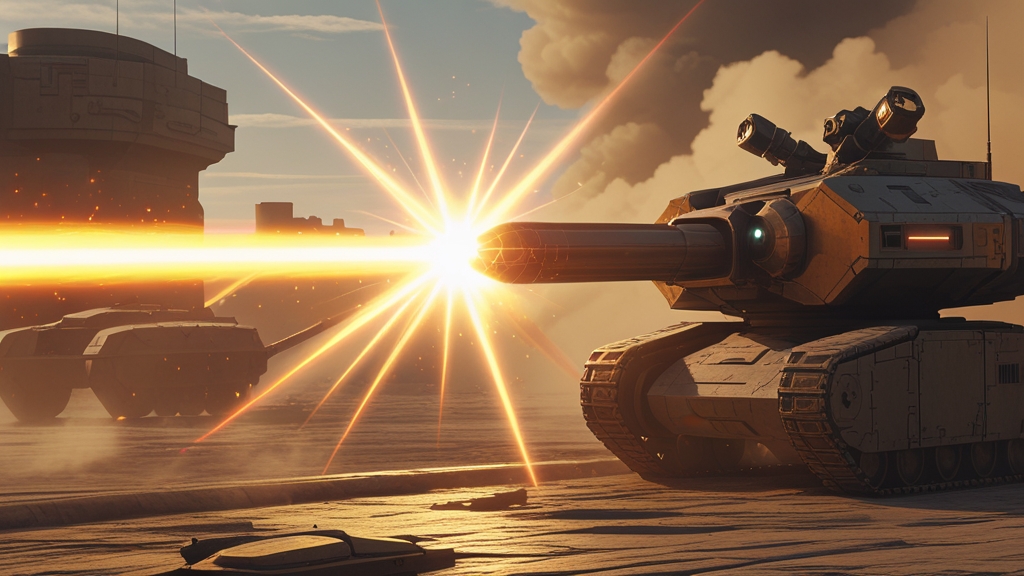
A Lascannon is a powerful laser weapon that fires a concentrated beam of energy capable of punching through tank armour. It is the Imperium’s standard heavy anti-armour weapon, found on vehicles, infantry heavy weapon teams and Dreadnoughts. Across the battlefields of the 41st Millennium, few weapons inspire as much confidence in Guardsmen, or as much dread in enemy tank crews, as the flash of a Lascannon discharge.
Where a lasgun is the humble “flashlight” of the common soldier, the Lascannon is its terrifying big brother: a weapon built not to kill individual soldiers but to destroy armoured vehicles, fortifications and monstrous creatures, ideally with a single shot.
How Does a Lascannon Work?
A Lascannon works on the same principle as all Imperial las-weapons, scaled up dramatically. A high-capacity power source stores a large charge, and when the weapon fires that energy is focused through a lasing medium into a single coherent beam of enormous intensity. The beam travels at the speed of light, so there is effectively no travel time and no need to lead a moving target.
On impact the beam superheats the target almost instantly. Armour plate doesn’t just melt; it is burned through, and the energy dumped into a vehicle can wreck its systems and kill the crew even without a full penetration.
The trade-off is rate of fire. Each shot draws a huge amount of power, so a Lascannon fires far more slowly than lighter weapons. Infantry teams carry the weapon with a separate power pack, while vehicle-mounted versions draw on the vehicle’s own power plant.
What Is the Lascannon’s Role on the Battlefield?
The Lascannon fills the Imperium’s long-range anti-armour role. It is the primary weapon for destroying enemy tanks, walkers and heavily armoured targets at range, combining accuracy, long reach and very high penetration.
In Astra Militarum armies, Lascannons are typically fielded by heavy weapon teams: two-man crews, a gunner and a loader, firing a tripod-mounted weapon from a defensive position with clear firing lanes. Dug in on high ground or behind cover, a few teams can lock down an entire avenue of approach.
Space Marine Devastator Squads also make extensive use of Lascannons. A squad carrying several Lascannons is one of the most potent anti-armour assets a Chapter can field, and a Space Marine’s strength means he can carry and fire the weapon without the tripod and crew a normal human needs.
On vehicles the Lascannon is everywhere. The Predator Annihilator mounts a twin Lascannon in its turret and can add Lascannon sponsons. The classic Land Raider carries twin Lascannons in both sponsons. Razorbacks can be fitted with a twin Lascannon turret, and Leman Russ tanks can take a hull-mounted Lascannon.
Where Did the Lascannon Originate?
Like most Imperial technology, the Lascannon is a standard pattern that the Adeptus Mechanicus has produced since before the Great Crusade. During the Emperor’s conquest of the galaxy, Lascannons were made in vast numbers to arm the Legiones Astartes and the Imperial Army. Compared with plasma or melta weapons they are relatively simple and robust, which helped make them the backbone of Imperial anti-armour doctrine.
Over ten thousand years, countless Forge Worlds have turned out their own patterns of the weapon, but the basic design has barely changed. In the Imperium, that is a feature rather than a failing.
How Does the Lascannon Compare to Other Anti-Tank Weapons?
The Lascannon sits within a family of Imperial anti-armour weapons, each with its own strengths.
Against the Meltagun, the Lascannon trades close-range devastation for range. A melta weapon at point-blank range can slag almost any armour, but it has to get very close to do it. The Lascannon can engage targets from much further away, which makes it far safer for the operator. In Imperial doctrine, melta weapons are for assault troops closing with the enemy; Lascannons are for fire support and defence. See our guide to melta weapons.
Compared with the Missile Launcher, the Lascannon is a pure specialist. Missile launchers are more flexible, with krak missiles for armour and frag missiles for infantry, but a dedicated Lascannon puts more punch into a single anti-tank shot.
The Autocannon offers a higher rate of fire but much less penetration. Autocannons are excellent against light vehicles, transports and heavy infantry; the Lascannon is the better choice against the heaviest armour.
Xenos races have their own answers, such as Aeldari Brightlances, T’au Railguns and Necron gauss weaponry. These are often more advanced, but the Lascannon’s strength is that the Imperium can build and maintain it in enormous numbers on thousands of worlds.
Which Units Carry Lascannons?
The list of units that can mount Lascannons reads like a catalogue of the Imperium’s war machines. In the Astra Militarum, heavy weapon teams, Leman Russ tanks and Sentinels can all carry them, and the Valkyrie can be armed with one. For Space Marines, the weapon appears on Devastator Squads, Predators, Land Raiders, Dreadnoughts, Razorbacks and the Repulsor, though in 11th Edition the Predators, Razorback and standard Dreadnought have moved to Warhammer Legends. The Adeptus Mechanicus field their own version, the cognis Lascannon, on Ironstrider Ballistarii.
Chaos Space Marines still use the same technology they took with them during the Horus Heresy, on Predators, Land Raiders and Havocs. The Adepta Sororitas, by contrast, lean far more on melta and flamer weapons.
Wargear options change between editions and codexes, so check the current datasheets in your codex or the Warhammer 40,000 app for exactly which units can take Lascannons today.
What Does the Lascannon Look Like on the Tabletop?
In Warhammer 40,000 the Lascannon is one of the most recognisable heavy weapons in the game: a long-ranged gun with very high Strength, heavy AP and multiple random damage per hit, but usually only a single shot. It’s built to threaten vehicles and monsters from across the board. For its exact profile in 11th Edition, check the current datasheet and the weapon abilities guide, since profiles and points change with codexes and the Munitorum Field Manual.
Lascannons are most efficient against high-Toughness, well-armoured targets. Firing one at infantry is usually wasteful, because damage from a single attack doesn’t spill over to other models; a basic bolter could do that job. Smart players give Lascannon units clear sight lines to the enemy’s vehicles and monsters and use them as area denial, forcing the opponent to think hard about where to park their armour. Remember that in 11th Edition cover worsens the attacker’s Ballistic Skill rather than improving the target’s save, so terrain matters for your single big shots. Our guide to how combat works covers the full attack sequence.
Twin Lascannons are two weapons fired together, but on the tabletop “Twin-linked” is a weapon ability that lets you re-roll the wound roll rather than doubling its shots. Check the current datasheet for the full weapon profile.
Why Is the Lascannon So Important to Warhammer Lore?
The Lascannon represents something fundamental about the Imperium of Man: reliance on ancient, proven technology in a galaxy where innovation is treated as heresy. The weapon has been built to essentially the same pattern for over ten thousand years, and the Adeptus Mechanicus maintains it through ritual and rote as much as understanding, treating its manufacture as a sacred rite.
That is the grimdark reality of the 41st Millennium in microcosm. The Lascannon works. It has always worked. And the Imperium has no intention of changing it.
The weapon also embodies the Imperium’s industrial approach to war. Other factions may field more exotic, specialised guns, but the Imperium’s strength lies in mass-produced, reliable equipment deployed in overwhelming numbers.
Frequently Asked Questions
Is a Lascannon better than a Meltagun?
Neither is universally better; they fill different roles. The Lascannon excels at long-range anti-armour fire, while the Meltagun is a short-range assault weapon. If you need to destroy a tank from across the battlefield, the Lascannon is the better choice. If you’re closing in on a vehicle or breaching a fortification, the Meltagun wins. Many lists include both to cover different situations.
Can a Lascannon kill a Space Marine?
Absolutely. A Lascannon is huge overkill against a single Space Marine; a direct hit would kill one outright regardless of power armour. On the tabletop, though, using it against infantry is usually wasteful, as you’re spending a premium anti-tank shot on a relatively cheap target and much of its damage is lost.
How many shots does a Lascannon fire?
On the tabletop, a standard Lascannon has typically had a single shot, with its power coming from the quality of that shot rather than volume of fire. Twin Lascannons are not “two shots”: Twin-linked is a weapon ability that lets you re-roll the wound roll, so check the current datasheet for the exact profile. In the lore, a Lascannon can fire repeatedly, but each discharge drains its power source, giving it a slower rate of fire than most weapons.
Do Chaos Space Marines use Lascannons?
Yes. Chaos Space Marines still use the Lascannon technology they took with them during the Horus Heresy. Chaos Predators, Land Raiders and Havocs all field Lascannons, often decorated with blasphemous sigils and dark iconography.
What is the difference between a Lascannon and a Lasgun?
Both are laser weapons, but the scale difference is enormous. A lasgun is a personal weapon carried by individual soldiers: reliable and easy to maintain, but relatively weak. A Lascannon is a crew-served heavy weapon designed to destroy vehicles, many times more powerful than a lasgun.
Can a Lascannon hurt a Titan?
Yes, but one Lascannon on its own won’t bring a Titan down. Titans are protected by void shields that have to be collapsed before shots can reach the armour, so it takes concentrated fire from many Lascannons, or much bigger weapons, to do real damage.
What is a twin Lascannon?
A twin Lascannon is two Lascannons mounted side by side and fired together, usually on vehicles such as Predator Annihilators, Razorbacks and Land Raiders. In the lore, the paired barrels put more energy on one target and make a kill more likely. Twin-linked rules have varied between editions, so check the current datasheet for exactly how it works on the tabletop.