
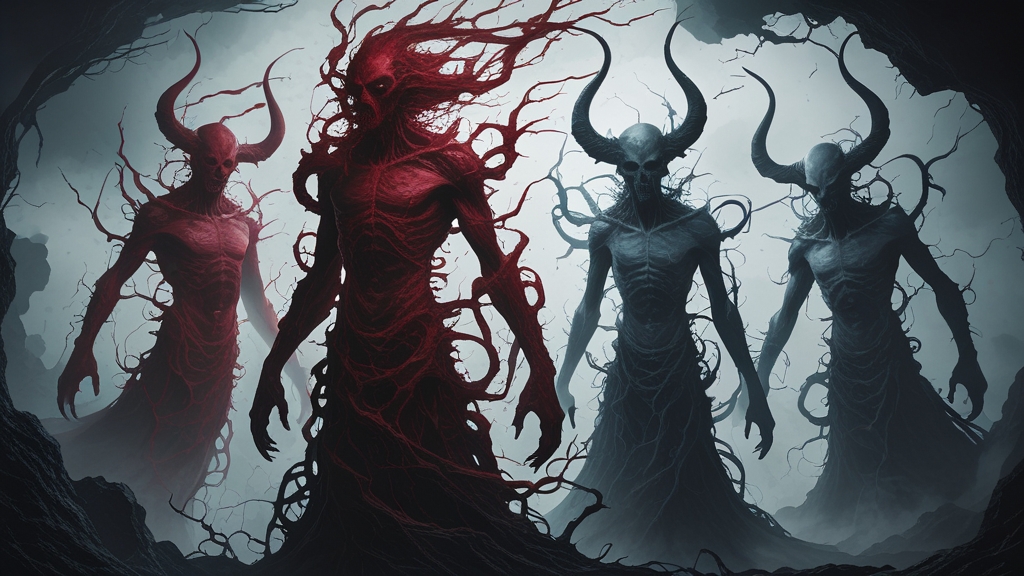
The Chaos Gods are the four malevolent deities who dwell within the Warp and serve as the primary antagonists of the Warhammer 40,000 and Warhammer Age of Sigmar universes. They are Khorne, the Blood God; Tzeentch, the Changer of Ways; Nurgle, the Plague Father; and Slaanesh, the Dark Prince. Born from the collective emotions of mortal beings, these four entities wage an eternal war against each other and against reality itself, seeking to corrupt, consume, and dominate all of existence.
This guide provides a comprehensive overview of each Chaos God, their domains, their daemonic servants, and their role in the Warhammer settings.
Who Are the Chaos Gods?
The Chaos Gods, also called the Dark Gods or the Ruinous Powers, are four immensely powerful entities that inhabit the Warp — the parallel dimension of psychic energy that underlies reality. Each Chaos God is born from and sustained by specific mortal emotions: Khorne feeds on rage and violence, Tzeentch on ambition and change, Nurgle on despair and decay, and Slaanesh on excess and sensation. They are not gods in the traditional sense of being creators or cosmic arbiters — they are more like vast, sentient psychic vortexes that have achieved consciousness and will.
The Chaos Gods are simultaneously the greatest threat to civilization in the Warhammer settings and, paradoxically, a reflection of the civilizations they threaten. They exist because mortal beings feel anger, hope, despair, and desire. They cannot be destroyed without destroying the emotions that sustain them — which would mean fundamentally altering what it means to be a sentient being. This is the fundamental tragedy of the Warhammer universe: the enemies of civilization are created by civilization itself.
Each Chaos God commands vast legions of Chaos Daemons, claims mortal followers and champions, and is associated with a Traitor Legion of Chaos Space Marines. They also war endlessly against each other in a conflict known as the Great Game, each seeking to dominate the others and achieve supremacy over the Warp.
Khorne — The Blood God
Khorne is the Chaos God of war, rage, hatred, blood, and martial honor. He is the oldest and arguably the most powerful of the four Chaos Gods, having grown to immense strength from the countless wars that have ravaged the galaxy since the dawn of sentient life. Khorne’s domain is pure, unrestrained violence — He cares not from whence the blood flows, only that it flows. Every act of killing, every battle, every moment of murderous rage feeds His power.
Domain: War, violence, rage, bloodshed, martial pride, hatred, murder, strength
Personality: Khorne is often portrayed as wrathful but not mindless. He values martial honor and martial skill, and despises sorcery and magic as the tools of cowards. He sits upon a Brass Throne atop a mountain of skulls in his domain within the Warp. Despite being the god of violence, Khorne has a strange code — He respects worthy foes and despises those who murder the helpless without challenge.
Daemon Servants: Khorne’s daemonic legions include Bloodletters (rank-and-file sword-wielding daemons), Bloodcrushers (Bloodletters mounted on Juggernauts of Khorne), Flesh Hounds (daemonic tracking beasts), and Skull Cannons. His Greater Daemons are the fearsome Bloodthirsters — towering, winged daemons of incredible martial prowess. The most famous Bloodthirster is Ka’Bandha, ancient nemesis of the Blood Angels.
Associated Legion: The World Eaters, led by the Daemon Primarch Angron. The World Eaters are berserkers who have given themselves over entirely to Khorne’s rage, fighting with chainaxes and caring for nothing but slaughter.
Sacred Number: 8
Symbol: A skull rune, often depicted as a stylized skull with a cross-like symbol
Key Characters: Angron (Daemon Primarch), Khârn the Betrayer (greatest mortal champion), Ka’Bandha (Bloodthirster), Skulltaker (daemonic herald)
Battle Cry: “Blood for the Blood God! Skulls for the Skull Throne!”
Tzeentch — The Changer of Ways
Tzeentch is the Chaos God of change, sorcery, ambition, manipulation, and knowledge. He is the Great Conspirator, the Architect of Fate, the Changer of Ways — a god who embodies the desire for change, progress, and power through knowledge. Where Khorne is direct and brutally honest, Tzeentch is labyrinthine and unknowable. His plans have plans, his schemes have counter-schemes, and even his own daemons cannot fully comprehend his intentions.
Domain: Change, sorcery, magic, ambition, manipulation, scheming, knowledge, hope, mutation
Personality: Tzeentch is paradoxical — He is the god of hope and ambition as much as He is the god of manipulation and betrayal. Every mortal who has ever desired change, progress, or improvement feeds Tzeentch’s power, making Him impossible to defeat through stagnation alone. Tzeentch’s realm in the Warp is the Crystal Labyrinth, an ever-shifting maze of crystalline corridors that defies logic and geometry. At its heart sits the Impossible Fortress, where Tzeentch weaves his endless schemes.
Daemon Servants: Tzeentch’s daemons include Horrors (giggling, fire-hurling daemons that split into smaller versions when killed — Pink Horrors split into Blue Horrors, which split into Brimstone Horrors), Flamers (flying daemons that spew magical fire), and Screamers (ray-like flying predators). His Greater Daemons are the Lords of Change — towering, bird-like sorcerers of vast intellect and power. Tzeentch also commands the Changeling, a shape-shifting trickster daemon.
Associated Legion: The Thousand Sons, led by the Daemon Primarch Magnus the Red. The Thousand Sons are sorcerers and scholars whose obsessive pursuit of knowledge led them to damnation. Many of their Astartes have been reduced to dust inside their armor (the Rubric Marines), animated only by sorcery.
Sacred Number: 9
Symbol: A flame or a many-pointed star, often stylized as intertwined serpents
Key Characters: Magnus the Red (Daemon Primarch), Ahriman (greatest mortal sorcerer), Kairos Fateweaver (two-headed Lord of Change who can see the past and future), the Changeling
Nurgle — The Plague Father
Nurgle is the Chaos God of decay, disease, despair, entropy, and paradoxically, endurance and the cycle of life and death. He is known as the Plague Father, Grandfather Nurgle, and the Lord of Decay. Unlike the other Chaos Gods, Nurgle is often portrayed with a twisted kind of warmth and affection — He genuinely loves His followers and His creations, viewing the plagues and diseases He spreads as gifts rather than punishments.
Domain: Decay, disease, pestilence, despair, entropy, endurance, the cycle of life and death, stagnation, resilience
Personality: Nurgle is the most paradoxical of the Chaos Gods. He is the god of despair, yet His followers are often the most cheerful and content beings in the galaxy — having accepted decay and death, they fear nothing. Nurgle’s realm in the Warp is a vast, festering garden of impossible fecundity, where every form of life and decay exists simultaneously. He sits at its heart in a mouldering mansion, endlessly brewing new plagues in his cauldron. He is depicted as jovial, grandfatherly, and genuinely caring toward His followers — even as He rots them from the inside out.
Daemon Servants: Nurgle’s daemons include Plaguebearers (shambling, one-eyed daemons who catalog diseases), Nurglings (tiny, mischievous miniature versions of Nurgle), Beasts of Nurgle (slug-like creatures of enthusiastic affection that accidentally kill everything they touch), and Plague Drones (Plaguebearers riding giant Rot Flies). His Greater Daemons are the Great Unclean Ones — vast, corpulent, jovial daemons that mirror Nurgle’s own bloated form.
Associated Legion: The Death Guard, led by the Daemon Primarch Mortarion. The Death Guard were once the most resilient and enduring of the Space Marine Legions; now they are plague-ridden walking corpses who spread Nurgle’s diseases across the galaxy.
Sacred Number: 7
Symbol: The tri-lobe mark of Nurgle (three circles arranged in a triangle)
Key Characters: Mortarion (Daemon Primarch), Typhus the Traveller (Herald of Nurgle, greatest plague spreader), Ku’gath Plaguefather (Great Unclean One), Rotigus (Great Unclean One)
Slaanesh — The Dark Prince
Slaanesh is the Chaos God of excess, pleasure, pain, perfection, and sensation. Known as the Dark Prince, the Prince of Pleasure, and She Who Thirsts, Slaanesh is the youngest of the four Chaos Gods, having been born from the collective decadence and hedonism of the ancient Aeldari (Eldar) civilization. Slaanesh’s birth was so violent that it tore a hole in reality — the Eye of Terror — and destroyed the Aeldari empire in a single cataclysmic moment known as the Fall.
Domain: Excess, pleasure, pain, perfection, obsession, sensation, hedonism, pride, vanity, art, music
Personality: Slaanesh embodies the pursuit of sensation taken to its ultimate extreme. This is not merely physical pleasure — Slaanesh feeds on any obsessive pursuit of perfection or sensation, whether it be art, music, martial skill, or cruelty. A warrior who endlessly pursues perfect swordsmanship feeds Slaanesh just as much as a hedonist pursuing physical pleasure. Slaanesh’s realm in the Warp consists of six concentric circles of temptation, each offering a different excess. Those who enter are invariably seduced and consumed.
Daemon Servants: Slaanesh’s daemons include Daemonettes (alluring, claw-handed daemons of terrifying speed and beauty), Fiends (six-legged beasts that mesmerize prey with their musk), Seekers (Daemonettes riding serpentine Steeds of Slaanesh), and Hellflayers (chariot-mounted daemons). Slaanesh’s Greater Daemons are the Keepers of Secrets — towering, elegant, and terrifyingly fast daemons of immense psychic power.
Associated Legion: The Emperor’s Children, led by the Daemon Primarch Fulgrim. Once the most aesthetically refined and honor-bound of the Legions, the Emperor’s Children fell to Slaanesh through their obsessive pursuit of perfection, which gradually devolved into hedonism, sensation-seeking, and depravity.
Sacred Number: 6
Symbol: A stylized combination of male and female symbols, or a circle with a line and claw
Key Characters: Fulgrim (Daemon Primarch), Lucius the Eternal (a swordsman who cannot truly die — anyone who kills him and feels even a moment of satisfaction is transformed into Lucius), Shalaxi Helbane (Keeper of Secrets, the greatest daemon-hunter of Slaanesh), N’Kari
Chaos Undivided
Chaos Undivided refers to the worship or service of Chaos as a whole rather than devotion to any single Chaos God. Champions of Chaos Undivided draw power from all four gods simultaneously without being exclusively sworn to any one, though this is an extraordinarily difficult and dangerous path. The Chaos Gods are jealous and possessive — serving all four requires either immense willpower, exceptional usefulness, or a careful balancing act.
The most prominent champion of Chaos Undivided is Abaddon the Despoiler, Warmaster of Chaos and leader of the Black Legion. Abaddon has explicitly refused to swear allegiance to any single god, instead demanding the blessings of all four while maintaining his own autonomy. His success in this regard — having launched thirteen Black Crusades and ultimately tearing open the Great Rift — has made him the most feared mortal servant of Chaos in the galaxy.
The Chaos Space Marines faction includes many warbands of Chaos Undivided, alongside the god-specific Legions. The Word Bearers, Night Lords, Iron Warriors, and Alpha Legion are all generally associated with Chaos Undivided, though individual members may patron specific gods.
The Great Game
The Great Game is the eternal war fought between the four Chaos Gods for supremacy over the Warp. Despite their common desire to corrupt and consume the mortal universe, the Chaos Gods are bitter rivals who expend as much — if not more — energy fighting each other as they do fighting their mortal enemies. This internecine conflict is one of the primary reasons the forces of Chaos have never permanently conquered reality.
The rivalries follow specific patterns. Khorne and Slaanesh are natural enemies — Khorne despises Slaanesh’s hedonism as weakness, while Slaanesh views Khorne’s mindless rage as crude and unrefined. Tzeentch and Nurgle are similarly opposed — Tzeentch represents change and ambition while Nurgle embodies stagnation and acceptance. These opposing pairs frequently ally against each other, creating a constantly shifting balance of power.
Occasionally, an existential threat forces the Chaos Gods to temporarily unite. They cooperated to corrupt Horus during the Heresy, and they sometimes align against a common foe. But these alliances never last — the Great Game always reasserts itself, and betrayal is inevitable.
How Chaos Gods Are Born
The Chaos Gods are born from the collective psychic emissions of mortal beings in the material universe. Every emotion felt by every sentient creature creates ripples in the Warp. Over millions of years, these ripples accumulate, intensify, and eventually coalesce into sentient entities — the Chaos Gods. They are, in a very real sense, humanity’s (and other species’) dark reflections given form and will.
Khorne, Tzeentch, and Nurgle are ancient — they achieved consciousness during humanity’s early history, fed by the emotions of countless species across the galaxy. Slaanesh is the notable exception: the youngest Chaos God was born in approximately M30 from the extreme psychic excess of the Aeldari civilization. The birth of Slaanesh was so catastrophic that it tore open the Eye of Terror, destroyed the Aeldari empire, and consumed the souls of billions of Aeldari in an instant. To this day, Slaanesh hungers for Aeldari souls, and the Aeldari must use soul stones and other protections to avoid being consumed by “She Who Thirsts” upon death.
Chaos Daemons
Chaos Daemons are the foot soldiers, servants, and manifestations of the Chaos Gods’ will. They are not truly independent beings — each daemon is a fragment of its patron god’s power given form and a degree of independent thought. Daemons exist primarily in the Warp, but they can manifest in the material universe under certain conditions: when the barrier between dimensions is thin, during Warp storms, through sorcerous rituals, or when a mortal’s psychic power inadvertently creates a breach.
Each Chaos God commands their own hierarchy of daemons, from the lowliest Nurglings and Brimstone Horrors to the mighty Greater Daemons — Bloodthirsters, Lords of Change, Great Unclean Ones, and Keepers of Secrets. Daemons cannot be truly killed in the material universe — destroying their physical form merely banishes them back to the Warp, where they eventually reform. Only in the Warp itself can a daemon be permanently destroyed.
On the tabletop, Chaos Daemons are a playable faction in both Warhammer 40,000 and Warhammer Age of Sigmar, representing daemonic incursions into the material realm. They can also be allied with the various Chaos Space Marine factions.
The Warp and Chaos
The Warp — also known as the Immaterium, the Empyrean, or the Sea of Souls — is the home dimension of the Chaos Gods. It is a parallel reality composed entirely of psychic energy, where thought and emotion have physical form. The Warp is not inherently evil — it is the medium through which psychic powers operate and the means by which faster-than-light travel is possible. But the Chaos Gods’ dominion over vast swathes of the Warp has made it an incredibly dangerous dimension, filled with predatory daemons and maddening unreality.
The relationship between the Warp and the material universe is symbiotic and parasitic. Mortal emotions feed the Warp and sustain the Chaos Gods. In turn, the Chaos Gods reach into the material universe through the Warp to corrupt, tempt, and consume mortal souls. This cycle cannot be broken without fundamentally changing the nature of either dimension.
Chaos in Age of Sigmar
The Chaos Gods also play a major role in Warhammer Age of Sigmar, the fantasy counterpart to Warhammer 40,000. In the Age of Sigmar setting, the same four Chaos Gods — Khorne, Tzeentch, Nurgle, and Slaanesh — are major antagonists, each commanding mortal and daemonic followers in the Mortal Realms.
The most significant difference is the status of Slaanesh, who was captured and imprisoned by the Aelven gods during the Age of Myth. Even imprisoned, Slaanesh’s influence seeps into the Mortal Realms through their followers. The Chaos Daemons themselves are identical across both settings — a Bloodthirster in 40k is the same entity as a Bloodthirster in Age of Sigmar, as the Warp transcends individual realities. This means that many Chaos Daemons miniatures can be used in both game systems.
Frequently Asked Questions
How many Chaos Gods are there?
There are four major Chaos Gods in Warhammer: Khorne, Tzeentch, Nurgle, and Slaanesh. There are also minor Chaos entities such as Malice/Malal (largely retconned) and the Horned Rat (significant in the old Warhammer Fantasy setting and Age of Sigmar, associated with the Skaven). However, the “Big Four” are the primary Chaos Gods in both Warhammer 40,000 and Age of Sigmar.
Which Chaos God is the strongest?
Khorne is generally considered the most powerful Chaos God in terms of raw military might, as every act of violence in the galaxy feeds his power. However, the balance of power in the Great Game constantly shifts. Tzeentch’s scheming, Nurgle’s inevitability, and Slaanesh’s seductive power each provide advantages in different circumstances. No single Chaos God can permanently dominate the others.
Can the Chaos Gods be killed?
The Chaos Gods cannot be killed in any conventional sense. They are sustained by mortal emotions — as long as sentient beings feel rage, ambition, despair, and desire, the Chaos Gods will exist. Destroying them would require fundamentally altering the nature of sentient consciousness itself. The Emperor’s original plan was not to destroy the Chaos Gods but to starve them by eliminating religious belief and superstition, though this plan ultimately failed.
What is the relationship between Chaos Gods and their followers?
The Chaos Gods offer their followers power — mutations, daemonic gifts, sorcery, immortality, and martial prowess — in exchange for devotion and service. However, this relationship is ultimately parasitic. The vast majority of Chaos followers are consumed, driven mad, or mutated into mindless Chaos Spawn. Only the most exceptional champions, such as Daemon Princes, achieve anything resembling the promised rewards, and even they are ultimately slaves to their patron god’s will.
Why do people worship Chaos?
People worship the Chaos Gods for many reasons: desperation, ambition, revenge, the promise of power, or simply because they were born into a culture that venerates them. In the grim darkness of the Warhammer settings, where life is often brutal and short, the promise of power, meaning, or even just survival can be irresistible. Many followers of Chaos do not even realize what they are worshipping until it is too late — the Chaos Gods are masters of gradual corruption.