
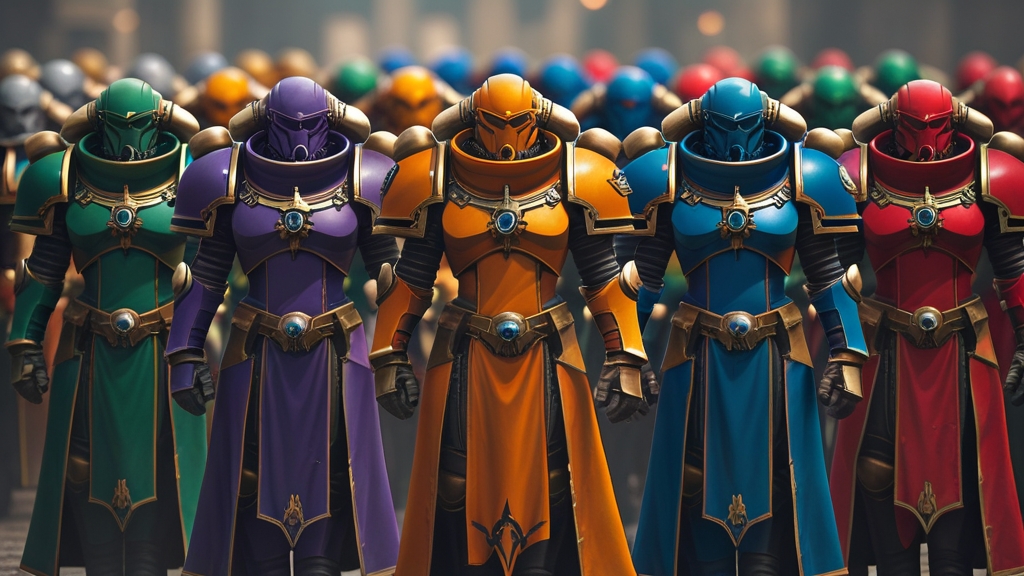
The Space Marines are the elite super-soldiers of the Imperium of Man in the Warhammer 40,000 universe, genetically enhanced and equipped with advanced power armour.
Created from the gene-seed of the Emperor’s original warriors, they serve as the first line of defence against the myriad threats facing humanity.
Each Space Marine belongs to a Chapter, each with its own culture, traditions, and combat doctrines.
Renowned for their unwavering loyalty, bravery, and martial prowess, they are often seen as living legends, embodying the Emperor’s will. In a galaxy rife with danger, the Space Marines stand as humanity’s indomitable shield.

Who Are The Space Marines?
Space Marines are elite super-soldiers in the Warhammer 40k universe, created through genetic modification from human DNA. They serve the Imperium of Man, embodying its might and discipline.
Organised into Chapters, each with unique traits, they protect humanity from Xenos, heretics, and the dark forces of Chaos.
What Space Marine Armies Are There?
- Black Templars: A zealous chapter known for their fervent crusades against heretics and aliens. They emphasize close combat and are dedicated to the Emperor, often seen leading the charge into battle.
- Blood Angels: A noble chapter with a focus on speed and melee combat, known for their iconic red armour. They struggle against the “Black Rage,” a curse that drives some members into a frenzy during battle.
- Dark Angels: Descended from the First Legion, a Chapter shrouded in secrecy and honour. They are dedicated to hunting down the Fallen, their former brothers who turned traitor, and possess a strong focus on tactical versatility.
- Deathwatch: An elite force made up of Space Marines from various chapters, specialising in combating alien threats. They utilize advanced weaponry and tactics, often deployed on critical missions.
- Imperial Fists: Masters of siege warfare and fortifications, this chapter is known for their resilience and defensive strategies. Their yellow armour symbolises their dedication to the Emperor’s defense.
- Iron Hands: A chapter that values strength and machine integration, focusing on technology and resilience. They often augment their bodies with cybernetics, reflecting their belief in the superiority of the machine.
- Salamanders: Renowned for their craftsmanship and mastery of flame, they are known for their strong sense of honour and compassion. They often protect civilians and are skilled in using fire-based weaponry.
- Space Wolves: Fierce warriors with a tribal culture, they are known for their ferocity in battle and strong bonds with their wolf-like companions. They favor close combat and are often seen as unpredictable.
- White Scars: Masters of fast-moving warfare, they specialize in hit-and-run tactics and rapid assaults. Their bike-mounted units are iconic, reflecting their nomadic warrior culture inspired by Mongolian steppe traditions.

How to Play Space Marines
Space Marines are the most versatile army in Warhammer 40k, capable of adapting to any playstyle. Their core strength lies in their balanced stat lines — good saves, decent shooting, solid melee — which means they can respond to threats flexibly rather than being locked into one approach.
In 11th Edition your army’s special rules come from the detachments you buy with Detachment Points (2 DP at 1,000 points, 3 DP at 2,000 points), not from your Chapter. Old Chapter Tactics are gone, so the Chapter you paint mainly shapes which units and detachments suit your theme: Ultramarines-style balanced forces, Imperial Fists gunlines or White Scars speed. The Blood Angels, Dark Angels, Space Wolves and Black Templars add their own supplement units and detachments. Whatever you pick, Space Marines play best with combined arms, mixing ranged firepower with mobile melee threats.
Key Tactics
- Time your Combat Doctrines — In 11th Edition this army rule replaced Oath of Moment (see our Codex Space Marines 11th Edition guide). Assault Doctrine lets a unit charge after Advancing, Devastator Doctrine gives its ranged attacks [ASSAULT], and Tactical Doctrine lets it shoot or charge after Falling Back. Each doctrine can normally be used once per battle, so save each one for the turn it matters most.
- Combined arms — Don’t lean entirely on shooting or melee. Use Intercessors and Hellblasters for ranged pressure while Assault Intercessors and Bladeguard Veterans handle melee.
- Attach your characters — Captains, Lieutenants, Chaplains and other Leaders join a bodyguard unit when you write your list, and each bodyguard can also take one Support character such as an Apothecary. Their “while leading” abilities keep working even if the squad is wiped out. See our Leader rules guide.
- Use transports — Impulsor and Rhino transports protect your infantry and deliver them to objectives safely.
- Plan your Stratagems — A unit can only benefit from one Stratagem per phase in 11th Edition, and Command Re-roll counts. Decide which turns matter before you spend your CP.
Best Space Marine Units
Intercessors
The standard battleline choice and backbone of most Space Marine armies. Bolt rifles provide reliable ranged firepower, and their tough, multi-wound power-armoured profile makes them durable objective holders, especially when dug into a terrain objective. The kit builds three bolt rifle variants: standard (balanced), auto (close range) and stalker (long range); check the current datasheet for which options are still available.
Bladeguard Veterans
Elite melee infantry with storm shields and master-crafted power weapons, giving them strong protection and hard-hitting attacks. They are one of the toughest and hardest-hitting melee infantry units available to Space Marines, excellent at holding objectives and counter-charging enemy threats.
Redemptor Dreadnought
A versatile and powerful walker that provides both strong shooting (macro plasma incinerator or heavy onslaught gatling cannon) and formidable melee. Its durability and firepower have made it a staple of Space Marine lists; see our Redemptor Dreadnought guide for loadouts.
Eradicators
Dedicated anti-tank infantry armed with melta rifles, able to delete vehicles and monsters with devastating melta volleys. Short-range melta at high Strength is exactly what you want against tanks and monsters, making them the best anti-armour infantry choice for Space Marines.
Captain in Terminator Armour
A durable Leader in Terminator armour who can join a Terminator squad and arrive with it by Deep Strike, more than 8″ from all enemy units. Re-roll auras are a thing of the past: in 11th Edition a Captain’s benefits apply to the unit he leads, so pick the bodyguard he joins with care. Check the current datasheet for his exact abilities, and our Deep Strike guide for how reserves work.
Painting Tips For Space Marine Armies
For beginners painting Space Marines armies in Warhammer 40k, consider these techniques:
- Base Coating: Start with a solid base coat to establish colour uniformity.
- Layering: Build up highlights gradually on armour and details for depth.
- Washes: Use washes to add shading in recesses, enhancing details and contrast.
- Edge Highlighting: Apply lighter colours to the edges of armour for a sharp, defined look.
- Freehand Designs: Experiment with freehanding Chapter symbols and markings for personalization.
- Weathering: Incorporate weathering effects like chips and scratches to convey battle-worn realism.
Need help getting started with painting? See our Warhammer Painting Guide For Beginners.

Best Space Marine Books For Beginners
- Helsreach (Aaron Dembski-Bowden): The story centers on the Black Templars, particularly the indomitable Chaplain Grimaldus, as they fight to protect the civilian population and hold the line against overwhelming odds. As battles rage, themes of faith, sacrifice, and the brutal reality of war are explored, showcasing the resilience and determination of the Imperium’s defenders in the face of chaos and destruction.
- Blood Angels (James Swallow): These novels follow the Blood Angels as they confront the horrors of the Black Rage and battle against the forces of Chaos. It delves into their tragic history and the burden of their legacy.
- Legacy of Caliban (Gav Thorpe): The story delves into the complexities of loyalty, betrayal, and redemption as the Dark Angels face a new threat from the Fallen—those who turned against their brothers during the Horus Heresy. As tensions rise, the chapter must grapple with its history while forging alliances and battling against both external enemies and internal strife.
- Deathwatch (Steve Parker): This novel follows a team of Deathwatch Space Marines as they undertake a perilous mission against alien threats. It highlights their unique skills and the challenges of working together from different chapters.
- Sons of Dorn (Chris Roberson): Follows young Space Marine Scouts from the Chapters descended from Rogal Dorn as they fight to earn their place among their battle-brothers.
- Wrath of Iron (Chris Wraight): Innumerable hordes of foul and lascivious daemons swarm from a tear in the fabric of reality to embrace their mortal pawns and drive them on to ever more depraved acts of worship. It falls to the merciless Space Marines of the Iron Hands Chapter to cleanse these worlds of the warp’s unholy taint, and it is upon the surface of Shardenus that the fate of a billion lost souls will be decided.
- Vulkan: Lord of Drakes (David Annandale): A Horus Heresy Primarchs novel about Vulkan and his Salamanders Legion, exploring the Primarch’s forge-smith nature and his commitment to protecting humanity.
- Space Wolf (William King): After being revived from a savage death on the battlefield, Ragnar is recruited into the fearsome Space Wolves Chapter. He is then thrown into a galactic war against the dark forces of Chaos.
- The Path of Heaven (Chris Wraight): This novel follows the White Scars during the Horus Heresy, focusing on their hit-and-run tactics and their struggle against the forces of Chaos. It explores their culture and the challenges they face in a turbulent galaxy.
All Space Marine Chapters
The Space Marines are organised into approximately 1,000 Chapters, each with their own heraldry, culture, combat doctrine, and proud history stretching back thousands of years. While most Chapters descend from one of the nine loyal First Founding Legions, centuries of tradition have given each Chapter a distinct identity on and off the tabletop.
The most well-known Chapters include the Ultramarines, who serve as the poster boys of Warhammer 40k and follow the Codex Astartes most closely. The Blood Angels are known for their artistic nature and the terrible curse of the Black Rage. The Dark Angels carry a secret shame from the Horus Heresy that defines their Chapter culture. The Space Wolves reject the Codex entirely, maintaining their Viking-inspired warrior traditions. The Imperial Fists are the masters of siege warfare and stoic defence. The Iron Hands embrace cybernetic augmentation as a path to perfection. The Raven Guard specialise in stealth and covert operations. The Salamanders are renowned for their compassion and mastery of flame weapons. And the White Scars are the undisputed masters of lightning-fast mobile warfare.
Beyond the First Founding Chapters, notable successor Chapters include the Black Templars, a zealous crusading Chapter that numbers far beyond the Codex-mandated 1,000 warriors, and the Deathwatch, a specialised Chapter that draws veterans from across all Chapters to fight the alien threat. For a comprehensive overview of every major Chapter, their lineage, and their defining characteristics, visit our complete Space Marine Chapters guide.
Space Marine Combat Patrols
Combat Patrol is the smallest standard game size in Warhammer 40k and the perfect entry point for new Space Marine players. Each Combat Patrol box contains a balanced, ready-to-play force, offering excellent value compared to buying the models individually. They are designed to be played straight out of the box against other Combat Patrol forces.
The generic Space Marines Combat Patrol is the box for Ultramarines and the other Codex Chapters; there isn’t an Ultramarines-specific one, but our Ultramarines Combat Patrol guide covers building a starter force for that Chapter. The divergent Chapters with their own supplements also have their own boxes, and in October 2025 the Iron Hands and White Scars got Combat Patrols of their own. The Blood Angels Combat Patrol emphasises aggressive close combat. The Dark Angels Combat Patrol is a Primaris force (a Captain in Gravis Armour, Intercessors, Hellblasters and Bladeguard Veterans) with Dark Angels upgrade sprues. The Space Wolves Combat Patrol reflects their ferocious assault style. And the Black Templars Combat Patrol delivers a crusading force ready for righteous combat.
If you are unsure which Chapter to start with, picking up a Combat Patrol box is the lowest-risk way to try out a Chapter. You get a complete playable army, a good variety of unit types to paint, and enough models to learn the rules without feeling overwhelmed. Many players start with one Combat Patrol and expand from there as they learn which units and playstyles they enjoy most.

Everything Space Marines on Warhammer Guild
Play
- Assault Intercessors Guide
- Brutalis Dreadnought Guide
- Codex: Space Marines 11th Edition
- Contemptor Dreadnought Guide
- Dreadnought Guide
- Heavy Intercessors Guide
- Jump Pack Intercessors Guide
- Leviathan Dreadnought Guide
- Redemptor Dreadnought Guide
- Space Marines 1000 Point Army List
- Space Marines Combat Patrol
Lore
- Can Space Marines Feel Emotions?
- Can Space Marines Feel Pain?
- Can Space Marines Remove Their Armour?
- How Are Space Marines Recruited?
- How Fast Can Space Marines Run?
- How Long Do Space Marines Live?
- How Many Space Marine Chapters Are There?
- How Many Space Marines Are There?
- Legion of the Damned
- What Do Space Marines Do Between Battles?
- What Is a Primaris Space Marine?
- What Is a Space Marine?
- Who Created the Space Marines?
Painting
Books & reviews
Frequently Asked Questions
How many Space Marine chapters are there?
There are roughly 1,000 Space Marine chapters in the Imperium, each with approximately 1,000 warriors. The most famous chapters include the Ultramarines, Blood Angels, Dark Angels, Space Wolves, and Imperial Fists.
What is the difference between Firstborn and Primaris Marines?
Firstborn Marines are the original Space Marines created using the Emperor’s gene-seed technology. Primaris Marines are a newer, improved version created by Belisarius Cawl using additional gene-seed implants, making them larger, stronger, and more resilient.
Which Space Marine chapter is the strongest?
No single chapter is definitively strongest as each excels in different areas. Ultramarines are the most versatile, Blood Angels are the best in melee, Imperial Fists excel at ranged combat, and Space Wolves are the most ferocious. It depends on your playstyle.
Can I play different Space Marine chapters?
Yes, you can play any of the major Space Marine chapters and many minor ones. Most Chapters use Codex: Space Marines, while the Blood Angels, Dark Angels, Space Wolves and Black Templars add their own supplement units, characters and detachments. You can also create your own custom Chapter with its own colour scheme; in 11th Edition it simply uses the codex detachments you choose.
What types of Space Marines are there?
Space Marines are split into Firstborn and the newer Primaris Marines, and then by battlefield role. Common types include battleline troops such as Intercessors (Tactical Squads moved to Legends in 11th Edition), Assault and Jump Pack units, heavy-weapon Devastators, plasma-armed Hellblasters, Terminators, Scouts and Dreadnoughts. Each Chapter also has specialists: Librarians (psykers), Chaplains, Apothecaries and Techmarines.
What powers and abilities do Space Marines have?
Space Marines get their abilities from 19 gene-seed organs implanted during their training. These give them a second heart, a fused bony ribcage, resistance to toxins, rapid blood clotting, the ability to survive in hostile environments and the Black Carapace that links them to their power armour. Most are not psychic; only Librarians wield psychic powers.
Are Space Marines human?
They start out human, but finished Space Marines are transhuman. Recruits are taken as boys, usually in their early teens, and transformed through gene-seed implants, surgery and hypno-indoctrination into warriors far larger, stronger and longer-lived than any normal person. They cannot have children and are emotionally distant from ordinary people, though they remain human at their core.
How many Space Marine factions are there in 40k?
On the tabletop, most Chapters use Codex: Space Marines, while the Blood Angels, Dark Angels, Space Wolves and Black Templars have their own supplements with extra units and rules. Grey Knights have a separate codex of their own, and the traitor Legions, such as the Chaos Space Marines, Death Guard, Thousand Sons and World Eaters, are separate enemy factions.
Related Content
- All Factions Guide — Every faction explained
- 40k on a Budget — Start collecting cheap
- 40k Factions Ranked — Competitive tier list
- How to Play 40k — Beginner rules guide