
Part of our Space Marines hub: every Space Marines guide, lore page and painting tutorial in one place.
A Space Marine is a genetically engineered supersoldier created to defend the Imperium of Man in the Warhammer 40,000 universe. They are humanity’s greatest warriors — stronger, faster, tougher, and more resilient than any normal human, encased in power armour and armed with the most devastating weapons the Imperium can produce.
Space Marines — officially known as the Adeptus Astartes — are the iconic figures of Warhammer 40,000. They are the poster boys of the franchise, the most recognisable silhouette in tabletop gaming, and arguably the most famous fictional soldiers in science fiction. But what are they, exactly? How are they made? What can they do? And what is their place in the grim darkness of the far future?
This guide covers everything you need to know about Space Marines — from their creation and biology to their equipment, organisation, and role in the Imperium of Man.
How Are Space Marines Made?
The creation of a Space Marine is one of the most brutal and transformative processes in all of science fiction. It begins with a human boy — typically selected between the ages of 10 and 16 from some of the most dangerous worlds in the Imperium — and ends, years later, with a transhuman warrior barely recognisable as the child he once was.
The process involves the surgical implantation of gene-seed organs — 19 specialised organs (22 for Primaris Marines) that fundamentally alter the recruit’s biology. These organs were originally designed by the Emperor of Mankind during the creation of the Primarchs and their Legions, and they represent some of the most advanced biotechnology ever created.
The 19 original implants are:
Secondary Heart: Provides redundancy and increased blood flow. A Space Marine can survive the destruction of his primary heart and continue fighting. Ossmodula: Strengthens and enlarges the skeleton, fusing the ribcage into a solid mass of bone and increasing overall size. Biscopea: Massively increases muscle growth and density, giving Space Marines their superhuman strength. Haemastamen: Alters blood chemistry to carry oxygen more efficiently and improve healing. Larraman’s Organ: Produces specialised blood-clotting cells that can seal even severe wounds in seconds. Catalepsean Node: Allows a Space Marine to remain conscious and functional without sleep for extended periods by shutting down parts of the brain in rotation. Preomnor: A pre-stomach that can neutralise nearly any poison or toxic substance, allowing Space Marines to eat virtually anything. Omophagea: Allows a Space Marine to absorb genetic memories by consuming the flesh of other creatures — eating an enemy’s brain can grant access to their knowledge and memories. Multi-lung: A third lung that can filter toxins and allow breathing in hostile atmospheres. Occulobe: Enhances visual acuity and allows sight in near-total darkness. Lyman’s Ear: Makes a Space Marine immune to motion sickness and enhances hearing. Sus-an Membrane: Allows a Space Marine to enter suspended animation, surviving injuries that would otherwise be fatal by shutting down all biological processes until medical help arrives. Melanochrome: Alters skin pigmentation in response to radiation, providing natural protection. Oolitic Kidney: Filters toxins from the blood with extreme efficiency. Neuroglottis: Enhances the sense of taste to the point where a Space Marine can detect poisons, identify substances, and even track prey by taste. Mucranoid: Secretes a waxy substance that protects the skin against extreme heat, cold, and vacuum. Betcher’s Gland: Produces acidic saliva that can burn through metal — a Space Marine can literally spit acid. Progenoid Glands: The most critical implants, these two glands (one in the throat, one in the chest) slowly mature over the Space Marine’s lifetime and eventually produce new gene-seed, allowing future generations of Space Marines to be created. Black Carapace: The nineteenth and final implant, a neural membrane under the skin that lets a Space Marine interface directly with his power armour (see the FAQ below).
The implantation process takes years, with organs being inserted in a specific sequence as the recruit’s body grows and adapts. Many recruits die during the process, their bodies unable to accept the gene-seed. Those who survive are fundamentally transformed into towering transhuman warriors.
How Tall Are Space Marines?
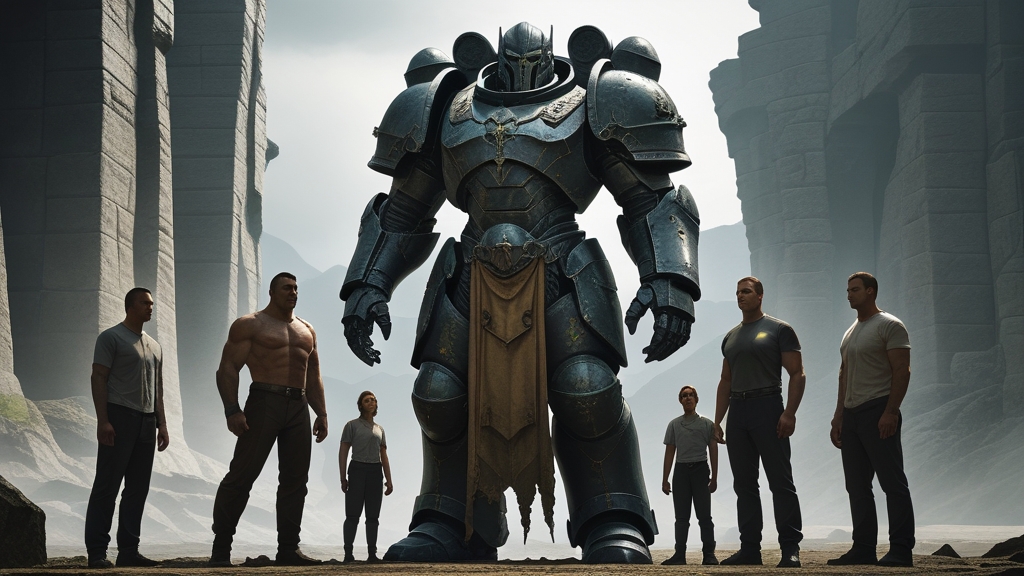
A standard Space Marine stands approximately 7 to 7.5 feet tall (213-229 cm) without armour. In full power armour, this increases to approximately 8 feet (244 cm) or more. Primaris Space Marines, the newer generation created by Archmagos Belisarius Cawl, are even larger — approximately 8.5 to 9 feet tall in armour.
This size makes Space Marines truly towering figures when standing among normal humans. A Space Marine in full armour dwarfs even the largest baseline human, and their sheer physical presence — combined with the bulk of their power armour — makes them seem more like walking tanks than individual soldiers. Exact heights and weights vary between sources, so treat these figures as typical rather than fixed.
What Equipment Do Space Marines Use?
Space Marines are equipped with some of the most advanced military technology in the Imperium, centred around two iconic pieces of equipment: power armour and the bolter.
Power Armour is the defining equipment of the Space Marines. These suits of ceramite-plated armour are marvels of technology — powered by a backpack-mounted reactor, interfaced directly with the Marine’s nervous system through the Black Carapace implant, and capable of shrugging off weapons fire that would destroy conventional vehicles. Power armour enhances a Space Marine’s already superhuman strength, provides environmental sealing for operations in vacuum or toxic atmospheres, and includes an advanced heads-up display with tactical information, squad communications, and targeting data.
The Bolter — more formally the Astartes-pattern boltgun — is the iconic weapon of the Space Marines. It fires mass-reactive rounds: small, self-propelled projectiles that penetrate their target and then detonate, blowing the target apart from the inside. A single bolter round can reduce a human to a spray of gore, and even heavily armoured targets are vulnerable to the sheer destructive force of these explosive rounds. Space Marines wield bolters one-handed with casual ease, firing with a precision that baseline humans could never achieve.
Beyond these basics, Space Marines have access to a vast arsenal including chainswords (motorised blades that chew through armour), power weapons (melee weapons wreathed in disruptive energy fields), plasma guns (superheated hydrogen weapons), melta guns (concentrated fusion beams), and heavy weapons like lascannons and missile launchers. Specialised units carry even more exotic equipment, from the jump packs of Assault Marines to the psychic hoods of Librarians.
What Are Space Marine Chapters?
Space Marines are organised into Chapters — semi-autonomous military organisations of approximately 1,000 Marines each. There are roughly 1,000 Chapters in existence, making the total Space Marine population approximately one million across the entire galaxy.
Each Chapter maintains its own fortress-monastery (often on a dedicated homeworld), its own fleet, its own traditions, and its own variant of the gene-seed inherited from one of the original Primarchs. Chapters are self-governing in most respects, answering ultimately to the High Lords of Terra but operating with enormous independence in practice.
The most famous Chapters include the Ultramarines (the poster boys of 40k, who maintain the Codex Astartes as the template for Chapter organisation), the Blood Angels (noble warriors cursed with a genetic flaw that drives them into berserk fury), the Space Wolves (viking-themed warriors from the frozen world of Fenris), the Dark Angels (secretive knights with a hidden shame), and the Imperial Fists (stoic defenders and siege specialists).
Who Are the Primarchs?
The Primarchs are the twenty demigod-like beings created by the Emperor of Mankind to lead his Space Marine Legions during the Great Crusade. Each Primarch was a genetically engineered superhuman of unimaginable power — towering warriors, brilliant tacticians, and charismatic leaders who served as both the genetic template and the commander of their respective Legion.
Nine Primarchs remained loyal to the Emperor during the Horus Heresy (Roboute Guilliman, Rogal Dorn, Leman Russ, Jaghatai Khan, Vulkan, Corvus Corax, Lion El’Jonson, Sanguinius, and Ferrus Manus), while nine turned traitor (Horus, Fulgrim, Perturabo, Konrad Curze, Angron, Mortarion, Magnus the Red, Lorgar, and Alpharius). Two Primarchs — the Second and Eleventh — have been erased from Imperial records entirely.
Of the loyal Primarchs, two are active in the current setting. Roboute Guilliman was revived from his centuries-long stasis and now leads the Imperium as its Lord Commander, and Lion El’Jonson has also returned after ten thousand years. The fates of the other loyal Primarchs vary: some are dead, others missing, and the Imperium’s legends say some may return in its hour of greatest need.
What Is Daily Life Like for a Space Marine?
Space Marines do not spend every waking moment in combat. Between campaigns, a Marine’s time is filled with training, battle drills, prayer and ritual, meditation, maintaining his wargear and studying tactics and the enemy. The exact routine depends on the Chapter: the Codex Astartes sets out guidance, but Chapters such as the Space Wolves or White Scars follow their own traditions, and the lore doesn’t give a fixed daily timetable that applies to everyone.
Their implants change how they rest. The Catalepsean Node lets a Space Marine rest parts of his brain in turn while staying alert, so he needs far less conventional sleep than a human. The Preomnor lets him eat almost anything without being poisoned, which is useful on campaign far from supply lines.
Social interaction between Space Marines is formal and hierarchical. They call each other “brother” and form bonds of fellowship forged in battle, but they have no families or romantic relationships, and their lives are devoted to war and the service of the Emperor.
How Long Do Space Marines Live?
Space Marines are functionally immortal in terms of aging. Their enhanced biology halts the aging process once they reach physical maturity, meaning a Space Marine does not grow old, develop age-related diseases, or deteriorate over time. Some Space Marines have lived for more than a thousand years. Dante of the Blood Angels, one of the oldest living Space Marines, has served for well over a millennium.
However, Space Marines are far from immortal in practice. They are warriors, and their entire existence revolves around combat against the most dangerous threats in the galaxy. The vast majority of Space Marines die in battle long before old age could ever become a factor. The average lifespan of a Space Marine, measured from induction to death in combat, varies enormously depending on the Chapter and the threats they face, but few survive more than a few centuries of constant warfare.
Can Space Marines Have Families?
No. The process of creating a Space Marine eliminates all sexual drive and reproductive capability. The genetic engineering and hormonal alterations that create a Space Marine fundamentally reshape their psychology, removing the desire for romantic or sexual relationships. Space Marines are conditioned to view their Chapter as their family — their Battle-Brothers as siblings, their Captains as fathers, and their Chapter Master as patriarch.
This is by design. The Emperor created the Space Marines as a dedicated military force, and anything that might divide their loyalties — romantic attachments, children, family obligations — was deliberately engineered out of their biology. A Space Marine’s only loyalty is to the Emperor, the Imperium, and their Chapter.
What Are Primaris Space Marines?
Primaris Marines are a new generation of Space Marines created by Archmagos Belisarius Cawl over a period of 10,000 years, using improved gene-seed technology and three additional implant organs. They were introduced to the setting (and the tabletop) during the Era Indomitus, when Roboute Guilliman was resurrected and launched the Indomitus Crusade to reclaim the Imperium.
Primaris Marines are larger, stronger, and more resilient than their Firstborn predecessors. They have access to new equipment — including Mk X Tacticus and Phobos armour, bolt rifles, and Repulsor grav-tanks — and are organised into new unit types including Intercessors (versatile line infantry), Hellblasters (plasma-armed infantry), and Inceptors (jump-pack troops who drop into battle). The introduction of Primaris Marines has been the most significant change to the Space Marine range in decades, with almost every new Space Marine kit for several years being Primaris. Since 10th Edition Games Workshop has largely dropped the Primaris label, and newer kits such as the Terminators and Sternguard Veterans are simply sold as Space Marines.
Frequently Asked Questions
How many Space Marines exist?
Approximately one million Space Marines exist across roughly 1,000 Chapters of about 1,000 Marines each. This makes them incredibly rare — a tiny number spread across an Imperium of countless billions of people. They are not a conventional army but an elite strike force, deployed only against the most critical threats.
Can Space Marines die?
Yes. Despite their extraordinary resilience, Space Marines can be killed by sufficient force. Heavy weapons, sustained fire, powerful melee attacks, psychic assaults, and weapons specifically designed to penetrate power armour can all kill a Space Marine. They are incredibly difficult to kill compared to normal humans, but they are not invulnerable. Most Space Marines ultimately die in combat.
Are Space Marines human?
This is a philosophical question with no definitive answer. Space Marines are created from human stock and retain human-level intelligence, personality, and — in some cases — emotional depth. However, the genetic engineering, organ implantation, and psychological conditioning they undergo transform them so completely that many in the Imperium consider them something beyond human — angels of the Emperor, demigods in ceramite. In practical terms, a Space Marine is transhuman: born human but transformed into something greater and more terrible.
What is the Black Carapace?
The Black Carapace is the final implant a Space Marine receives, and it is what allows them to interface directly with power armour. This sub-dermal membrane bonds with the Marine’s nervous system and connects to ports in the power armour, creating a seamless neural link. With the Black Carapace, power armour becomes an extension of the Marine’s body rather than an external suit — they can feel through it, react through it, and control it with the same instinctive ease as their own limbs.
What is the difference between Firstborn and Primaris Marines?
Firstborn Marines are created using the original 19-organ gene-seed implantation process established during the Great Crusade. Primaris Marines receive three additional organs — the Sinew Coils (reinforced tendons), the Magnificat (growth hormone regulator), and the Belisarian Furnace (emergency combat stimulant) — making them physically superior to Firstborn. On the tabletop, Primaris and Firstborn units now sit side by side in the same codex, and each datasheet has its own profile, so compare the units you are interested in in the current Space Marines codex rather than assuming a blanket difference. Lore-wise, the integration of Primaris Marines into existing Chapters has been a source of tension, with some Firstborn viewing the newcomers with suspicion.
Can women become Space Marines?
No. In the lore, the gene-seed organs only work with male tissue, so only boys can be implanted. The Imperium’s elite female warriors come from other organisations, such as the Adepta Sororitas (Sisters of Battle) and the Sisters of Silence, rather than the Adeptus Astartes.
What is a Chaos Space Marine?
A Chaos Space Marine is a Space Marine who has turned against the Emperor and serves the Chaos Gods. Many are veterans of the traitor Legions that rebelled with Horus during the Horus Heresy, ten thousand years ago; others are renegades who have fallen since. They share the same biology as loyalists but are often mutated and corrupted by the Warp.
Who created the Space Marines?
The Emperor of Mankind created the Space Marines, using the genetic templates of his twenty Primarchs to make the gene-seed for their Legions. Ten thousand years later, Archmagos Belisarius Cawl created the Primaris Marines by building on that work. Every Chapter’s gene-seed traces back to one of the original Primarchs.