
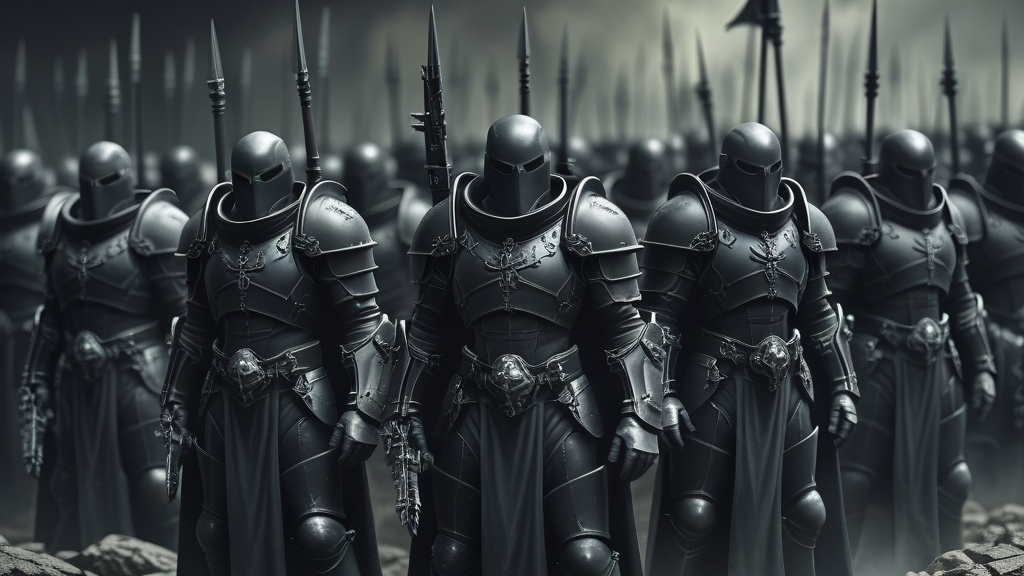
Raven Guard are the unseen predators of the Warhammer 40k universe, masters of stealth and guerrilla warfare.
Striking from the shadows with precision and speed, they hit their enemies hard and vanish before the counter-attack lands. Their identity is built on infiltration, lightning-fast strikes and mobility.
On the tabletop they are a Space Marine Chapter like any other, so new players get the full, flexible Space Marine range — themed around Phobos-armoured infiltrators, jump-pack assault troops and snipers. Painting them is all about making black armour read well with subtle highlights.

Who Are Raven Guard?
Raven Guard are the Emperor’s secret hunters, the black-armoured spectres that haunt the galaxy’s warzones.
Descended from their brooding Primarch, Corvus Corax, they are the silent hand of the Imperium. Where others charge head-on, Raven Guard slip through the shadows and strike only when the moment is right. They are masters of sabotage, infiltration and assassination, waging war with surgical precision.
Once a proud Legion, the Raven Guard were all but destroyed during the Horus Heresy, betrayed at the Dropsite Massacre. They have never fully recovered their numbers, and instead became the scalpel where others wield the hammer: hit-and-run raids, decapitation strikes and battlefield misdirection, forever carrying the scars of that betrayal.
What Are Raven Guard’s Army Strengths?
Raven Guard embody subtlety and precision. Here’s what a Raven Guard-themed army does well:
- Stealth and infiltration: Phobos units such as Infiltrators, Incursors and Eliminators can set up forward or stay hidden, letting you control where the fight happens from the first turn.
- Precision strikes: snipers and fast assault units can pick off characters and vulnerable support units before they can react.
- Mobility: jump-pack troops and units that arrive from reserves let you reposition quickly, exploit gaps in the enemy line and threaten the backfield.
- Making the opponent react: threats that can appear anywhere force your opponent to spread out and play on your terms.
- Flexibility: as Space Marines, Raven Guard can still field the full range of tanks, Terminators and battleline infantry when a mission calls for it.
Where Should Beginners Start?
For new players looking to command the Raven Guard, these units suit the Chapter’s style:
- Infiltrators: light, stealthy Phobos infantry that set up ambushes and deny the enemy space near your lines.
- Captain in Phobos Armour: a stealthy commander who fits naturally at the head of a Phobos force.
- Vanguard Veterans with Jump Packs: fast shock troops for blitzing enemy lines in classic Raven Guard hit-and-run style.
- Eliminators: snipers built to remove high-value targets from a distance.
- Reivers: close-quarters terror troops, equipped with grav-chutes in the lore for dropping straight into the fight.
- Suppressors: mobile fire-support troops that pin the enemy down while the rest of your force moves in. In 11th Edition they no longer have their own datasheet and are fielded using the Inceptor Squad rules.

Raven Guard Lore and History
The Raven Guard were the XIX Legion, founded by the enigmatic Primarch Corvus Corax. Corax grew up on the prison moon of Lycaeus, where he led a bloody uprising against its overlords before he was discovered by the Emperor. That origin forged a Primarch who valued freedom, subtlety and precision over brute force — a commander who understood that the most devastating blow is the one the enemy never sees coming. Under Corax, the Raven Guard became masters of guerrilla warfare, stealth operations and precision strikes.
The Legion suffered catastrophically at the Dropsite Massacre on Isstvan V, where it was nearly annihilated alongside the Salamanders and Iron Hands. Corax’s desperate attempts to rebuild his shattered Legion through gene-seed experimentation ended in tragedy, producing monstrous mutants. That failure haunted the Primarch until he departed for the Eye of Terror, leaving behind a single word: “Nevermore”. The Chapter has never fully recovered its numbers, though the arrival of Primaris Marines has helped restore its strength.
The Raven Guard’s way of war emphasises covert operations, infiltration and surgical strikes against high-value targets. Their warriors are trained to operate independently behind enemy lines, gathering intelligence and eliminating key targets before the enemy even knows it is under attack. Kayvaan Shrike, once a famous Shadow Captain and now Chapter Master, exemplifies this — appearing from nowhere to deliver a killing blow before vanishing again. Their pale skin and dark eyes, a quirk of their gene-seed, give them a ghostly appearance that suits their reputation.
Raven Guard on the Tabletop in 11th Edition
Raven Guard use the Space Marines codex. There’s no separate Chapter Tactic giving them cover in the open or protection at long range — that kind of chapter-wide rule belongs to earlier editions. Instead you capture the Raven Guard style through your choice of detachments and units, including the Chapter’s own Shadowmark Talon detachment. In 11th Edition you spend Detachment Points on one to three detachments (2 DP at 1,000 points, 3 DP at 2,000 points), so you can build around Phobos, reserves and fast-attack detachments that suit the Chapter. Check the current codex and the Munitorum Field Manual for which detachments are available, what they cost and what they do.
The 11th Edition core rules also suit the Raven Guard playstyle well:
- Hidden: Infantry in terrain that haven’t shot this turn or last turn are only visible within 15″, which rewards patient, dug-in Phobos units.
- Cover: cover now worsens the attacker’s Ballistic Skill by 1 against ranged attacks for Infantry in terrain, and Stealth gives a unit the benefit of cover at all times.
- Deep Strike and reserves: deep strikers can arrive from battle round 2 anywhere more than 8″ from enemy units, including in the enemy deployment zone.
- Lone Operative: units with this ability can’t be seen from more than 12″ away unless they’re attached to another unit.
Expect to win through positioning and target priority rather than raw durability. See our Warhammer 40k faction tier list for where Space Marines currently stand.
Collecting Raven Guard
A Raven Guard collection usually leans on Phobos-armoured units, which gives a visually cohesive and tactically focused army. There’s no Raven Guard-specific Combat Patrol box; you start from the standard Space Marines Combat Patrol and paint it in Raven Guard colours. Our Raven Guard Combat Patrol guide covers how to play that box as Raven Guard.
Infiltrators, Incursors and Eliminators form the backbone of a Phobos force, with a Captain or Librarian in Phobos Armour to lead them. Jump-pack units add melee punch. For a centrepiece character, Kayvaan Shrike is the obvious choice. The Invictor Tactical Warsuit, a stealthy walker that can set up forward, also suits the Chapter’s style.
How to Paint the Raven Guard
Painting the Raven Guard means making black armour look deep and dark while still showing its shape. The classic scheme is black armour with white Chapter markings and red eye lenses. Their look should be cold and understated rather than flashy.
Classic Raven Guard Scheme
- Base colour: Abaddon Black for the armour.
- Shading: Nuln Oil in the recesses and joints.
- Highlights: Eshin Grey for subtle edge highlights, with a finer Dawnstone or Fenrisian Grey edge on the sharpest corners.
- Metals: Leadbelcher for weapons, bionics and mechanical details, edged with Stormhost Silver.
- Accents: Mephiston Red for eye lenses and small details.
- Skin: Rakarth Flesh with a Druchii Violet wash for the Chapter’s unnaturally pale complexion.
- Markings: crisp white for Chapter icons and lightning-bolt motifs.
For a slightly softer, blue-tinted black, swap the base for Corvus Black and shade with Drakenhof Nightshade. A cool green or blue on lenses and power cells also works if you want something less traditional.

Raven Guard Painting Techniques
- Subtle edge highlighting: use a dark grey or very light blue-grey to edge the black armour, focusing on the edges where light would naturally hit. This shows the shape of the armour without losing the dark look.
- Drybrushing for texture: lightly drybrush grey or metallic paint onto weapons, backpacks and mechanical parts to suggest wear.
- Object source lighting (OSL): use a glowing red or green on eye lenses, weapon barrels or power packs, starting with a bright spot and blending outward, for a predatory glow.
- Weathering and battle damage: sponge on subtle metallic chips at exposed areas like knees, elbows and shoulder pads.
- Camo cloaks: Phobos units’ cloaks are a chance to add an environmental camo pattern and some visual interest against all that black.
- Freehand: the raven iconography on shoulder pads and banners is a good place to try freehand.
- Matt varnish: finish with a matt varnish to keep the armour dark and non-reflective.
Visit our Raven Guard painting guide for step-by-step techniques.
Related Armies
If you enjoy Raven Guard, you might also like these armies:
- Iron Hands — fellow survivors of the Dropsite Massacre, bound to the Raven Guard by shared tragedy.
- Salamanders — the third Legion caught at Isstvan V, with a very different, resilient style of war.
- White Scars — another Chapter built around rapid strikes and hit-and-run tactics.
Everything Raven Guard on Warhammer Guild
Frequently Asked Questions
Who are the Raven Guard?
The Raven Guard are a stealthy Space Marine Chapter founded by the Primarch Corvus Corax. They specialise in covert operations, guerrilla warfare and surgical strikes, using stealth and misdirection to defeat enemies larger and stronger than themselves.
Are Raven Guard good for beginners?
Yes, with a caveat. As Space Marines they have a forgiving, well-supported range, but a stealth-focused Raven Guard army rewards careful positioning and target priority, which takes a few games to learn.
What are the strengths of Raven Guard?
A Raven Guard-style army excels at forward deployment, reserves and precision strikes. Phobos units can set up forward and stay hidden, snipers can target characters, and deep strikers can hit hard from unexpected angles.
What are the weaknesses of Raven Guard?
Stealthy, lightly armoured units lack staying power in prolonged engagements. Once their initial strikes are made, they can struggle to hold ground against more durable armies. They need to win through precision, not attrition.
How does Raven Guard stealth work on the tabletop?
There’s no Raven Guard-only stealth rule in the current game. Stealth comes from the units and detachments you choose plus the 11th Edition core rules: Infantry hidden in terrain are only visible within 15″, cover worsens incoming ranged attacks’ Ballistic Skill by 1, and Infiltrators, Scouts and Deep Strike let units start forward or arrive where they’re needed.
Who leads the Raven Guard?
Kayvaan Shrike leads the Raven Guard as Chapter Master. He made his name as a Shadow Captain famous for jump-pack ambushes and hit-and-run raids, and he still leads from the front in the same style. Their Primarch, Corvus Corax, vanished into the Eye of Terror after the Horus Heresy, leaving only the word ‘Nevermore’.
What is the Raven Guard homeworld?
The Raven Guard’s homeworld is Deliverance, the former prison moon of Lycaeus. It orbits the forge world of Kiavahr. Corax led the prisoners’ uprising there, and after the revolt the moon was renamed Deliverance. It remains the Chapter’s home and the site of its fortress-monastery, the Ravenspire.
Related Content
- 40k Factions Ranked — Competitive tier list
- 40k on a Budget — Start collecting cheap
- How to Play 40k — Beginner rules guide
- All Factions Guide — Every faction explained