
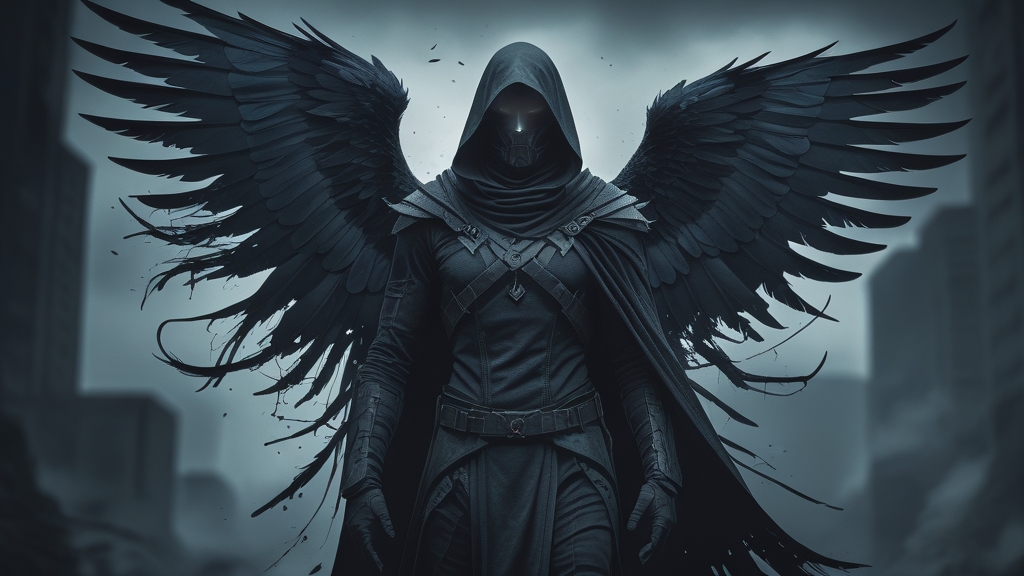
Part of our Raven Guard hub: every Raven Guard guide, lore page and painting tutorial in one place.
Corvus Corax is the Primarch of the Raven Guard, the nineteenth Legion of the Adeptus Astartes. Known as the Deliverer, the Shadowed Lord, and the Raven Lord, Corax is a master of stealth warfare, guerrilla tactics, and liberation. His story is one of the most tragic among the loyalist Primarchs — a leader who fought to free the oppressed, only to see his legion nearly destroyed and his desperate attempts to rebuild it spiral into horror. Today, Corvus Corax stalks the Warp as something no longer entirely human, hunting the traitors who betrayed the Imperium.
Who Is Corvus Corax?
Corvus Corax is one of the twenty Primarchs created by the Emperor of Mankind to lead His Great Crusade across the galaxy. Like all Primarchs, Corax was scattered from the Emperor’s laboratory on Terra by the Chaos Gods and landed on a distant world where he grew to adulthood before being reunited with his father. What sets Corax apart from his brothers is his deep, abiding hatred of tyranny and oppression. While many Primarchs conquered through brute force or strategic genius, Corax liberated. He fought for the downtrodden and the enslaved, and this moral core defined everything about him and his legion.
Physically, Corvus Corax is distinctive among the Primarchs. He is pale-skinned with coal-black eyes that have no visible iris or sclera — just pools of darkness that seem to absorb light. His black hair and dark armour complete the raven-like appearance that gave his legion its name. Most remarkably, Corax possesses a supernatural ability to blend into shadows, becoming effectively invisible even to enhanced senses. This is not technology or camouflage — it is an innate psychic gift that allows him to exist in a state between visibility and invisibility.
Origins: The Slave Revolt on Lycaeus
Corvus Corax’s incubation pod landed on the moon of Lycaeus, a mining colony orbiting the planet Kiavahr. Lycaeus was a place of misery and oppression. The tech-guilds of Kiavahr used the moon as a mining operation staffed entirely by slave labour. The workers lived and died in the mines, subjected to brutal conditions, starvation, and casual cruelty. It was into this hell that the infant Primarch fell.
Corax was found and raised by the slaves themselves. Unlike many Primarchs who were raised by rulers or warriors, Corax grew up among the lowest and most oppressed people imaginable. This shaped his character fundamentally. He saw firsthand what tyranny did to ordinary people, and he developed an unshakeable commitment to liberation and justice that would define his entire existence.
As Corax grew to adulthood at an inhuman rate, his superhuman abilities became apparent. He was stronger, faster, and smarter than any normal human, and he possessed the uncanny ability to move unseen through even the most heavily guarded areas. He used these gifts to organise a slave rebellion. Over months of careful planning, Corax built a resistance movement within the mines, training fighters, stockpiling weapons, and coordinating a simultaneous uprising across the entire moon.
When the revolt came, it was devastating. The slaves rose as one, overwhelming their overseers and seizing control of Lycaeus in a single coordinated strike. Corax led from the front, using his shadow-walking abilities to eliminate key targets and sow confusion among the defenders. The tech-guilds of Kiavahr attempted to retake the moon, but Corax had prepared for this, turning the moon’s own defences against them and negotiating from a position of strength.
The liberated slaves renamed their moon Deliverance, and Corax became their unquestioned leader — not through fear or force, but through the loyalty he had earned by fighting alongside them and suffering as they suffered. When the Emperor arrived to reclaim His lost son, He found not a warlord or a conqueror, but a liberator who had built a society based on freedom and justice. The Emperor was reportedly pleased, and Corax was given command of the XIX Legion, which he renamed the Raven Guard.
The Great Crusade
Corvus Corax led the Raven Guard across the galaxy during the Great Crusade, bringing human worlds into compliance with the burgeoning Imperium. His approach to warfare was markedly different from brothers like Angron or Perturabo. Where they used overwhelming force and accepted massive casualties, Corax employed stealth, precision strikes, and guerrilla tactics to achieve objectives with minimal loss of life — both for his own legion and for civilian populations.
The Raven Guard became masters of covert operations. They would infiltrate a world, identify key leadership targets and infrastructure, then launch devastating precision strikes that decapitated the enemy’s command structure before they even knew they were under attack. This approach was enormously effective but also slower than the brute-force methods of other legions, which occasionally drew criticism from more aggressive Primarchs.
Corax’s relationship with his brother Primarchs was complex. He had a particular antipathy toward Konrad Curze of the Night Lords and Angron of the World Eaters — Primarchs whose methods of warfare relied on terror and brutality that Corax found morally abhorrent. He was closer to Horus, who respected Corax’s tactical brilliance, and to Vulkan, who shared Corax’s concern for civilian casualties. His relationship with the Emperor was respectful but distant; Corax obeyed, but he harboured private doubts about some of the Imperium’s methods.
The Horus Heresy and the Dropsite Massacre
When Horus turned traitor and launched his rebellion against the Emperor, Corvus Corax remained loyal without hesitation. The betrayal of Horus shocked Corax, but his moral compass was unshakeable — tyranny was tyranny, regardless of who practised it, and Horus had chosen to become a tyrant.
Corax led the Raven Guard as part of the loyalist response force sent to the Isstvan system to confront Horus. This would prove to be the darkest day in the Raven Guard’s history. At the Dropsite Massacre on Isstvan V, the loyalist legions — the Raven Guard, Salamanders, and Iron Hands — attacked the traitor positions, expecting reinforcements from four other legions. Those reinforcements came, but instead of supporting the loyalists, the supposedly loyal legions revealed their own treachery and attacked the loyalists from behind.
The result was a catastrophe. Caught between the traitor legions, the Raven Guard was nearly annihilated. Ferrus Manus of the Iron Hands was killed. Vulkan was believed dead. Corvus Corax fought with desperate fury, his shadow-walking abilities allowing him to survive situations that should have been fatal, but he could not save his legion. By the time Corax managed to escape Isstvan V, the Raven Guard had been reduced from a full legion of approximately eighty thousand marines to a shattered remnant of fewer than three thousand.
The Dropsite Massacre broke something in Corvus Corax. He had always fought to protect others, and yet he had led his sons into a trap that destroyed them. The guilt and rage would consume him for the remainder of the Heresy and beyond.
The Raptor Project
Desperate to rebuild his shattered legion, Corvus Corax returned to Terra and petitioned the Emperor for help. The Emperor, recognising the desperate situation, granted Corax access to the original Primarch genetic template — the raw genetic material from which the Primarchs themselves had been created. With this, Corax hoped to accelerate the creation of new Space Marines and rapidly rebuild the Raven Guard’s numbers.
The Raptor Project, as it became known, was initially promising. Using the Primarch genetic data, Corax and his Apothecaries were able to dramatically speed up the process of creating new Space Marines. The first results were encouraging — the new marines, dubbed Raptors, were larger and more powerful than standard Astartes, though they lacked some of the refinement of normally created marines.
However, the project was sabotaged. Alpharius and Omegon of the Alpha Legion had infiltrated the Raven Guard’s operations and corrupted the genetic data. As the Raptor Project continued, the new creations became increasingly unstable and monstrous. Rather than producing enhanced warriors, the corrupted process created twisted, deformed creatures — still loyal and still capable of fighting, but no longer truly human or Astartes. These mutant Raptors were savage and uncontrollable, more beast than warrior.
Corvus Corax was faced with an impossible choice. The creatures his project had produced were still his sons — loyal, willing to fight and die for the Imperium. But they were abominations, and their existence was a testament to his hubris in thinking he could shortcut the Emperor’s own processes. In one of the most heartbreaking moments in all of Warhammer 40,000 lore, Corax personally euthanised the mutant Raptors, granting them the Emperor’s Peace. It is said that he wept as he did it.
The failure of the Raptor Project compounded Corax’s grief from the Dropsite Massacre. He had not only failed to protect his legion at Isstvan V, but his attempt to rebuild it had produced monsters. The psychological toll was immense.
Disappearance into the Eye of Terror
After the Horus Heresy ended with the Siege of Terra and the Emperor’s internment on the Golden Throne, Corvus Corax withdrew increasingly from the affairs of the Imperium. He spent long periods alone in his quarters aboard the Raven Guard’s flagship, speaking to no one. His officers heard him repeating a single word through the locked door: “Nevermore.”
Eventually, Corvus Corax departed the Raven Guard entirely. He left his legion in the capable hands of his surviving officers and set course for the Eye of Terror — the great Warp rift where the traitor legions had retreated. His stated purpose was vengeance. He would hunt the traitors who had destroyed his legion at the Dropsite Massacre, pursuing them into the Warp itself if necessary.
For ten thousand years, Corvus Corax has been inside the Eye of Terror, hunting traitor marines. Reports from the few survivors who have encountered him describe something terrifying — Corax is no longer entirely physical. He has become something like a living shadow, a creature of darkness that can manifest from any shadow and strike with devastating lethality before vanishing again. Some sources describe him as having become a daemon-like entity, but one of loyalty and vengeance rather than Chaos.
Becoming a Shadow
The transformation of Corvus Corax within the Warp is one of the most fascinating developments in recent Warhammer 40,000 lore. During the events surrounding the fall of Cadia and the opening of the Great Rift, Corax appeared on the daemon world of Lorgar’s exile. There, he attacked the Word Bearers Primarch Lorgar — one of the architects of the Horus Heresy — in a form that was no longer recognisably human.
Corax had become a being of shadows. He could shift between a physical form and a shadow state, he commanded flocks of spectral ravens, and his presence caused light itself to flee. This was not Chaos corruption — Corax remained loyal to the Emperor. Instead, it appears that his innate psychic gifts, combined with millennia spent in the Warp, had evolved him into something new. His ability to walk in shadows, which he had possessed since childhood on Lycaeus, had grown to the point where he had become shadow itself.
His attack on Lorgar was devastating. The Primarch of the Word Bearers, who had spent ten thousand years growing in daemonic power, was forced to flee from Corax. This suggests that Corax’s power in his shadow form is enormous — potentially rivalling or exceeding the daemon Primarchs themselves. For fans of the Raven Guard and the loyalist cause, this is a source of considerable satisfaction.
The implications of Corax’s transformation are profound. It suggests that the Primarchs’ potential was never fully realised during the Great Crusade, and that given enough time and the right circumstances, they can evolve beyond their original design. Corax has become something unprecedented — a loyalist entity of Warp-like power who hunts traitors through the immaterium itself.
For more on the Raven Guard chapter, visit our Raven Guard army guide. To understand the broader context of the Heresy, see our Horus Heresy explained guide.
Frequently Asked Questions
Is Corvus Corax dead?
No, Corvus Corax is not dead. He is one of the few loyalist Primarchs whose survival is confirmed in current lore. He exists within the Eye of Terror as a shadow-like entity, hunting traitor marines. He has been directly depicted attacking Lorgar in recent lore, confirming he is alive and more powerful than ever.
What are Corvus Corax’s abilities?
Corax possesses superhuman physical abilities common to all Primarchs, but his unique gifts centre on stealth and shadow manipulation. He can become effectively invisible, blend into any shadow, and in his current evolved form, transform into a being of living shadow. He commands spectral ravens and can manifest and attack from any area of darkness. He is also an exceptional tactician specialising in guerrilla warfare and precision strikes.
Why did Corvus Corax say “Nevermore”?
The word “Nevermore” is a direct reference to Edgar Allan Poe’s poem “The Raven,” which is the literary inspiration for Corvus Corax and the Raven Guard. In the lore, Corax repeated this word as a mantra of grief and determination — a vow that he would never again allow the failures of the Dropsite Massacre and the Raptor Project to be repeated, and that the traitors would “nevermore” escape justice.
Could Corvus Corax return to the Imperium like Roboute Guilliman did?
It is possible but uncertain. Corax’s transformation in the Warp makes a physical return complicated — he may no longer be able to exist fully in the material universe in the way he once did. However, Games Workshop has been slowly advancing the narrative of Primarch returns, and Corax is one of the more likely candidates given his confirmed survival and recent lore appearances.
What is the relationship between Corvus Corax and Konrad Curze?
Corvus Corax and Konrad Curze (the Night Haunter, Primarch of the Night Lords) are often considered dark mirrors of each other. Both operate in darkness and use stealth and fear as weapons, but their motivations are opposite. Corax uses shadow to liberate and protect, while Curze uses darkness to terrorise and control. They despised each other during the Great Crusade and Heresy, and their philosophical conflict embodies the difference between justice and tyranny.
What happened to the Raven Guard after Corvus Corax left?
The Raven Guard survived as a chapter and continues to operate in the 41st Millennium. They rebuilt their numbers slowly over the millennia following the Heresy and remain one of the loyalist Space Marine chapters, maintaining their founder’s traditions of stealth warfare and precision strikes. They honour Corax’s memory and teachings while awaiting the potential return of their Primarch.
What does Corvus Corax mean?
Corvus corax is the scientific Latin name of the common raven, which is why the name suits the Raven Guard’s primarch so well. The name was given to him on Lycaeus, and the raven theme runs through his whole Legion: black armour, raven iconography, and the stealthy, watchful style of war they’re known for. Even his famous ‘Nevermore’ is a nod to Poe’s The Raven.
Is there a Corvus Corax model?
Yes. Forge World has made a resin Corvus Corax miniature for the Horus Heresy game, showing him with his flight pack and lightning claws. He doesn’t have rules or a model for current Warhammer 40,000, because he isn’t active in the 41st millennium storyline. Raven Guard players can still use him in Heresy-era games.
Related Content
- The Horus Heresy Explained — Complete Timeline & Guide — understand the pivotal Horus Heresy era
- Best Warhammer Books to Read — Fiction Guide — find great Warhammer novels to read
- Warhammer Etiquette Guide — Sportsmanship & Table Manners — explore more Warhammer content