
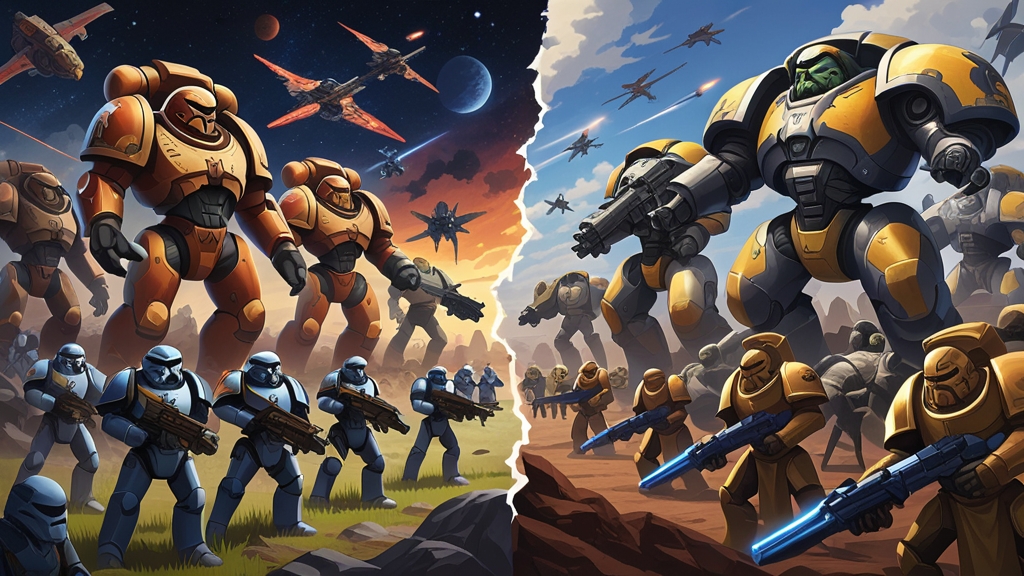
Warhammer 40,000 has 23 playable factions with their own codex, each with its own playstyle, look and lore. They fall into three broad groups: the Imperium of Man, the forces of Chaos, and the various Xenos (alien) races, all fighting for survival in a galaxy at endless war. This guide lists every playable faction in Warhammer 40k 11th Edition, with a short playstyle summary, a difficulty rating and a link to our detailed army guide.
Whether you’re a new player choosing your first army or a veteran wanting a quick reference, this is the place to start.
How Many Factions Are in Warhammer 40k?
There are 23 factions with their own codex: Space Marines, Astra Militarum, Adeptus Custodes, Adepta Sororitas, Adeptus Mechanicus, Imperial Knights, Grey Knights, Imperial Agents, Chaos Space Marines, Death Guard, Thousand Sons, World Eaters, Emperor’s Children, Chaos Daemons, Chaos Knights, Aeldari, Drukhari, Tyranids, Orks, Necrons, T’au Empire, Genestealer Cults and Leagues of Votann. Counts you see elsewhere range from about 21 to 28 because some sources also count the Space Marine Chapters with their own codex supplements (Blood Angels, Dark Angels, Space Wolves and Black Templars), and sometimes the Deathwatch, as separate armies.
The factions are grouped into the Imperium (humanity’s galaxy-spanning civilisation), Chaos (the corrupted forces of the Warp) and Xenos (alien races). Each plays very differently, from the elite, few-model armies of the Adeptus Custodes to the endless swarms of the Tyranids.
Under the 11th Edition rules, launched in June 2026, existing 10th Edition codexes stay valid until a faction receives its 11th Edition codex. Every faction builds its army the same way, by spending Detachment Points on one to three detachments. See our 11th Edition rules changes guide for how that works.
Imperium Factions
The Imperium of Man is the largest human civilisation in the galaxy, spanning around a million worlds and ruled, in theory, by the Emperor of Mankind from the Golden Throne on Terra. Imperium factions are the many military arms of this vast empire, from the superhuman Space Marines to the countless regiments of the Astra Militarum.
Space Marines
Space Marines are the iconic faction of Warhammer 40,000: genetically enhanced superhuman soldiers organised into Chapters of roughly 1,000 warriors each. They are the Imperium’s finest soldiers, each one stronger, faster and tougher than any baseline human. Space Marines are the most popular faction in the game and suit beginners and veterans alike.
Playstyle: Versatile and well-rounded. Space Marines can be built for shooting, melee or a balanced approach, and their wide range of detachments lets you push the army in almost any direction. They have good durability, solid firepower and strong melee options.
Difficulty: Beginner. Space Marines are the most beginner-friendly faction, with forgiving stats and a huge range of options.
Major Chapters:
- Ultramarines — Tactical flexibility, the “default” Space Marine Chapter
- Blood Angels — Aggressive melee specialists with a vampiric theme; own codex supplement and unique units
- Dark Angels — Combined arms with elite Deathwing Terminators and Ravenwing bikers; own codex supplement
- Space Wolves — Fierce, Norse-themed melee fighters with unique unit options; own codex supplement
- Black Templars — Zealous crusaders focused on close combat; own codex supplement
- Imperial Fists — Siege specialists and experts in fortification
- Iron Hands — Technology-focused, with a strong affinity for vehicles and Dreadnoughts
- Salamanders — Flame and melta weapon specialists
- Raven Guard — Stealth and infiltration specialists
- White Scars — Fast-attack specialists focused on speed and mobility
- Deathwatch — Xenos-hunting specialists with mixed-unit kill teams; fielded through dedicated Space Marine detachments rather than a codex supplement
Chapters without their own supplement use the main Space Marines codex and pick detachments that suit their theme.
Astra Militarum (Imperial Guard)
Astra Militarum, formerly known as the Imperial Guard, are the vast conventional armies of the Imperium: billions of ordinary human soldiers who hold the line against the horrors of the 41st Millennium through sheer numbers, heavy firepower and armoured might. Where Space Marines are a surgical strike force, the Astra Militarum is the Imperium’s sledgehammer.
Playstyle: Massed infantry backed by powerful tanks and artillery. Astra Militarum excels at ranged firepower and bringing overwhelming numbers to bear. Individual soldiers are weak, but they are cheap and numerous, and officers issue Orders to boost nearby units.
Difficulty: Intermediate. It needs careful positioning and Order management, and individual models are fragile.
Adeptus Custodes
Adeptus Custodes are the Emperor’s personal bodyguard, among the greatest warriors in the Imperium and each one individually superior to a Space Marine. The Emperor created them personally through a more refined process than the one used for the Astartes. Each Custodian is a one-man army clad in auramite armour and wielding master-crafted weapons.
Playstyle: Elite, low model count. Every Custodian is extremely powerful and durable. Armies often contain very few models, so each casualty matters. They excel in melee but have solid shooting options too.
Difficulty: Intermediate. Easy to learn thanks to the low model count, but every decision matters because you have so few models.
Adepta Sororitas (Sisters of Battle)
Adepta Sororitas, the Sisters of Battle, are the military arm of the Ecclesiarchy, the Imperium’s state church. They are fanatically devoted warriors who wield bolters, flamers and meltas while their faith manifests on the battlefield as genuine miracles.
Playstyle: Mid-range shooting with strong melee options. Sisters combine bolter-heavy firepower with Miracle dice, a faith-based resource that lets them replace key rolls with a result they’ve already banked. They have strong synergy between units and reward aggressive play.
Difficulty: Intermediate. Miracle dice add a layer of resource management that takes practice.
Adeptus Mechanicus
Adeptus Mechanicus are the tech-priests and machine-warriors of Mars, the Imperium’s technological priesthood. They worship the Machine God (the Omnissiah) and maintain the Imperium’s technology, from starships to bolters. On the battlefield they field augmented cyborg soldiers, arcane weapons and walking war machines.
Playstyle: Ranged-focused army with strong shooting at multiple ranges. Adeptus Mechanicus units tend to be fragile but deadly, with excellent special weapons and a mix of infantry, cavalry and vehicles. They reward careful positioning and target priority.
Difficulty: Advanced. Lots of rules interactions and relatively fragile units that punish positioning errors.
Imperial Knights
Imperial Knights are towering war machines piloted by noble houses. Each Knight is a walking fortress several storeys tall, armed with weapons that can level buildings. An Imperial Knights army has very few models, sometimes only a handful, each one a massive centrepiece.
Playstyle: Ultra-elite, ultra-low model count. Every big Knight is a devastating war machine, often backed by smaller Armiger-class Knights. They excel at destroying vehicles and monsters, and games hinge on keeping your few models alive and choosing targets wisely.
Difficulty: Beginner to Intermediate. Very few models to learn, but limited tactical flexibility and vulnerability to certain matchups.
Grey Knights
Grey Knights are a secret Chapter of psyker Space Marines, the Chamber Militant of the Ordo Malleus, created to hunt and banish daemons. Every battle-brother is a psyker clad in blessed power armour or Terminator armour and armed with nemesis force weapons. They have their own codex, separate from the main Space Marines book.
Playstyle: Elite, mobile strike force. Grey Knights field small numbers of very capable units, including plenty of Terminators, and are known for teleporting into position. Their psychic abilities are built into their datasheets rather than a separate phase.
Difficulty: Intermediate to Advanced. Low model count means every loss hurts, and getting the most from their mobility takes practice.
Imperial Agents
Imperial Agents represent the shadowy organisations that operate across the Imperium: the Inquisition, the Officio Assassinorum, the Sisters of Silence and other specialists. They can be fielded as their own army, and a limited number can be added to other Imperium armies to provide unique capabilities.
Playstyle: Highly specialised units that fill specific roles. Imperial Agents are often used to supplement other armies with assassins, Inquisitors and other unique characters. As a standalone force they offer a diverse, eclectic mix of elite operatives.
Difficulty: Advanced. Needs good game knowledge to use well, and relies on synergy and specific counter-play.
Chaos Factions
The forces of Chaos are the corrupted enemies of the Imperium: warriors, daemons and machines that serve the Chaos Gods. From the fallen Space Marines of the Traitor Legions to the daemonic hordes of the Warp, Chaos factions offer aggressive, often unpredictable playstyles.
Chaos Space Marines
Chaos Space Marines are the Traitor Legions and renegade warbands who turned against the Emperor during the Horus Heresy and still wage the Long War 10,000 years later. They combine the superhuman abilities of Space Marines with the dark blessings of Chaos: daemonic mutations, sorcery and unholy relics.
Playstyle: Aggressive and versatile. Chaos Space Marines mix melee power, sorcerers, daemon engines and possessed warriors. They tend to favour close-range fighting, with powerful characters and daemon-empowered units leading the charge.
Difficulty: Intermediate. Similar to Space Marines in complexity, with extra Chaos mechanics to manage.
Death Guard
Death Guard are the plague-ridden followers of Nurgle, the Chaos God of decay. Once the grim, resilient XIV Legion, they are now bloated, rotting warriors who spread disease across the galaxy. Led by the Daemon Primarch Mortarion, they are relentless and terrifyingly hard to kill.
Playstyle: Slow but incredibly durable. Death Guard are one of the toughest armies in the game, with high Toughness, damage reduction and strong close-range firepower. They lack speed but make up for it with sheer resilience and contagion-themed abilities that weaken nearby enemies.
Difficulty: Beginner. Very forgiving thanks to their durability, and the slower playstyle is easy to learn.
Thousand Sons
Thousand Sons are the sorcerous followers of Tzeentch, the Chaos God of change and magic. Their ranks include powerful psyker sorcerers and the eerie Rubric Marines, suits of power armour animated by sorcery after their occupants were reduced to dust. Led by the Daemon Primarch Magnus the Red, they are the game’s signature sorcerer army.
Playstyle: Shooting-focused army built around psychic attacks. There’s no separate psychic phase in modern 40k: Thousand Sons sorcery takes the form of psychic weapons and abilities on their datasheets, many of which deal mortal wounds or buff and debuff units. Rubric Marines are tough, reliable infantry with strong invulnerable saves.
Difficulty: Intermediate to Advanced. Getting the most out of them means knowing which sorcery to use and when.
World Eaters
World Eaters are the berserker followers of Khorne, the Blood God. Driven mad by the Butcher’s Nails implanted in their brains, they live for close combat and the spilling of blood. Led by the Daemon Primarch Angron, they are the most aggressive melee faction in the game.
Playstyle: Pure melee aggression. World Eaters want to get into combat as quickly as possible and butcher everything they reach. They have minimal shooting but devastating melee output. Games are fast and violent.
Difficulty: Beginner to Intermediate. A simple plan (charge and kill), but you need good movement and target selection to avoid being shot apart before you arrive.
Emperor’s Children
Emperor’s Children are the Traitor Legion devoted to Slaanesh, the Chaos God of excess. Once the III Legion, obsessed with perfection, they fell into decadence and sensation-seeking under their Primarch Fulgrim. Since 2025 they have been a standalone Chaos faction with their own codex and a new range of models, rather than a part of the Chaos Space Marines army.
Playstyle: Fast, aggressive and elite. Emperor’s Children favour swift assaults, sonic weaponry such as Noise Marines and duelling characters, and reward getting stuck in at the right moment.
Difficulty: Intermediate. Elite infantry that hit hard but punish poor charge timing.
Chaos Daemons
Chaos Daemons are the servants of the Chaos Gods, manifesting from the Warp to wreak havoc on the material universe. They include the Bloodletters of Khorne, Horrors of Tzeentch, Plaguebearers of Nurgle and Daemonettes of Slaanesh, along with their Greater Daemon commanders.
Playstyle: Varied, depending on which god’s daemons you emphasise. Khorne daemons are melee-focused, Tzeentch daemons are sorcery and shooting specialists, Nurgle daemons are durable anvils, and Slaanesh daemons are fast and deadly. Single-god and mixed armies are both viable.
Difficulty: Intermediate to Advanced. Daemon armies need careful list-building and an understanding of each god’s strengths and weaknesses.
Chaos Knights
Chaos Knights are the corrupted counterparts of Imperial Knights: towering war machines pledged to the Dark Gods, their pilots driven mad by exposure to the Warp. They share the Imperial Knights’ ultra-elite, low-model-count style, but with Chaos-themed abilities built around spreading dread and fear.
Playstyle: Ultra-elite, low model count, with smaller War Dog Knights supporting the big Knights. Chaos Knights are good at weakening enemy units’ morale and overwhelming them with firepower.
Difficulty: Beginner to Intermediate. Similar to Imperial Knights in accessibility.
Xenos Factions
The Xenos (alien) factions of Warhammer 40,000 are the non-human civilisations competing with humanity and Chaos for control of the galaxy. Each is radically different from the others, with its own mechanics, aesthetic and playstyle.
Aeldari (Eldar)
Aeldari, formerly known as Eldar, are an ancient, psychically gifted alien race whose great civilisation was destroyed by the birth of the Chaos God Slaanesh. Many survivors live on Craftworlds, vast world-ships drifting through space, fighting to prevent their species’ extinction. They are fast, fragile and highly specialised.
Playstyle: Each Aeldari unit excels at one thing and is vulnerable when caught out of position. Aeldari armies reward careful planning, precise movement and knowing when to commit and when to withdraw. They have powerful psykers such as Farseers and specialised Aspect Warriors for every role.
Difficulty: Advanced. Fragile units punish mistakes severely, so you need good game knowledge and tactical precision.
Drukhari (Dark Eldar)
Drukhari, the Dark Eldar, are the twisted kin of the Aeldari who live in the city of Commorragh within the Webway. They are raiders, pirates and sadists who sustain themselves by feeding on the suffering of others. On the battlefield they are blisteringly fast and very fragile.
Playstyle: Glass-cannon raiding force. Drukhari are one of the fastest armies in the game, hitting hard with poisoned weapons and dark lances from open-topped skimmers. They are very fragile and rely on speed and well-timed strikes to win before they are wiped out.
Difficulty: Advanced. Very fragile; they need expert movement and target priority to avoid being tabled early.
Tyranids
Tyranids are an extragalactic swarm of bio-engineered organisms driven by a collective Hive Mind to consume all biological matter in the galaxy. On the battlefield, Tyranid armies range from huge hordes of small creatures to towering bio-titans.
Playstyle: Swarm, monsters or both. Tyranids can be played as overwhelming hordes of cheap creatures, a smaller force of massive bio-monsters, or a mix. They excel in melee, are held together by Synapse creatures that relay the Hive Mind’s will, and can bury opponents under sheer volume of attacks.
Difficulty: Beginner to Intermediate. Horde lists need lots of models but are forgiving; monster-heavy lists are simpler to manage.
Orks
Orks are a warlike, fungoid alien race who live for fighting. They are among the most numerous species in the galaxy, and their technology runs on scrap engineering and collective belief: if enough Orks believe something works, it does. They bring plenty of comic relief to the setting while being a genuinely terrifying threat.
Playstyle: Aggressive, chaotic and fun. Orks bring huge numbers of choppy Boyz, ramshackle vehicles and unpredictable weapons. They excel in melee and close-range shooting, and their Waaagh! supercharges the army for a critical turn.
Difficulty: Beginner. Forgiving thanks to large numbers and a straightforward “charge forward and fight” plan.
Necrons
Necrons are an ancient race of immortal machine-beings who ruled much of the galaxy millions of years ago before entering a long slumber in their tomb worlds. Now awakening, they seek to reclaim their empire. They are known for self-repairing living metal bodies, devastating gauss weaponry and an implacable advance.
Playstyle: Durable, mid-range shooting army. Their Reanimation Protocols restore lost wounds and return destroyed models to units over the course of the game, so they are hard to kill for good. They have excellent anti-infantry and anti-vehicle shooting and reward steady, methodical play.
Difficulty: Beginner. Reanimation Protocols make the army forgiving, and the straightforward playstyle is easy to learn.
T’au Empire
T’au Empire is a young, technologically advanced alien civilisation built on the philosophy of the Greater Good, with advanced battlesuits and superb ranged firepower. The T’au are one of the few factions that could be called “hopeful”, which sets them in stark contrast to the grimdark tone of most other factions.
Playstyle: Shooting-focused army with little melee ability beyond their Kroot auxiliaries. T’au armies are built around powerful ranged weapons, from Fire Warrior pulse rifles to Crisis Battlesuits and Riptides, with units spotting for each other to improve their shooting. They rely on keeping enemies at arm’s length.
Difficulty: Intermediate. Strong shooting makes them effective, but their weakness in melee makes positioning critical.
Genestealer Cults
Genestealer Cults are alien-human hybrid cults that infiltrate Imperial worlds over generations, secretly worshipping the Tyranid Hive Mind as a god. When the time is right they rise in coordinated rebellion, weakening planetary defences for the arrival of the hive fleets. On the battlefield they use ambushes, mining equipment and stolen military hardware.
Playstyle: Ambush army. Genestealer Cults emerge from unexpected angles, overwhelm key targets with surprise attacks and can bring destroyed units back to the fight. They are fragile but have excellent alpha-strike potential and unusual deployment options.
Difficulty: Advanced. Ambush timing takes planning, fragile units are punished by mistakes, and deployment decisions are complex.
Leagues of Votann
Leagues of Votann are abhuman descendants of ancient human colonists, the Kin, nicknamed “Space Dwarfs” by fans. They are organised into Leagues guided by ancient AI Ancestor Cores, and fight with advanced technology including ion weaponry, exo-armour and heavily armoured vehicles. They joined the game in 2022.
Playstyle: Durable, mid-range shooting army with strong vehicles. Leagues of Votann have tough infantry, powerful short-to-mid-range weapons and a Judgement token mechanic that makes them more effective against enemies they’ve marked. They reward focused fire and grinding engagements.
Difficulty: Beginner to Intermediate. Durable and straightforward to play.
Choosing Your First Faction
Choosing your first Warhammer 40k faction is one of the biggest decisions you’ll make in the hobby. Here are the key factors to consider:
- Rule of Cool: Pick the faction whose models, lore and look appeal to you most. You’ll spend dozens of hours building and painting your army, so you need to love how it looks.
- Playstyle: Decide whether you prefer shooting, melee, sorcery, hordes of models or small elite forces. Each faction offers a different experience.
- Budget: Horde armies (Orks, Tyranids, Astra Militarum) need more models and cost more. Elite armies (Custodes, Knights, Grey Knights) need fewer.
- Competitive viability: Game balance changes regularly. Don’t choose a faction purely on current competitive strength; pick what you love, and the rules will cycle.
- Beginner-friendly factions: Space Marines, Necrons, Death Guard and Orks are generally considered the most beginner-friendly thanks to forgiving stats and straightforward playstyles.
Frequently Asked Questions
How many factions are in Warhammer 40k?
There are 23 factions with their own codex: Space Marines, Astra Militarum, Adeptus Custodes, Adepta Sororitas, Adeptus Mechanicus, Imperial Knights, Grey Knights, Imperial Agents, Chaos Space Marines, Death Guard, Thousand Sons, World Eaters, Emperor’s Children, Chaos Daemons, Chaos Knights, Aeldari, Drukhari, Tyranids, Orks, Necrons, T’au Empire, Genestealer Cults and Leagues of Votann. Some counts are higher because they treat Space Marine Chapters with their own codex supplements, such as Blood Angels and Space Wolves, as separate armies.
Which Warhammer 40k faction is best for beginners?
The best factions for beginners are Space Marines, Necrons, Death Guard and Orks. Space Marines are the most versatile and best-supported faction, with a huge range of models and resources. Necrons are durable and forgiving thanks to Reanimation Protocols. Death Guard are extremely tough, giving new players time to learn. Orks are fun, forgiving and encourage aggressive play.
Which Warhammer 40k faction is the most competitive?
Competitive strength changes with every balance update and new codex. No faction is permanently the best, and Games Workshop regularly adjusts points and rules to keep things balanced. Rather than chasing the current meta, choose a faction you enjoy: you’ll do better with an army you love and know well than with a “top tier” army you find boring.
Can Warhammer 40k factions ally?
Only in limited ways. Generally you build your army from a single faction’s datasheets. There are exceptions, such as including some Imperial Agents in other Imperium armies, and specific rules that allow limited cross-faction units. The details change with each edition and codex, so check the current Core Rules and your faction’s codex for what’s allowed.
What is the most popular Warhammer 40k faction?
Space Marines are by far the most popular Warhammer 40k faction, thanks to their iconic status, huge model range, deep lore, beginner-friendly rules and the variety offered by different Chapters. Among Xenos factions, Tyranids, Orks and Necrons are consistently popular.
What are the races in Warhammer 40k?
The main races in Warhammer 40,000 are humans (who make up the Imperium and most Chaos forces), the Aeldari (including the Drukhari and Harlequins), Orks, Necrons, Tyranids, the T’au and the Leagues of Votann. The T’au also field alien auxiliaries such as Kroot and Vespid, and Genestealer Cults are human-Tyranid hybrids. Chaos Daemons are warp entities rather than a mortal species.
Are Grey Knights and Emperor’s Children separate factions?
Yes. The Grey Knights are a separate Space Marine faction with their own codex, and the Emperor’s Children became a standalone Chaos faction with a dedicated codex and new models in 2025. Both are included in the 23 factions listed above.
Which Warhammer 40k races are not playable?
Several alien races exist only in the lore. Examples include the Hrud, the Jokaero, the long-extinct Old Ones, the Rak’Gol, the Enslavers and the Khrave. Some once-playable armies have come back in new forms: the old Squats returned in spirit as the Leagues of Votann, and Kroot and Vespid appear only as part of T’au armies rather than as factions of their own.
What is the difference between a faction and a subfaction in 40k?
A faction is an army with its own codex and rules, such as Space Marines or Necrons. A subfaction is a group within it, such as a Space Marine Chapter, an Aeldari Craftworld, a Tyranid Hive Fleet or an Ork clan, that shares the parent army’s units but has its own colours, lore and sometimes its own detachment or supplement. This is why faction counts vary between sources.