
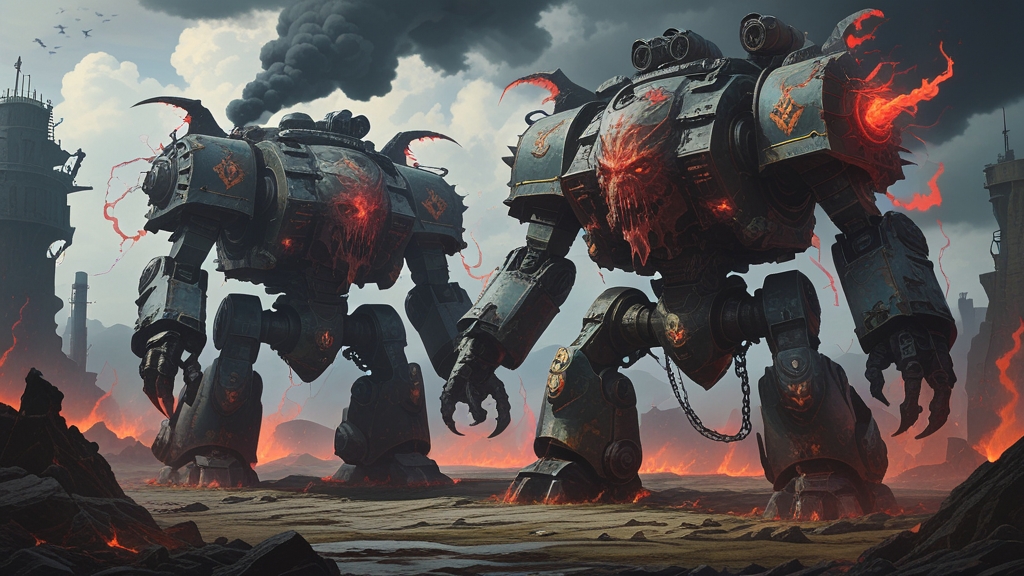
The Chaos Knights are towering war machines given over to the Dark Chaos Gods. Once noble Imperial Knights, they have turned their backs on the Imperium and the Emperor, and now stride across the galaxy as tyrants, butchers and daemon-haunted engines of ruin.
This guide covers who they are, what the army does well on the table, which kits to start with and how to paint them.
Who Are The Chaos Knights?
The Chaos Knights were once Imperial Knight households sworn to defend the Imperium. Some fell during the Horus Heresy itself, when several households sided with the Warmaster; others have been corrupted in the ten thousand years since, through tyranny, isolation or the whispers of the Warp working through their Thrones Mechanicum.
These fallen nobles may pledge themselves to Khorne, Tzeentch, Nurgle or Slaanesh, or serve Chaos Undivided. From towering Knight Tyrants to packs of War Dogs, they bring terror wherever they walk, driven by madness, hatred and the influence of their dark masters.
What Are Chaos Knights Army Strengths?
Chaos Knights are a low-model-count army of huge walkers. Here’s what makes them stand out:
- Sheer Firepower: Chaos Knights carry some of the heaviest guns in the game, such as the Desecrator’s laser destructor or the Despoiler’s avenger gatling cannon, and can threaten both infantry and vehicles.
- Durability: Each Knight has a huge pool of wounds and high Toughness, and big Knights carry invulnerable saves. Small arms barely scratch them.
- Dread: The army’s identity revolves around terrifying the enemy. Its abilities punish enemy units near your Knights, particularly ones that are already Battle-shocked. Check the current codex for the exact army rule.
- Melee Brutality: Many Knights carry reaper chainswords, thunderstrike gauntlets or flails, and their sheer size lets them crush infantry underfoot.
The drawbacks come from the same place: there are very few models, so every loss is keenly felt, and the army can struggle to hold several objectives at once or to screen against faster opponents. Big Knights are also Vehicles, so in 11th Edition they don’t get cover just for standing in a terrain footprint; they need genuine intervening terrain to hide behind.
Where Should Beginners Start?
If you’re new to Chaos Knights, these kits will teach you the army:
- Knight Desecrator: A versatile big Knight with a long-range laser destructor and strong melee options. A good first centrepiece.
- War Dogs: Small, fast Armiger-class walkers that harass the enemy, screen your big Knights and grab objectives. Every list needs some.
- Knight Rampager: A melee powerhouse armed with a reaper chainsword and heavy flail, perfect for aggressive players who want to get up close.
- Knight Despoiler: Highly adaptable, with a wide choice of weapons. Good for players learning to balance offence and defence.
- Knight Abominant: A daemon-touched Knight built for close combat, with a distinctive, warped look.
Starting with these units gives you experience of ranged firepower, mobility and close combat.
How To Paint Chaos Knights?
Painting Chaos Knights lets you bring corruption and battle-scarred armour to life. Here are two straightforward Citadel schemes, with tips and techniques.
Colour Schemes
Black and Red
- Base Coat: Abaddon Black on the armour panels and Mephiston Red for the red details.
- Layering: Highlight the black armour with Eshin Grey edges or a light drybrush, and the red areas with Evil Sunz Scarlet.
- Details: Retributor Armour or Balthasar Gold for trim and accents, shaded with Agrax Earthshade. Nuln Oil in the recesses adds depth.
Brass and Red
- Base Coat: Balthasar Gold (or Warplock Bronze for a darker tone) on the trim and metalwork, and Mephiston Red for the armour panels.
- Highlighting: Highlight the brass with Brass Scorpion and layer the red with Evil Sunz Scarlet.
- Details: Wash the metal with Agrax Earthshade for an aged, grimy finish, and pick out skulls, horns and Chaos icons with Screaming Skull or Ushabti Bone.
Chaos Knights Painting Techniques
- Base Coating: Start with a solid spray primer such as Leadbelcher for a metallic base or Chaos Black for a darker look. An even base coat makes smooth layering much easier later.
- Washing: Washes like Nuln Oil or Agrax Earthshade add grime and depth to the armour, especially in crevices and joints.
- Drybrushing: Perfect for texture on weathered armour. Lightly drybrush edges with Necron Compound or Stormhost Silver for a worn, battle-damaged effect on bare metal.
- Edge Highlighting: Sharp highlights on raised edges, with a bright metallic or a lighter red, make the big panels pop.
- Contrast Paints: Citadel Contrast paints are great for quick shading. Basilicanum Grey over metallics gives armour a darker, corrupted look.
Chaos Knights Lore and History
The Chaos Knights, known collectively as the Dread Households, fall broadly into Iconoclast and Infernal houses. They are corrupted nobles who have turned their towering Knight suits to the service of the Dark Gods.
The corruption of Knight households goes back millennia, in some cases to the Horus Heresy itself, when several houses sided with the Warmaster against the Emperor. In the worst cases the Thrones Mechanicum, the neural interfaces that bond pilot to machine and to the spirits of past pilots, became conduits for daemonic possession, and over the centuries the line between pilot and machine has blurred.
Not every Chaos Knight serves a household. Dreadblades are traitor Knights who fight alone or in small groups, outcasts and renegades who sell their service to warlords and warbands. Their motives are unpredictable, and even other Chaos forces treat them warily.
The war machines themselves change under Chaos influence. Armour plates twist into leering faces, weapons sprout spikes and trophies, and the machine spirits are consumed by daemons or driven into feral madness. War Dogs are often described hunting in packs, stalking prey across the battlefield.
Chaos Knights in 11th Edition
Chaos Knights are one of the game’s few super-heavy armies. A low-model-count force of towering war machines trades board presence for overwhelming damage and psychological pressure. In 11th Edition they still use their existing codex until a dedicated 11th Edition codex arrives, and their codex detachments, such as Traitoris Lance, slot into the new Detachment Points system. Check the Warhammer 40,000 app and the Munitorum Field Manual for current Detachment Point costs and points.
Lists usually balance big Knights such as Despoilers, Rampagers and Tyrants with packs of War Dogs. War Dogs provide the objective play and screening that the big Knights lack, while the big Knights bring the killing power. That matters more in 11th Edition, where objectives are terrain areas and you score by having more Objective Control in the area than your opponent.
The main challenge for Chaos Knights is armies with plenty of efficient anti-tank, and the difficulty of holding several objectives at once. Games are often decided by whether the Knights can remove enough enemy scoring units before being outmanoeuvred. See our faction tier list for current standings.
Collecting Chaos Knights
Chaos Knights need very few models to reach a full 2,000-point army. A typical list contains a handful of big Knights plus some War Dogs, usually around a dozen models or fewer. Individual kits cost more than infantry boxes, but the total outlay is often lower than for a horde army.
Start with the Chaos Knights Combat Patrol for the best value entry point. From there, a single Knight Desecrator or Knight Rampager kit adds a powerful centrepiece, and another box of War Dogs rounds out a solid 1,000-point force. Most big Knight kits build several variants, and magnetising the weapons is highly recommended.
Chaos Knights also have huge conversion potential. The large, flat armour panels are perfect for freehand, sculpted details and Chaos iconography, and many players kitbash parts from other Chaos kits. Check our painting guide for tips on a suitably corrupted look.
Painting Chaos Knights
Difficulty: Intermediate to Advanced
Each Knight is essentially a display piece, with large armour panels that demand clean work but give you plenty of room for freehand, weathering and corruption. Break the model into sub-assemblies and paint the skeleton, armour panels and weapons separately before final assembly.
Key paints: Leadbelcher (skeleton/metalwork), Abaddon Black and Mephiston Red (common armour colours), Typhus Corrosion and Ryza Rust (weathering), Nurgle’s Rot and Blood for the Blood God (corruption effects). Agrax Earthshade and Nuln Oil are essential for shading the metalwork. For glowing energy effects, Tesseract Glow or Hexwraith Flame add supernatural menace.
Corruption and battle damage are where the hobby magic happens. Stipple on chipped paint, add rust to show centuries of neglect, and use texture paints for organic growths. Many painters sculpt tentacles, faces and mutations in Green Stuff to make each Knight unique. The large panels are also ideal for practising freehand heraldry and Chaos stars.
Related Armies
If you enjoy Chaos Knights, you might also like these armies:
- Imperial Knights — the loyal households that Chaos Knights mirror.
- Chaos Space Marines — Chaos Knights often fight alongside Chaos Space Marines as devastating heavy support.
- Slaves to Darkness — the Age of Sigmar equivalent of Chaos Undivided forces.
Everything Chaos Knights on Warhammer Guild
Frequently Asked Questions
Who are the Chaos Knights?
Chaos Knights are towering war machines corrupted by the Ruinous Powers, piloted by nobles who have sworn allegiance to the Chaos Gods. They are twisted reflections of their Imperial counterparts, and the most corrupted are openly daemon-possessed.
Are Chaos Knights good for beginners?
Chaos Knights can be a good first army thanks to their low model count, which makes them quick to build and paint. Each model is durable, so small mistakes are forgiving. The flip side is that every decision matters more, because losing a single Knight is a big chunk of your army.
What are the strengths of Chaos Knights?
Chaos Knights hit extremely hard with ranged and melee weapons, and their dread abilities punish nearby enemies. Their low model count means you invest heavily in a few powerful units that dominate the battlefield.
What are the weaknesses of Chaos Knights?
Chaos Knights have very few models, making each loss painful. They struggle with board control and holding multiple objectives simultaneously, and massed anti-tank firepower can bring down individual Knights quickly.
How many models are in a Chaos Knights army?
A 2,000-point Chaos Knights army usually has around a dozen models or fewer. Lists built mostly from big Knights may have only a handful, while lists with lots of War Dogs run a little higher. Either way, it’s one of the smallest armies in Warhammer 40k by model count.
What is the difference between Iconoclast and Infernal Chaos Knights?
Iconoclast households have turned on the Imperium through tyranny and cruelty, but still rely mostly on their own mortal strength and machines. Infernal households have made full pacts with the Dark Gods, letting daemons into their Knights and their Thrones Mechanicum. In practice, Iconoclasts look like brutal warlords, while Infernal Knights are visibly warped by daemonic corruption.
What are War Dogs in Chaos Knights?
War Dogs are the Armiger-class Chaos Knights: smaller, faster walkers that hunt in packs alongside the big Knights. The plastic kit builds several variants, including the Karnivore, Stalker, Brigand, Executioner and Huntsman, each with its own weapons. In games they provide the board control and objective play that a handful of large Knights cannot.
What is the biggest Chaos Knight?
The Knight Tyrant is the largest Chaos Knight in the plastic range. It is the Dominus-class traitor counterpart to the Imperial Knight Castellan and Valiant, armed with massive weapons such as plasma decimators or a volcano lance. It towers over the Questoris-class Knights like the Rampager, Despoiler and Desecrator, and often serves as the army’s centrepiece.
Related Content
- 40k Factions Ranked — Competitive tier list
- How to Play 40k — Beginner rules guide
- 40k on a Budget — Start collecting cheap
- All Factions Guide — Every faction explained