
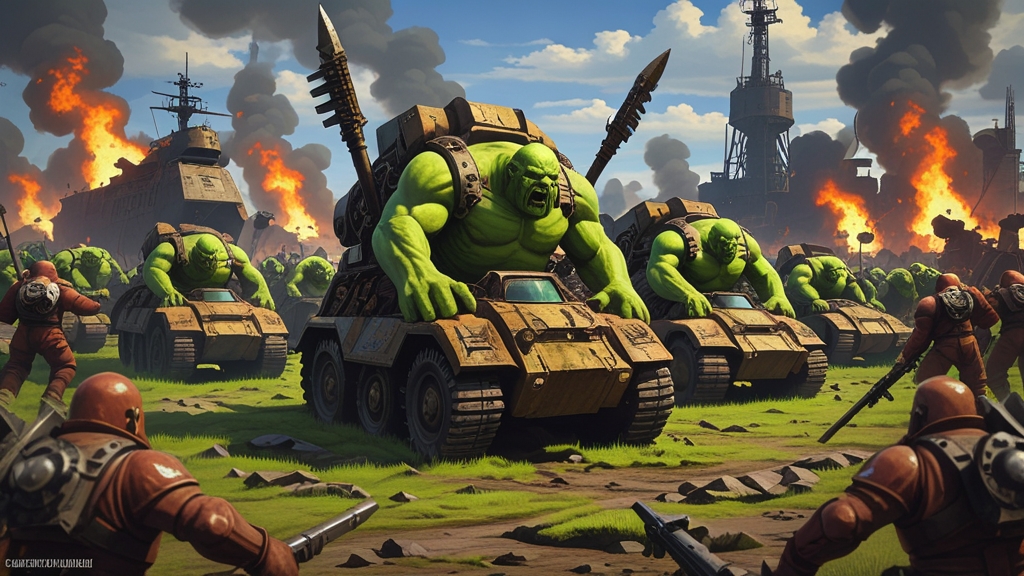
Orks are the loudest, greenest and most numerous threat in the galaxy: a spore-born species that lives for fighting and builds its guns and vehicles out of scrap that only works because the Orks believe it will. On the tabletop they are an aggressive, forgiving army that rewards bold play, and in the hobby they are one of the most relaxed and conversion-friendly factions to collect. They fight the Imperium, the forces of Chaos and anyone else who looks like a good scrap.
This guide covers who the Orks are, how they play in Warhammer 40,000 11th Edition, where to start collecting and how to paint them.
Who Are the Orks?
The Orks are a brutish and resilient faction in the Warhammer 40,000 universe, known for their green skin, great size and love of violence. They are a warrior species engineered long ago and born from spores, and they thrive in the chaos of battle. Orks live for war, often gathering into vast WAAAGH!s led by the strongest among them, the Warboss.
Their culture is built around fighting, boasting and crude humour, with an emphasis on strength and low cunning. Ork technology looks primitive but works surprisingly well, kept running by the collective belief of the Orks around it.
Orks Lore and History
The Orks are the most widespread and arguably the most dangerous alien threat in the galaxy — a belligerent, green-skinned fungoid species whose entire culture, biology and psychology is oriented around one thing: war. Created by the ancient Old Ones during the War in Heaven as a warrior race to fight the Necrons and C’tan, the Orks have long since outlived their creators and spread to every corner of the galaxy, waging an eternal and joyous WAAAGH! against anything and everything they encounter.
Ork biology is extraordinarily robust. They are a symbiotic organism, part animal and part fungus, that reproduces through spores released throughout their lives and upon death. This means that an Ork infestation is almost impossible to eradicate — even if every Ork on a world is killed, their spores can grow into new fungal ecosystems that spawn new Orks. Their genetic heritage gives them an instinctive understanding of mechanics and warfare, allowing even the most primitive Ork tribe to build crude but effective weapons and vehicles.
Ork society is governed by one simple principle: might makes right. The biggest, meanest Ork in any group becomes the Warboss, ruling through brute force and low cunning. When a sufficiently powerful Warboss emerges, he can unite multiple tribes into a WAAAGH! — a crusade of conquest that sweeps across star systems like a green tide. The most infamous in Imperial history are Ghazghkull Mag Uruk Thraka’s invasions of Armageddon, which have tied down enormous Imperial resources.
Ork technology runs on something that baffles Imperial scholars: the WAAAGH! field, a latent psychic energy generated by large groups of Orks that makes their ramshackle machines work far better than they should. A gun that is essentially welded-together scrap fires because the Orks believe it will. The major Ork clans — Goffs (melee specialists), Evil Sunz (speed freaks), Bad Moons (wealthy shooters), Deathskulls (looters), Blood Axes (tacticians) and Snakebites (traditionalists) — each bring their own flavour to the endless green tide.
What Are the Orks Army Strengths?
The Ork army is built on numbers, resilience and brute force, with a healthy dose of unpredictability.
- Weight of bodies: large mobs of Boyz and Gretchin let Orks swamp objectives and overwhelm opponents through sheer volume.
- Melee punch: most of the army is built to charge, and units like Nobz, Meganobz and Deff Dreads hit very hard up close.
- Transports and vehicles: Trukks, Battlewagons and buggies give the army speed and protection on the way in.
The weaknesses are just as clear. Ork shooting is unreliable, individual models are fragile, and an army that relies on getting into combat can struggle against fast or long-ranged opponents if its first wave stalls in the open.
How to Play Orks
Orks are the quintessential aggressive army — your game plan revolves around getting into melee as fast as possible and overwhelming the enemy with numbers and brutality. Ork shooting is unreliable (most units typically hit on 5s), but their melee is devastating.
The WAAAGH! is the army’s signature rule: once per battle you call it, and for a round your army surges forward. In the 2026 Orks codex for 11th Edition, Orks can always re-roll Advance rolls, and once per battle, at the start of your Command phase, you can use the War Cry to make your units riled up until the end of the next turn: riled-up units get a 5+ invulnerable save, Assault on their guns and the ability to charge after Advancing (the old +1 Strength and +1 Attacks are gone). Other rules, such as Ghazghkull’s, can rile up units too — our new Orks codex guide covers the changes. Whatever the exact bonuses, timing the WAAAGH! for the turn your big charges go in is the difference between a crushing victory and stranded Boyz.
Key Tactics
- Flood the board — use cheap Boyz and Gretchin to pressure objectives and force your opponent to split their fire. In 11th Edition objectives are terrain areas, so bodies standing in that terrain count.
- Time the WAAAGH! — call it on the turn you’re most likely to make critical charges, usually turn 2 or 3.
- Use Trukks and Battlewagons — transports protect your Boyz from shooting on the approach. Infantry hiding in terrain now benefits from cover’s −1 to hit, but a mob caught in the open still melts.
- Charge with purpose — in 11th Edition you roll 2D6 before picking charge targets within that distance, engagement range is 2″, and charging units fight first that turn. Line up multiple threats so a short roll still finds a target.
- Da Jump — the Weirdboy’s signature trick teleports a mob of Boyz across the battlefield. There’s no psychic phase any more: in 11th Edition Da Jump is a psychic ability used in your Movement phase that puts the Weirdboy’s unit into strategic reserves with Deep Strike, ready to drop back in more than 8″ from the enemy, though a roll of 1 leaves it battle-shocked.
Best Ork Units
Beast Snagga Boyz
Tougher Boyz built to hunt big game, with bonuses against monsters and vehicles. They are a strong general-purpose infantry choice, able to handle both elite infantry and light vehicles, and slightly pricier than regular Boyz.
Meganobz
Ork elites in heavy mega armour with power klaws and brutal melee output. Put them in a Trukk or Battlewagon for a reliable delivery system. They are your go-to answer to enemy elite infantry such as Terminators.
Squighog Boyz
Beast Snagga cavalry riding massive squigs, giving Orks rare speed and hitting power. They are excellent for flanking, grabbing objectives and charging into enemy flanks, and share the Beast Snagga knack for hunting monsters and vehicles.
Deff Dreads
Orky walkers that are tough and hit hard in melee. They provide a durable anchor for your line and absorb fire that would otherwise shred your Boyz. Remember that in 11th Edition vehicles no longer get cover just for standing in a terrain footprint, so use intervening terrain to hide them on the way in.
Warboss
The classic Ork leader and a formidable melee combatant. In 11th Edition there are no HQ slots: the Warboss is a Leader character you attach to a mob such as Boyz or Nobz when you write your list, and his bonuses apply to the unit he’s leading. The Warboss in Mega Armour trades speed for durability. Check the datasheet for which units each version can join.
Where Should Beginners Start?
If you’re starting an Ork collection, these are the key models:
- Ork Boyz: the backbone of the army. A big mob of Boyz is the iconic Ork unit.
- Warboss: a powerful leader who makes the mob he joins much more dangerous.
- Gretchin (Grots): cheap bodies for holding objectives and screening.
- Deff Dread or Killa Kanz: walkers that add heavy support and melee power against tougher opponents.
Start with the Orks Combat Patrol for a good-value entry point, or pick up the 11th Edition launch set, Armageddon, which pits Orks against Space Marines. From there, add more Boyz, Nobz and a Warboss. For vehicle enthusiasts, the Trukk and the various buggy kits are fantastic hobby projects, and the Deff Dread is a fan favourite that’s fun to build and effective on the table.
Building an Ork Army in 11th Edition
Ork army building now uses the 11th Edition Detachment Points system: 2 DP at 1,000 points (Incursion) and 3 DP at 2,000 points (Strike Force), with each detachment costing 1 to 3 DP. You can go all-in on one big detachment or mix smaller ones, as long as you don’t take the same detachment twice or two detachments with the same Unique tag. Your 10th Edition Ork codex detachments were legal at launch, but the 2026 Orks codex now replaces them, so build from the new book — see our Orks codex guide and the Orks 1000 point army list for a worked example.
Popular themes have long included Green Tide lists that flood the board with Boyz, Speed Freeks lists built around buggies and bikes, and Dread Mob lists packed with Deff Dreads and Killa Kanz. Ghazghkull Thraka remains the army’s headline character. Ork strengths are attack volume, board presence and the swing turn from a well-timed WAAAGH!; the challenges are low individual model quality and armies that can remove bodies efficiently. See the faction tier list for current competitive standings, and check the Munitorum Field Manual for current points.
Collecting Orks
Collecting Orks is pure hobby joy. The Ork range is enormous, characterful and packed with personality — every model tells a story of ramshackle ingenuity and gleeful violence, from a mob of Boyz to the towering Gorkanaut.
Orks are also the king of conversions. The Ork philosophy of “loot it and make it Orky” applies to the hobby too: spare parts from almost any kit can be glued onto Ork vehicles and gear for a characterful look.
Painting Orks
Difficulty: Beginner-Friendly
Orks are the most forgiving army to paint in the entire Warhammer range. The rough, scrappy aesthetic means visible brushstrokes and uneven coverage all add to the Orky look. Rust, grime, battle damage and general filth aren’t just acceptable — they’re desirable. If you’re new to painting miniatures, Orks are arguably the best army to learn with.
Key paints: Orruk Flesh (Contrast) or Warpstone Glow (skin), Biel-Tan Green (skin wash), Leadbelcher (metal), Agrax Earthshade (all-over wash), Mournfang Brown (leather), Abaddon Black (cloth), Mephiston Red (accent details), Typhus Corrosion (rust) and Ryza Rust (rust highlight). A clan-specific spot colour — yellow for Bad Moons, red for Evil Sunz, black for Goffs — ties the army together.
Colour Scheme Ideas
Classic green skins
- Base coat: Waaagh! Flesh, a dark green base paint, for the skin.
- Highlights: layer up with a brighter green such as Warboss Green to pick out muscles and features.
- Armour and weapons: Leadbelcher, highlighted with a brighter silver.
- Details: straps and pouches in browns or tans.
- Wash: Agrax Earthshade over the gear to add depth and grime.
Bad Moons
- Base coat: a bright yellow such as Averland Sunset for armour and clothing.
- Highlights: a lighter yellow or off-white on the edges.
- Skin: a darker green to contrast with the yellow.
- Details: black or dark grey for weapons and metal, with highlights as needed.
- Wash: a brown wash to deepen the shadows.
Deathskulls
- Base coat: a blue such as Kantor Blue for armour and clothing.
- Highlights: lighter blues to add depth.
- Skin: a classic green, as above.
- Details: dark metallics for weapons, plus yellow or white markings to reflect the clan’s looting habits.
- Wash: an all-over wash for a rugged, battle-worn finish.
Painting Techniques for Orks
- Speed-painting method: spray Leadbelcher for all metal areas (or prime and use Orruk Flesh on the skin), apply a heavy Agrax Earthshade wash over everything, then pick out skin, cloth and leather. The all-over wash creates instant depth and grime.
- Drybrushing: great for armour and weapons. A lighter silver or green drybrushed over raised edges gives a weathered, battle-worn look.
- Washes: Agrax Earthshade or Nuln Oil in the recesses of armour, skin and clothing brings out detail.
- Edge highlighting: a lighter colour along the sharp edges of armour plates defines the model.
- Contrast paints: ideal for skin and cloth on big mobs, giving shading in one coat.
- Vehicles: sponge on Leadbelcher for paint chips, add rust effects and finish with transfers or freehand glyphs. Checkerboard patterns, a classic Ork design, are easier than they look — use a fine brush and embrace imperfection.
For a full step-by-step process, see our Orks painting guide.
Related Armies
If you enjoy Orks, you might also like these armies:
- Tyranids — Both factions bring overwhelming hordes to the tabletop with aggressive, in-your-face playstyles.
- Astra Militarum — Classic rivals on the battlefield, representing two very different approaches to massed warfare.
- Orruk Warclans — The Orruk Warclans are the Age of Sigmar equivalent, bringing the same green-skinned brutality to the Mortal Realms.
Everything Orks on Warhammer Guild
Play
Lore
Painting
Books & reviews
Frequently Asked Questions
Who are the Orks?
The Orks are the most numerous and warlike alien race in Warhammer 40k. They are brutal, green-skinned fungoid creatures who live only for fighting. Their technology shouldn’t work but does, thanks to a collective psychic field called the WAAAGH! generated by their belief that it will.
Are Orks good for beginners?
Orks are a fun beginner army with a forgiving, aggressive playstyle — charge forward and krump things. Their random elements (like inaccurate shooting) are entertaining rather than frustrating, and their models are characterful and fun to paint.
What are the strengths of Orks?
Orks excel at overwhelming the enemy with sheer numbers and brutal melee combat. They have some of the cheapest infantry in the game, powerful vehicles like Battlewagons and Deff Dreads, and the once-per-battle WAAAGH! gives the whole army a devastating turn of aggression.
What are the weaknesses of Orks?
Orks have poor Ballistic Skill, making their shooting unreliable. Their armour saves are weak, and while they have numbers, individual Ork models are fragile. They need to close to melee range quickly or risk being shot apart.
How much does an Ork army cost?
An Ork army needs a lot of models, so it is moderately expensive to build up to 2,000 points, and the cost depends heavily on whether you go infantry-heavy or vehicle-heavy. Starting with a Combat Patrol box (or the Armageddon starter set) and adding Boyz is the most economical approach. Check current prices, as they change regularly.
What is the WAAAGH!?
The WAAAGH! is both a psychic phenomenon and a massive Ork invasion. Collectively, Orks generate a psychic field that makes their technology work and grows stronger as more Orks gather. When enough Orks unite under a powerful Warboss, they launch a WAAAGH! — a crusade of destruction. On the tabletop it’s the army rule you call once per battle for a turn of all-out aggression.
Are Warhammer 40k Orks the same as orcs?
They are closely related but not the same. Warhammer 40,000 spells the name Orks for its sci-fi greenskins, while Warhammer Fantasy and The Old World use Orcs and Age of Sigmar calls its version Orruks. All three share the same green-skinned love of war, but 40k Orks are a spore-born fungoid species with crude guns, vehicles and starships kept working by the power of the WAAAGH!.
Who is the leader of the Orks?
The Orks have no single ruler. Each tribe is led by its biggest, toughest Warboss, and a Warboss strong enough to unite many tribes becomes a Warlord at the head of a WAAAGH!. The most famous Ork leader is Ghazghkull Mag Uruk Thraka, the Prophet of the Waaagh!, who believes he is the chosen messenger of the Ork gods Gork and Mork.
What are the Ork ranks?
Ork society is ranked by size and strength. At the bottom are Snotlings and Gretchin, then the Boyz who make up the mobs, then Nobz, the bigger Orks who bully the Boyz into line, and finally the Warboss at the top. Specialist Oddboyz such as Meks, Painboyz and Weirdboyz sit outside this ladder and are valued for their skills rather than their size.
What were the Krorks?
Krorks were the original warrior race the Old Ones engineered to fight the Necrons and C’tan during the War in Heaven. They were larger and far more capable than modern Orks, who are their degenerate descendants. The Orks’ instinctive grasp of technology and warfare is a remnant of that design, and some lore hints that Orks grow back towards Krork-like power the more they fight.
Related Content
- 40k on a Budget — Start collecting cheap
- 40k Factions Ranked — Competitive tier list
- How to Play 40k — Beginner rules guide
- All Factions Guide — Every faction explained
New (August 2026): New Orks Codex (2026): Ghazghkull, the Waaagh! Rule & Every Big Change — everything that changed for the green tide.
Book review: Brutal Kunnin Review — our review of the best modern Ork novel.