
Part of our Space Marines hub: every Space Marines guide, lore page and painting tutorial in one place.
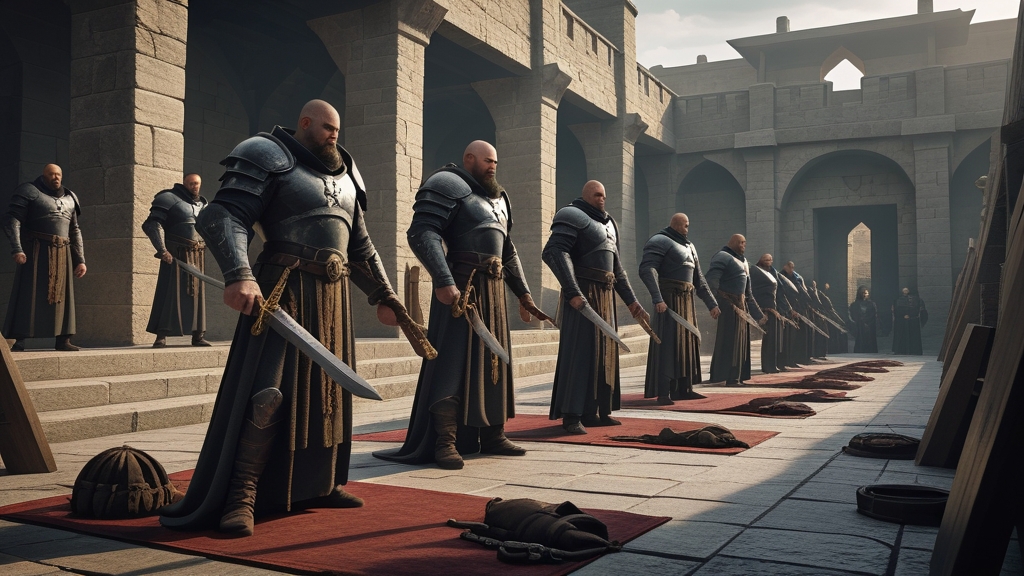
Between battles, Space Marines train constantly with combat drills and weapons practice, pray in their Chapter’s chapel, maintain their wargear alongside Chapter serfs, study tactical doctrine, and pursue chapter-specific traditions. Space Wolves feast and tell sagas, Blood Angels create art and music, and Ultramarines study the Codex Astartes. Despite the popular image of Space Marines as warriors who exist only for combat, their daily lives are structured, purposeful, and surprisingly varied — a monastic existence built around the twin pillars of martial perfection and spiritual devotion.
The fortress-monastery of a Space Marine Chapter is not merely a barracks; it is a self-contained world that serves as home, temple, armoury, training ground, and reliquary. Within its walls, Space Marines follow a daily routine that has been refined over millennia, designed to keep them at peak physical and mental readiness at all times. Understanding what happens inside these fortresses — how Space Marines spend the hours, days, and sometimes weeks between deployments — reveals the full picture of what it means to be one of the Emperor’s Angels of Death.
How Do Space Marines Train?
Training is the single largest time commitment in a Space Marine’s daily schedule. A Marine who is not deployed on active operations spends the majority of his waking hours in some form of combat training, and the variety and intensity of that training would be lethal for a baseline human.
Physical combat drills form the foundation. Space Marines spar against each other in melee combat, practising with every weapon in their Chapter’s armoury — chainswords, power swords, thunder hammers, combat knives, and their bare hands. These sparring sessions are conducted at full intensity, with injuries being common and considered an acceptable training cost. A broken bone or laceration suffered in the training cages is treated by the Apothecary and considered a lesson learned. Space Marines do not hold back against each other; pulling punches would be an insult to their brothers and would breed bad habits that could prove fatal in actual combat.
Live-fire exercises with bolters, plasma weapons, melta guns, and heavy weapons are conducted in dedicated ranges and simulated battlefields within the fortress-monastery. These exercises test accuracy, reaction time, target prioritisation, and the ability to coordinate fire with squad members under realistic conditions. Some Chapters use servitor-drones or captured xenos organisms as live targets, adding an element of genuine danger to range exercises.
Tactical simulations and war games pit squads, companies, or even entire battle groups against each other in elaborate scenarios designed to test strategic thinking, adaptability, and leadership. These simulations range from tabletop exercises (similar to, and predating, the game of Warhammer 40,000 itself) to full-scale exercises conducted on the Chapter’s homeworld or in void-training environments. The results are analysed in detail, with both victories and defeats studied for tactical lessons.
Specialised training varies by role. Assault Marines practise jump pack manoeuvres and close-quarters fighting. Devastators drill on heavy weapon deployment and fire discipline. Scouts learn stealth, reconnaissance, and survival skills. Techmarines study the machine-spirits of their Chapter’s vehicles and equipment. Librarians practise psychic discipline under the supervision of their Chief Librarian. Every Marine’s training programme is tailored to his role, his experience level, and his Chapter’s tactical doctrine.
What Role Does Prayer and Worship Play?
Prayer and spiritual devotion occupy a significant portion of a Space Marine’s daily routine, though the form this takes varies enormously between Chapters. For most Chapters, the day begins and ends with formal prayer — rites conducted in the Chapter’s chapel by the Chaplains, who serve as both spiritual leaders and keepers of the Chapter’s traditions.
The Black Templars are the most devout Chapter, spending hours each day in prayer, meditation, and the recitation of litanies of hate against the enemies of the Emperor. Their faith is intense, personal, and expressed with a fervour that borders on fanaticism. Every battle is a crusade, every training session a devotion, and every moment of rest an opportunity for prayer. The Templars’ relationship with the Emperor is direct and passionate — they worship Him as a god without reservation or theological nuance.
The Ultramarines approach worship through the lens of duty and tradition. Their rites are formal, structured, and conducted according to the patterns established by Roboute Guilliman in the Codex Astartes. Prayer for an Ultramarine is an expression of discipline rather than passion — a recognition of the Emperor’s authority and the Marine’s place within the chain of command that extends from the squad sergeant all the way to the Golden Throne.
The Dark Angels’ rites are secretive and layered with hidden meanings. Their Chaplains — called Interrogator-Chaplains — lead rituals that simultaneously honour the Emperor and reinforce the Chapter’s obsessive secrecy. Lower-ranking Marines participate in ceremonies whose full significance is known only to the Inner Circle, the senior leadership who guard the Chapter’s darkest secrets. This dual-layered approach to worship reflects the Dark Angels’ fundamental character: devotion wrapped in deception.
Some Chapters have less conventionally religious practices. The Space Wolves honour the Emperor as the Allfather but express their devotion through Fenrisian cultural traditions — sagas, feasts, and the veneration of heroic deeds rather than formal prayer. The White Scars practise a form of meditative discipline rooted in Chogorian philosophy, seeking inner stillness and spiritual balance through contemplation and calligraphy.
How Do Space Marines Maintain Their Wargear?
The maintenance of wargear — armour, weapons, and equipment — is treated as a sacred duty rather than a mundane chore. A Space Marine’s power armour is a relic of his Chapter, often centuries old and bearing the accumulated honours of every Marine who has worn it before him. Maintaining this armour is an act of reverence, a communion between the warrior and the machine-spirit that inhabits his plate.
Each Marine is responsible for the basic maintenance of his own equipment — cleaning, oiling, performing minor repairs, and conducting the rituals of blessing that the Adeptus Mechanicus prescribes for all Imperial technology. This maintenance is typically performed daily, with the Marine carefully inspecting every component of his armour and weapons for damage, wear, or malfunction. The process is meditative, providing an opportunity for quiet reflection while performing a necessary task.
More complex repairs and modifications are handled by the Chapter’s Techmarines — Space Marines who have been trained on Mars by the Adeptus Mechanicus in the rites of technology. Techmarines serve as the Chapter’s engineers, maintaining vehicles, repairing battle damage to power armour, and performing the sacred rituals that keep the Chapter’s most ancient and powerful wargear functional. The relationship between a Techmarine and the Chapter’s equipment is quasi-religious, reflecting the Mechanicus doctrine that machines have spirits that must be appeased and honoured.
Chapter serfs — the mortal servants who support the Chapter — assist with wargear maintenance under the supervision of Techmarines. These serfs are typically failed aspirants or the descendants of the Chapter’s homeworld population, bound to lifelong service. They perform tasks like polishing armour, sharpening blades, manufacturing ammunition, and running the logistics that keep the Chapter supplied. While they lack the reverence that a Space Marine brings to wargear maintenance, their contribution is essential — without serfs, the Marines would spend far more time on mundane maintenance and far less on training and combat readiness.
What Chapter-Specific Traditions Exist?
Some of the most fascinating aspects of Space Marine daily life are the unique traditions that each Chapter maintains between battles:
Space Wolves — The Feast: The Great Hall of the Fang is the social centre of the Space Wolves Chapter, where warriors gather to feast on Fenrisian game, drink mjod (a potent Fenrisian ale that would kill a baseline human), and tell sagas of their battles. These feasts are raucous, boisterous affairs that would scandalise the more restrained Chapters — Space Wolves arm-wrestle, brawl, and compete in drinking contests with the same competitive intensity they bring to warfare. The feasts serve a vital social function, reinforcing pack bonds and allowing Marines to process the stresses of combat through communal celebration.
Blood Angels — Art and Beauty: Blood Angels pursue artistic creation with genuine passion and skill. Their fortress-monastery on Baal contains galleries of paintings, sculptures, and musical compositions created by Marines over millennia. Blood Angels paint, sculpt, write poetry, and compose music during their rest periods, channelling the intense aesthetic sensitivity inherited from Sanguinius into creative expression. This artistic tradition serves a dual purpose: it provides an outlet for the intense emotions that the Blood Angels’ gene-seed amplifies, and it counterbalances the savage violence of the Red Thirst and Black Rage with beauty and creation.
Ultramarines — Study and Debate: Ultramarines spend significant time studying the Codex Astartes, debating tactical doctrine, and analysing historical battles. Their training includes formal seminars where officers present tactical problems and Marines are expected to propose solutions grounded in Codex principles. This intellectual rigour extends to broader subjects — Ultramarines study rhetoric, governance, logistics, and diplomacy, reflecting Guilliman’s vision of the Space Marine as a leader and administrator as well as a warrior.
Dark Angels — Vigils and Secrets: Between battles, Dark Angels maintain vigils — periods of solitary meditation and prayer in darkened cells within their fortress-monastery, the Rock. These vigils serve both spiritual and psychological purposes, reinforcing the discipline and secrecy that define the Chapter. Senior Marines of the Inner Circle spend additional time in the dungeons beneath the Rock, interrogating captured Fallen Angels in sessions that can last years or even decades.
Iron Hands — Augmentation and Forge Work: Iron Hands Marines spend their downtime in the forges of their Clan Companies, crafting cybernetic augmentations, repairing their bionic components, and working metal in the tradition of their Primarch Ferrus Manus. The forge is both workshop and temple for the Iron Hands — working metal is a form of worship, and the creation of a finely crafted augmetic is considered a devotional act. Marines who have performed well in battle may reward themselves by replacing another piece of organic tissue with a mechanical upgrade.
White Scars — Riding and Philosophy: White Scars maintain their connection to the steppe traditions of Chogoris through mounted exercises (on both biological mounts and bikes/Land Speeders), falconry, and the practice of Chogorian calligraphy. They also pursue a contemplative philosophical tradition, discussing concepts of speed, freedom, and the nature of warfare in formal sessions that balance their reputation as wild, undisciplined riders. The White Scars are deeper thinkers than outsiders typically credit, and their rest periods reflect this duality of action and contemplation.
Do Space Marines Sleep?
Not in the conventional sense. The Catalepsean Node — one of the nineteen gene-seed implants — allows Space Marines to rest by shutting down portions of their brain in sequence rather than sleeping all at once. This means a Space Marine is never fully unconscious unless he chooses to be or is rendered so by injury. He can remain functional for extended periods — weeks or even months — without conventional sleep, though sustained operation without any rest period eventually degrades performance.
When Space Marines do rest, they typically enter a state of meditation rather than true sleep. This meditation serves both physical and psychological purposes — allowing the brain and body to recover while maintaining a level of awareness that would allow the Marine to respond instantly to a threat. Some Chapters have specific meditation practices: White Scars practise Chogorian stillness meditation, Blood Angels sometimes enter trance-states where they commune with echoes of Sanguinius, and Space Wolves are rumoured to dream of the hunt during their rest periods.
Do Space Marines Eat Normal Food?
Space Marines can eat almost anything thanks to the Preomnor — a pre-stomach that neutralises toxins and breaks down substances that would be indigestible or poisonous to baseline humans. They can survive by eating plants, animals, minerals, and even some organic materials that no human could consume. However, most Chapters provide their Marines with specially formulated nutrient rations designed to support their enhanced metabolism.
Some Chapters have distinctive dietary traditions. Space Wolves eat Fenrisian game — massive beasts hunted on their homeworld — and drink mjod during their feasts. Salamanders share meals with the civilian population of Nocturne, eating the same food as the mortals they protect. Ultramarines consume balanced, Codex-prescribed rations that optimise nutrition for combat readiness. The Iron Hands are reputed to view eating as a weakness of the flesh, consuming nutrient paste efficiently rather than deriving any pleasure from the act.
Frequently Asked Questions
Do Space Marines have free time?
Not in the way civilians understand the concept. Every hour of a Space Marine’s day is allocated to a specific activity — training, prayer, maintenance, study, or rest. However, within this structure, Marines do have periods of relative freedom where they can pursue personal interests: art for Blood Angels, sagas for Space Wolves, study for Ultramarines. The concept of leisure is alien to them, but personal enrichment within the bounds of Chapter tradition is encouraged.
Do Space Marines socialise with each other?
Yes, extensively. Squad bonds are the core social unit, with Marines who fight together also training, eating, and praying together. The nature of socialisation varies by Chapter — Space Wolves are loud and gregarious, Ultramarines are formal but cordial, Dark Angels are guarded and hierarchical. Rivalries between squads and companies are common and generally healthy, driving competition that improves overall Chapter performance.
Can Space Marines read and write?
Yes. Space Marine hypno-conditioning includes comprehensive education in literacy, numeracy, history, and tactical doctrine. Many Marines are voracious readers, particularly in Chapters that value intellectual development like the Ultramarines and Blood Angels. Some Marines maintain personal journals, compose poetry or prose, or study subjects ranging from philosophy to xenos biology during their non-training hours.
Do Space Marines ever relax?
The closest equivalent to relaxation for most Space Marines is the meditative maintenance of wargear or the practice of Chapter-specific cultural traditions. Space Wolves come closest to conventional relaxation during their feasts. Blood Angels find respite in artistic creation. But the concept of doing nothing — of idle relaxation without purpose — is essentially foreign to Space Marine psychology. Even rest serves the purpose of maintaining combat readiness.
What is a Space Marine’s daily routine?
A Space Marine’s day is a fixed cycle of training, prayer, wargear maintenance, study and rest, repeated with monastic discipline. Most Chapters open and close the day with formal rites led by the Chaplains, and the bulk of the waking hours go to combat drills, live-fire exercises and tactical simulations. Personal time is filled with Chapter traditions, such as sagas for the Space Wolves or art for the Blood Angels, rather than idle leisure.
Do Space Marines fight each other?
Yes, but almost always in training or ritual. Battle-brothers spar at full intensity in the training cages, and some Chapters settle rivalries through honour duels, most famously the Space Wolves and Dark Angels. Open war between loyalist Chapters is rare, though it has happened, as in the Badab War, when the Astral Claws and their allies seceded and were brought down by other Chapters.
What do Space Marines do on their ships between battles?
Much the same as in their fortress-monastery. Battle-barges and strike cruisers carry training cages, firing ranges, chapels and armouries, so Marines keep up their drills, rites and wargear maintenance during long voyages. Chapter serfs and Techmarines keep the ship’s systems and vehicles in order, while officers study intelligence and plan the next deployment.