
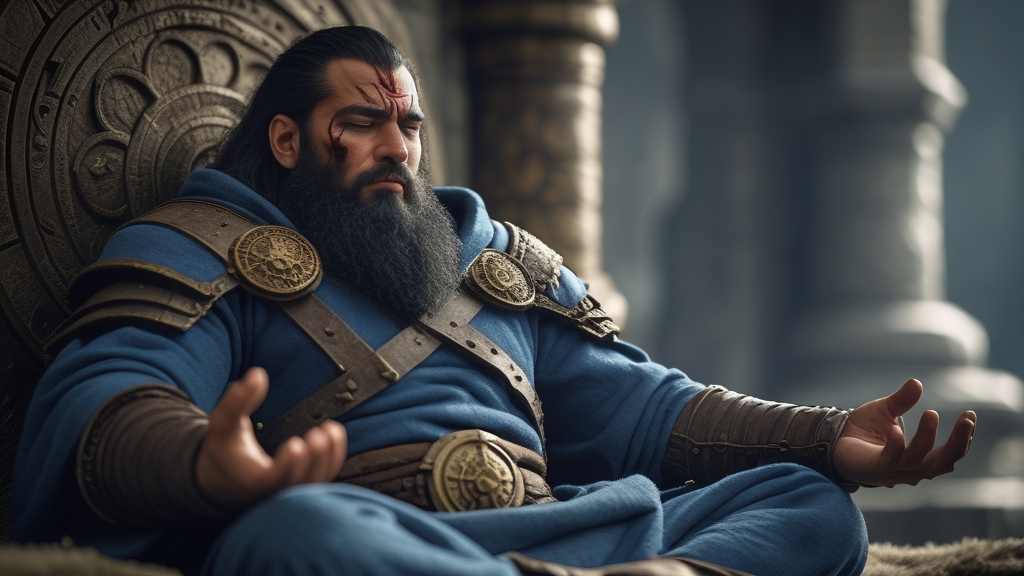
Space Marines don’t need to sleep in the normal human way. Their Catalepsean Node implant lets them rest one half of the brain at a time while the other half stays alert, so they can go without true sleep for long periods and stay functional. They do still rest, usually in meditation-like states when circumstances allow, and the background never suggests they can go without rest forever.
What Is the Catalepsean Node?
The Catalepsean Node is one of the 19 implanted organs that transform a human aspirant into a Space Marine. It is implanted in the brain and changes how the Marine’s brain manages sleep and rest.
In a normal human, sleep is a whole-brain process — both hemispheres shut down together for several hours. Without it, humans rapidly deteriorate: concentration fails, judgement slips and, over long enough periods, hallucinations follow.
The Catalepsean Node lets a Space Marine rest one hemisphere of the brain at a time, while the other remains conscious. This mirrors the unihemispheric sleep seen in some real-world animals — dolphins, for example, can rest one brain hemisphere while they keep swimming and surfacing to breathe.
For a Space Marine, this means he never needs to fully “shut down”. One half of the brain rests while the other keeps watch, so the Marine can stand guard or stay on alert through long operations.
The result is a warrior who is hard to catch truly unconscious and who doesn’t need to stop for rest the way normal soldiers do. In a galaxy of constant warfare, that is an extraordinary advantage.
How Long Can Space Marines Go Without Sleep?
The background doesn’t give a firm number. Most sources simply say the Catalepsean Node allows a Marine to go without sleep for long periods while remaining effective, far longer than any unaugmented soldier could manage.
Because the Node lets each hemisphere take its turn to rest, a Marine relying on it isn’t skipping rest altogether — he is resting in a different way. It is reasonable to assume that even a Space Marine eventually needs fuller rest, and fiction regularly shows Marines resting or meditating between battles, but exact limits and recovery times are not something the lore pins down. Treat any precise figure you see quoted with caution.
What Does Space Marine Meditation Look Like?
When Space Marines are shown resting fully, it is often described as meditation, prayer or a trance-like state rather than ordinary sleep, though fiction also shows Marines simply sleeping when the chance arises.
Meditation also has a psychological side. Space Marines fight constantly, witness horrors beyond human comprehension, and carry the weight of their Chapter’s traditions. Rites of contemplation, prayer and hypno-conditioning help them process those experiences and stay focused.
How individual Chapters rest is rarely described in detail, but their wider cultures colour how their downtime is portrayed:
- Ultramarines follow the Codex Astartes closely, and their fiction shows disciplined, ordered routines between battles.
- Blood Angels are famous for their artistic tradition — painting, sculpture and other crafts — and for the constant struggle against the Red Thirst and the Black Rage.
- Dark Angels are defined by secrecy, and their inner circles carry the burden of the Chapter’s hidden history.
Can a Space Marine Be Surprised While Resting?
It is very difficult to catch a Space Marine off-guard, even while he rests. Because the Catalepsean Node keeps half the brain alert, and his senses are enhanced by other implants, a resting Marine is still aware of his surroundings.
His enhanced reflexes and combat conditioning also mean he can go from rest to combat-ready in moments. Attacking a resting Space Marine is one of the galaxy’s more dangerous propositions.
That said, nothing in the lore makes Marines immune to ambush. Stealthy enemies and traitors who know how Space Marines think — the Alpha Legion being the classic example — are exactly the kind of foes that could exploit a lapse.
Do Space Marines Dream?
The lore doesn’t give a single answer, but Black Library fiction does show Space Marines experiencing dreams, memories and visions.
The clearest examples are tied to gene-seed and the warp. The Black Rage of the Blood Angels and their successors is described as the Marine reliving the last moments of their Primarch, Sanguinius, in visions that overwhelm his own identity. Some fiction also shows Marines haunted by memories of their lives before induction or of the agony of their transformation.
Librarians (psychic Space Marines) are especially vulnerable, because their psychic sensitivity makes them receptive to the warp. A Librarian’s dreams or trances can carry genuine visions — and the warp is also a source of danger, which is why psykers rely on strict mental discipline.
How Does Sleep Deprivation Affect Space Marines?
The Catalepsean Node makes Space Marines extraordinarily resilient to sleep deprivation, but the background doesn’t set out what happens when they are pushed past their limits, how long that takes, or how long they need to recover.
What can be said is that the Node reduces the problem rather than abolishing it: a Marine using it is still resting, just one hemisphere at a time. Beyond that, any specific symptoms, timescales or recovery periods are fan extrapolation rather than established lore.
What About Night Operations?
Space Marines are well suited to night operations and long watches, partly because of their sleep adaptations. A Marine who doesn’t need to sleep normally can keep watch, patrol or fight through the night.
The Occulobe implant also enhances the Marine’s eyesight, including his vision in low light. Combined with the Catalepsean Node, this makes Space Marines formidable night fighters.
The Raven Guard are the Chapter most associated with stealth and covert warfare. Their gene-seed gives them strikingly pale skin and dark hair and eyes, and their doctrine favours striking from the shadows rather than open battle.
Frequently Asked Questions
Can Space Marines turn off the Catalepsean Node?
The lore doesn’t describe a way to switch the Node off. It is an organic implant rather than a mechanical device, and fiction shows Marines resting fully or meditating when they are somewhere safe, so the Node evidently doesn’t prevent deeper rest. It simply means they don’t depend on it.
Do Chaos Space Marines still have the Catalepsean Node?
Chaos Space Marines were created with the same implants as their loyalist brothers, so they have the Catalepsean Node too. Ten millennia of warp exposure and mutation have changed many of them in unpredictable ways, but the lore doesn’t detail what that means for their sleep.
How does the Catalepsean Node compare to real animals?
The Catalepsean Node closely resembles unihemispheric sleep in dolphins, some birds and other animals. Dolphins can rest one brain hemisphere at a time, which lets them keep swimming, surface to breathe and watch for predators. The Node gives Space Marines a version of a capability that already exists in nature.
Do Primaris Marines sleep differently?
Primaris Marines have the same Catalepsean Node as Firstborn Marines, plus three extra implants: the Sinew Coil, the Magnificat and the Belisarian Furnace. None of those is described as changing how they sleep, so as far as the lore goes their rest works the same way.
What happens if the Catalepsean Node fails?
The lore doesn’t really say. Implants can fail or be rejected, and Apothecaries are responsible for a Marine’s physical health, but what a failed Node would mean in practice, and whether it could be fixed, isn’t established.