
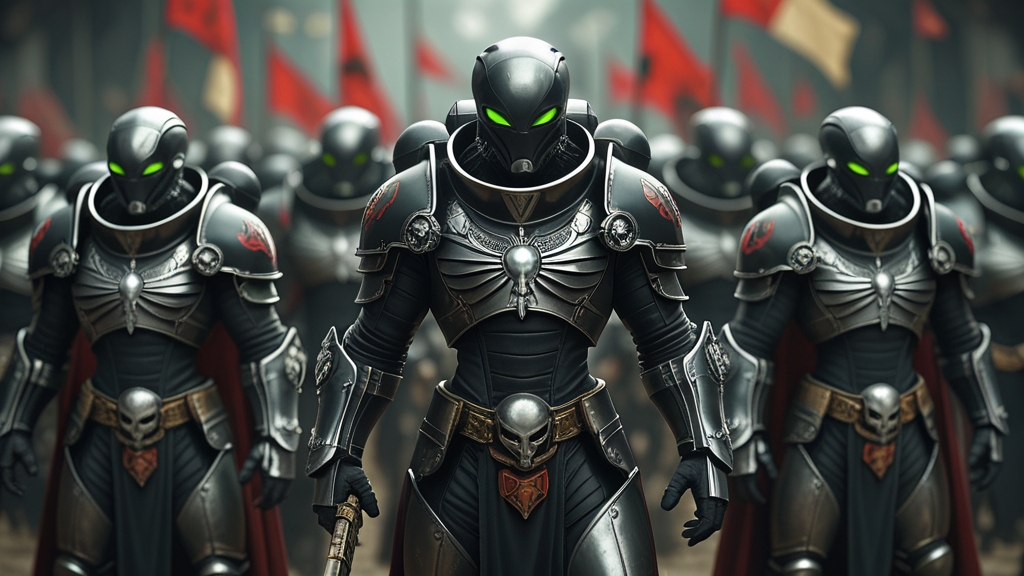
Charged with safeguarding humanity from the ever-encroaching threat of Xenos species, the Deathwatch warriors are drawn from every Space Marine chapter and brought together to form the ultimate alien extermination force.
Clad in black armour with a silver left arm, the Deathwatch fight the enemies of mankind with unparalleled skill, precision and adaptability. This guide covers who they are, how they play in 11th Edition, how to start a collection and how to paint them.

Who Are The Deathwatch?
The Deathwatch are a specialised, elite Chapter of Space Marines that serves as the Chamber Militant of the Ordo Xenos, the branch of the Inquisition tasked with dealing with alien threats.
Unlike other Chapters, the Deathwatch is not built from a single gene-seed line. It is made up of warriors selected from many different Space Marine Chapters, each serving on temporary detachment and bringing the skills, tactics and knowledge of his parent Chapter to the fight against the alien.
Key elements of Deathwatch culture include:
- Kill Teams: Deathwatch forces are organised into small, hyper-specialised Kill Teams, mixing Marines with different wargear and roles in a single squad.
- Xenos expertise: Every Deathwatch Marine is a seasoned veteran. They study how to hunt and destroy specific alien species, from Tyranids and Orks to Aeldari and Necrons, and their gear is chosen for that purpose.
- Inquisition ties: Serving alongside the Inquisition, the Deathwatch is often deployed on covert, high-risk missions to neutralise alien threats before they grow too great.
Deathwatch 40k: Quick Facts
The Deathwatch are the elite xenos hunters of Warhammer 40,000: a Space Marine Chapter built from veterans of other Chapters, serving as the Chamber Militant of the Inquisition’s Ordo Xenos. They fight in small, mixed Kill Teams armed with special issue ammunition, and each warrior returns home with the silver arm of service once his vigil ends.
| Field | Detail |
|---|---|
| Role | Chamber Militant of the Ordo Xenos, hunting alien threats |
| Founded | During the War of the Beast in the 32nd Millennium |
| Recruits | Veterans on temporary detachment from other Space Marine Chapters |
| Colours | Black armour with a silver left arm; one shoulder pad keeps the parent Chapter’s heraldry |
| Bases | Watch Fortresses scattered across the galaxy |
| Organisation | Small, hyper-specialised Kill Teams |
| Special ammunition | Hellfire, Kraken, Vengeance |
| Key units | Deathwatch Veterans, mixed Kill Teams, Corvus Blackstar, Watch Master, Watch Captain Artemis |
| Weaknesses | Small, points-heavy armies with no cheap screening units |
The Deathwatch Combat Patrol plus upgrade sprues is the usual starting point for a new collection.
What Are The Deathwatch Army Strengths?
The Deathwatch are known for versatility and for specialist tools aimed at alien enemies.
Their key strengths include:
- Flexible Kill Teams: Deathwatch Kill Teams combine different kinds of Space Marine in one unit, so a single squad can carry anti-infantry, anti-armour and close-combat options at once.
- Special issue ammunition: Deathwatch bolters are loaded with special rounds such as Hellfire, Kraken and Vengeance, each suited to a different kind of target. It is the faction’s signature tool and lets the same unit switch roles from game to game.
- Elite veterans: Every model is a veteran Space Marine, so units are durable and hit hard for their size.
Their drawbacks include:
- Small numbers: Being elite, the Deathwatch are usually outnumbered, so every model lost is felt and board control can be a struggle.
- High cost: Deathwatch units are points-heavy, so careful list building matters.

Where Should Beginners Start?
For newcomers to the Deathwatch, a small, balanced force teaches the army’s strengths quickly. These are the units to look at first:
- Deathwatch Veterans: The classic Deathwatch squad, with a wide choice of melee and ranged wargear. A good unit for learning how loadouts shape a unit’s role.
- Mixed Kill Teams: The Deathwatch range includes Kill Team units that combine different Space Marine troop types in one squad, such as Intercessors alongside heavier or more specialised Marines. Exactly which units can join each Kill Team is set by the current datasheets, so check the codex before you build.
- Corvus Blackstar: The iconic Deathwatch flyer, used as both a transport and a fire-support aircraft.
- Characters and Dreadnoughts: A Watch Master or Watch Captain Artemis leads the force. As a Space Marine Chapter, the Deathwatch can generally also draw on the wider Space Marine range, including Dreadnoughts, for heavy support. Check the current codex for any restrictions on which units they can take.
Starting with these units gives you a solid base for learning the Deathwatch’s tactical depth, from small elite squads to flexible firepower.
Deathwatch on the Tabletop in 11th Edition
On the tabletop the Deathwatch play as a Space Marine force with their own units and rules, so they use the Space Marine rules alongside Deathwatch-specific datasheets and detachments. Under 11th Edition you build your army with Detachment Points: 2 DP in a 1,000-point Incursion game and 3 DP in a 2,000-point Strike Force game, with detachments costing 1 to 3 DP each. That lets you pair a Deathwatch detachment with another Space Marine detachment, as long as you don’t take the same detachment twice or two detachments with the same Unique tag. At Incursion you can also take a single 3 DP detachment as your only one. Our Detachment Points guide walks through it.
Other 11th Edition changes suit elite armies like the Deathwatch. A unit can only benefit from one stratagem per phase, so plan your CP around your key Kill Team rather than stacking buffs. Cover now worsens the attacker’s Ballistic Skill by 1, which helps infantry that hug terrain. And objectives are terrain areas, which rewards durable squads that can hold ground. For exact datasheets, detachment costs and points, check the current Space Marines codex, the Deathwatch rules in the Warhammer 40,000 app and the latest Munitorum Field Manual. Check our Warhammer 40k faction tier list to see their current standing.
Deathwatch Lore and History
The Deathwatch stands apart from all other Space Marine Chapters as the Chamber Militant of the Ordo Xenos, the branch of the Imperial Inquisition dedicated to combating alien threats. It was founded during the War of the Beast in the 32nd Millennium, when a massive Ork invasion nearly destroyed the Imperium, to be a dedicated weapon against xenos. Unlike any other Chapter, the Deathwatch draws its battle-brothers from across the Adeptus Astartes, with warriors from many different Chapters serving together in Kill Teams.
Each Deathwatch battle-brother brings the traditions, skills and heritage of his parent Chapter to the Long Watch. A Blood Angels assault specialist might fight alongside an Imperial Fists defensive expert and a Raven Guard infiltrator, giving a Kill Team great versatility. These warriors serve a vigil of no fixed length at one of the Deathwatch’s Watch Fortresses, swearing oaths to set aside their Chapter rivalries and dedicate themselves to the destruction of the alien. When their vigil ends, they return to their parent Chapter bearing the silver arm of service as a mark of honour.
The Deathwatch has fought in many of the Imperium’s xenocide campaigns, from the Jericho Reach to the defence of the Eastern Fringe against the Tyranid Hive Fleets. Its Watch Fortresses hold sealed archives of xenos lore, including forbidden knowledge of alien technology and weaknesses. Because of their mission, the Deathwatch usually fight in small, elite teams rather than massed formations, specialising in surgical strikes, assassinations and operations behind enemy lines.
Collecting Deathwatch
Collecting Deathwatch is rewarding because the army encourages kit-bashing and customisation. The Deathwatch Combat Patrol is an excellent entry point, providing core units for your first Kill Teams. The Deathwatch upgrade sprues are essential for converting standard Primaris and Firstborn kits into Deathwatch warriors.
What makes Deathwatch collecting special is the freedom to include Marines from any loyal Chapter. Each battle-brother can wear the heraldry of his parent Chapter on one shoulder pad alongside the silver arm, creating varied, characterful squads. After the Combat Patrol, Veterans, a Corvus Blackstar and a Watch Master are natural next purchases. The army is also a great excuse to paint a variety of Chapter colour schemes within a single force.
How To Paint Deathwatch
Deathwatch combine a unifying black and silver scheme with the chance to paint heraldry from many different Chapters. Below are two schemes and the techniques that make them work. For a full step-by-step, see our Deathwatch painting guide.
Colour Scheme Ideas
Classic Deathwatch
- Base colour: Abaddon Black for the armour.
- Shading: Nuln Oil in the recesses and panel lines to deepen the shadows.
- Highlights: Eshin Grey for subtle edge highlights that keep the armour dark.
- Silver arm and metals: Leadbelcher for the left arm, trims and weapons, washed with Nuln Oil.
- Accent: Mephiston Red on lenses, purity seals and bolter casings.
- Metal highlights: Stormhost Silver to edge the arm and weapons for a polished finish.
This is the classic Deathwatch look: black armour with a bright silver arm and red accents.
Battle-worn Deathwatch
- Base colour: Corvus Black, a very dark grey-black that gives a slightly worn look.
- Shading: Agrax Earthshade for a grimier, battle-hardened finish.
- Highlights: Dawnstone for sharper, more weathered edge highlights.
- Silver arm and metals: Leadbelcher for the left arm, washed with Nuln Oil and highlighted with Runefang Steel, so the arm stays silver as it should.
- Accent: Khorne Red on lenses, purity seals and insignia for a darker red.
This scheme gives the Deathwatch a grittier, more battle-worn feel while keeping the iconic black and silver.

Deathwatch Painting Techniques
These techniques help bring out the distinctive elements of your Deathwatch units:
- Edge highlighting: Because the armour is mostly black, edge highlighting does most of the work. A grey such as Dawnstone or Eshin Grey gives definition without making the armour look grey.
- Metallic shading: The silver left arm is the defining feature of a Deathwatch Marine. Basecoat it with Leadbelcher, shade with Nuln Oil, then highlight with Stormhost Silver.
- Detail work: For parchment and purity seals, use Screaming Skull or Wraithbone, then a wash of Agrax Earthshade to bring out the script.
- Chapter shoulder pads: Each Marine keeps his parent Chapter’s heraldry on one shoulder pad. Painting a Blood Angels red pad next to an Ultramarines blue one and an Imperial Fists yellow one makes a squad look wonderfully varied, so batch-paint the black armour and give each pad individual attention.
With these schemes and techniques you will have a force that stands out on the tabletop with the iconic black and silver, proudly showing its mixed Chapter heritage.
Related Armies
If you enjoy Deathwatch, you might also like these armies:
- Dark Angels — The Deathwatch and Dark Angels both operate with secrecy and specialised elite units.
- Ultramarines — Many Deathwatch veterans hail from the Ultramarines and their successors.
- Imperial Agents — Both forces operate as elite specialists serving the wider Imperium, and both are closely tied to the Inquisition.
Everything Deathwatch on Warhammer Guild
Frequently Asked Questions
Who are the Deathwatch?
The Deathwatch are an elite Space Marine Chapter specialising in xenos hunting. Made up of veterans drawn from other Chapters, they serve as the Ordo Xenos’ Chamber Militant, deploying in small Kill Teams against alien threats across the galaxy.
Are Deathwatch good for beginners?
Deathwatch are moderately challenging for beginners. Their Kill Teams mix different unit types and wargear, which offers great flexibility but means learning several profiles and planning your list carefully.
What are the strengths of Deathwatch?
Deathwatch excel at elite, flexible Kill Teams that can be built for almost any threat. Their special issue ammunition gives their bolters options against different targets, and every model is a highly skilled veteran.
What are the weaknesses of Deathwatch?
Deathwatch armies are typically very small due to their elite nature, making them vulnerable to attrition. They lack cheap screening units and can struggle with board control against larger armies.
How do Deathwatch kill teams work?
Deathwatch Kill Teams let you combine different kinds of Space Marine, such as Intercessors with heavier or more specialised Marines, in a single squad. This creates versatile units that can handle several threats, but it takes careful planning. Check the current datasheets for which models each Kill Team can include.
Why do Deathwatch Marines have a silver arm?
The silver left arm marks a warrior as a member of the Deathwatch, set against the black armour of the Chapter. One shoulder pad keeps the heraldry of the Marine’s parent Chapter, and when his vigil ends he returns home bearing the silver arm of service as a permanent mark of honour.
Where is the Deathwatch based?
The Deathwatch has no single home world. It operates from Watch Fortresses scattered across the galaxy, each responsible for its own region of space and its own Kill Teams. The best known is Watch Fortress Erioch in the Jericho Reach, and many fortresses hold sealed archives of xenos lore and captured alien technology.
Who is the most famous Deathwatch character?
Watch Captain Artemis is the Deathwatch’s best-known named hero, a veteran Kill Team leader who has had his own miniature and rules in several editions. Unusually, his parent Chapter has never been revealed, which fits the Deathwatch’s culture of secrecy and its oath that brothers set aside their old Chapter rivalries.
Do the Deathwatch only fight aliens?
Primarily, yes. As the Chamber Militant of the Ordo Xenos, the Deathwatch exists to hunt xenos threats, from Tyranid splinter fleets to Ork warlords and Necron tomb worlds. Kill Teams can be drawn into other wars when an alien threat overlaps with Chaos or rebellion, but their training, oaths and special issue ammunition are built around exterminating aliens.
Related Content
- How to Play 40k — Beginner rules guide
- All Factions Guide — Every faction explained
- 40k Factions Ranked — Competitive tier list
- 40k on a Budget — Start collecting cheap