
Part of our Space Marines hub: every Space Marines guide, lore page and painting tutorial in one place.
Into the Breach — Assault Intercessors Overview
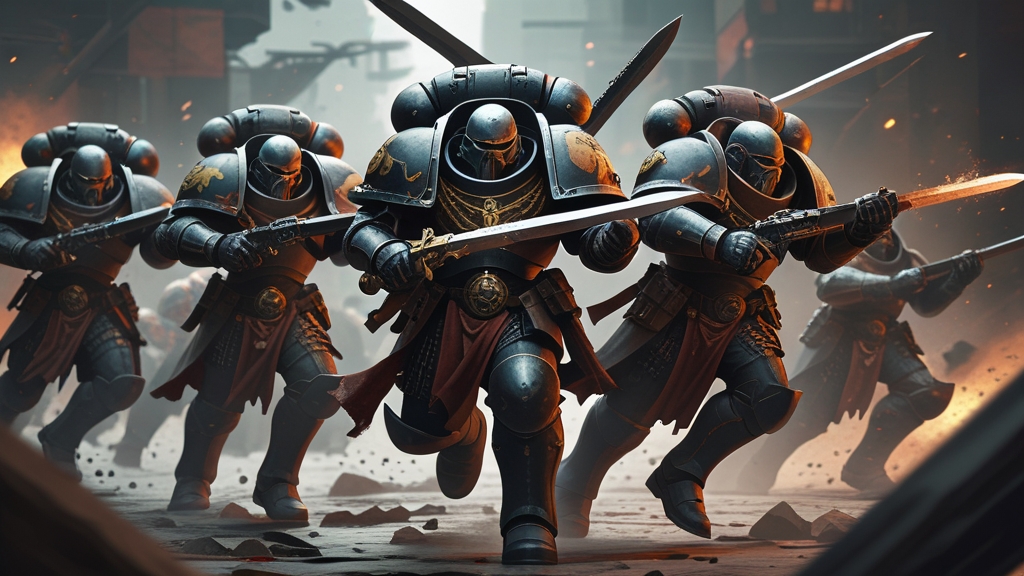
Assault Intercessors are the dedicated melee infantry of Space Marine armies. Where standard Intercessors hold positions with disciplined bolt rifle fire, Assault Intercessors are the warriors who close the distance and fight the enemy blade to blade. Armed with heavy bolt pistols and Astartes chainswords, these Primaris Marines are built to charge, fight and hold ground.
In the lore, Assault Intercessors are the shock troops of a Primaris strike force. They are not the subtle warriors who infiltrate or outmanoeuvre; they are the hammer that smashes through the enemy line. When a position must be taken by force and ranged fire alone will not dislodge a dug-in enemy, Assault Intercessors are unleashed.
Their role in a Space Marine army is straightforward but essential. They give melee capability to an army that can lean heavily on shooting, they contest objectives that ranged units struggle to take, and they counter-charge enemy melee threats that would otherwise overwhelm your gunline, all at a relatively low points cost.
Assault Intercessors Datasheet Overview
Assault Intercessors use the Primaris Marine profile: sturdy power-armoured infantry with two wounds each and a good armour save. Where they differ from standard Intercessors is their equipment and the rule that supports their aggressive playstyle.
Every model carries an Astartes chainsword and a heavy bolt pistol. The chainswords give the squad a high volume of melee attacks, so a full unit puts out a lot of attacks against enemy infantry. The heavy bolt pistols give them some ranged output before a charge and let them shoot while engaged; in 11th Edition the old Pistol keyword has been replaced by Close-Quarters.
The Sergeant can swap to a heavier melee weapon, such as a power fist, power weapon or thunder hammer, which gives the squad a way to threaten tougher targets than basic infantry.
The squad’s datasheet ability rewards them for charging, reflecting their shock assault role. Rather than rely on remembered numbers from older editions, check the exact wording, the current statline and the points cost in the 11th Edition Space Marines codex, the Warhammer 40,000 app and the latest Munitorum Field Manual.
Best Assault Intercessors Loadouts
Standard Chainswords with Power Fist Sergeant
This is the most common loadout. The chainswords provide volume of attacks against infantry, while the Sergeant’s power fist gives you the ability to threaten heavier targets. It is versatile enough to handle most situations.
Thunder Hammer Sergeant
For maximum Sergeant punch, the thunder hammer hits harder than the power fist at the cost of fewer attacks. It’s better against single tough targets like characters or small elite units, and worse against larger squads. Choose based on your expected opponents.
Five or Ten Models?
Running a full ten-model squad maximises your attacks and makes the unit very threatening on the charge, but it’s harder to hide behind terrain and puts a lot of points in one place. Five-model squads are cheaper, easier to hide and let you threaten more objectives at once. There are no combat squads any more, so decide the size when you write your list.
Assault Intercessors Charge Tactics
The Charge Phase Is Everything
Assault Intercessors live and die by the charge. A successful charge is devastating; a failed one leaves them stranded in the open, exposed to enemy shooting. Every decision you make with them should be about setting up good charges.
Maximising Charge Success
In 11th Edition you roll 2D6 for the charge first, then pick targets within 12″ and within the distance you rolled. Engagement range is now 2″, so you need to end within 2″ of the target rather than 1″. Get as close as possible in the Movement phase, but remember that a unit that Advances can’t charge that turn. Use terrain to approach without being shot off the board, and remember that charging units get Fights First that turn.
Multi-Charges
If you can reach more than one enemy unit with your roll, charging several can tie up enemy shooting units in combat. Only do it when the extra target is worth it, and make sure you can still fight the unit that matters most.
Pile In and Consolidate
In 11th Edition all pile-ins happen at the start of the Fight phase (up to 3″), and units consolidate up to 3″ after fighting. Use these moves to reach enemy models you didn’t charge, or to move onto an objective. Since objectives are now terrain areas, a good consolidate can put your squad inside the objective you need to control.
Army Synergies and Support
Character Attachments
Assault Intercessors make a natural bodyguard unit. In 11th Edition each bodyguard unit can take one Leader and one Support character, and you lock those pairings in when you write your army roster. A Captain is one Leader that can join Assault Intercessor Squads; Chaplains and Lieutenants are popular melee-minded options too. Each character’s datasheet lists exactly which units it can join and what it does while leading, and if the datasheet and the Munitorum Field Manual disagree, follow the Munitorum Field Manual. Our Leader rules guide explains how attached units work.
Transport Delivery
An Impulsor is the classic delivery vehicle for Assault Intercessors: fast enough to get them into charge range quickly and sturdy enough to survive a turn of shooting. A Repulsor is tougher and better armed but costs significantly more. The choice depends on your army’s needs and available points.
Combined Arms
Assault Intercessors work best as part of a combined-arms plan. Use your shooting to soften up the enemy, then send in the Assault Intercessors to finish them off, so you’re not throwing your melee troops into full-strength units that can annihilate them before they swing.
Stratagems
In 11th Edition a unit can only benefit from one Stratagem per phase, and Command Re-roll counts as one. Decide in advance whether a key charge gets a buff Stratagem or is saved for a re-roll, because you can’t do both on the same unit in the same phase.
Competitive Play Considerations
Assault Intercessors are a common sight in competitive Space Marine lists because they provide melee capability at a reasonable cost. They are one of the few cheap infantry units that can genuinely threaten enemy units in close combat, which matters for taking and holding objectives.
In tournament play, they typically serve as objective grabbers and counter-charge units rather than primary damage dealers. Their job is to take an objective, survive on it for a turn and force the enemy to commit resources to dislodging them.
Their main weakness is shooting. They’re only basic power-armoured infantry, and they die to concentrated fire. Terrain matters even more in 11th Edition: infantry fully within terrain get the benefit of cover (−1 to the attacker’s hit rolls), and infantry in terrain that haven’t shot recently can only be seen from within 15″. Use that to get them into combat before the enemy shoots them off the board.
Painting Assault Intercessors
Assault Intercessors are dynamic models with great action poses. Paint them in your Chapter colours with emphasis on the chainsword blades — try adding blood effects with Blood for the Blood God technical paint for a visceral look. The heavy bolt pistols can be picked out in gunmetal with careful edge highlighting. Basing with battlefield debris, spent shell casings and fallen enemies enhances the assault theme.
Frequently Asked Questions
Are Assault Intercessors good?
Yes, they are a solid, cheap melee infantry choice. They provide close-combat capability and objective presence at a reasonable points cost, which is why many Space Marine lists include them.
Assault Intercessors vs Bladeguard Veterans?
Bladeguard Veterans hit harder and are more durable but cost significantly more. Assault Intercessors are better as cheap objective grabbers and screens, while Bladeguard are premium melee killers. Many lists include both, with each serving a different role.
Should I charge every turn?
Not necessarily. Only charge when you have a reasonable chance of making it and when the combat will be favourable. Sometimes it is better to wait a turn, reposition and charge next turn with a shorter distance. Patience wins more games than reckless aggression.
What is the best Chapter for Assault Intercessors?
Chapter Tactics no longer exist; in current 40k your army’s bonuses come from the detachments you choose with your Detachment Points. Melee-focused detachments, and the Blood Angels and Black Templars rules in particular, suit Assault Intercessors well, but they’re effective in any Space Marine army. See our Detachment Points guide for how detachments work in 11th Edition.
How many units should I take?
One or two squads of five is a common starting point. Taking many more risks over-investing in melee at the expense of shooting. Start with one unit and add more if your army needs additional close-combat presence.
Are Assault Intercessors Battleline?
Assault Intercessors have long been a Battleline unit for Space Marines, the melee counterpart to standard Intercessors, which makes them one of the cheapest ways to add close-combat bodies that can also hold objectives. Check the current datasheet for their keywords. They’re usually fielded in squads of five, which keeps them flexible, or ten when you want a bigger charge threat.
Where can I find Assault Intercessors building instructions?
The multipart kit comes with a printed instruction booklet, and Games Workshop hosts downloadable building instructions for many current kits on the Warhammer website. If you have the push-fit Assault Intercessors from a starter set, the instructions are in that set’s booklet. Those models snap together without glue, while the multipart kit needs plastic glue and offers more weapon and pose options.
Can Assault Intercessors have jump packs?
Yes, but as a separate unit. Assault Intercessors with Jump Packs have their own kit and datasheet, trading the foot-slogging squad’s role for much greater speed and the ability to arrive from reserves. Standard Assault Intercessors can’t be given jump packs, so if you want flying melee Primaris Marines, buy the jump pack kit instead.
Related Content
- Chaos Space Marines – Warhammer 40k Guide — the traitor counterparts of the Space Marines
- How to Play Warhammer 40k — Complete Beginner’s Guide — learn the core rules of Warhammer 40K
- Drop Pod Guide — Space Marine Orbital Assault — explore another helpful guide
- All Warhammer 40k Factions Ranked — Tier List — see which factions rank highest