
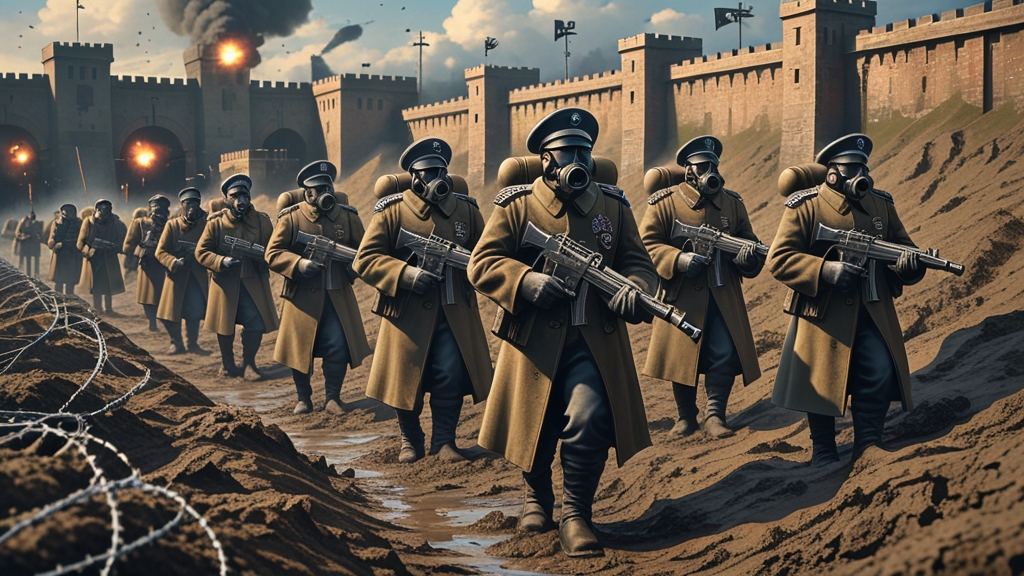
The Siege of Vraks was a 17-year Imperial campaign to reclaim the fortress world of Vraks Prime from the forces of Chaos, and it stands as one of the most brutal, costly, and fascinating military engagements in all of Warhammer 40,000 lore. It cost approximately 14 million Imperial lives — including the near-total destruction of multiple Death Korps of Krieg regiments — and resulted in the planet being declared Perdita (lost) and subjected to Exterminatus, rendering the entire campaign’s sacrifices arguably meaningless. The Siege of Vraks is Warhammer 40,000 at its most grimly authentic: a war of attrition fought for a prize that wasn’t worth the cost, by soldiers who weren’t given a choice.
The Siege of Vraks was originally presented in a three-volume series of campaign books by Forge World (Imperial Armour Volumes 5, 6, and 7), which provided both the narrative history of the siege and rules for fielding the forces involved on the tabletop. These books are considered some of the finest supplements ever produced for Warhammer 40,000, combining detailed military history with atmospheric artwork, extensive force organisation charts, and some of Forge World’s most iconic model ranges.
What Was Vraks Prime?
Vraks Prime was an Armoury World — a planet dedicated to the storage and distribution of military equipment for the Imperial Guard. Located in the Scarus Sector of Segmentum Obscurus, Vraks housed vast quantities of weapons, ammunition, vehicles, and supplies in underground storage vaults and surface warehouses. The planet’s military significance was enormous: its stockpiles were intended to supply entire crusade fleets and sector-wide military campaigns.
The planet itself was heavily fortified. As an armoury world containing vast quantities of military equipment, Vraks was protected by multiple rings of defensive fortifications — trenches, bunkers, minefields, artillery positions, and anti-aircraft batteries arranged in concentric rings around the planet’s central citadel. These defences were designed to repel any external attack and protect the stockpiles within. Ironically, these same defences would make the planet extraordinarily difficult for the Imperium to reclaim once it fell to Chaos.
Vraks also served as a Cardinal World, hosting a significant religious population and serving as a pilgrimage destination. This dual nature — military storehouse and religious centre — would prove critical to the planet’s fall, as the religious infrastructure provided the vector through which Chaos corruption spread.
How Did Vraks Fall to Chaos?
The fall of Vraks was orchestrated by Cardinal Xaphan, the world’s senior religious authority. Xaphan was a charismatic demagogue who, corrupted by agents of Chaos, used his religious authority to turn the planet’s population against the Imperium. He preached that the Imperium had abandoned Vraks, that the Administratum was corrupt, and that the people of Vraks should take control of their own destiny.
Xaphan’s rebellion began as a religious uprising — a populist revolt dressed in the language of faith. Millions of pilgrims and citizens rallied to his cause, seizing control of the planet’s military stockpiles and turning the fortifications meant to protect Vraks into defences against the Imperium itself. The rebellion was initially treated as a routine civil disturbance, but the scale of Vraks’ military resources meant that the rebels were immediately and dangerously well-armed.
As the rebellion progressed, the Chaos corruption became more overt. Chaos Space Marines — particularly elements of the Alpha Legion — infiltrated the rebel forces, providing military expertise and accelerating the population’s descent into Chaos worship. Renegade militia forces, mutants, and eventually daemons swelled the rebel ranks. What had started as a religious uprising became a full-scale Chaos insurrection, with Vraks’ formidable defences and vast armouries now serving the enemies of the Imperium.
How Did the Siege Begin?
The Imperium’s response to the loss of Vraks was constrained by the planet’s strategic importance. Vraks could not simply be bombarded from orbit — the underground storage vaults were hardened against orbital strikes, and destroying the planet’s surface would not guarantee the destruction of the stockpiles. Moreover, the Imperium wanted to reclaim the weapons and supplies, not destroy them. This meant a ground assault: a siege.
The task fell primarily to the Death Korps of Krieg — a regiment of the Imperial Guard renowned for their specialisation in siege warfare, their willingness to accept catastrophic casualties, and their absolute devotion to the Emperor. The Krieg were the perfect (and perhaps only) force for a mission that would require years of grinding attrition against fortified positions, because the Krieg did not care about casualties. Every soldier of Krieg considered themselves already dead, fighting to atone for their homeworld’s past heresy. The siege of Vraks was, for them, exactly the kind of penance they sought.
The initial deployment was enormous: 34 regiments of the Death Korps of Krieg, supported by artillery, siege equipment, and armoured units. The Krieg established their own fortified lines opposite the rebel positions and began a systematic advance toward the central citadel. The plan was simple in conception and devastating in execution: a slow, methodical advance through the concentric rings of fortifications, reducing each defensive line through bombardment, assault, and attrition.
What Was the Fighting Like?
The Siege of Vraks deliberately evoked the Western Front of World War I, and the parallels are extensive and intentional. The fighting was characterised by trench warfare, artillery bombardment, gas attacks, infantry assaults across no man’s land, and a grinding, attritional pace that measured progress in metres rather than kilometres.
The Krieg dug trenches, parallels, and saps toward the rebel positions, inching forward under constant fire. Artillery duels consumed vast quantities of ammunition as both sides attempted to suppress each other’s guns. Infantry assaults were launched against fortified positions, often resulting in enormous casualties for minimal territorial gain. Gas weapons — chemical and biological — were used by both sides, adding a horrifying dimension to the already brutal fighting.
The rebel forces were well-supplied (from Vraks’ own stockpiles) and fanatically motivated (by Chaos corruption). They fought with the ferocity of the damned, often literally. As the siege progressed, the Chaos influence deepened: mutants replaced regular soldiers, daemons appeared on the battlefield, and the very environment became corrupted by Warp energy. The Krieg, protected by their gas masks and their psychology of self-sacrifice, endured conditions that would have broken almost any other regiment.
The siege lasted 17 Terran years. Seventeen years of trench warfare, artillery bombardment, and infantry assaults on a single planet. The scale of the fighting consumed regiment after regiment of Krieg soldiers, each replacement wave taking up the positions of the dead and continuing the advance. The casualty figures were staggering — approximately 14 million Imperial dead by the siege’s end, with the rebel/Chaos casualties estimated at similar or higher numbers.
What Forces Were Involved?
The Siege of Vraks involved a wide range of Imperial and Chaos forces, making it one of the most diverse military engagements in 40k lore.
Imperial forces were spearheaded by the Death Korps of Krieg, but also included elements of the Imperial Navy (providing orbital support and air cover), the Titan Legions (deploying god-machines against the heaviest fortifications), the Grey Knights (responding to daemonic incursions), and the Red Scorpions Space Marine Chapter (providing elite assault capability at critical moments). The diversity of Imperial forces reflected the escalating nature of the siege — as the Chaos presence grew, increasingly specialised forces were required to counter it.
Chaos forces included the original rebel militia, renegade Imperial Guard units, Chaos cultists, mutant hordes, traitor Titans, and Chaos Space Marines from the Alpha Legion, World Eaters, and Death Guard. As the siege progressed, daemonic forces became increasingly prominent, with Nurgle daemons in particular infesting the trenches and fortifications. The involvement of multiple Chaos factions reflected the siege’s role as a magnet for Chaos forces — the prolonged suffering and death generated by the fighting attracted the attention of the Dark Gods, who poured resources into the defence.
How Did the Siege End?
The siege ended not with a triumphant Imperial victory but with a grim, pyrrhic conclusion that perfectly encapsulates the Warhammer 40,000 setting’s ethos.
After 17 years of fighting, the Krieg and their supporting forces finally breached the inner citadel and overcame the last organised resistance. But the victory was hollow. The planet was so thoroughly corrupted by Chaos that it could not be reclaimed for productive use. The stockpiles that the Imperium had fought to recover were contaminated, corrupted, or destroyed. The population was dead, mutated, or daemonically possessed. The infrastructure was in ruins.
In the aftermath, the Inquisition declared Vraks Perdita — a lost world, too corrupted for human habitation. The planet was subjected to Exterminatus, destroying whatever remained on its surface. Fourteen million Imperial soldiers had died to reclaim a world that was ultimately judged unsalvageable and destroyed anyway.
This ending is what elevates the Siege of Vraks from a mere battle narrative to a statement about the nature of war in the 41st Millennium. The Imperium did not fight for Vraks because it was the smart or efficient thing to do. It fought because its institutional machinery demanded it — because losing an armoury world to Chaos was unacceptable regardless of the cost of reclaiming it. The 14 million dead were not a miscalculation; they were the system working as intended. The Imperium spent those lives because it could, and because its bureaucratic, militaristic culture does not weigh individual lives against strategic outcomes.
Why Is the Siege of Vraks So Important to the Community?
The Siege of Vraks holds a special place in the Warhammer 40,000 community for several reasons.
It is the definitive Death Korps of Krieg story. The Death Korps are one of the most popular Imperial Guard regiments, and the Siege of Vraks is their signature campaign. The siege’s trench-warfare aesthetic, its WWI parallels, and its themes of sacrifice and attrition perfectly showcase what makes the Krieg distinctive and appealing. For many fans, the Siege of Vraks is what made them fall in love with the Death Korps.
The Forge World books are masterpieces. The three Imperial Armour volumes that describe the siege are considered among the finest publications in Games Workshop’s history. They combine detailed narrative with gorgeous artwork, comprehensive army lists, and technical specifications that bring the siege to life in extraordinary detail. The books are now out of print and highly collectible.
It captures 40k’s essence. The Siege of Vraks is grimdark in the truest sense. It is not grimdark because it features skulls and darkness and evil gods. It is grimdark because it tells the story of millions of people dying for nothing — a war fought because the system demanded it, not because it made sense. The siege’s futility, its scale, and its grim conclusion embody what makes Warhammer 40,000 distinctive as a setting.
Gaming legacy. The Siege of Vraks inspired countless tabletop gaming campaigns, with players recreating the siege’s battles using Forge World’s detailed army lists and terrain guidelines. The campaign format — with its escalating forces, narrative progression, and diverse army compositions — provided a template for narrative gaming that many groups still follow.
The Siege of Vraks on the Tabletop
The Siege of Vraks was accompanied by extensive tabletop rules in the Imperial Armour volumes. These rules included army lists for the Death Korps of Krieg (with their unique regiment doctrine, specialised units, and characteristic equipment), the Vraks Renegade Militia (with rules for mutants, Chaos cultists, and renegade vehicles), and various supporting forces.
Forge World produced a wide range of resin miniatures to support the Vraks campaign, including Death Korps infantry, artillery, cavalry, and specialist units, as well as renegade militia, mutant mobs, and Chaos vehicles. These miniatures became some of Forge World’s most iconic products, and Death Korps models remain among the company’s best-selling lines.
While the original Imperial Armour army lists have been superseded by subsequent editions of Warhammer 40,000, the Siege of Vraks remains a popular theme for narrative gaming. Players regularly create Vraks-themed armies, build trench-warfare terrain boards, and run campaign weekends inspired by the siege’s narrative progression.
Frequently Asked Questions
How many Death Korps of Krieg died at Vraks?
The exact figure varies by source, but approximately 14 million Imperial Guard died during the siege, the vast majority of whom were Death Korps of Krieg. Multiple complete regiments were effectively destroyed and replaced during the 17-year campaign.
Was the Siege of Vraks worth it?
From a purely strategic standpoint, no. The Imperium spent 17 years and 14 million lives to reclaim a world that was ultimately destroyed anyway. However, the Imperium does not make strategic calculations the way a rational actor would — it responds to threats according to institutional doctrine, and doctrine demanded that a lost armoury world be reclaimed regardless of the cost.
Can I still buy the Forge World Siege of Vraks books?
The original Imperial Armour Volumes 5, 6, and 7 are out of print but available on the secondary market. They command high prices due to their collectibility and the quality of their content. PDF versions occasionally appear through official Forge World or Games Workshop digital releases.
Are the Death Korps of Krieg still available as models?
Yes. Forge World continues to produce Death Korps of Krieg resin models, and Games Workshop has released plastic Death Korps models (notably the Kill Team: Octarius set). The Krieg remain one of the most popular and recognisable Imperial Guard regiments.
Did any Space Marines fight at Vraks?
Yes. The Red Scorpions Chapter deployed elements to Vraks during critical phases of the siege, and the Grey Knights intervened when daemonic incursions threatened to overwhelm the Imperial forces. However, the siege was primarily an Imperial Guard operation, with Space Marines playing supporting rather than leading roles.
When did the Siege of Vraks take place?
The Siege of Vraks ran from 813.M41 to 830.M41, the seventeen years of the Imperial campaign. Cardinal Xaphan’s rebellion broke out shortly before, after which the Death Korps of Krieg began their long advance on the citadel. The siege therefore took place well before the Great Rift, in the closing centuries of the 41st Millennium.
Who led the Imperial forces at the Siege of Vraks?
Lord Commander Zuehlke led the Imperial forces, at the head of the Death Korps of Krieg’s siege army. He directed the slow, methodical advance through Vraks’ rings of fortifications over the siege’s seventeen years. Inquisitors also oversaw the campaign, and the Red Scorpions and Grey Knights joined at critical moments.
Is there a Siege of Vraks novel?
Yes. Black Library published Siege of Vraks by Steve Lyons, a novel set during the campaign that follows the Death Korps of Krieg in the trenches. It is a good way into the story if you can’t track down Forge World’s out-of-print Imperial Armour volumes, though those remain the most detailed account of the siege.
Related Content
- The Horus Heresy Explained — Complete Timeline & Guide — foundational lore for Warhammer 40K
- What Is the Necroquake? — Nagash’s Great Ritual — related lore topic
- Best Warhammer Books to Read — Fiction Guide — top-rated Warhammer novels and books
- All Warhammer 40k Factions — The Complete Guide — overview of all Warhammer 40K factions