
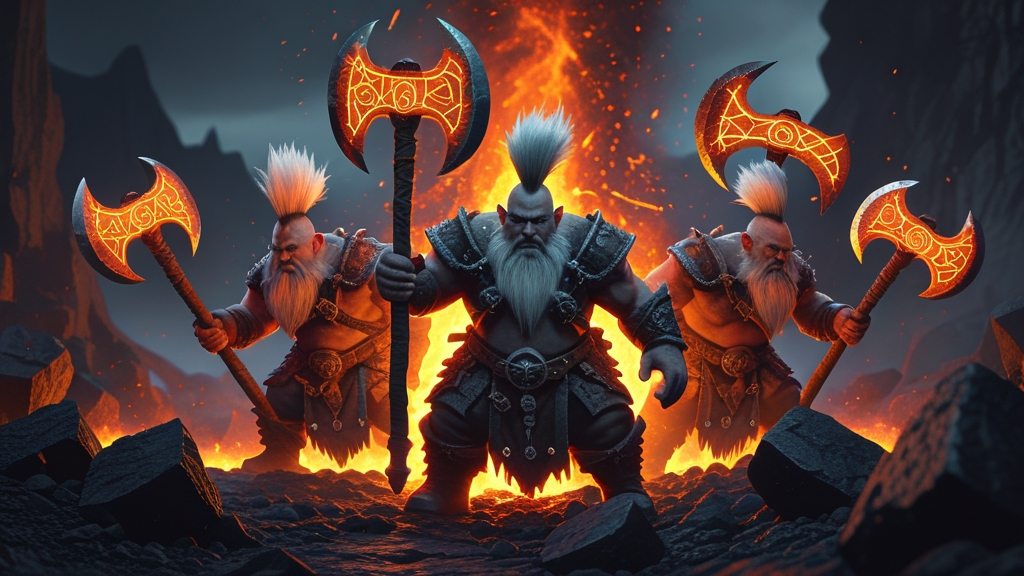
Part of our Fyreslayers & Khazalite Holds hub: every Fyreslayers & Khazalite Holds guide, lore page and painting tutorial in one place.
The Fyreslayers are one of the most fascinating and unique factions in Age of Sigmar — a civilisation of duardin warriors driven by an obsessive, near-religious quest to recover the scattered essence of their shattered god, Grimnir. Unlike other duardin factions who build empires or seek profit through trade, the Fyreslayers measure wealth in a single currency: ur-gold, the divine metal that contains fragments of Grimnir’s power.
Every aspect of Fyreslayer culture revolves around this singular pursuit. Their lodges function as mercenary companies, selling their martial prowess to any who can pay in gold — because within that gold might lurk a fragment of Grimnir’s divine essence. Their Runesmiters and Runefathers can detect ur-gold through an almost supernatural sense, and when they find it, they forge it into runes that are hammered directly into the flesh of their warriors, granting them supernatural strength, resilience, and fury in battle.
This guide explores the deep lore of the Fyreslayers — from Grimnir’s legendary sacrifice against the godbeast Vulcatrix to the inner workings of the lodges, the sacred art of runic empowerment, and the Magmadroth mounts that make the Fyreslayers one of the most visually striking armies in the Mortal Realms.
Who Was Grimnir and What Was His Sacrifice?
Grimnir was one of the two duardin ancestor gods who survived the destruction of the World-That-Was, alongside his brother Grungni. When the Mortal Realms were young and Sigmar was building his great pantheon, both duardin gods were rescued from captivity by Sigmar and pledged their aid to his cause. But while Grungni was a craftsman and builder, Grimnir was a warrior — the god of oaths, vengeance, and battle.
Grimnir’s defining moment came when Sigmar asked both duardin gods to help tame the Mortal Realms. Grungni set to work forging weapons and armour for Sigmar’s forces. Grimnir, true to his warrior nature, chose a more direct approach — he would slay Vulcatrix, the Mother of Salamanders, a colossal godbeast of living fire that terrorised the Realm of Aqshy.
The battle between Grimnir and Vulcatrix was apocalyptic. Grimnir fought the godbeast for days, matching divine fury against primordial flame. Neither could overcome the other. In the end, Grimnir delivered a killing blow that destroyed Vulcatrix, but the explosion of divine and elemental energy destroyed him as well. Both combatants were annihilated simultaneously, and their combined essence shattered across the Mortal Realms.
Vulcatrix’s remains became the Magmadroths — great fire-drakes born from the fragments of the godbeast’s power. Grimnir’s divine essence was scattered as tiny fragments of magical gold that became embedded in ore deposits throughout every realm. This shattered god-essence is what the Fyreslayers call ur-gold, and recovering every last fragment of it is the driving purpose of their entire civilisation.
The theological implications are profound. The Fyreslayers believe that if they can recover every fragment of Grimnir’s scattered essence, they can reassemble their god and bring him back to life. This belief fuels everything they do — every battle fought, every contract taken, every mine dug. It transforms what might otherwise appear to be simple greed into a sacred religious mission.
What Is Ur-Gold and How Do the Runes Work?
Ur-gold is not ordinary gold. While it resembles mundane gold to untrained eyes, ur-gold contains fragments of Grimnir’s divine essence, giving it supernatural properties. Fyreslayer Runesmiters — the faction’s priest-smiths — can sense the presence of ur-gold through a combination of trained intuition and divine sensitivity. They can distinguish a nugget of ur-gold from a mountain of mundane gold, and this ability makes them indispensable to every lodge.
When ur-gold is identified and recovered, the Runesmiters forge it into sacred runes using techniques passed down through generations since Grimnir’s fall. These runes are not decorative — they are hammered directly into the bare flesh of Fyreslayer warriors in a painful ritual that bonds the divine essence to the warrior’s body. The process is agonising, but the rewards are extraordinary.
Each rune type grants different abilities. Some runes enhance physical strength, allowing a Fyreslayer to strike with force that belies his stature. Others grant supernatural toughness, letting warriors shrug off wounds that would fell a Stormcast Eternal. Some runes enhance speed, others sharpen senses, and the most powerful runes can grant near-invulnerability for short periods or unleash explosive blasts of divine fire.
The more ur-gold runes a Fyreslayer bears, the more powerful he becomes — but there are limits. Only the mightiest warriors can bear multiple runes without being overwhelmed by the divine energy. Runefathers, the leaders of Fyreslayer lodges, typically bear the most runes and are among the most formidable individual combatants in the Mortal Realms. The process of receiving runes is cumulative over a lifetime, with warriors earning the right to bear additional runes through deeds of valour and service.
There is a darker side to the rune process. The divine fire of Grimnir that flows through the runes is addictive, and warriors who bear many runes can become consumed by a berserker fury that makes them difficult to control. This battle-rage is both the Fyreslayers’ greatest strength and their most dangerous weakness, as it can drive warriors to fight beyond all reason or strategic sense.
How Are the Fyreslayer Lodges Organised?
Fyreslayer society is organised into lodges — semi-independent communities built around a central magmahold, which is typically a massive underground fortress carved into volcanic rock or situated near sources of geothermal energy. Each lodge is led by a Runefather, the most senior warrior-leader, who governs with the counsel of the lodge’s Runesmiters and Battlesmiths.
The Runefather is the patriarch of the lodge, combining the roles of military commander, political leader, and spiritual figurehead. He is always the most heavily runed warrior in the lodge, bearing ur-gold that has been accumulated over decades of service. His authority is absolute in matters of war and diplomacy, and he decides which contracts the lodge will accept.
The Runesons are the heirs and chief lieutenants of the Runefather. Each lodge typically has several Runesons who lead the lodge’s fighting forces in battle. They compete with each other for glory and their father’s favour, and the most accomplished Runeson will eventually inherit leadership of the lodge. This competitive dynamic keeps the Runesons sharp and aggressive.
The Runesmiters and Runemasters form the priestly caste of the lodge. They maintain the sacred forges where ur-gold is refined and runes are crafted. They perform the rituals that bond runes to warriors’ flesh. They can also invoke the power of Grimnir in battle, calling forth divine fire to smite enemies or empower allies. The Runemaster is the senior priest, while Runesmiters serve under him.
The Battlesmith is the lodge’s keeper of history and lore. He carries the lodge’s icon — a great totem that records the lodge’s deeds and honours. In battle, the Battlesmith inspires nearby warriors through the spiritual connection between the lodge icon and the ur-gold runes they bear, making surrounding Fyreslayers fight harder and endure more punishment.
Hearthguard Berzerkers and Auric Hearthguard form the elite warrior castes. Hearthguard Berzerkers are the lodge’s shock troops, heavily runed warriors who fight with great broadaxes or flamestrike poleaxes and charge headlong into the enemy. Auric Hearthguard are the ranged specialists, wielding magmapikes that fire streams of molten rock at distant foes.
Vulkite Berzerkers are the rank-and-file warriors of the lodge — though calling any Fyreslayer rank-and-file understates their ferocity. Every Vulkite bears at least some ur-gold runes and fights with the fury of a warrior on a divine mission. They form the backbone of any Fyreslayer army and are far more dangerous than their relatively modest stature might suggest.
Why Do the Fyreslayers Fight as Mercenaries?
The Fyreslayers’ mercenary culture is frequently misunderstood by outsiders who see duardin warriors selling their services and assume simple greed. The reality is far more nuanced. Fyreslayers fight as mercenaries because it is the most efficient way to acquire gold — and within that gold, fragments of ur-gold that contain Grimnir’s essence.
A lodge cannot mine enough ur-gold on its own to sustain its warriors. The fragments of Grimnir are scattered across every realm, embedded in gold deposits throughout the Mortal Realms. By fighting for anyone willing to pay in gold, the Fyreslayers can accumulate vast quantities of the precious metal, which their Runesmiters then carefully sift for traces of ur-gold. Most of the gold they receive is mundane, but even a single fragment of ur-gold makes an entire campaign worthwhile.
This mercenary ethos creates fascinating diplomatic dynamics. Fyreslayers will fight for anyone — Order, Chaos, Death, or Destruction — as long as the payment is sufficient. They have been known to fight for Sigmar’s forces in one campaign and for a Chaos warlord in the next. This moral flexibility horrifies many of their potential allies, but the Fyreslayers see no contradiction. Their loyalty is to Grimnir and the sacred quest, not to any mortal cause or alliance.
However, the Fyreslayers are not without principles. They always honour their contracts once accepted — breaking a sworn oath is anathema to duardin culture. They will not fight against a previous employer during the same campaign, and they will not accept contracts that require them to betray a current employer. Their reliability once hired is absolute, which is why so many disparate forces continue to employ them despite their mercenary nature.
Some lodges have developed stronger allegiances than others. The Vostarg lodge, for example, has a long history of fighting alongside Sigmar’s forces and has developed genuine loyalty to the God-King’s cause. The Greyfyrd lodge is known for its strict adherence to contractual obligations above all else. Each lodge’s personality and history shape how they approach the mercenary life.
What Are Magmadroths and Where Do They Come From?
Magmadroths are massive fire-drakes — draconic creatures born from the shattered remains of Vulcatrix, the godbeast that Grimnir slew in his final battle. Just as Grimnir’s essence scattered as ur-gold, Vulcatrix’s essence coalesced into these magnificent creatures, making them literal children of the same cataclysm that defines Fyreslayer civilisation.
This shared origin creates a deep bond between Fyreslayers and Magmadroths. The creatures are drawn to volcanic environments and the intense heat of Fyreslayer magmaholds, and the Fyreslayers have developed techniques for rearing and bonding with them over the millennia. A Magmadroth bonded to a Fyreslayer Runefather or Runeson becomes a devastating weapon of war — a creature that can breathe streams of liquid fire, crush enemies beneath its massive bulk, and radiate such intense heat that nearby foes are weakened before the fighting even begins.
Magmadroths are not mere beasts, however. They possess a primal intelligence and a connection to the volcanic forces of Aqshy that gives them an almost elemental quality. They can sense ur-gold just as the Runesmiters can, and they become agitated and excited in its presence. Some Fyreslayer scholars believe that the Magmadroths instinctively seek to reunite with the other half of the cataclysm — that just as the Fyreslayers seek to reassemble Grimnir through ur-gold, the Magmadroths are drawn to the divine energy that was once part of Vulcatrix.
On the tabletop, Magmadroths serve as the Fyreslayers’ centrepiece models. A Runefather on Magmadroth is one of the most iconic units in the Age of Sigmar range — a mohawked duardin lord riding a massive fire-drake into battle, rune-axes blazing with divine fire. These models embody everything that makes the Fyreslayers unique: ancient duardin warrior culture, divine ur-gold power, and the legacy of Grimnir’s apocalyptic sacrifice.
How Do the Fyreslayers Connect to Other Duardin Factions?
The Fyreslayers are one of three major duardin factions in Age of Sigmar, alongside the Kharadron Overlords and the Cities of Sigmar duardin. Each faction represents a different response to the destruction of the World-That-Was and the challenges of the Mortal Realms.
The Fyreslayers chose faith — dedicating themselves to the recovery of Grimnir’s essence and the hope of their god’s resurrection. The Kharadron Overlords chose technology and commerce, building sky-fleets and establishing a mercantile confederation that rejects the old gods entirely. The Cities of Sigmar duardin chose integration, joining Sigmar’s civilisation and fighting alongside humans and aelves.
Relations between these factions are complicated. The Fyreslayers and Kharadron Overlords share duardin heritage but disagree fundamentally on religion and priorities. The Kharadron view the Fyreslayers’ obsession with ur-gold as dangerous fanaticism, while the Fyreslayers see the Kharadron’s rejection of Grimnir as blasphemy. Despite this, trade and occasional military cooperation do occur when mutual interests align.
The broader duardin diaspora remains fragmented, with no unified duardin civilisation existing in the Mortal Realms. This fragmentation is a source of both strength — each faction has developed unique capabilities — and weakness, as the duardin lack the coordinated power they wielded in the World-That-Was.
Frequently Asked Questions
Why do Fyreslayers fight with so little armour?
Fyreslayers fight bare-chested because the ur-gold runes hammered into their flesh provide supernatural protection that exceeds conventional armour. The runes generate a field of divine energy that deflects blows and absorbs damage. Wearing armour over the runes would actually interfere with this protection. Their exposed skin also allows the heat generated by their runes to dissipate, preventing the warriors from overheating during the fury of battle.
Can Grimnir actually be reassembled?
This is one of the great unanswered questions of Age of Sigmar lore. The Fyreslayers believe absolutely that recovering all ur-gold will restore Grimnir, and there is evidence that concentrated ur-gold does manifest divine properties. However, some scholars in the Mortal Realms question whether a shattered god can truly be reassembled, or whether the Fyreslayers are pursuing an impossible dream. Games Workshop has left this deliberately ambiguous.
Are Fyreslayers good or evil?
Fyreslayers are part of the Order Grand Alliance, making them broadly aligned with the forces of civilisation and Sigmar. However, their willingness to fight for anyone who pays — including Chaos warlords — puts them in a morally grey area. They are not evil, but their priorities are narrowly focused on the ur-gold quest rather than broader moral concerns. Most Fyreslayers would consider the question irrelevant — they serve Grimnir, not abstract concepts of good or evil.
How do Fyreslayers relate to the Slayers of the old Warhammer world?
Fyreslayers are the spiritual successors to the Slayers of Warhammer Fantasy. Both are mohawked, bare-chested duardin warriors who fight with reckless fury. However, the motivations differ significantly. Old World Slayers sought honourable death in battle to atone for personal shame. Fyreslayers fight not to die but to recover ur-gold and restore their god. The aesthetic is similar, but the narrative purpose has evolved substantially for the Age of Sigmar setting.
What is the best way to start collecting Fyreslayers?
The best starting point for a Fyreslayers army is typically the faction’s Start Collecting or Vanguard box, which provides a Runefather or Runeson on Magmadroth alongside a core of Vulkite Berzerkers. This gives you the army’s centrepiece model and a solid infantry base to build from. From there, adding Hearthguard Berzerkers for elite melee punch and Auric Hearthguard for ranged capability will round out a competitive force.
What are the main Fyreslayer lodges?
The best-known Fyreslayer lodges are the Vostarg, the Greyfyrd, the Hermdar and the Lofnir, each with its own temperament and battlefield style. The Vostarg are one of the oldest and proudest lodges, the Greyfyrd are famed mercenaries, the Hermdar are grim and relentless fighters, and the Lofnir are known for their Magmadroth-riding warriors. Players can also invent their own lodge with its own colours.
Do Fyreslayers use magic?
Fyreslayers have no wizards. Their supernatural power comes from the ur-gold runes hammered into their flesh and from priests such as Runesmiters, who chant prayers to Grimnir to bless warriors, smite enemies or summon molten manifestations. In game terms that makes them a prayer-based army rather than a spellcasting one, with ur-gold runes giving the whole force temporary boosts.