
Part of our Skaven hub: every Skaven guide, lore page and painting tutorial in one place.
The Skaven are a race of malevolent ratmen who inhabit the Under-Empire, a vast network of tunnels and warrens that stretches beneath the Mortal Realms. They worship the Great Horned Rat, the Chaos God of ruin and pestilence, and are organised into Great Clans that constantly scheme against each other even as they plot the downfall of all other races.
The Skaven are Warhammer’s definitive villain race — a civilisation of billions of malevolent ratmen who inhabit a vast subterranean empire beneath the Mortal Realms. They are cowards, backstabbers, megalomaniacs, and geniuses in equal measure. Every Skaven believes it is destined to rule the world, and every Skaven is willing to sacrifice any number of its kin to achieve that destiny. The result is a faction that is simultaneously the greatest threat to civilisation in the Mortal Realms and its own worst enemy.
This deep lore guide covers everything you need to know about the Skaven — from the Under-Empire and the Great Clans to the Council of Thirteen, warpstone technology, the Great Horned Rat, and the key characters who define the faction.
What Is the Under-Empire?
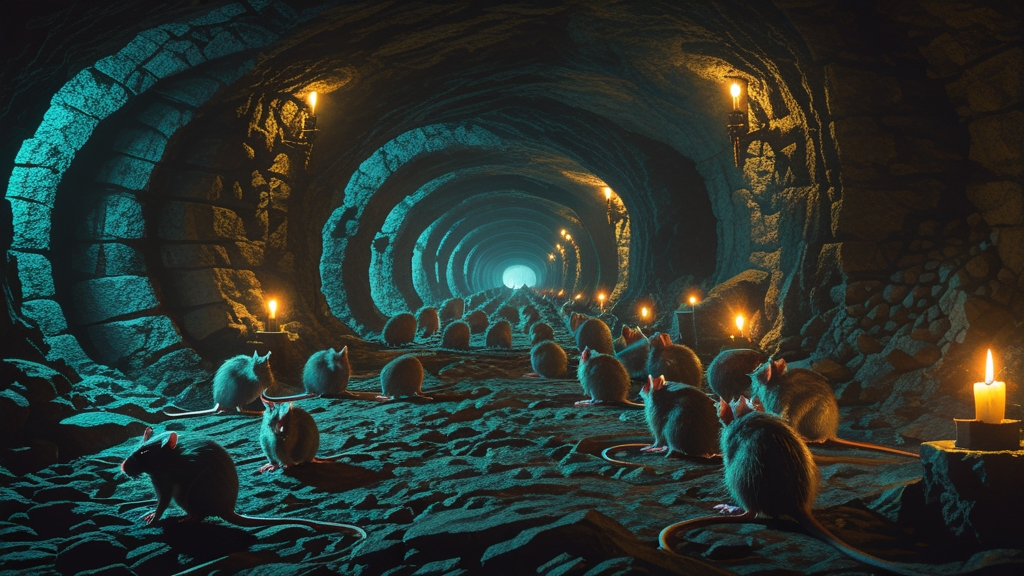
The Under-Empire is the Skaven’s sprawling subterranean civilisation — a network of tunnels, warrens, burrows, and underground cities that extends beneath every Mortal Realm. The Under-Empire is one of the largest civilisations in existence, rivalling or exceeding the surface empires of Order in population and geographical extent. Where the cities of men, aelves, and duardin rise above ground, the Skaven have gnawed an entire world beneath them.
The heart of the Under-Empire is Blight City — a sprawling, impossible metropolis that exists partially in the Mortal Realms and partially in the Realm of Chaos itself. Blight City is the Skaven capital, the seat of the Council of Thirteen, and the largest concentration of Skaven anywhere in existence. Its architecture is a nightmare of haphazard construction — towers built on top of other towers, tunnels that loop back on themselves, districts that collapse and are rebuilt on top of the rubble. Blight City is powered by warpstone — the crystallised Chaos energy that fuels all Skaven technology — and the entire city thrums with sickly green light and toxic radiation.
The tunnels of the Under-Empire are connected by Gnawholes — tears in reality that allow Skaven to travel between distant locations and even between Realms. These Gnawholes are created by Skaven engineers using massive warpstone-powered boring machines that literally chew through the fabric of reality. The Gnawhole network gives the Skaven strategic mobility that no other faction can match — they can appear anywhere there is a Gnawhole exit, striking without warning and retreating before retaliation.
Life in the Under-Empire is brutal, short, and dominated by constant scheming. Resources are scarce despite the Skaven’s vast territory because the population always exceeds the food supply. This scarcity drives the constant internecine warfare that defines Skaven society — every clan, every warband, every individual Skaven is competing with every other for food, warpstone, territory, and status. Alliances form and dissolve in moments. Betrayal is not just common but expected. Trust is a concept that Skaven literally do not understand.
What Are the Great Clans?
Skaven society is organised into clans, and the most powerful clans — the Great Clans — dominate the Under-Empire and control the Council of Thirteen. Each Great Clan has a distinct identity, specialisation, and approach to conquest:
Clan Verminus is the warrior clan — the largest of the Great Clans by sheer numbers. Verminus provides the bulk of the Skaven military: Clanrats, Stormvermin, and the endless hordes of expendable infantry that form the backbone of every Skaven army. Clan Verminus fights through overwhelming numbers, drowning enemies in bodies until resistance collapses. Their philosophy is simple: throw enough rats at a problem and eventually the problem dies. The Clawlords who lead Verminus warbands are the most martially skilled Skaven — which is to say they are slightly less cowardly than average and marginally better at fighting.
Clan Skryre is the engineer clan — mad scientists who combine warpstone technology with insane ingenuity to create weapons of terrifying and unreliable power. Skryre produces Warplock Jezzails (warpstone-powered sniper rifles), Ratling Guns (hand-cranked Gatling weapons), Warp Lightning Cannons (artillery that fires bolts of warpstone lightning), and Doomwheels (enormous hamster wheels mounted with warpstone generators). Skryre technology is devastatingly powerful when it works and catastrophically lethal to the user when it does not. Every Skryre weapon has a meaningful chance of exploding, misfiring, or otherwise killing its operator. The Skryre engineers consider this an acceptable cost of innovation.
Clan Pestilens is the plague clan — fanatical zealots who worship the Great Horned Rat through the medium of disease. Pestilens breeds plagues in vast cauldrons called plague furnaces, cultivating diseases that can wipe out entire cities. Their Plague Monks fight with frenzied devotion, hurling themselves at enemies while chanting prayers to the Great Horned Rat and hurling plague censers that spread toxic gas. Clan Pestilens is unique among Skaven clans for being genuinely faithful — most Skaven pay lip service to the Great Horned Rat while pursuing their own interests, but Pestilens monks truly believe in their god with a fervour that unnerves even other Skaven.
Clan Moulder is the flesh-shaping clan — bio-engineers who breed, mutate, and modify living creatures using warpstone. Moulder creates the monstrous beasts that accompany Skaven armies: Rat Ogres (massive brutes stitched together from rats and other creatures), Hell Pit Abominations (towering masses of mutated flesh that regenerate damage), and Giant Rats (exactly what they sound like, but bigger and angrier). The Master Moulders who run the clan’s breeding pits treat flesh as raw material, combining species, grafting limbs, and injecting warpstone until something useful emerges from the horror.
Clan Eshin is the assassin clan — spies, saboteurs, and killers who operate in the shadows. Eshin is the most secretive of the Great Clans, and their Gutter Runners and Night Runners are the most individually skilled fighters in the Skaven race. Where other clans rely on numbers or technology, Eshin relies on stealth, poison, and precision killing. An Eshin Deathmaster can infiltrate any fortress, assassinate any target, and disappear without a trace. Clan Eshin sells its services to other clans, making assassination and espionage a commercial enterprise.
What Is the Council of Thirteen?
The Council of Thirteen is the governing body of the Skaven race — a council of the thirteen most powerful Skaven warlords, with the thirteenth seat symbolically reserved for the Great Horned Rat himself. The Council theoretically makes decisions that affect the entire Under-Empire, directing wars, allocating resources, and mediating disputes between clans.
In practice, the Council is a den of backstabbing, manipulation, and paranoia that makes any human political body look harmonious by comparison. Every Council member is simultaneously plotting against every other member while maintaining a facade of cooperation. Alliances on the Council shift constantly. Assassination attempts are routine. Members have been poisoned at Council meetings, stabbed under the table, and replaced by body doubles without the other members noticing — or caring.
The Council’s dysfunction is both the Skaven’s greatest weakness and, paradoxically, a survival mechanism. Because no single Skaven can accumulate enough power to dominate the entire race, the Under-Empire avoids the catastrophic single-point-of-failure that would come from unified leadership. If the Skaven ever truly united under a single leader, they would be the most dangerous force in the Mortal Realms. The Council’s dysfunction ensures this never happens.
What Is Warpstone and Why Does It Matter?
Warpstone is crystallised Chaos energy — solidified magic in its rawest, most unstable form. It appears as glowing green-black crystals that radiate mutation-causing energy. For most races, warpstone is a dangerous contaminant to be avoided. For the Skaven, it is the foundation of their entire civilisation.
The Skaven use warpstone for everything. It powers their weapons and war machines. It fuels their sorcery. It feeds their mutations. It is their currency, their drug, their religious sacrament, and their technological fuel source all in one. Skaven are uniquely resistant (though far from immune) to warpstone’s mutagenic effects, which allows them to handle and consume quantities that would kill or transform any other race.
Warpstone consumption is both a religious practice and a practical necessity for many Skaven. Grey Seers — the priestly caste of Skaven society — consume warpstone to fuel their sorcery, snorting powdered warpstone like snuff before casting spells. The warpstone enhances their connection to the Great Horned Rat and amplifies their magical power, but also slowly poisons them, drives them mad, and causes progressive mutation. Grey Seers tend to be either brilliantly powerful or gibbering wrecks, with little middle ground.
Who Is Thanquol?
Thanquol is the most famous Skaven character in Warhammer lore — a Grey Seer of considerable power and even greater self-importance who has survived an improbable number of disasters through a combination of cowardice, luck, and a willingness to sacrifice anyone near him to save his own skin. Thanquol is convinced he is the greatest Skaven who has ever lived, destined to rule the Under-Empire and eventually the entire world. Every failure — and there have been many — is attributed to the incompetence of his underlings, the treachery of his rivals, or the intervention of his nemesis, the dwarf Gotrek Gurnisson.
Thanquol is accompanied by Boneripper, a series of increasingly elaborate Rat Ogre bodyguards. Each Boneripper is eventually destroyed in the course of Thanquol’s misadventures and replaced with a newer, more heavily armed model. The current Boneripper is a warpstone-enhanced monstrosity bristling with weapons, and Thanquol treats it with the same casual disregard he treats all his minions — as an expendable tool to be used and discarded as needed.
Despite his ego and his numerous failures, Thanquol is genuinely powerful. His command of warp lightning and other Skaven sorceries is formidable, and his survival instinct borders on supernatural. He has escaped situations that killed everyone around him so many times that some lore scholars have speculated the Great Horned Rat actively protects him — perhaps because Thanquol’s chaos and destruction serve the god’s purposes even when Thanquol’s plans fail.
What Is the Great Horned Rat?
The Great Horned Rat is the Chaos God of ruin, pestilence, and entropy — the patron deity of the Skaven race and the newest member of the Chaos pantheon. Unlike the other four Chaos Gods (Khorne, Tzeentch, Nurgle, Slaanesh), the Great Horned Rat achieved godhood relatively recently, ascending to full Chaos God status during the End Times that destroyed the World-That-Was and ushered in the Age of Sigmar setting.
The Great Horned Rat embodies decay, corruption, and the inevitable entropy that consumes all things. Where Nurgle represents the cycle of decay and rebirth, the Great Horned Rat represents pure ruin — things falling apart, systems collapsing, civilisations crumbling from within. The Skaven are both his worshippers and his instruments, spreading ruin wherever they go not through deliberate malice but through their fundamental nature as agents of chaos and destruction.
The Great Horned Rat’s relationship with the other Chaos Gods is contentious. The original four view him as an upstart and a lesser deity, while the Great Horned Rat considers himself their equal (or superior, depending on which Grey Seer you ask). This tension mirrors the Skaven’s relationship with the other Chaos factions — nominally aligned but fundamentally competitive, cooperating only when mutual interests align and betraying each other the moment they diverge.
Frequently Asked Questions
How many Skaven exist in the Mortal Realms?
The exact number is unknowable, but the Skaven population dwarfs every other race in the Mortal Realms. Skaven breed at extraordinary rates and their population is limited only by food supply and internal warfare. Estimates in the billions are conservative. The sheer weight of numbers is one of the Skaven’s greatest strategic advantages — they can absorb losses that would annihilate any other faction and replace them within a generation.
Are all Skaven evil?
Yes. Unlike some Warhammer factions where individuals might deviate from their race’s norm, the Skaven are universally selfish, treacherous, and malicious. This is not a cultural trait but a fundamental aspect of their nature — the Great Horned Rat’s influence permeates every Skaven soul. Individual Skaven may vary in competence, ambition, and the scale of their villainy, but none possess anything resembling empathy, altruism, or moral conscience.
Can Skaven be played as a Chaos faction in Age of Sigmar?
Yes. The Skaven are categorised as a Chaos faction in Age of Sigmar, reflecting their worship of the Great Horned Rat as a Chaos God. On the tabletop, Skaven can be built around any of the Great Clans, each offering different playstyles — Clan Verminus for hordes, Skryre for shooting and warmachines, Pestilens for melee and debuffs, Moulder for monsters, and Eshin for assassination and stealth.
What happened to the Skaven in the Old World?
In the original Warhammer Fantasy setting, the Skaven played a pivotal role in the End Times — the apocalyptic event that destroyed the World-That-Was. Clan Pestilens sabotaged Nagash’s Great Black Pyramid, and the Skaven contributed to the destruction of multiple human and dwarven civilisations. When the old world was destroyed and the Mortal Realms were created, the Skaven survived through the Realm of Chaos, eventually establishing a new Under-Empire beneath the Mortal Realms.
Why do the Skaven speak in third person?
Skaven speech patterns — referring to themselves in third person, repeating words for emphasis (“yes-yes”, “kill-kill”), and speaking in a chittering, rapid cadence — reflect their psychology. The third-person self-reference reflects their ego (they consider themselves important enough to narrate their own actions). The word repetition reflects their anxious, hyperactive nature. These speech patterns have become one of the most iconic elements of Warhammer’s characterisation and are instantly recognisable to fans of the setting.
Are Skaven in Warhammer 40k?
No. The Skaven belong to Warhammer’s fantasy settings: they were a major faction in Warhammer Fantasy Battle and are now an Age of Sigmar army. There is no Skaven faction in Warhammer 40,000, and the ratmen aren’t part of its lore. If you like the swarming, tech-mad style, Orks or Genestealer Cults are the nearest 40k equivalents in feel.
What is a Verminlord?
A Verminlord is a greater daemon of the Great Horned Rat: a towering, horned rat-daemon that leads Skaven armies and carries out its god’s will. Different kinds are tied to the Great Clans, such as the Verminlord Warbringer for Verminus, the Corruptor for Pestilens and the Deceiver for Eshin. Lord Skreech Verminking is the mightiest of them.