
Part of our Daughters of Khaine hub: every Daughters of Khaine guide, lore page and painting tutorial in one place.
The Daughters of Khaine are one of the most morally ambiguous factions in Age of Sigmar — a warrior cult of aelven priestesses who worship the dead god Khaine through blood rituals and battlefield slaughter. Behind their fanatical devotion lies one of the greatest deceptions in the Mortal Realms: the cult’s true leader is not Khaine but Morathi, an ancient and manipulative sorceress who has used it to gather power for centuries.
The Daughters of Khaine are warriors of extraordinary skill and savagery. Their Witch Aelves dance through combat with poisoned blades, their Melusai strike with serpentine speed, and their Khinerai descend from the skies on leathery wings. All of them fight in a state of religious fervour, driven to ever greater violence by the Blood Rites.
This guide explores the lore of the Daughters of Khaine — from Morathi’s grand deception and her ascent to godhood, to the structure of the cult, the origins of the Melusai and Khinerai, and the blood-soaked theology that drives the faction to war.
Who Is Morathi and What Is Her Deception?
Morathi-Khaine, as she is now known, is one of the oldest and most powerful beings in the Mortal Realms. She is an aelf who survived the destruction of the World-That-Was, endured imprisonment within Slaanesh, and emerged into the Mortal Realms with a singular ambition: to achieve godhood.
In the World-That-Was, Morathi was the mother of Malekith, the Witch King of the Dark Elves. She was a sorceress of immense power and a political manipulator without equal. When that world ended, her soul was among the countless aelven souls devoured by Slaanesh, and she endured torment within the Dark Prince before eventually escaping.
Morathi emerged changed. Her time inside Slaanesh had warped her body into a monstrous, serpentine shape. She concealed this behind powerful illusion magic, presenting herself as the beautiful, regal aelf she had always been. Only her most trusted servants knew the truth of her true form.
Her great deception was the cult itself. Having recovered the Iron Heart of Khaine, Morathi claimed that the aelven god of murder spoke through her — that she was his High Oracle, channelling his divine will. In truth Khaine was long dead. The worship, devotion and blood offered to Khaine flowed to Morathi instead, building a fanatical army and feeding her own growing power.
How Did Morathi Achieve Godhood?
Morathi’s ascension to true godhood is one of the most dramatic narrative events in Age of Sigmar. It came during the Broken Realms campaign, the culmination of a plan centuries in the making. Fuelled by the worship of her followers — worship she had long redirected to herself — Morathi finally claimed the divinity she had sought for so long, and she now openly calls herself Morathi-Khaine.
Her godhood has a strange shape. Morathi exists as two linked halves: Morathi-Khaine, the beautiful warrior-goddess who leads the cult in person, and the Shadow Queen, the monstrous serpentine form that embodies everything she hid for so long. The two are bound together, and the Shadow Queen is the raw, rage-filled power behind the regal mask.
Morathi’s ascension was viewed with alarm across the Mortal Realms. Sigmar and the other powers of Order had tolerated her as a useful ally, but a new god who had seized divinity through cunning was a far more dangerous proposition. Her success proved that godhood in the Mortal Realms could be taken, not merely inherited.
What Are the Blood Rites and How Do They Work?
The Blood Rites are the central religious and military practice of the Daughters of Khaine — escalating rituals in which the cult’s warriors whip themselves into an ever greater frenzy as battle goes on.
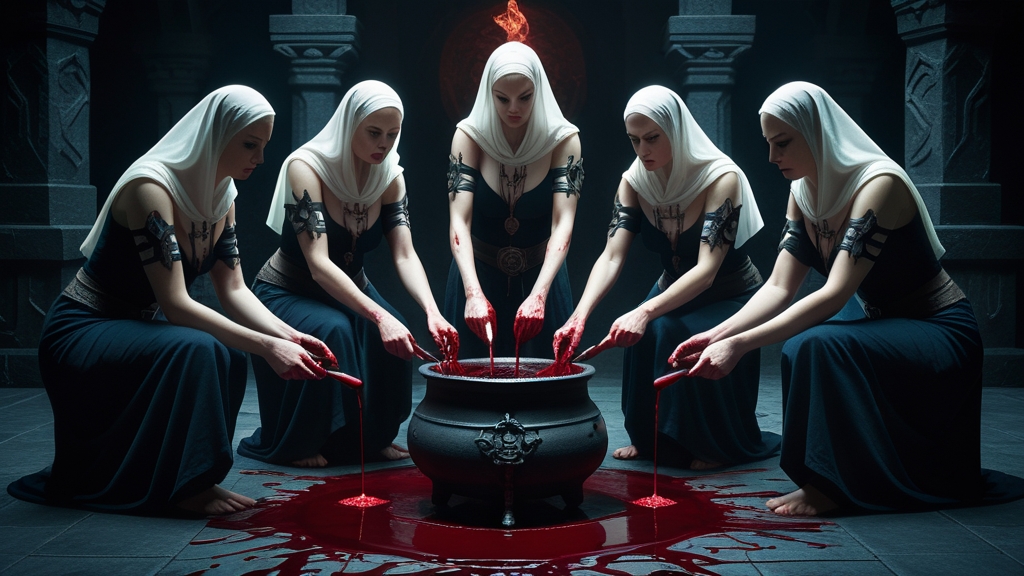
Before battle, the Daughters perform preparatory rites: prayers to Khaine (in reality, to Morathi), ritual scarification, and the drinking of witchbrew and blood from the cauldrons that accompany the war hosts. These rites heighten the warriors’ senses and aggression.
As the fighting begins and blood starts to flow, the frenzy builds. The warriors grow faster, more reckless and more resistant to pain, and by the height of a battle a war host is a whirlwind of blades that feels no fear and shows no mercy.
Blood is also the cult’s currency of power. Hag Queens use the contents of their cauldrons to preserve their own youth and vigour, and the slaughter the Daughters commit is as much an act of worship as of war.
On the tabletop, the Blood Rites have traditionally been represented by an army rule that grants increasing bonuses as the battle rounds go by, capturing the idea of escalating ritual frenzy. Check the current Daughters of Khaine battletome for exactly how it works in Age of Sigmar 4th Edition.
What Are the Melusai and Where Do They Come From?
The Melusai are among the most striking elements of the Daughters of Khaine: half-aelf, half-serpent warriors of lethal grace. They are not a separate race. They are among Morathi’s most devoted followers, transformed by her blood magic into forms that echo her own hidden serpentine shape.
That transformation is a mark of favour. Melusai are fiercely loyal to Morathi, and because their shape mirrors her secret one, they are bound especially closely to her. They serve as elite shock troops, temple guardians and bodyguards.
The best known Melusai are the Blood Stalkers, archers who wield heartseeker bows, and the Blood Sisters, who fight with crystal-touch glaives that can turn living flesh to crystal. The cult also fields more powerful Melusai such as the Bloodwrack Medusa, whose gaze is deadly, and the Melusai Ironscale, a battlefield leader of the serpentine warriors.
Who Are the Khinerai and What Is Their Role?
The Khinerai are the aerial warriors of the Daughters of Khaine — winged aelves who descend on leathery wings to strike from above. Like the Melusai, they owe their forms to Morathi’s dark sorcery, transformed in her service into harpy-like hunters of the skies.
Khinerai are scouts, harassers and shock troops who strike from unexpected angles, falling on war machines, spellcasters and commanders who believe themselves safe behind walls of infantry.
There are two types. Khinerai Heartrenders hurl barbed javelins as they swoop down and then climb back out of reach. Khinerai Lifetakers dive into melee with barbed sickles, using the momentum of their descent to strike hard before taking to the air again.
How Does the Cult Operate?
The cult of Khaine is organised into temples, each a self-contained war-cult with its own traditions, spread across the Mortal Realms. The oldest and most fanatical is Hagg Nar, Morathi’s own temple in the shadow realm of Ulgu.
At the top of the hierarchy sits Morathi-Khaine herself, whose word is divine law. Below her are the Hag Queens — high priestesses who lead temples and preside over the Blood Rites, keeping themselves youthful with the contents of their sacred cauldrons. Slaughter Queens are the cult’s foremost warrior-leaders, leading the faithful into battle at the head of the war hosts.
The temples are places of blood worship and martial training in equal measure. Young aelves learn the acrobatic, twin-bladed fighting style of the Witch Aelves and are steeped in the theology of blood sacrifice that underpins everything the cult does.
Cauldrons of Blood are the focal points of the cult’s ceremonies. The greatest are borne into battle as mobile altars, accompanied by Avatars of Khaine — iron statues of the god animated by the faith of his worshippers.
The cult’s internal politics are vicious. Temples compete fiercely for Morathi’s favour, and rivalry, intrigue and betrayal are common in the struggle for influence among the priestesses.
How Do the Daughters of Khaine Fit into the Order Alliance?
The Daughters of Khaine are part of the Order Grand Alliance, making them nominal allies of Sigmar’s forces, the Sylvaneth, the Lumineth Realm-lords and other Order factions. Their relationship with these allies is fraught and often marked by mutual suspicion.
Sigmar tolerates the Daughters because they are effective warriors against Chaos and because confronting Morathi directly would risk open war within the alliance. The Stormcast Eternals and the Daughters fight side by side when necessity demands it, but there is little warmth in the relationship.
Other Order factions are warier still. The Lumineth Realm-lords, followers of Teclis, regard the cult as a dangerous sect led by a manipulator. Even the Cities of Sigmar, some of which host Khainite temples, keep a careful eye on cult activities.
The Daughters’ practice of blood sacrifice puts them at odds with the moral standards of many of their allies. What the Daughters see as sacred observance, others see as barbaric murder, and that gulf limits how closely they can cooperate.
Frequently Asked Questions
Is Khaine actually dead?
Yes, as far as the lore tells us, Khaine perished long ago. What remains are relics such as his Iron Heart and the Avatars of Khaine, iron statues animated by the faith of his followers. The divine power the Daughters draw on through their rituals actually flows to Morathi, filtered through the imagery and theology of Khaine worship.
Do the Daughters of Khaine know Morathi is their true goddess?
For most of the cult’s history, rank-and-file Daughters genuinely believed they worshipped Khaine and that Morathi was merely his Oracle. Since her ascension during the Broken Realms events, Morathi is openly worshipped as Morathi-Khaine, blurring the line between the deception and the reality. For most cult members, the theological nuances matter less than the power and purpose the Blood Rites give them.
Can males join the Daughters of Khaine?
The warrior cult itself is made up of women. Male aelves live in Khainite society and serve Morathi in other roles, but they do not fight in the war hosts as Witch Aelves or lead the temples as priestesses.
What happened at Anvilgard/Har Kuron?
One of Morathi’s boldest moves was the seizure of Anvilgard, a major Cities of Sigmar settlement. Her agents orchestrated a coup that overthrew the city’s Sigmarite rulers, and the city was renamed Har Kuron. It was a direct blow against Sigmar’s domain and remains a major flashpoint in the Mortal Realms.
How do the Daughters of Khaine compare to Drukhari in 40k?
While both factions feature dark, violent aelves, they are distinct. Drukhari are pirates and raiders who feed on the suffering of others to stave off Slaanesh’s claim on their souls. The Daughters of Khaine are a religious cult whose violence serves ritual purposes and feeds Morathi’s divine power. Both draw on the dark elf archetype, but their motivations and societies differ significantly.
What is the Iron Heart of Khaine?
The Iron Heart of Khaine is the relic at the centre of Morathi’s cult. Morathi claimed she could hear Khaine’s will through it, and she used it to found the Daughters of Khaine and give her role as High Oracle authority. To the faithful it’s proof their god still lives, but in truth it served Morathi’s own plans.
What are the Daughters of Khaine temples?
The cult is split into temples, each with its own traditions. The best known are Hagg Nar, the oldest and most fanatical temple, as well as Draichi Ganeth, the Kraith, Khailebron, Khelt Nar and Zainthar Kai. Temples compete fiercely for Morathi’s favour, which matches the cult’s vicious internal politics.
How is Morathi related to Malerion?
Morathi is Malerion’s mother. In the World-That-Was he was Malekith, the Witch King of the Dark Elves, and in the Mortal Realms he became Malerion, the aelven god of shadow who rules the realm of Ulgu. The two are rivals as much as family, and neither fully trusts the other.