
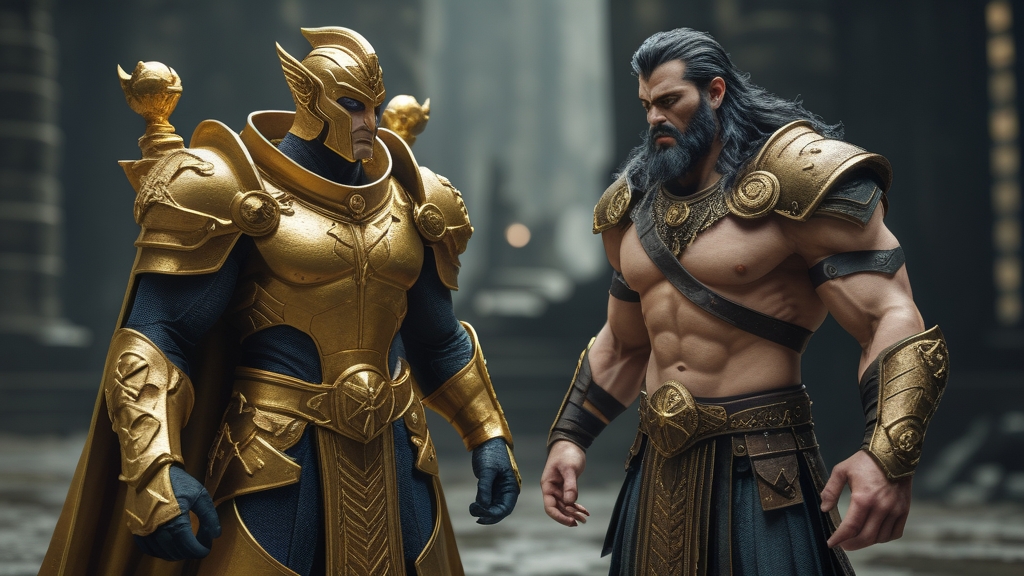
No. While Custodians are the Emperor’s finest individual warriors and vastly superior to Space Marines in every measurable way, Primarchs operate on an entirely different level of power. A single Primarch could likely defeat dozens of Custodes simultaneously. The comparison is not between equals — it is between exceptional soldiers and demigods. Even the greatest Custodian who ever lived would be outmatched by a Primarch in single combat, just as the greatest Space Marine would be outmatched by a Custodian.
This question is one of the most debated in Warhammer 40,000 lore discussions, because both Custodians and Primarchs are so far above baseline Space Marines that the gap between them can be difficult to comprehend. To understand why a Custodian cannot beat a Primarch, you must first understand what each of these beings truly is — and recognise that despite both being creations of the Emperor, they were designed for fundamentally different purposes and operate at fundamentally different scales of power.
How Powerful Are Custodians?
The Adeptus Custodes — the Custodian Guard, the Ten Thousand, the Emperor’s personal bodyguards — are the single most powerful individual warriors the Imperium can field, bar the Primarchs themselves. Each Custodian is a masterwork of genetic engineering, created through a process even more intensive and individualised than Space Marine creation. Where Space Marines are mass-produced soldiers (relatively speaking), each Custodian is a hand-crafted weapon, individually engineered from infancy using techniques that the Emperor himself designed.
A single Custodian is worth at least a squad of Space Marines in combat effectiveness — some sources suggest a single Custodian can match an entire company. Their reflexes are faster, their strength is greater, their tactical awareness is sharper, and their equipment — particularly their Guardian Spears and Auramite armour — is superior to anything the Space Marines possess. They have no gene-seed flaws, no psychological vulnerabilities, and no weaknesses in their conditioning. They are, in the truest sense, perfect warriors.
Beyond raw combat ability, Custodians are also exceptional strategic and political minds. Unlike Space Marines, whose conditioning narrows their focus to warfare, Custodians are educated in philosophy, art, politics, diplomacy, and every other discipline that might be relevant to protecting the Emperor and the Imperium. They are warrior-scholars of the highest order, capable of operating as diplomats, investigators, and statesmen as well as soldiers.
In combat, Custodians move with a speed and precision that makes even veteran Space Marines look clumsy. Their fighting styles are unique to each individual, developed over centuries of practice and refinement, and they can read and counter an opponent’s techniques with uncanny prescience. Group combat between Custodians is a masterpiece of coordination — each warrior anticipating his brothers’ movements and creating openings that no individual fighter could exploit alone.
How Powerful Are Primarchs?
Primarchs are not warriors. They are weapons of mass destruction given humanoid form. Created by the Emperor using a combination of genetic engineering, Warp sorcery, and technologies that even the Emperor’s closest allies did not fully understand, the twenty Primarchs were designed to be the generals of humanity’s conquest of the galaxy — beings powerful enough to lead entire Legions of Space Marines, conquer worlds single-handedly, and embody the Emperor’s vision for humanity’s future.
The scale of a Primarch’s power is difficult to overstate. In physical terms alone, a Primarch stands 10 to 12 feet tall, with strength sufficient to tear a battle tank apart with bare hands, speed fast enough to deflect bolter rounds, and durability that allows them to shrug off weapons that would kill a Space Marine outright. Angron tore his way through a Warhound Titan’s leg. Vulkan survived an orbital bombardment. Magnus the Red could destroy starships with his psychic powers alone. These are not warriors operating at the top end of a conventional scale — they are beings who exist outside that scale entirely.
Beyond physical power, Primarchs possess supernatural abilities that defy conventional analysis. Each Primarch has a unique “aura” that affects those around them — Sanguinius inspired devotion and hope, Konrad Curze radiated dread and terror, Lorgar could sway millions with a single speech. These abilities are not merely charisma; they are Warp-derived powers that operate on a level beyond normal psychic phenomena. A Primarch’s presence on a battlefield can literally change the outcome of a war, not just through their personal combat contribution but through the effect they have on every warrior around them.
In terms of martial skill, every Primarch is a peerless combatant who has had millennia to refine their fighting ability. They process combat information at a speed that makes even Custodian reflexes seem sluggish, and their sheer physical power means that every blow carries the force of a vehicle-mounted weapon. A Primarch does not just fight opponents; he demolishes them — breaking through defences that would stop any lesser warrior, shrugging off attacks that would kill anything else, and ending fights with a finality that leaves no doubt about the power gap.
What Does the Lore Say About Custodes vs Primarchs?
The lore provides several direct and indirect comparisons between Custodians and Primarchs, and the verdict is unambiguous: Primarchs are in a completely different league.
During the Great Crusade, Custodians served alongside Primarchs and witnessed their power firsthand. Constantin Valdor — the Captain-General of the Custodes and possibly the greatest Custodian who ever lived — was considered roughly equivalent to a Primarch in political authority but never in combat power. Valdor was a transcendent warrior who could defeat virtually any other fighter in the galaxy, but the lore consistently places him below the Primarchs in raw combat capability.
In the Horus Heresy novel series, there are several scenes where Custodians face Primarch-level threats. During the Battle of Prospero, Custodians fighting alongside the Space Wolves faced Magnus the Red’s psychic might and were completely overwhelmed by his Warp-powered attacks. During the Siege of Terra, squads of Custodians faced Daemon Primarchs in the corridors of the Imperial Palace, and despite their extraordinary skill and courage, they were cut down by beings whose power simply exceeded anything they could counter.
The most telling evidence comes from the Emperor himself. He created the Custodians to guard him personally — but he created the Primarchs to conquer the galaxy. The difference in purpose reflects the difference in power. Custodians are the ultimate defensive warriors, designed to protect a single individual against any threat. Primarchs are offensive weapons of cosmic scale, designed to subjugate entire civilisations. The Emperor clearly considered the two to be operating on different tiers of capability, and he designed them accordingly.
Could Multiple Custodians Defeat a Primarch?
Numbers could theoretically shift the balance, but the required numbers are extreme. Estimates based on lore depictions suggest that it would take dozens — possibly hundreds — of Custodians acting in perfect coordination to have a realistic chance of bringing down a Primarch, and even then, the Primarch would likely inflict catastrophic casualties before falling.
The problem is one of scaling. A Primarch’s speed means that adding more opponents does not proportionally increase the threat, because the Primarch can eliminate additional attackers faster than they can coordinate. A Primarch’s durability means that individual Custodian strikes — each of which would kill a Space Marine several times over — may not inflict sufficient damage to slow the Primarch down. And a Primarch’s area-effect capabilities (whether through massive melee sweeps, psychic powers, or sheer physical destruction) mean that closely grouped opponents are vulnerable to being destroyed en masse.
The historical example most often cited is the theoretical scenario of Custodians attempting to stop a Primarch who has turned traitor. During the Horus Heresy, the Emperor apparently considered the possibility that one or more Primarchs might rebel, and his contingency planning did not rely on the Custodes being able to defeat a Primarch in combat. Instead, the Emperor’s plan — as far as it can be reconstructed — involved using other Primarchs to check rebellious brothers, suggesting that he himself recognised that Custodians alone were not sufficient to counter a Primarch threat.
Where Do Space Marines Fit in This Hierarchy?
Understanding the Custodes-vs-Primarch comparison requires placing it in the broader hierarchy of Imperial warriors. The power scale looks roughly like this:
Imperial Guard Soldier: A baseline human with standard military training and equipment. The foundation of the Imperium’s military, effective through sheer numbers.
Space Marine: A transhuman warrior worth roughly 10-100 Imperial Guard soldiers depending on the situation. Enhanced biology, superior equipment, centuries of training.
Custodian: A perfected warrior worth roughly 10-100 Space Marines depending on the situation. Superior to Space Marines in every measurable way, with no gene-seed flaws or conditioning weaknesses.
Primarch: A demigod-level being whose power transcends conventional military comparison. Capable of defeating hundreds of Space Marines or dozens of Custodians. Possesses supernatural abilities that defy physical analysis.
The Emperor: The most powerful human psyker who has ever lived, creator of the Primarchs and Custodes, master of technologies that border on godhood. The only being in the Imperium who could reliably defeat any Primarch.
Each tier represents a quantum leap in capability, not a linear increase. A Custodian is not merely “a better Space Marine” — he is a fundamentally different class of warrior. Similarly, a Primarch is not merely “a better Custodian” — he is a different order of being entirely. This is why the question “could a Custodian beat a Primarch?” is answered so definitively: no, because the gap between them is not one that skill, experience, or determination can bridge.
The Exceptions and Edge Cases
While the general answer is clear, intellectual honesty requires acknowledging some edge cases and qualifications:
Wounded or diminished Primarchs: A Primarch who is severely wounded, exhausted, or fighting under constraints (psychic dampening, for example) might be vulnerable to an exceptional Custodian. However, even in diminished states, Primarchs have demonstrated combat capabilities far beyond what any Custodian could match.
Specialised anti-Primarch weapons: The Emperor may have created weapons specifically designed to harm or contain Primarchs — the Apollonian Spear and similar relics are sometimes theorised to have this purpose. A Custodian wielding such a weapon might pose a greater threat than standard equipment would suggest, though this remains speculative.
Constantin Valdor: Valdor is sometimes argued to be an exception — a Custodian so extraordinary that he approaches Primarch-level capability. While Valdor was certainly the greatest Custodian and one of the most formidable warriors in the Imperium, the lore stops short of placing him on equal footing with the Primarchs in combat. His authority and respect were equal to theirs; his raw power was not.
Psychic Primarchs vs non-psychic combat: If the comparison is limited to pure physical combat without psychic powers, the gap narrows slightly — but only slightly. Even without their supernatural abilities, Primarchs are physically superior to Custodians in size, strength, speed, and durability. The psychic powers of Primarchs like Magnus or Lorgar simply widen an already decisive gap.
Frequently Asked Questions
Could Valdor beat a Primarch?
Almost certainly not in a straight fight. Constantin Valdor was the greatest Custodian ever created and an extraordinary warrior, but the lore consistently places Primarchs above even the finest Custodians. Valdor’s greatness lay in his combination of combat skill, political acumen, and strategic thinking — not in raw power that could match a demigod.
How many Custodians equal one Primarch?
There is no precise answer, but lore suggests that dozens to hundreds of Custodians would be needed to defeat a Primarch, and the casualties would be catastrophic. The comparison is somewhat misleading because the power gap is qualitative, not merely quantitative — you cannot simply stack enough lesser warriors to equal a being who operates on a fundamentally different level.
Are Custodians stronger than Primaris Space Marines?
Yes, significantly. Primaris Space Marines are superior to Firstborn Marines but still far below Custodians. The gap between a Primaris Marine and a Custodian is comparable to the gap between a standard Marine and a Firstborn — a quantum leap in capability rather than an incremental improvement.
Has a Custodian ever killed a Primarch?
No Custodian has ever killed a Primarch in established lore. The only beings confirmed to have killed Primarchs are other Primarchs (Fulgrim killed Ferrus Manus), the Emperor himself, and assassins using extraordinarily specialised methods (the Callidus Assassin who wounded Horus, though she did not kill him). Custodians have not been shown achieving this feat.
Why did the Emperor make Primarchs if he had Custodians?
Because Custodians and Primarchs serve different purposes. Custodians are bodyguards — the ultimate defensive warriors, designed to protect the Emperor personally. Primarchs are generals and conquerors — offensive weapons designed to lead the Great Crusade and bring the entire galaxy under human control. The Emperor needed both: beings to guard him while he worked, and beings to fight the wars he could not personally attend to. The Custodians were his shield; the Primarchs were his sword.