
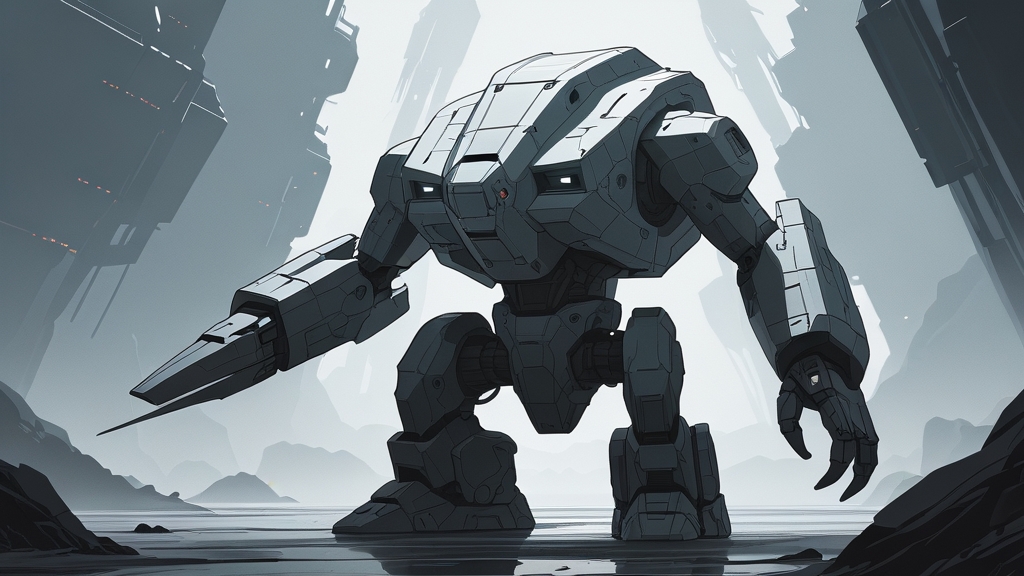
What Is a Ghostkeel?
The Ghostkeel is the T’au Empire’s premier stealth battlesuit — a large, advanced combat platform that combines devastating firepower with cutting-edge cloaking technology to create a mobile weapons system that is extraordinarily difficult for the enemy to target. On the Warhammer 40,000 tabletop, the Ghostkeel functions as a durable, mobile weapons platform that uses its stealth field generators to shrug off incoming fire while delivering punishing damage with its primary weapon systems.
The Ghostkeel occupies a unique tactical niche in the T’au army. Unlike the brute-force approach of Riptides or the close-range devastation of Crisis Battlesuits, the Ghostkeel operates as a lone hunter — operating ahead of the main force, harassing enemy flanks, and drawing disproportionate fire that would otherwise target your more vulnerable units. Its stealth technology makes it far harder to hit than its size would suggest, forcing opponents to either commit excessive firepower to killing it or accept its presence as it picks apart their army.
For T’au players who enjoy a more aggressive, forward-deployed playstyle that breaks from the traditional gunline approach, the Ghostkeel is one of the most rewarding units in the codex. It rewards careful positioning, intelligent target selection and good use of terrain.
Ghostkeel Lore and Technology
The XV95 Ghostkeel Battlesuit represents the pinnacle of T’au stealth technology — a field that the Earth Caste has pursued with obsessive dedication since the earliest days of the T’au Empire’s expansion across the galaxy. Where primitive stealth systems relied on simple visual camouflage or electronic countermeasures, the Ghostkeel integrates a suite of technologies so advanced that the battlesuit can effectively vanish from both visual observation and sensor detection simultaneously.
The Ghostkeel’s stealth field generator works by bending light and electromagnetic radiation around the battlesuit, creating a zone of optical distortion that makes the suit appear as little more than a shimmer in the air — like heat haze on a desert horizon. At range, the effect is so complete that the Ghostkeel is virtually invisible; only at close range, where the field’s interference patterns become visible to the naked eye, can the battlesuit be detected with any reliability.
But visual stealth alone is insufficient against the sophisticated sensor arrays of many galactic civilisations. The Ghostkeel therefore also incorporates an electronic warfare suite that jams targeting sensors, scrambles auspex readings, and floods enemy communication channels with ghost returns and false signals. Enemy targeting cogitators receive contradictory data — the Ghostkeel appears to be in multiple locations simultaneously, or nowhere at all. By the time the target lock resolves, the Ghostkeel has already repositioned and begun firing.
The pilot of a Ghostkeel is accompanied by two AI-driven drone companions — stealth drones that orbit the battlesuit and project additional electromagnetic interference that further degrades enemy targeting. These drones are slaved to the battlesuit’s fire control system and coordinate their jamming patterns with the Ghostkeel’s own stealth field, creating overlapping zones of electronic denial that make the entire system far more effective than any single component.
Ghostkeels are typically piloted by experienced stealth cadre veterans — shas’vre or shas’el who have proven their skill in Stealth Suit operations and demonstrated the tactical patience and independent thinking required to operate alone, deep behind enemy lines, without the support structure that most T’au warriors rely upon.
Datasheet and Core Stats
On the tabletop the Ghostkeel is a large, durable battlesuit whose defining feature is how hard it is to shoot. Its electrowarfare suite and stealth drones make it harder to hit than a model of its size should be, which effectively multiplies its durability against enemy shooting. It is quick for its size, so it can move between firing positions and get out of danger.
Exact characteristics, abilities, deployment options and points change with codexes and balance updates, so we don’t list them here. In 11th Edition, existing 10th Edition codexes remain valid until your faction receives its 11th Edition codex. Check the current T’au Empire datasheet in your codex or the Warhammer 40,000 app, and the Munitorum Field Manual for points.
The Ghostkeel and 11th Edition Cover
11th Edition reworked cover: the benefit of cover now worsens the attacker’s Ballistic Skill by 1 against ranged attacks, rather than improving your save. As a large battlesuit, the Ghostkeel doesn’t get cover just for standing in a terrain area. It only benefits when intervening terrain means it isn’t fully visible to the shooter. A unit with the Stealth ability always has the benefit of cover against ranged attacks, so check whether your current datasheet gives the Ghostkeel Stealth or a similar hit penalty. Either way, the more ways you can make the enemy miss, the more the Ghostkeel’s durability is worth.
Weapon Options
The Ghostkeel carries a primary weapon and a pair of secondary weapons, and the choice of primary weapon defines the battlesuit’s tactical role.
Fusion Collider
The fusion collider is a melta-type weapon that hits hardest at close range. This loadout turns the Ghostkeel into an aggressive tank-hunter that moves up to striking distance of enemy armour and tries to eliminate it before the enemy can respond.
Take the fusion collider when your local meta features vehicle-heavy armies or when your T’au list lacks dedicated anti-armour. The combination of forward positioning, a hard-to-hit profile and heavy close-range damage is a threat vehicle-reliant armies struggle to answer.
Cyclic Ion Raker
The cyclic ion raker offers more shots at moderate strength, with an overcharged profile that trades safety for extra power. (The old rule where overcharged ion weapons inflicted mortal wounds on hit rolls of 1 belongs to earlier editions; check the current datasheet for the drawback that applies now.) This loadout is more versatile, capable of engaging infantry and lighter vehicles.
The standard fire mode provides consistent anti-infantry shooting, good for clearing objective holders and screening units. The overcharged mode adds the punch needed to threaten multi-wound models and light vehicles. Take the cyclic ion raker when you want a flexible platform that can adapt to different targets.
Secondary Weapons
The Ghostkeel’s secondary weapons supplement the primary. Burst cannons add anti-infantry volume, fusion blasters add anti-armour punch, and flamers give a short-range option that doesn’t need to roll to hit. A common approach is to match them to the primary: burst cannons or flamers with the cyclic ion raker for infantry clearing, fusion blasters with the fusion collider for concentrated anti-vehicle power.
How to Use the Ghostkeel on the Tabletop
The Ghostkeel excels as a flanking harasser that forces the enemy to react to threats from unexpected angles.
Forward Deployment
Set the Ghostkeel up where it threatens a key enemy unit or objective early, ideally behind line-of-sight blocking terrain on a flank. If your current datasheet or detachment lets it deploy forward or make a pre-battle move, use that to get it into position. In 11th Edition, Infiltrators must set up more than 8″ from the enemy deployment zone and all enemy units. Avoid positions where the Ghostkeel is exposed to the enemy’s whole army: its defences are strong, but concentrated fire will still bring it down.
Fire and Fade
The classic Ghostkeel playstyle is to emerge from behind terrain, deliver a volley, then reposition so it isn’t exposed to the enemy’s full firepower. Use terrain to limit how many enemy units can see it at once. If your opponent wants to kill the Ghostkeel, they have to move units towards it, pulling resources away from the main battle.
Drawing Fire
One of the Ghostkeel’s most underappreciated roles is drawing fire away from your main force. A Ghostkeel threatening the enemy’s flank or backfield forces them to spend shooting on a target that is hard to hit, instead of on your more vulnerable Crisis Suits, Pathfinders or Hammerheads. Even if the Ghostkeel dies, the fire it absorbed would otherwise have killed less durable units.
Army Synergies
The Ghostkeel operates independently but benefits from broader T’au army support.
Stealth Suits
Pairing Ghostkeels with Stealth Suit teams creates a stealth cadre that stretches the enemy’s ability to deal with multiple forward threats at once. While the enemy deals with the Ghostkeel, Stealth Suits can take flanking objectives.
Pathfinders and Spotting
Markerlights no longer simply improve BS as they did in older editions. Under the current T’au Empire army rule, spotting units such as Pathfinders mark a target so that other units shooting it become more accurate. A Ghostkeel shooting at a target that has been spotted gets more out of its weapons, so plan your spotting around its targets. Check your current codex for the exact rule.
Stratagems
In 11th Edition a unit can only benefit from one Stratagem per phase, and Command Re-roll counts as one. Decide whether the Ghostkeel needs a defensive Stratagem or an offensive one in a given phase, rather than planning to stack both.
Countering the Ghostkeel
Ignore it if you can. The Ghostkeel is an inefficient target for shooting, and chasing it with melee units pulls your forces out of position. If you must deal with it, use weapons that hit automatically, such as Torrent weapons, which don’t care about hit modifiers, or weapons with Ignores Cover, which strip the benefit of cover (including from Stealth). A large volume of dice also helps. Fast melee units can engage the Ghostkeel in close combat, where its weak melee makes it vulnerable.
Frequently Asked Questions
Is the Ghostkeel competitive?
The Ghostkeel sees variable competitive play depending on the meta and the points cost. When priced correctly, its combination of mobility, a hard-to-hit profile and solid firepower makes it a useful tool in T’au lists. When overcosted, its damage output does not justify the investment. Check current tournament data for the latest performance.
Fusion collider vs cyclic ion raker — which is better?
Fusion collider for vehicle-heavy metas and dedicated anti-armour work. Cyclic ion raker for balanced metas where flexibility is more valuable than focused anti-vehicle power. The cyclic ion raker is generally the more versatile choice, but which one sees more competitive play shifts with balance updates.
How many Ghostkeels should I take?
One is a common choice. Two creates a potent stealth cadre but requires significant points investment and may be limited by the army-building rules on duplicate datasheets. Check the current core rules and Munitorum Field Manual for any limits.
Can the Ghostkeel hold objectives?
The Ghostkeel can hold objectives thanks to its durability, but it is not ideal for this role. Its value is generated by mobile harassment and fire-and-fade tactics, not by sitting still on an objective. Use cheaper units for objective holding and keep the Ghostkeel mobile.
What drones should the Ghostkeel take?
The Ghostkeel comes with two stealth drones that are part of its electrowarfare suite. In recent editions drones are no longer fielded as separate models with their own profiles; they are represented in the Ghostkeel’s own rules. Check the current datasheet for exactly how they work.
What is the difference between a Ghostkeel and a Riptide?
The Riptide is a bigger, heavier XV104 battlesuit built for raw firepower and toughness, powered by a nova reactor and carrying large main guns. The Ghostkeel is a smaller XV95 stealth battlesuit that relies on its stealth field and drones to avoid being hit, deploys forward and hunts targets on the flanks. Many T’au lists use both.
When was the Ghostkeel released?
The Ghostkeel was released in 2015, during 7th Edition, alongside the Stormsurge as part of a big T’au Empire wave. Both battlesuits brought new large kits to the army, with the Ghostkeel adding a stealth-focused option between Crisis Suits and the Riptide. The same plastic kit is still used today.
Related Content
- How to Play Warhammer 40k — Complete Beginner’s Guide — learn the core rules of Warhammer 40K
- All Warhammer 40k Factions Ranked — Tier List — see which factions rank highest