
Part of our T'au Empire hub: every T'au Empire guide, lore page and painting tutorial in one place.
The Kindred Hunters — Kroot Lore and Background
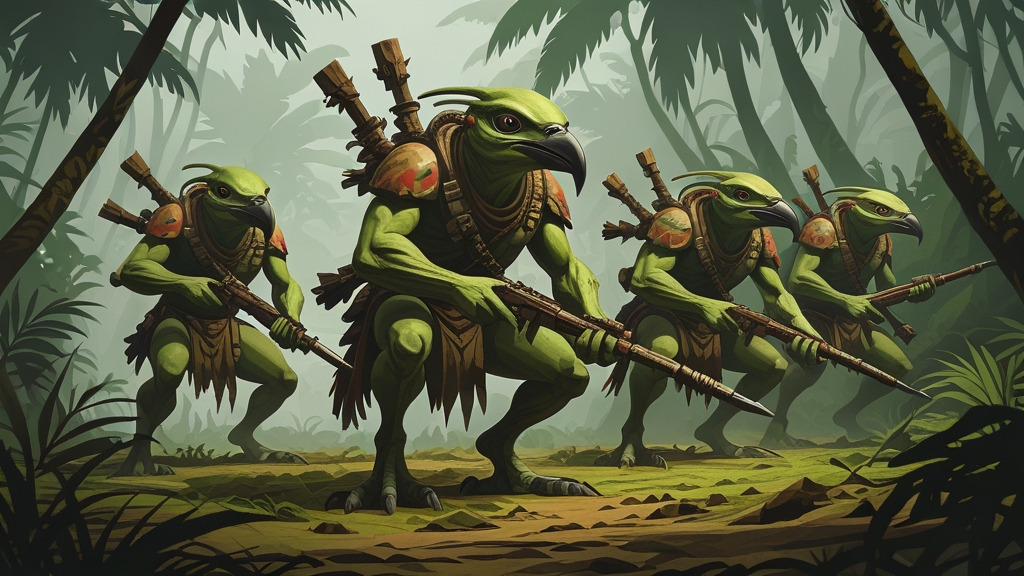
The Kroot are one of the most fascinating alien species in the Warhammer 40,000 universe. Bird-like carnivores who hail from the world of Pech, the Kroot have a unique biological trait: they can absorb genetic material from the creatures they consume. By eating their enemies, the Kroot evolve, gaining traits and abilities from the species they devour. This biological plasticity has allowed them to adapt to a huge range of environments and ways of war.
The Kroot’s relationship with the T’au Empire is one of pragmatic alliance rather than true unity. When the T’au were expanding their empire, they encountered the Kroot engaged in a desperate war against the Orks. The T’au provided military aid, and in return, the Kroot pledged their services as auxiliary warriors. This alliance has endured for generations, with Kroot kindreds fighting alongside T’au forces across the galaxy. However, the Kroot are not subjects of the T’au — they are allies and mercenaries.
Kroot society is organised around kindreds — extended family groups guided by Shapers, the wisest and most experienced Kroot. Shapers guide the evolution of their kindred by selecting which creatures the Kroot should eat and which they should avoid. A wise Shaper can lead a kindred toward beneficial evolutionary paths, while a poor choice can lead to degeneration. Shapers are part leaders, part genetic stewards, directing the evolution of their people through selective consumption.
In battle, the Kroot are natural hunters: fast, stealthy and dangerous at close range. Their keen senses make them superb trackers, and their lean, muscular bodies are adapted for ambush. They fight with Kroot rifles — long weapons fitted with blades for close combat — and with their beaks, talons and sheer ferocity. They prefer to strike from concealment with overwhelming aggression before the enemy can react.
Kroot on the Tabletop in 11th Edition
Kroot occupy a unique tactical niche in T’au Empire armies. They are cheap, numerous light infantry with abilities that standard T’au units lack — particularly forward deployment, screening and melee.
Their statline is modest compared to Space Marines or other elite infantry: low Toughness, light saves and single-wound models in the basic squads. What they lack in raw stats, they make up for in numbers, special rules and flexibility. The Kroot rifle works both as a ranged weapon and in close combat, so Kroot have a baseline capability in both phases, though they are not exceptional at either. Check the current datasheets in the Warhammer 40,000 app and points in the Munitorum Field Manual for exact values.
Kroot have long had forward-deployment abilities that let them start the game outside the normal deployment zone or make pre-battle moves. In 11th Edition, Infiltrators set up more than 8″ from the enemy deployment zone and all enemy units, and Scouts moves must end more than 8″ from enemies — check which abilities each Kroot datasheet currently has.
11th Edition’s terrain rules also suit Kroot well. Cover now worsens the attacker’s Ballistic Skill by 1 against ranged attacks, and Infantry, Beasts and Swarms get it while inside a terrain area. Units hiding in terrain that haven’t shot recently can only be seen from within 15″. A Kroot squad sitting in a ruin on an objective is much harder to remove than its basic stats suggest. See our 11th Edition rules changes for the full details.
T’au players build their army rules with Detachment Points in 11th Edition, and the T’au range has included Kroot-focused detachments. Until your faction’s 11th Edition codex arrives, the existing codex stays valid, so check the current detachments in the app before planning an all-Kroot force.
The Expanded Kroot Range
The 2023 Kroot wave dramatically increased the Kroot model range. Where once Kroot were limited to basic Carnivore squads, Hounds and Krootox, the range now includes:
Kroot Carnivores
The bread and butter of the Kroot range. Cheap and numerous, they handle screening, objective grabbing and the melee capability that the rest of the T’au army lacks. They are expendable and should be treated as such — trade them for objectives and screening value.
Kroot Hounds
Fast, aggressive beasts that excel at charging and tying up enemy units. Kroot Hounds are cheap and their speed makes them ideal for rushing forward to engage or block enemy units before they can reach your T’au gunline.
Krootox Riders
Kroot mounted on powerful Krootox beasts, carrying a repeater cannon. They add ranged punch and solid melee to a Kroot contingent.
Krootox Rampagers
Dedicated Krootox melee cavalry. Rampagers are the heavy assault unit of a Kroot force, able to crash into enemy infantry and hold objectives through brute force.
Kroot War Shaper
The combat leader of the kindred and the closest thing to the old generic Shaper. A War Shaper leads Kroot Carnivores and makes them a more serious threat rather than a purely expendable screen.
Kroot Trail Shaper
A scouting character focused on the Kroot’s skill as trackers and ambushers, adding tactical flexibility in the early game.
Kroot Flesh Shaper
A character built around the Kroot’s flesh-eating biology, who makes the kindred more dangerous and resilient as it feeds. Check the current datasheet for exactly what it does and which units it can join.
Kroot Lone-spear
A lone hunter mounted on a Kalamandra, acting as a sniper and skirmisher that picks off targets from range.
Kroot Farstalkers
Specialist Kroot hunters from the Farstalker Kinband, originally a Kill Team kit. The kinband is also a cheap way to add more Kroot models to a collection — check the current 40k datasheet before including them in a list.
Kroot Tactics in T’au Armies
Screening
A key role of Kroot in a T’au army is screening. T’au battlesuits and vehicles are devastating at range but vulnerable to deep-striking melee units. Kroot deployed forward stop enemy assault units from charging straight into your gunline, and every 8″ bubble around them denies enemy reserves landing space. The enemy must deal with the Kroot first, giving your battlesuits an extra turn of shooting.
Objective Grabbing
In 11th Edition objectives are terrain areas, and Kroot are Infantry that gain cover and can be hard to see inside terrain. Getting them onto midfield objectives early gives you an early scoring advantage. Even if the enemy destroys the Kroot, you have scored points while your opponent spent resources killing cheap troops — an efficient trade.
Melee Counter-Charge
T’au armies traditionally lack melee capability. Kroot provide a melee element that can counter-charge enemy units that get through your screens. While Kroot will not win protracted fights against dedicated assault units, they can tie up enemy units for a turn, giving your battlesuits time to reposition and shoot the threat.
Action Monkeys
Many missions ask units to perform actions. Kroot are perfect for this. They are cheap enough that dedicating a squad to actions does not significantly reduce your army’s combat power, and their forward deployment gets them to action locations quickly. Use Kroot for actions while your expensive battlesuits focus on killing — just keep them from being Battle-shocked, as Battle-shocked units can’t do actions.
All-Kroot Army — Is It Viable?
With the expanded range, running a Kroot-heavy or all-Kroot force is possible and plays completely differently from standard T’au — aggressive, fast, melee-oriented and swarming. It will not outshoot a standard T’au gunline or outfight dedicated assault armies, but it offers a unique and fun playstyle that can catch opponents off guard.
A Kroot-heavy army relies on numbers, getting onto objectives early and using the roster’s variety to handle different threats: Krootox Rampagers for heavy hitting, Hounds for speed and screening, Carnivores to hold objectives and the Shapers to tie everything together. How well it works in matched play depends on the detachments available to T’au at the time, so check the current rules.
Kroot in Competitive Play
Kroot Carnivores have long been a staple of competitive T’au Empire lists. Their low cost and forward deployment make them efficient screens and objective grabbers that free up your expensive battlesuits to focus on damage dealing.
How many Kroot competitive players take, and which of the newer units see play, shifts with each points update and balance dataslate. For a worked example of Kroot in a list, see our T’au Empire 1000-point army list, and check our faction rankings for how T’au are performing.
Painting Kroot
Kroot offer a refreshing painting experience compared to heavily armoured models. Their skin can be painted in a wide range of colours — green, brown, grey, or more exotic hues — reflecting the genetic diversity of different kindreds. Start with a base colour, apply a wash for depth, then drybrush highlights across the skin texture. The quills and beak can be painted in contrasting bone or ivory tones. Kroot rifles benefit from a wood-and-metal look, with the stock painted in brown wood tones and the blades in weathered steel. Tribal markings and war paint add character to individual models.
Frequently Asked Questions
Are Kroot good in 11th Edition?
Kroot Carnivores remain a useful, cheap utility unit for T’au. 11th Edition’s cover and terrain-objective rules reward cheap Infantry that sit in terrain on objectives, which plays to their strengths. Exactly how strong they are depends on current points and the T’au detachments available, so check the latest Munitorum Field Manual.
How many Kroot should I take?
Most T’au lists want at least one or two units of Kroot Carnivores for screening and objectives. Add Hounds and a Shaper if you want to invest more in the Kroot contingent. The sweet spot depends on your army’s other needs and how much screening you require.
Can Kroot fight in melee?
They are competent but not exceptional in melee. Kroot rifles double as melee weapons. Against weak targets, they can be effective. Against dedicated assault units, they will lose — but tying up enemy melee units for a turn is still valuable.
Should I use Kroot as sacrificial units?
Yes. Kroot are cheap and their main value is in screening and objective grabbing. Trading a cheap Kroot squad for an early objective score or to absorb a charge that would otherwise hit your battlesuits is excellent value. Do not become attached to your Kroot — they exist to be traded for tactical advantage.
What is the best Kroot unit in the expanded range?
Kroot Carnivores remain the best value for most lists thanks to their low cost and utility. Among the newer units, Kroot Hounds offer cheap, fast screening and Krootox Rampagers are the strongest combat unit. The best character depends on which units you are running, so compare the War Shaper, Trail Shaper and Flesh Shaper datasheets for your list.
What new Kroot units have been released?
The 2023 Kroot wave added the Kroot Lone-spear (a sniper riding a Kalamandra), the War Shaper, Trail Shaper and Flesh Shaper characters, and Krootox Rampagers. It also brought new plastic kits for Kroot Carnivores, Kroot Hounds and Krootox Riders. Kroot Farstalkers come from the Farstalker Kinband, a Kill Team kit that also makes a cheap way to add more Kroot.
Do Kroot eat their enemies?
Yes. Kroot eat the flesh of fallen foes, including humans, because their biology lets them absorb useful traits from what they consume. Shapers decide which species are worth eating and which would cause harmful mutations. The habit unsettles many of the T’au’s allies, but the T’au tolerate it as part of the alliance.
Do Kroot only fight for the T’au?
No. Kroot kindreds are mercenaries at heart, and many hire themselves out across the galaxy, sometimes even to Imperial Rogue Traders and Inquisitors. Their bond with the T’au Empire is the strongest and longest-lasting, which is why they appear as T’au auxiliaries on the tabletop. Away from the T’au, kindreds fight for whoever offers payment, or new prey worth eating.
Related Content
- How to Play Warhammer 40k — Complete Beginner’s Guide — learn the core rules of Warhammer 40K
- Skitarii Guide — Adeptus Mechanicus Troops Tactics — explore another helpful guide
- All Warhammer 40k Factions Ranked — Tier List — see which factions rank highest