
Lord of Skulls Guide — Khorne Super-Heavy Daemon Engine
What Is the Lord of Skulls?
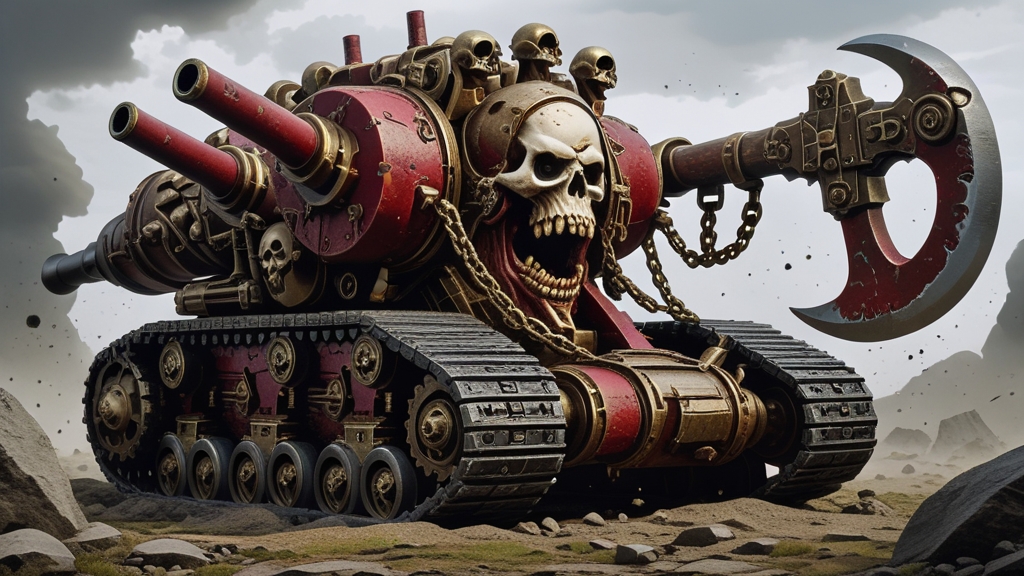
The Lord of Skulls is Khorne’s destructive fury rendered in brass, blood and daemon-fire. This colossal daemon engine grinds across the battlefield on huge treads, its skull-faced hull housing a bound daemon of Khorne that wants nothing but slaughter. With a gatling cannon, a main gun and a giant chain-cleaver, it is one of the biggest and most dangerous units a Chaos army can field in Warhammer 40,000.
On the tabletop it is a Titanic war machine, combining the firepower of a battle tank with the close-combat power of a Greater Daemon. Its sheer size and industrial-horror look make it a true centrepiece model, on the table and on the display shelf.
The Lord of Skulls belongs to the wider family of Chaos daemon engines: war machines forged in the brass foundries of the Blood God’s domain and powered by a bound daemon. Where smaller engines such as the Maulerfiend or Forgefiend house lesser daemons, the Lord of Skulls holds something far more powerful.
Lord of Skulls Lore
Lords of Skulls are forged in Khorne’s realm in the Warp, in the furnaces around the Brass Citadel, by daemon-smiths who weld brass and iron around the essence of a bound daemon. The resulting fusion of daemon and machine is driven by pure rage: every system runs on the daemon’s fury, and every weapon is an extension of Khorne’s will.
In the material realm, Lords of Skulls appear in the bloodiest campaigns, where the servants of Khorne seek to drown entire worlds in blood. They fight alongside World Eaters warbands, Khorne Berzerkers, daemon legions and lesser daemon engines, grinding everything in their path to ruin.
Each one is shaped by the daemon bound within it. Some methodically reduce fortifications and armoured columns, while others charge headlong into the thickest fighting. All share an unquenchable thirst for skulls that only constant, brutal combat can briefly satisfy.
Weapons
The Lord of Skulls is dangerous at every range. As standard it carries a gorestorm cannon, a hades gatling cannon and the great cleaver of Khorne, a huge chain-axe that is its main melee weapon. On the current datasheet the two guns can be swapped:
- Gorestorm cannon (standard), or swap it for a daemongore cannon or an ichor cannon
- Hades gatling cannon (standard), or swap it for a skullhurler
The guns thin out targets while the Lord of Skulls closes in, and the great cleaver is what makes it so dangerous once it reaches combat. Profiles, which options are legal and how each one performs change between editions and balance updates, so compare the options on the current datasheet before you glue anything in place. Many builders magnetise the guns so they can swap later.
How to Use the Lord of Skulls in 11th Edition
A Lord of Skulls is a big commitment. It takes a large share of your army’s points, and your plan has to account for it. The tips below use the 11th Edition core rules. For your army’s own rules, check the current codex and the Munitorum Field Manual.
Deployment
The Lord of Skulls is Titanic, and in a matched play game a Titanic unit costs its owner their next setup turn during deployment, so your opponent gets to see where it goes and react. It can’t hide behind most terrain. In 11th Edition, Vehicles and Monsters no longer get the benefit of cover just for standing in a terrain area; they only benefit when intervening terrain genuinely blocks part of them from view. Use big terrain to block line of sight on the way in rather than expecting it to make the engine harder to hit.
Protect its flanks with supporting units. Berzerkers, Bloodletters or other aggressive melee units alongside it create a broad threat that stops opponents simply walking around it or tying it up with a cheap screen.
The Advance
Move up aggressively from the start and use the ranged weapons to thin out the units that can hurt it most, such as dedicated anti-tank squads and vehicles. Every turn it spends far from the fight is a turn its cleaver is wasted.
Remember that objectives in 11th Edition are terrain areas. A Lord of Skulls driving into the middle of the table forces your opponent to deal with it or give up the central objectives, which helps your other units score.
In Melee
The Lord of Skulls comes alive in combat. In 11th Edition you roll 2D6 for the charge first and then pick targets within 12″ and within that distance, and engagement range is 2″. Charging units fight first that turn, so a successful charge lets the great cleaver strike before most enemies can answer. Pick a target the Lord of Skulls can reliably destroy, rather than getting bogged down in a unit it can’t finish.
Plan your Stratagems around the one-per-phase rule: in 11th a unit can only benefit from one Stratagem in each phase, and Command Re-roll counts as one. Choose between a damage boost and a re-roll on the charge instead of trying to stack both.
Which Army Fields It?
In 11th Edition the Khorne Lord of Skulls is a World Eaters datasheet (Titanic, Towering), so World Eaters armies are its home. Which detachments give it extra benefits, and its current points, depend on the latest rules and the Munitorum Field Manual, so check before you build a list around it. Under the 11th Edition Detachment Points system you can mix detachments within your faction to support a Khorne-heavy force.
Building and Painting the Lord of Skulls
The Lord of Skulls is one of the largest kits Games Workshop has made. Building it is a multi-session project: work in sub-assemblies (hull, tracks, weapons and details) and dry-fit as you go, because the hull and track sections need careful alignment. Check current availability and kit details with Games Workshop before buying.
The large, flat hull panels and track guards suit an airbrush for smooth base coats and gradients, though brushes work fine. The classic Khorne scheme of brass and red looks superb on this model, and its many skulls, chains and devotional details are perfect for washes, drybrushing and sponge weathering. Blood for the Blood God technical paint is almost obligatory on the cleaver and the daemon-maw.
Lord of Skulls in Competitive Play
As a Titanic unit, the Lord of Skulls has always faced the same challenge: it costs so many points that the rest of the army gets thinner. Whether it is worth it depends on whether it can do enough on its own to make up for that.
Against opponents with little heavy anti-tank firepower it can destroy several key units and dominate the centre of the table. Against well-prepared armies with plenty of anti-tank weapons it can be crippled before it reaches combat, leaving you with a depleted army and no centrepiece. That makes it a high-risk, high-reward choice. Its points cost changes with each Munitorum Field Manual, so check current values before deciding. It also sits more comfortably in larger games, where it takes up a smaller share of your points.
Lord of Skulls vs Other Super-Heavies
Compared with Imperial Knights, the Lord of Skulls usually offers stronger melee output but less flexibility. Many Knights can do their job at range all game, while the Lord of Skulls needs to reach combat to show its full potential. When it does get there, few Knights can match it.
Within the Chaos range, Forge World has produced other Khorne war engines over the years, but the Lord of Skulls is the best known and one of the most visually impressive models in the range, which matters for the hobby side of Warhammer.
Frequently Asked Questions
Is the Lord of Skulls worth the points?
It depends on your opponents and playstyle. In casual games, and against opponents short on anti-tank weapons, the Lord of Skulls is devastating and great fun. In competitive play its value rises and falls with points changes and what other armies are bringing. If your local scene is full of heavy anti-tank weapons, think carefully.
Can the Lord of Skulls be used in World Eaters armies?
Yes. In 11th Edition the Khorne Lord of Skulls is a World Eaters datasheet. Check the latest rules and the Munitorum Field Manual for its points and which detachments help it.
How do I transport the Lord of Skulls to games?
The Lord of Skulls is a large and heavy model that needs careful transport. A dedicated case or magnetised tray is essential. Many players magnetise the weapons for separate transport and use foam-lined cases designed for large models. Never transport it loose in a box: the weight and delicate details make damage almost certain.
What army should I pair with the Lord of Skulls?
Aggressive melee armies work best. World Eaters with Khorne Berzerkers, or Chaos forces with Possessed and other daemon engines, create enough pressure that your opponent can’t focus all their firepower on the Lord of Skulls. You need several threats advancing at once.
Can I use the Lord of Skulls in larger games?
Yes. In games above 2,000 points (such as Onslaught) it takes up a smaller share of your army, so the rest of your force isn’t stretched as thin. It is one of the most enjoyable super-heavies to field when points are less of a squeeze.
Explore the full forces of Chaos in our Chaos Daemons faction guide, or dive deeper into the dark powers with our Chaos Gods lore guide to understand the forces that drive these terrifying war machines.
What weapons does the Lord of Skulls have?
As standard, the Lord of Skulls carries a gorestorm cannon, a hades gatling cannon and the great cleaver of Khorne, a huge chain-axe for melee. The gorestorm cannon can be swapped for a daemongore cannon or ichor cannon, and the hades gatling cannon for a skullhurler. The guns deal with targets on the way in, and the cleaver is what makes it so dangerous once it reaches combat.
Related Content
- Blades Of Khorne Army Guide — full army overview for Blades Of Khorne
- Bloodthirster Guide — related unit tactics and analysis
- Warhammer 40k Factions Ranked — see where every faction stands