
Part of our Chaos Daemons hub: every Chaos Daemons guide, lore page and painting tutorial in one place.
What Is a Bloodthirster?
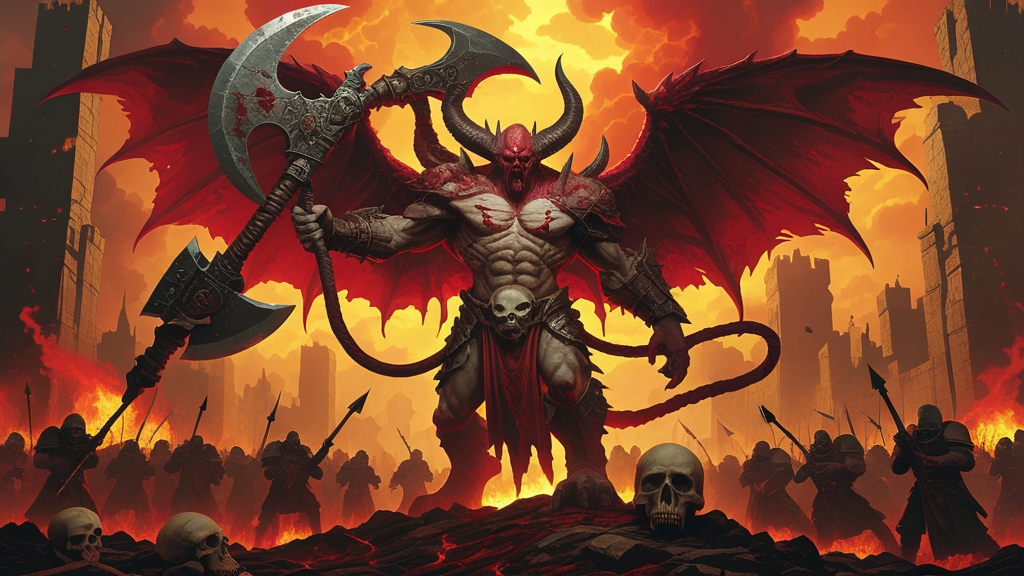
The Bloodthirster is the greatest of Khorne’s daemons — a towering winged engine of destruction that embodies the Blood God’s rage made manifest. Winged, wreathed in hellfire and armed with weapons forged in the Blood God’s realm, a Bloodthirster is one of the most terrifying entities that can manifest in realspace. Where lesser daemons of Khorne are savage but containable, a Bloodthirster is an extinction-level threat that can single-handedly break an army’s back.
In the lore, Bloodthirsters are the generals and champions of Khorne’s endless legions. They are not mindless berserkers: for all their rage, they possess a savage cunning that makes them dangerous commanders as well as combatants, and they despise any foe who will not fight them face to face.
The most infamous Bloodthirsters, such as An’ggrath the Unbound and Skarbrand the Exiled, are named in legend across the galaxy. Skarbrand in particular radiates a rage so intense that warriors near him, friend and foe alike, are driven into a killing frenzy.
Bloodthirster on the Tabletop
The Bloodthirster is a winged Greater Daemon of Khorne in the Chaos Daemons army: a fast, durable Monster Character built for extreme melee combat. It flies, hits very hard and is protected by a daemonic invulnerable save, which matters because AP can’t reduce it.
Its exact characteristics, weapon profiles, abilities and points have changed between editions and balance updates, so we don’t quote a statline here. Check the current Chaos Daemons datasheet in the Warhammer 40,000 app and the Munitorum Field Manual for exact values.
Bloodthirster Kit Variants
The plastic Bloodthirster kit builds three classic versions, each with a different weapon loadout. They used to be separate datasheets. In 10th Edition they were merged into a single Bloodthirster datasheet with weapon options, so on the tabletop you are choosing a loadout rather than a different unit. Check the current datasheet for which options are available and how each weapon performs.
Bloodthirster of Unfettered Fury
The classic pose, armed with an axe of Khorne (the “mighty axe of Khorne” in Age of Sigmar) and a lash of Khorne. The axe deals heavy blows, while the whip-like lash lets it lash out at enemies around it.
Bloodthirster of Insensate Rage
Armed with the great axe of Khorne, an enormous two-handed weapon. This is the build for hitting as hard as possible with every swing, which makes it a natural choice for hunting monsters and vehicles.
Wrath of Khorne Bloodthirster
Carries an axe of Khorne and a bloodflail, and traditionally breathes hellfire. The kit’s third classic loadout, it gives the model a different look and weapon mix from the other two.
The same kit can also build Skarbrand, the exiled Bloodthirster, who has his own rules.
How to Use the Bloodthirster — Tactics and Strategy
Deep Strike Deployment
If the Bloodthirster’s current datasheet or army rules give it Deep Strike, arriving from reserves protects it from early shooting and lets you place it where it’s needed. In 11th Edition, all reserves (Deep Strike units included) count towards a 50% points cap, can’t arrive until battle round 2, and are destroyed if they haven’t arrived by the end of battle round 3. A deep striker must be set up more than 8″ horizontally from all enemy units, and after arriving it can’t move again until the Charge phase, but it can still charge. Since engagement range is now 2″, that usually means a 7 or more on 2D6. See our Deep Strike in 11th Edition guide for the full rules.
When you land, think about the following turn as well as the charge. Even if the charge fails, a Bloodthirster that threatens several targets forces your opponent to react rather than follow their own plan.
On the Table from the Start
Deploying the Bloodthirster on the table from the start puts pressure on your opponent immediately. Its flying speed means it threatens a large part of the board. If your list has several other high-priority targets (other Greater Daemons, Daemon Princes and so on), deploying them all aggressively can overwhelm your opponent’s ability to deal with every threat.
The risk is that a Bloodthirster on the table can be seen and shot. Armies with strong anti-monster shooting will focus it immediately. In 11th Edition, Monsters no longer get the benefit of cover just for being in a terrain area, only when intervening terrain genuinely blocks part of them from view, so use large ruins to block line of sight during your approach rather than relying on cover once you are exposed.
Charge Sequencing
When the Bloodthirster charges, choose your target carefully. In 11th Edition you roll 2D6 for the charge first and then pick targets within that distance, and charging units fight first that turn. Prioritise units that will die in a single Fight phase. You don’t want the Bloodthirster stuck in combat with a unit it can’t finish off, where it is exposed to counter-charges and shooting next turn. Ideal targets include:
- Enemy vehicles and monsters that will be destroyed in one round of combat
- Elite infantry squads that cannot survive the Bloodthirster’s attacks
- Characters without adequate bodyguard protection
- Units holding critical objectives
Threat Projection
Even when the Bloodthirster isn’t in combat, its presence shapes the battlefield. Its movement plus a charge covers a huge area, so opponents have to plan around it, often deploying defensively or giving up parts of the board. Use that pressure to control space, and to make it hard for your opponent to hold central terrain objectives, without committing to combat too early.
Synergies with Chaos Daemon Units
- Bloodletters: Khorne’s core daemon infantry. Several squads advancing alongside the Bloodthirster give your opponent too many melee threats to deal with and can hold the objectives the Bloodthirster clears.
- Skull Cannon: One of the few sources of ranged fire in a Khorne daemon force, useful for softening up targets before the Bloodthirster charges.
- Karanak: The three-headed Hound of Vengeance, a fast hunter that adds another threat to your opponent’s backfield. Check his current datasheet for his exact abilities.
- Daemon Prince: A secondary melee threat that forces split target priority. If the opponent shoots the Bloodthirster, the Daemon Prince arrives intact, and vice versa.
Bloodthirster in Competitive Play
The Bloodthirster is a powerful but meta-dependent choice in competitive 40k. Its effectiveness depends heavily on the shooting environment:
- Favourable metas: When the competitive meta favours melee combat or light shooting, the Bloodthirster thrives. In environments where most armies focus on midboard brawling, the Bloodthirster’s combat prowess is unmatched.
- Unfavourable metas: Heavy shooting metas with multiple anti-monster weapons make the Bloodthirster risky. T’au gunlines, Astra Militarum tank formations and similar armies can kill or cripple a Bloodthirster before it reaches combat.
- Deep strike reliability: In 11th Edition a deep striker lands more than 8″ away and needs to end within 2″ of the target, so an unmodified charge usually needs a 7 or more on 2D6, which succeeds a little under 60% of the time. Remember that a unit can only benefit from one Stratagem per phase, and Command Re-roll counts as one.
Painting the Bloodthirster
The Bloodthirster is one of the largest and most impressive kits in the Chaos Daemons range. The model’s size and detail level make it an excellent display piece and painting project. Key considerations include skin tone, wing membranes, and the transition between flesh and armour. Subassembly painting (painting wings, body, and weapon separately before final assembly) is strongly recommended.
Frequently Asked Questions
Is the Bloodthirster good in 11th Edition?
It remains one of the most dangerous melee units in the game, combining speed, durability and huge combat output. How competitive it is at any moment depends on its current points and datasheet and what other armies are bringing. Its effectiveness always depends on whether it reaches combat intact.
Which Bloodthirster variant is best?
On the tabletop the variants are now weapon options on a single datasheet, so the best choice depends on the current weapon profiles. As a rule of thumb, the great axe (Insensate Rage) suits hunting monsters and vehicles, while the Unfettered Fury loadout is the classic all-rounder. Check the current datasheet and recent tournament lists before deciding. If you’re unsure, build the pose you like best; many players magnetise the arms.
Can I take multiple Bloodthirsters?
Generally yes, within the usual limits on duplicate units in matched play (check the current Munitorum Field Manual). Two Bloodthirsters are very hard for opponents to handle, because killing one in a turn is achievable but killing both rarely is.
How do I counter a Bloodthirster?
Focus fire with high-strength, high-AP weapons before it reaches melee. Massed lascannon or meltagun fire is effective. Avoid committing single units to melee against it — the Bloodthirster will almost always win one-on-one combat.
Does the Bloodthirster work in Chaos Space Marine armies?
The Bloodthirster is a Chaos Daemons unit. Whether other Chaos armies can include daemons, and how, depends on the current codexes and Munitorum Field Manual, so check the latest faction rules before planning a list around it.
What’s the difference between a Bloodthirster and Skarbrand?
Skarbrand is a single, named Bloodthirster who was exiled by Khorne. Tricked by Tzeentch, he struck at the Blood God himself, and Khorne hurled him out of the Brass Citadel, tearing his wings as he fell. Skarbrand now burns with endless rage and has his own rules. A standard Bloodthirster is one of Khorne’s many greater daemons, and the plastic Bloodthirster kit can also build Skarbrand.
Is the Bloodthirster in Age of Sigmar?
Yes. Bloodthirsters are greater daemons in the Blades of Khorne army in Age of Sigmar as well as in the Chaos Daemons army in Warhammer 40,000. The same plastic kit works in both games, which makes it a good buy if you play both or might switch later.
Related Articles
- Chaos Daemons Faction Guide — Full Army Overview
- Chaos Gods — Complete Lore Guide
- All Warhammer Guides
Related Content
- Blades of Khorne – Warhammer Age of Sigmar Guide — apply this guide to a specific army
- How to Play Warhammer 40k — Complete Beginner’s Guide — learn the core rules of Warhammer 40K
- Lord of Skulls Guide — Khorne Super-Heavy Daemon Engine — explore another helpful guide
- All Warhammer 40k Factions Ranked — Tier List — see which factions rank highest