
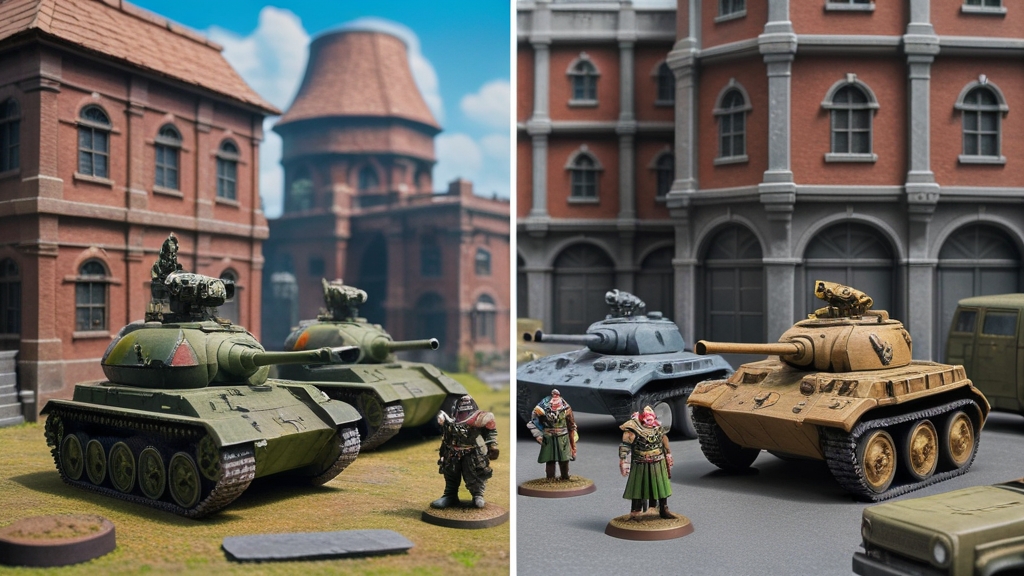
Warhammer 40k operates on a scale that defies everyday comprehension. A Space Marine stands over 7 feet tall in armour — taller than any NBA player and encased in ceramite plate that can shrug off conventional weapons. A Warlord Titan stands roughly 33 metres tall — the height of a 10-storey building. Hive cities stretch miles into the sky. And the Emperor’s Imperial Palace covers most of the Himalayan mountain range.
One of the things that makes Warhammer 40k so compelling is its sheer scale. The setting operates at sizes that make real-world military hardware look like toys. But how big is everything, really? This guide puts every major element of the 40k universe into real-world context, from the soldiers to the vehicles to the ships to the cities, using comparisons you can actually visualise.
How Big Is a Space Marine?
A standard Space Marine in Mark X power armour stands approximately 7 feet 2 inches (2.18 metres) tall — taller than most NBA centres and substantially broader. Without armour, a Space Marine is still around 6 feet 8 inches (2.03 metres), roughly the height of LeBron James but with significantly more muscle mass. Space Marines weigh approximately 750 pounds (340 kg) in full armour, or about the weight of a large motorcycle.
But height alone does not capture the scale. A Space Marine’s proportions are not human. Their shoulders are inhumanly broad — wider than a standard doorframe. Their limbs are thick with enhanced musculature and reinforced bone. Their torso contains additional organs (a second heart, the Betcher’s Gland, the Mucranoid, and others) that a normal human does not possess. Standing next to a Space Marine, an average person would look like a child standing next to a professional bodybuilder — except the bodybuilder is encased in powered ceramic tank armour and carrying a weapon that fires self-propelled explosive rounds.
A Primaris Marine is even larger — roughly 8 feet (2.44 metres) in armour. The Custodes are larger still, standing up to 9 feet in their auramite warplate. And the Primarchs towered over everyone — Vulkan, the tallest, was reportedly around 12 feet (3.66 metres) tall, while most Primarchs stood between 10 and 11 feet. The Emperor himself is described inconsistently, but most accounts place him taller than any Primarch — a being whose physical presence was as overwhelming as his psychic power.
How Big Are Warhammer 40k Vehicles?
The Rhino — the most common Space Marine transport — is roughly the size of a large SUV or small armoured personnel carrier. It measures approximately 6.6 metres long, 4.5 metres wide, and 3.6 metres tall. For comparison, a modern military Humvee is about 4.6 metres long. The Rhino is designed to carry ten Space Marines, which gives you a sense of how cramped the interior must be given the occupants’ size.
The Land Raider — the Space Marines’ main battle tank — is comparable in size to a city bus. At approximately 10.3 metres long and 6.1 metres wide, it is larger than any real-world armoured fighting vehicle. Its armour is thicker than a modern main battle tank’s, and its twin-linked lascannons deliver firepower that exceeds anything in a contemporary military arsenal. The Land Raider’s interior accommodates either five Terminators (Space Marines in even heavier armour) or ten standard Marines — which, again, gives you a sense of just how large this vehicle is.
The Baneblade — the Imperial Guard’s super-heavy tank — is genuinely enormous. At approximately 13.5 metres long and weighing over 300 tonnes (versus a modern Abrams tank’s 73 tonnes), the Baneblade is closer in scale to a World War I landship than a modern tank. It carries a crew of ten, mounts a main cannon capable of levelling buildings, and features multiple secondary weapons that allow it to engage targets in every direction simultaneously. Standing next to a Baneblade, a modern main battle tank would look like a compact car parked next to a school bus.
How Tall Is a Titan?
Titans are where 40k’s scale becomes genuinely staggering. The smallest class — the Warhound Scout Titan — stands approximately 15 metres tall (about 50 feet), comparable to a five-storey building. A Warhound weighs around 400 tonnes and is classified as a “scout” vehicle. Its weapons — turbo-laser destructors, plasma blastguns, inferno cannons — could individually destroy any real-world military target with a single shot.
The Reaver Battle Titan stands approximately 22 metres tall (about 72 feet) — the height of a seven-storey building. It carries weapons capable of levelling city blocks and is protected by void shields that dissipate incoming fire by shunting its energy into the Warp. A Reaver walking through a modern city would tower above most residential buildings and its footsteps would crack roads and shatter underground infrastructure.
The Warlord Battle Titan stands approximately 33 metres tall (about 108 feet) — the height of a ten-storey building. At full stride, a Warlord’s head would be level with the roof of most office buildings. Its main weapons — volcano cannons, gatling blasters, apocalypse missile launchers — can engage targets at ranges measured in kilometres. A single Warlord Titan could theoretically destroy a modern military base without coming within range of any weapon the base possesses.
And then there is the Imperator Titan — the largest class of battle engine the Imperium deploys. An Imperator stands approximately 55 metres tall (about 180 feet), comparable to a seventeen-storey building or roughly the height of the Leaning Tower of Pisa. Its carapace-mounted weapons can level entire city districts, and it carries a small cathedral on its back — complete with a choir of servitors whose psychic screaming serves as a weapon of mass psychological warfare. An Imperator walking through Manhattan would reach the lower floors of most skyscrapers, and its weapons could level entire city blocks per volley.
How Big Are Warhammer 40k Ships?
Imperial Navy vessels operate at a scale that makes real-world aircraft carriers look like rowing boats. An Imperial Navy escort — the smallest class of warship — is typically 1.5 to 2 kilometres long. That is roughly the length of twenty modern aircraft carriers placed end to end. An escort is considered a minor vessel, barely worth mentioning in fleet engagements.
A standard Imperial cruiser — the backbone of the Imperial Navy — is approximately 5 kilometres long (about 3.1 miles). This is larger than most real-world cities are wide. A cruiser’s crew numbers in the tens of thousands, and its internal structure includes manufactories, barracks, chapels, hydroponic farms, and living quarters that could house a small town. Many crew members are born, live, and die aboard the ship without ever seeing the outside.
An Imperial battleship ranges from 6 to 8 kilometres long. The Gloriana-class battleships used by the Primarchs during the Great Crusade were roughly 20 kilometres long — larger than Manhattan island. These ships carried entire Space Marine Legions, with their associated vehicles, support staff, and supplies for extended campaigns. The Phalanx — the Imperial Fists’ mobile fortress-monastery — is described as being the size of a small moon.
But even these are dwarfed by certain outliers. The Rock — the Dark Angels’ mobile fortress — is literally a chunk of a destroyed planet. Craftworld ships — the Aeldari worldships — are continent-sized vessels that carry entire civilisations. And the World Engine — a Necron war-construct — was a planet-sized weapon that required an entire Space Marine Chapter to destroy from the inside.
How Big Are Hive Cities?
Hive cities are the most common form of urban settlement in the Imperium, and their scale is genuinely difficult to comprehend. A typical hive city is a conical or spire-shaped structure that rises several miles (up to 10 miles or more) above the planet’s surface. The base of a major hive might span 50-100 kilometres across — larger than most real-world metropolitan areas. The population of a single hive can range from 10 billion to over 100 billion people, crammed into layered levels that stack from the sunlit upper spires to the lightless, lawless depths of the Underhive.
To visualise a hive city, imagine taking all of New York City’s buildings and stacking them on top of each other, then repeating that stack a hundred times, then encasing the whole thing in a shell of ferrocrete and plastek. The upper levels (the Spires) house the wealthy and powerful in relative luxury. The mid-levels (the Hive Proper) house the working population in cramped, industrial conditions. The lower levels (the Underhive) are lawless wastelands where gangs, mutants, and far worse things lurk in the perpetual darkness. And beneath even the Underhive lie the Sump — toxic, radioactive depths where the city’s waste accumulates over millennia.
How Big Is the Emperor’s Imperial Palace?
The Imperial Palace on Terra is the most absurdly scaled structure in the 40k setting. It covers most of the Himalayan mountain range — an area of approximately 600,000 square kilometres (231,000 square miles). For comparison, France is about 640,000 square kilometres. The Imperial Palace is essentially a country-sized fortified complex that encompasses entire mountain ranges within its walls.
The Palace’s fortifications include walls miles high, defence batteries that can engage orbital targets, void shield generators that protect the entire complex from orbital bombardment, and garrison forces numbering in the millions. The Eternity Gate — the final entrance to the Sanctum Imperialis where the Golden Throne sits — is a door so large that Titans can walk through it. The Palace’s interior contains bureaucratic complexes the size of cities, cathedrals that dwarf real-world structures, and archives that have been accumulating documents for ten thousand years — many of which have never been read and never will be.
During the Siege of Terra in the Horus Heresy, the Palace’s defences held against an assault by traitor Space Marine Legions, Titan Legions, daemonic hosts, and corrupted Imperial Army forces numbering in the hundreds of billions. The siege lasted months and devastated the Palace’s outer precincts, but the inner sanctum was never breached — a testament to the scale and strength of the fortifications.
How Does the Imperium Compare to Real-World Empires?
The Imperium of Man spans approximately one million worlds across the Milky Way galaxy. The galaxy itself is roughly 100,000 light-years across and contains an estimated 100-400 billion stars. The Imperium controls a fraction of these stars, but even that fraction represents a territory so vast that light itself takes tens of thousands of years to cross it. Communication between distant worlds can take weeks or months, and some worlds are so isolated that they go centuries between Imperial contact.
For comparison, the British Empire at its peak controlled about 35.5 million square kilometres of Earth’s surface — roughly 23% of the planet’s land area. The Imperium controls a significant fraction of the galaxy’s habitable worlds, a territory so much larger that comparison becomes meaningless. The administrative challenges of governing a million worlds scattered across 100,000 light-years make the British Empire’s logistical difficulties look trivial by comparison.
The Imperium’s population is estimated at multiple quadrillions (thousands of trillions) of humans. Earth’s current population is about 8 billion. The Imperium has more people on a single major hive world than Earth has in total. This scale is why the Imperium can lose entire planets and barely notice — the bureaucratic machinery is so vast that the destruction of a world with billions of inhabitants might not register in Imperial records for decades or centuries.
Frequently Asked Questions
Are the scale descriptions consistent across 40k sources?
No, and this is a well-known issue. Different novels, codexes, and rulebooks give different measurements for the same things. Space Marine height ranges from 7 to 8 feet depending on the source. Ship lengths vary by factors of two or three between different publications. Games Workshop has acknowledged that scale consistency is not a priority — the setting prioritises dramatic impact over precise engineering specifications.
Could real-world physics support a hive city?
Not with current materials science. A structure miles tall would require materials far stronger than anything we can produce, engineering solutions for heat dissipation, atmospheric pressure, and structural load that do not exist, and a power source capable of sustaining billions of inhabitants. In 40k, these problems are solved by Imperial engineering and the Mechanicus’s (poorly understood) technology.
How do Space Marines fit inside vehicles?
This is a common source of humour in the 40k community. The tabletop models are not to scale with each other — if they were, vehicles like the Rhino would be far larger than their miniature suggests. In the lore, Space Marine vehicles are cramped even for their superhuman occupants, with Marines described as being packed in shoulder-to-shoulder for transport.
Is the Imperium bigger than Star Wars’ Galactic Empire?
Both control roughly similar territories — a significant portion of a single galaxy. The Galactic Empire in Star Wars controlled approximately 1.5 million member worlds. The Imperium controls approximately one million worlds. In terms of territory, they are comparable. In terms of military capability, the Imperium’s individual assets (Space Marines, Titans) are generally more powerful than their Star Wars equivalents, but the Galactic Empire’s Death Star-class weapons exceed anything the Imperium fields.
What is the biggest thing in Warhammer 40k?
The Great Rift — the Cicatrix Maledictum — is a tear in reality that spans the entire galaxy, roughly 100,000 light-years long. It is the largest “structure” in the setting, though it is a wound in reality rather than a physical object. Among physical constructs, the Webway — the Aeldari’s dimensional tunnel network — spans the galaxy and exists in a dimension parallel to realspace, making it arguably the largest artificial structure in the setting.