
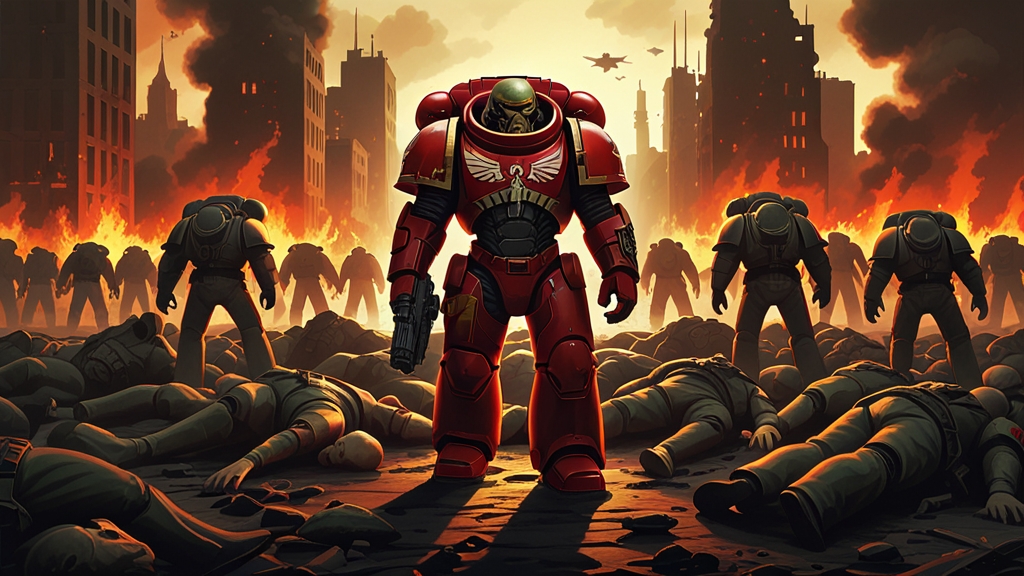
Are Space Marines the Good Guys?
No — and that is one of the most important things to understand about Warhammer 40,000. Space Marines protect humanity from existential threats, but they also commit genocide against alien civilisations that pose no threat, enforce a brutal theocratic dictatorship, and destroy anything that challenges Imperial dogma — including innocent humans who happen to have witnessed the wrong things. In Warhammer 40,000, there are no good guys. The Space Marines are the protagonists of many stories, but protagonist and hero are not the same thing.
This distinction is central to what makes Warhammer 40,000 a compelling setting. The Space Marines are humanity’s greatest defenders, and they are also humanity’s greatest instruments of oppression. They save worlds and they destroy worlds. They fight monsters and they are, by many definitions, monsters themselves. Understanding this duality is essential to understanding the setting — and to understanding why millions of fans find it so fascinating.
What Do Space Marines Protect?
Space Marines exist to protect humanity from the myriad threats that beset the Imperium of Man. Their primary adversaries include the forces of Chaos (traitor Marines, daemons, and corrupted humans), Ork Waaaghs (massive greenskin invasions), Tyranid hive fleets (extragalactic swarms that consume all biomass), Necron dynasties (awakening robotic conquerors), and any other threat that imperils Imperial worlds.
In this defensive role, Space Marines are undeniably heroic. They are deployed to the most dangerous warzones in the galaxy, fighting battles that no ordinary human could survive. They defend hive cities against daemonic invasions, hold the line against Tyranid swarms that outnumber them millions to one, and strike deep behind enemy lines to eliminate threats before they can reach populated worlds. The individual bravery and sacrifice of Space Marines in defence of humanity is genuine and often deeply moving in the lore.
Space Marines also protect humanity in a more abstract sense: they are a deterrent. The knowledge that a Space Marine chapter patrols a particular region of space discourages potential aggressors and provides psychological reassurance to Imperial citizens. The mere existence of the Astartes — transhuman warriors of terrifying power — serves as a constant reminder that the Imperium has teeth.
What Atrocities Do Space Marines Commit?
The same Space Marines who defend humanity also commit acts that, by any civilised standard, constitute war crimes, genocide, and crimes against humanity.
Xenocide: Space Marines routinely exterminate entire alien species — not because those species pose an immediate military threat, but because the Imperial Creed holds that the galaxy belongs to humanity alone. Peaceful alien civilisations, pre-spaceflight species, and even potential allies are destroyed simply for being non-human. The Great Crusade, the Imperium’s founding military campaign, involved the systematic extermination of countless alien species across the galaxy, many of which had lived peacefully alongside human colonies for centuries.
Civilian casualties: Space Marines do not distinguish between combatants and civilians when prosecuting their wars. Entire populations are put to the sword if they are deemed corrupted, heretical, or simply in the way. The concept of proportionality — using only the force necessary to achieve a military objective — is essentially alien to Space Marine doctrine. Overwhelming, devastating force is the default response to any threat.
Mind-wiping and execution of witnesses: Imperial citizens who witness Space Marines in action, particularly against Chaos or daemonic threats, are routinely mind-wiped or killed to prevent the spread of forbidden knowledge. The Grey Knights — the Space Marine chapter specialising in daemon-hunting — are notorious for eliminating all witnesses to their operations, including the very Imperial soldiers they were deployed to save.
Enforcing tyranny: Space Marines enforce the Imperium’s theocratic rule through violence. They crush rebellions that may have legitimate grievances, suppress dissent against Imperial authorities who may be corrupt or incompetent, and enforce religious orthodoxy that the Emperor himself never sanctioned. In doing so, they perpetuate a system of governance that causes immense suffering to the very humans they claim to protect.
Is Their Violence Necessary?
The “necessity argument” is the most common defence of Space Marine morality, and it has genuine force. The threats facing the Imperium are real, existential, and uncompromising. Chaos does not negotiate. Tyranids cannot be reasoned with. Orks do not accept surrender. In a galaxy where the alternatives to brutal defence are extinction, enslavement, or consumption, the Space Marines’ violence can be framed as the lesser evil.
However, the necessity argument has significant weaknesses. Not all of the Space Marines’ violence is directed at existential threats. The extermination of peaceful alien species, the suppression of legitimate dissent, and the enforcement of religious dogma serve the Imperium’s political structures rather than humanity’s survival. The Imperium often creates the conditions that make its own brutality “necessary” — it refuses to negotiate with aliens who could be allies, suppresses technology that could solve its problems, and maintains a social order that generates the very instability it then violently suppresses.
The T’au Empire demonstrates that alternative approaches are at least partially viable. The T’au cooperate with alien species, invest in technological progress, and govern through rational policy rather than religious tyranny. While the T’au face fewer existential threats than the Imperium (partly due to their smaller size), their example suggests that some of the Imperium’s cruelty is a choice rather than a necessity.
Do Individual Space Marines Have Morality?
One of the most nuanced aspects of the Space Marines’ characterisation is the tension between individual morality and institutional evil. Many individual Space Marines demonstrate genuine virtue — courage, self-sacrifice, compassion for the humans they protect, and a sincere desire to do good. The lore is full of examples of individual Marines making moral choices, questioning orders, and struggling with the contradictions of their role.
Characters like Uriel Ventris of the Ultramarines, who questions strict adherence to the Codex Astartes, or the Salamanders chapter, which is known for its genuine concern for civilian welfare, demonstrate that individual Space Marines can and do possess moral agency. The Blood Angels struggle against the Red Thirst and Black Rage — internal flaws that threaten to turn them into the very monsters they fight. The Space Wolves have a tradition of independence and individual conscience that sometimes puts them at odds with Imperial authority.
However, individual virtue does not absolve institutional evil. A Space Marine who personally treats civilians with compassion but participates in a system that genocides alien species is not “good” in any comprehensive moral sense. The institution of the Adeptus Astartes is designed to produce obedient weapons, and the psycho-indoctrination, genetic modification, and cultural conditioning that every Space Marine undergoes is specifically intended to override individual moral judgment in favour of institutional loyalty.
Why Does This Moral Complexity Matter?
The moral ambiguity of the Space Marines is not a flaw in the setting — it is the setting’s greatest strength. Warhammer 40,000 is a moral thought experiment disguised as a tabletop wargame: what would happen to human morality under conditions of absolute extremity?
The Space Marines embody this thought experiment perfectly. They are what humanity becomes when survival requires the surrender of everything that makes civilisation worth defending. They protect human lives but destroy human values. They ensure humanity’s physical survival while contributing to the death of humanity’s moral soul. The question “are Space Marines the good guys?” is really the question “can a civilisation remain good while doing what is necessary to survive?”
This moral complexity is what elevates Warhammer 40,000 above simple power fantasy. In a setting where the Space Marines were unambiguously heroic, the stories would be straightforward and ultimately shallow. By making the Space Marines both protectors and oppressors, Games Workshop created a setting that rewards genuine moral engagement and provokes the kind of debates that have sustained the community for decades.
It is also worth noting that Games Workshop has been increasingly explicit about the fact that the Imperium is not aspirational. In a 2021 statement, the company made clear that the Imperium is “the cruelest and most bloody regime imaginable” and that its values should not be emulated. The Space Marines are compelling characters, but they are not role models.
Frequently Asked Questions
Which Space Marine chapter is the most moral?
The Salamanders are widely considered the most moral chapter, known for their genuine concern for civilian welfare and their willingness to prioritise saving lives over completing military objectives. Their Primarch Vulkan emphasised the protection of ordinary humans, and this ethos has persisted for ten thousand years. However, even the Salamanders serve the Imperium and participate in its systemic atrocities — they are simply less enthusiastic about it than most.
Were Space Marines always morally ambiguous?
The moral ambiguity of the Space Marines has been present since the earliest editions of Warhammer 40,000, but it has become more prominent over time. Early editions leaned more heavily into satirical commentary on fascism and militarism, while later editions have developed the moral complexity into a more nuanced narrative. The Horus Heresy novel series, in particular, deepened the moral ambiguity of the Astartes considerably.
Do Space Marines ever refuse orders?
Yes, though rarely. Space Marines are psycho-conditioned to obey, but they are not robots, and instances of Marines questioning or refusing orders do occur in the lore. Chapter Masters have the authority to refuse orders from Imperial institutions they consider unjust, and entire chapters have occasionally gone renegade when they believe the Imperium has betrayed its own principles. The Space Wolves’ conflict with the Inquisition over the treatment of civilians is a notable example.
Are Chaos Space Marines the bad guys?
Chaos Space Marines are generally presented as more overtly villainous than loyalist Marines, having pledged themselves to the dark powers of Chaos. However, many Chaos Marines turned traitor for understandable reasons — disgust at the Emperor’s hypocrisy, legitimate grievances against the Imperium, or corruption they did not choose. The Night Lords trilogy by Aaron Dembski-Bowden, in particular, presents Chaos Marines as complex, tragic figures rather than simple villains.
Why do people root for Space Marines if they’re not good?
People root for Space Marines for the same reasons they root for any compelling protagonist — they are brave, powerful, and fight against terrifying threats. The moral ambiguity does not make them less compelling; it makes them more compelling. Audiences are drawn to characters who face impossible choices and moral dilemmas, and the Space Marines’ position as humanity’s protectors who are also humanity’s oppressors creates a narrative tension that is endlessly fascinating.