
Part of our Blood Angels hub: every Blood Angels guide, lore page and painting tutorial in one place.
Astorath the Grim — Blood Angels Chaplain of Death
Who Is Astorath the Grim?
Astorath the Grim is the Redeemer of the Lost, the High Chaplain of the Blood Angels, and one of the most tragic figures in the entire Warhammer 40,000 universe. His sacred duty is unlike that of any other Chaplain in the Imperium: Astorath travels the galaxy seeking out Blood Angels and their successor chapters who have succumbed to the Black Rage — and grants them the Emperor’s Peace. In simpler terms, he mercy-kills his own brothers.
The Black Rage is a genetic curse carried by every Blood Angel. It is a psychic echo of the death of their primarch, Sanguinius, at the hands of Horus during the Siege of Terra. When the Black Rage takes hold, a Blood Angel relives Sanguinius’s final moments — they see the world through the primarch’s dying eyes, perceiving every enemy as Horus and every ally as a potential traitor. They become lost in a psychic hallucination of the worst moment in Blood Angels history, fighting with berserker fury but completely divorced from reality.
There is no cure for the Black Rage. Once it takes a Blood Angel, he is lost forever. The kindest fate is a glorious death in battle, which is why those who fall to the Black Rage are gathered into the Death Company — black-armoured berserkers who are unleashed upon the enemy in a final, suicidal charge. But sometimes, a Death Company marine survives the battle. Sometimes, the enemy is destroyed but the afflicted brother remains, trapped in his madness. It is then that Astorath arrives to perform his grim duty.
The Burden of the Redeemer
Astorath’s role as Redeemer of the Lost is unique in the Imperium. No other Space Marine chapter has a dedicated executioner for its own warriors. The role exists because the Black Rage is the Blood Angels’ darkest secret — a genetic flaw so severe that it could potentially see the chapter declared corrupt and destroyed by the Inquisition if its full extent were known.
Each execution weighs on Astorath. He is not a mindless killer — he is a Chaplain, a spiritual leader whose primary duty in any other chapter would be to inspire and protect his brothers. Instead, he must end the lives of warriors who fought with honour and distinction, warriors whose only crime is carrying their primarch’s genetic legacy. Every swing of his executioner’s axe kills a loyal servant of the Emperor, and Astorath bears the spiritual weight of every death.
The Blood Angels and their successors both revere and fear Astorath. His arrival at a chapter’s fortress-monastery is greeted with a mixture of respect and dread — respect for his courage in bearing such a terrible burden, and dread because his presence means that brothers will die. Some successor chapters have attempted to hide their Black Rage afflicted from Astorath, either out of misplaced compassion or shame, but the Redeemer always finds them. It is his sacred duty, and he will not be denied.
The Executioner’s Axe
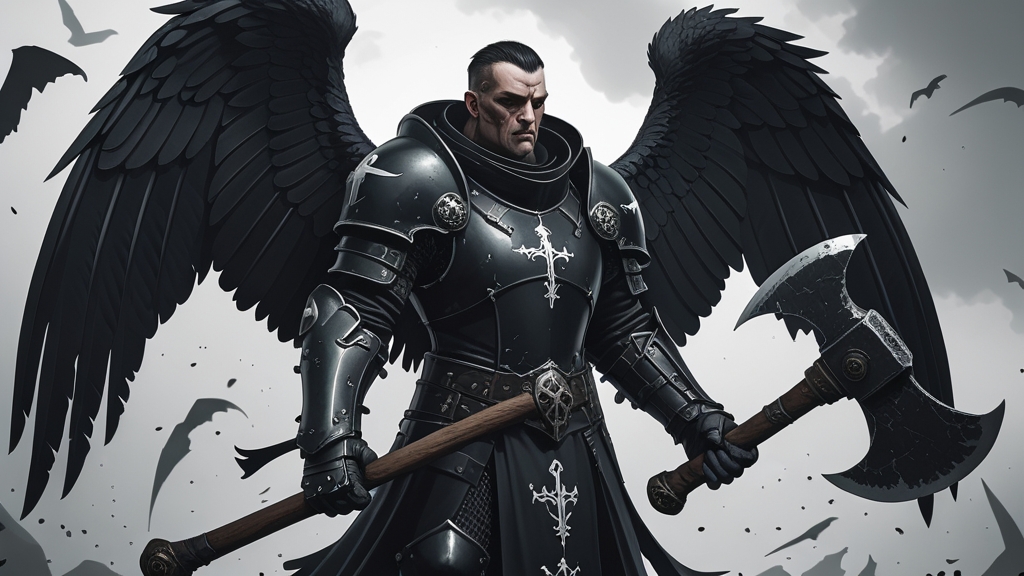
Astorath’s signature weapon is the Executioner’s Axe — a massive two-handed power weapon forged specifically for his grim purpose. This is not a battle weapon designed for war against the enemies of the Imperium (though it serves admirably in that role). It is a ritual instrument of mercy, designed to deliver a clean, instant death to warriors who deserve far better than the madness that has claimed them.
The Executioner’s Axe is one of the finest weapons in the Blood Angels armoury. It is made to cut through even Astartes power armour in a single blow, ensuring that the Emperor’s Peace is delivered swiftly and without unnecessary suffering. In Astorath’s hands, it has ended more noble lives than anyone cares to count — each one a tragedy, each one a mercy.
On the tabletop, the axe is his signature melee weapon and the main reason he is feared in combat. Its exact profile and abilities change between codexes and balance updates, so check the current Blood Angels rules for its numbers.
Astorath and the Black Rage
Astorath’s relationship with the Black Rage is deeply personal. As a Blood Angel himself, he carries the same genetic flaw that he must execute others for succumbing to. Every day, Astorath feels the pull of the Black Rage — the whisper of Sanguinius’s death echoing in his blood, urging him toward the same berserker madness that claims his brothers. That he has resisted for so long is a testament to his extraordinary willpower and faith.
Some Blood Angels scholars believe that Astorath’s constant proximity to death — his daily confrontation with the Black Rage’s consequences — actually helps him resist the curse. By witnessing the horror of the Black Rage up close, by seeing what it reduces noble warriors to, Astorath maintains a clarity of purpose that strengthens his mind against the psychic echoes that seek to overwhelm it. The duty that makes his life a constant sorrow may also be the thing that keeps him sane.
There is a terrible irony in Astorath’s existence. He is the Blood Angels’ greatest weapon against the Black Rage — not through a cure, but through a compassionate end for those it claims. Yet he himself may one day fall to the very curse he fights against. If that day comes, who will grant the Redeemer his own redemption? This question haunts Astorath and adds another layer of tragic depth to an already sorrowful figure.
The Death Company
Astorath’s duties are inextricably linked to the Death Company — the formation of Blood Angels who have succumbed to the Black Rage and been gathered for their final battle. Understanding the Death Company is essential to understanding Astorath’s role within the chapter.
When a Blood Angel falls to the Black Rage, he is removed from his regular duties and inducted into the Death Company. His armour is repainted black, and red saltire crosses are painted over it — symbols of Sanguinius’s sacrifice. The warrior is given close-combat weapons suitable for the berserker fury that now drives him, and he is pointed at the enemy for what is intended to be his final engagement.
Death Company marines fight with superhuman ferocity even by Space Marine standards. The Black Rage fills them with an all-consuming rage and renders them nearly immune to pain — they continue fighting through wounds that would kill a normal Astartes, driven by the psychic echo of Sanguinius’s desperate last stand against Horus. They are among the most devastating melee units in the entire game, but they are also completely uncontrollable, attacking anything they perceive as the enemy (which, in their delusional state, is virtually everything).
After the battle, any Death Company marines who survive must be dealt with. They cannot be returned to normal service — the Black Rage is permanent and irreversible. This is when Astorath steps forward. With the Executioner’s Axe in hand and a prayer on his lips, he approaches each surviving Death Company marine and delivers the killing blow. It is an act of mercy, of love, and of profound sorrow — the most terrible kindness a brother can perform for another.
Astorath’s Connection to Sanguinius
Astorath’s entire existence is defined by Sanguinius — the Blood Angels’ primarch, who fell fighting Horus during the Siege of Terra. The Black Rage that Astorath combats is a direct consequence of Sanguinius’s death, and every execution Astorath performs is, in a sense, a continuation of the tragedy that began when Sanguinius fell.
Some within the Blood Angels and their successors suspect that Astorath is bound to Sanguinius’s legacy in a way that goes beyond normal genetic inheritance. His long resistance to the Black Rage and his uncanny habit of arriving exactly where he is needed feed that belief, though the background never spells out an answer.
He is not the only figure tied to that legacy: the Sanguinor — the mysterious golden warrior said to appear to Blood Angels in their darkest moments — is the other great enigma of Sanguinius’s line. Where the Sanguinor embodies the primarch’s hope, Astorath carries out the grim duty his curse demands.
Astorath in Battle
While Astorath’s primary role is as the Redeemer of the Lost, he is also a formidable warrior who fights alongside his brothers against the enemies of the Imperium. In battle, Astorath serves as both a Chaplain — inspiring nearby Blood Angels with his presence and his litanies of faith — and a devastating melee combatant who carves through enemy ranks with the Executioner’s Axe.
Astorath typically fights alongside the Death Company, leading them into battle and directing their berserker fury as effectively as their madness allows. His presence provides whatever meagre control is possible over these lost brothers, channelling their rage toward the enemy rather than allowing it to scatter in all directions. Under Astorath’s guidance, the Death Company becomes a more focused weapon — still uncontrollable by normal standards, but directed with enough purpose to achieve tactical objectives.
On the tabletop he is a named Blood Angels Character with a jump pack, and he is usually fielded as a Leader attached to a Death Company unit so he can add his abilities to theirs. In 11th Edition, attachments are fixed when you write your army roster, and a Leader keeps its “while leading” abilities even if its bodyguard is wiped out (see our Leader rules guide). Which units he can join, his abilities and his points change with codexes and balance updates, so check the current Blood Angels codex and the Munitorum Field Manual.
Legacy and Impact
Astorath the Grim represents one of Warhammer 40,000’s most powerful themes: the cost of duty. In a setting where characters are often defined by their power and their victories, Astorath is defined by his sorrow and his willingness to bear a burden that would break lesser souls. He does not enjoy his work. He does not seek glory. He performs a necessary service with compassion, faith, and an unbreakable resolve that has sustained him across centuries of killing his own brothers.
His story also highlights the Blood Angels’ central tragedy — they are among the noblest and most heroic Space Marine chapters, but they carry a genetic flaw that dooms some of their finest warriors to madness and death. Astorath is both the embodiment of this tragedy and the chapter’s answer to it: not a cure, but a compassionate response to an incurable condition.
He is a character who makes the grimdark setting feel genuinely emotional rather than merely bleak: the question at the heart of his story is what it means to do the right thing when the right thing is unspeakably painful.
Astorath in Fiction
Astorath’s main showcase is Astorath: Angel of Mercy by Guy Haley, a novel in Black Library’s character series that follows the Redeemer of the Lost on his travels among the Blood Angels’ successor Chapters. It is the best place to see his duty, his doubts and his methods up close. He also turns up in the wider Blood Angels background and fiction, usually in a supporting role.
Frequently Asked Questions
Why does Astorath kill Blood Angels who have the Black Rage?
The Black Rage is incurable. Once a Blood Angel succumbs, he is permanently trapped in a psychic hallucination of Sanguinius’s death, unable to distinguish friend from foe. Death Company marines who survive their final battle cannot be returned to normal service and exist in a state of eternal torment. Astorath grants them the Emperor’s Peace — a merciful death that ends their suffering.
Has Astorath ever refused to execute a Blood Angel?
The background presents him as unwavering in his duty. His faith is absolute — he understands that mercy-killing afflicted brothers is a kindness, not a cruelty, and he will not allow personal grief to prevent him from doing what must be done.
Can Astorath himself fall to the Black Rage?
Yes. Astorath carries the same genetic flaw as all Blood Angels and is theoretically susceptible to the Black Rage. His extraordinary resistance is attributed to his exceptional willpower and faith, but the possibility of his own fall remains one of the most haunting aspects of his character.
Is Astorath the most powerful Blood Angels character?
In melee combat, Astorath is one of the strongest Blood Angels characters thanks to the Executioner’s Axe. However, characters like Commander Dante (Chapter Master) hold higher rank and arguably greater overall influence. Astorath’s power is more specialised — he is the supreme authority on matters of the Black Rage and the Death Company.
How does Astorath know when Blood Angels fall to the Black Rage?
The background never fully explains it. He seems to arrive wherever the Black Rage is claiming brothers, and whether that is down to an uncanny gift, Sanguinius’s legacy or simply a vast network of reports from the successor Chapters is left open. He travels the galaxy constantly, arriving at successor chapter homeworlds when his services are needed.
What is Astorath’s relationship with the Death Company on the tabletop?
He is built to lead them. Astorath is usually attached to a Death Company unit as its Leader, adding his own melee threat and abilities to theirs, which makes him a natural centrepiece for Death Company-focused armies. Check the current Blood Angels codex for exactly which units he can join and what he gives them.
Which book should I read about Astorath?
Astorath: Angel of Mercy by Guy Haley. It follows the Redeemer of the Lost to the world of Dulcis, where he finds the Red Wings successor Chapter on the brink of destruction. Astorath also appears in the wider Blood Angels books, but this is the only novel built around him.
Does Astorath have a jump pack?
Yes. Astorath wears a winged jump pack, which lets him leap across the battlefield to reach the Death Company and the enemy. The red-and-black wings and his Executioner’s Axe make his miniature one of the most recognisable Blood Angels characters.
Related Content
- The Emperor of Mankind — The immortal ruler of humanity
- All 40k Factions — Every faction explained
- The Chaos Gods — Khorne, Tzeentch, Nurgle, Slaanesh
- The Horus Heresy Explained — The galaxy’s greatest civil war