
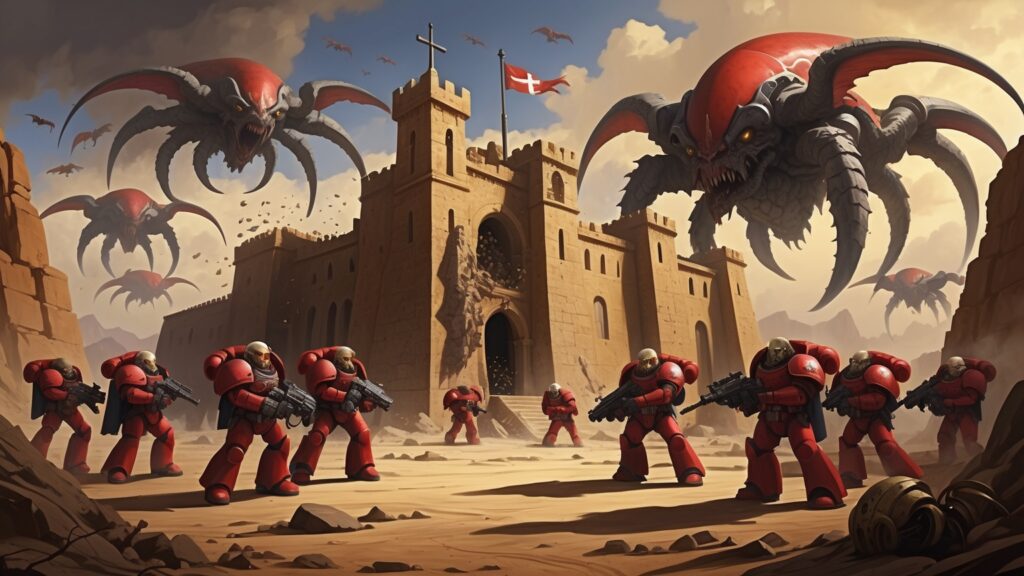
The Devastation of Baal was Hive Fleet Leviathan’s massive assault on the Blood Angels homeworld, nearly destroying the Chapter entirely in what became one of the most desperate last stands in Warhammer 40,000 history. The Blood Angels were saved only by the arrival of the Great Rift, which disrupted the Tyranid swarm, and the subsequent reinforcements from Guilliman’s Indomitus Crusade. The Devastation of Baal is significant not only for its military scope but for what it reveals about the Blood Angels’ character — a Chapter that fights hardest when it has nothing left to lose, and whose darkest curse becomes their greatest weapon in their darkest hour.
The Blood Angels, successors of the martyred Primarch Sanguinius, have always borne twin curses — the Red Thirst (an overwhelming desire for blood) and the Black Rage (a psychic death-echo of Sanguinius’s final battle against Horus). At Baal, these curses threatened to consume the Chapter even as the Tyranids threatened to devour them. The Devastation of Baal tested whether the Blood Angels could survive their own nature and an overwhelming alien threat simultaneously.
Why Did the Tyranids Attack Baal?
Hive Fleet Leviathan was drawn to Baal by the Blood Angels’ gene-seed. The Tyranids are attracted to rich sources of genetic material, and the Blood Angels possess some of the most distinctive and potent gene-seed in the Imperium — gene-seed marked by Sanguinius’s unique genetic legacy. To a Tyranid Hive Fleet, the Blood Angels represented an irresistibly rich genetic prize, and Baal — where the Chapter’s gene-seed reserves were stored — was the ultimate target.
The Hive Mind’s strategy was methodical. Leviathan had been cutting a path through the galaxy, consuming world after world, and its trajectory had been carefully (or instinctively) calculated to converge on Baal. The Blood Angels recognised the threat well in advance — Commander Dante, the Chapter Master and oldest living Space Marine, had years to prepare for the inevitable assault. He used that time to call in every favour, every alliance, and every successor Chapter he could reach.
Dante’s preparations were extraordinary. He issued a call to arms that brought together virtually every Blood Angels successor Chapter — the Flesh Tearers, the Angels Encarmine, the Angels Vermillion, the Knights of Blood, and dozens of others. For the first time in millennia, the entire bloodline of Sanguinius gathered in one place, united by the knowledge that if Baal fell, Sanguinius’s legacy would die with it.
What Happened During the Battle?
The battle for Baal was fought across the entire Baal system — on Baal itself, on its moons Baal Prime and Baal Secundus, and in the void between them. The Tyranid fleet was enormous, comprising billions of organisms ranging from ship-sized bio-vessels to swarms of smaller creatures that darkened the skies of every world they touched.
The initial void battle was costly for both sides. The Blood Angels fleet, augmented by successor Chapter vessels, fought with desperate courage, but the Tyranid fleet’s sheer biomass overwhelmed conventional void tactics. For every bio-ship destroyed, ten more pressed forward. The defenders were gradually pushed back from the system’s outer reaches to Baal itself, ceding the moons to the swarm.
On the ground, the fighting was apocalyptic. Baal’s surface — already a harsh desert world — became a nightmarish battlefield as billions of Tyranid organisms crashed against the Blood Angels’ fortifications. The defenders fought from the walls of the Arx Angelicum — the Blood Angels’ fortress monastery — in a siege that echoed the ancient sieges of Terra itself. Every Blood Angel, from the newest Scout to the oldest Veteran, fought in the line. The Death Company — Marines consumed by the Black Rage — were unleashed in suicidal counter-attacks that tore through Tyranid formations with unhinged ferocity.
The battle reached its nadir when the Tyranids breached the fortress walls. Hand-to-hand fighting raged through the corridors and chambers of the Arx Angelicum, with Blood Angels fighting and dying in rooms they had trained, worshipped, and lived in for centuries. The Chapter’s sacred relics, its gene-seed vaults, and its history were all at stake. Commander Dante, despite his age and exhaustion, fought at the front, killing everything that came within reach of his axe.
How Were the Blood Angels Saved?
The Blood Angels’ salvation came from an unexpected source — the Great Rift. At the battle’s climax, the Cicatrix Maledictum tore open across the galaxy, and its effects reached Baal. The massive surge of Warp energy disrupted the Hive Mind’s psychic control over Leviathan’s organisms. Without the Hive Mind’s coordination, the Tyranid swarm lost its cohesion — individual organisms reverted to instinctive behaviour, formations collapsed, and the relentless strategic pressure that had been driving the Blood Angels to extinction suddenly dissipated.
A daemonic incursion — spawned by the Rift’s opening — also struck the Tyranid forces, with Khornate daemons manifesting in the midst of the swarm and attacking the xenos organisms. This bizarre three-way battle (Blood Angels, Tyranids, daemons) further disrupted the Tyranid assault and gave the defenders a desperately needed respite. The daemons were not allies of the Blood Angels — they attacked everything indiscriminately — but their presence divided the Tyranid swarm’s attention at a critical moment.
The final salvation came with the arrival of Guilliman’s Indomitus Crusade. A massive Imperial fleet — carrying Primaris Marine reinforcements created from Blood Angels gene-seed — arrived in the Baal system and broke the back of the remaining Tyranid forces. The Crusade fleet brought not only military relief but Primaris Marines who would replenish the Blood Angels’ devastated ranks. Guilliman himself met with Dante, reportedly regarding the ancient Chapter Master with a respect that he showed few others.
What Was Commander Dante’s Role?
Commander Dante — Chapter Master of the Blood Angels and the oldest living (non-Dreadnought) Space Marine in the Imperium — was the architect of Baal’s defence and its greatest hero. Dante had served for over 1,500 years, and the weight of those centuries pressed heavily on him during the battle. He was tired — not merely physically exhausted but spiritually weary, carrying the burden of leading the Blood Angels through crisis after crisis for longer than any marine should have to endure.
Despite his exhaustion, Dante’s leadership was extraordinary. He had planned the defence of Baal for years, positioning forces, preparing fortifications, and coordinating with successor Chapters. During the battle itself, he fought in the thick of the fighting, refusing to retreat even when the situation seemed hopeless. His personal combat against the Swarmlord — Hive Fleet Leviathan’s supreme bioform — was one of the battle’s defining moments, with Dante ultimately defeating the creature at enormous personal cost.
After the battle, Guilliman appointed Dante as Regent of the Imperium Nihilus — the dark half of the Imperium cut off by the Great Rift. This appointment recognised Dante not only as a warrior but as a leader of exceptional ability — perhaps the only individual Guilliman trusted to hold together the fragmented Imperial territories beyond the Rift. It also gave Dante a new purpose, pulling him back from the edge of despair that the battle had brought him to.
What Were the Consequences?
The Devastation of Baal nearly destroyed the Blood Angels as a fighting force. The Chapter and its successors suffered catastrophic casualties — some successor Chapters were reduced to a handful of survivors, and others were effectively destroyed. The Blood Angels themselves lost the majority of their battle-brothers, and only the arrival of Primaris reinforcements prevented the Chapter from falling below viable strength.
Baal itself was devastated. The planet’s already harsh environment was further ruined by the Tyranid invasion, with vast areas contaminated by alien biomatter and the remnants of the swarm. The Arx Angelicum required extensive reconstruction, and many of the Chapter’s sacred relics were damaged or destroyed. The physical scars of the battle would take decades to heal.
The integration of Primaris Marines into the Blood Angels raised questions about the Chapter’s identity. Would the new Primaris brothers carry the Red Thirst and Black Rage? (They do.) Would they be accepted by the Firstborn survivors who had fought and bled at Baal? The tensions between old and new were significant, though Dante’s leadership helped smooth the transition.
For the broader 40k narrative, the Devastation of Baal served as a powerful demonstration of the Tyranid threat. Hive Fleet Leviathan had nearly destroyed one of the most iconic Space Marine Chapters — and it had done so as just one tendril of a far larger organism. The full Tyranid threat remains incalculable, and Baal proved that even the Imperium’s finest warriors can be brought to the brink of extinction by the Great Devourer.
Frequently Asked Questions
Which novel covers the Devastation of Baal?
Devastation of Baal by Guy Haley is the definitive account of the battle. It is widely regarded as one of the best Warhammer 40,000 novels, praised for its portrayal of Commander Dante, its depiction of the Blood Angels’ character, and its apocalyptic battle sequences.
Did the Blood Angels lose any successor Chapters?
Yes. Several successor Chapters were effectively destroyed during the battle, reduced to so few survivors that they could no longer function as independent Chapters. The Knights of Blood — a Chapter already declared renegade by the Imperium — fought and died at Baal as an act of redemption, and were posthumously recognised for their sacrifice.
Is the Swarmlord permanently dead?
No. The Swarmlord is a unique bioform that the Hive Mind can regenerate whenever it is destroyed. Dante defeated the Swarmlord at Baal, but it has since been reconstituted by the Hive Mind. The Swarmlord has been killed and regenerated multiple times throughout the lore — its “death” is always temporary.
Did the Tyranids gain anything from attacking Baal?
Yes. Despite their defeat, the Tyranids consumed enormous quantities of biomass from Baal’s moons and surface. The biological material absorbed by the swarm — including the genetic material of fallen Blood Angels — has been incorporated into the Hive Fleet. This means future Tyranid organisms may incorporate adaptations derived from Blood Angels gene-seed, potentially making them even more dangerous.
Can I play the Devastation of Baal on the tabletop?
Yes. Blood Angels versus Tyranids is a classic and thematic matchup. The Shield of Baal campaign supplement (from an earlier edition) included specific missions for this conflict, and the current Crusade rules system is ideal for recreating the desperate, progressive nature of the Baal campaign.
When did the Devastation of Baal happen?
The Devastation of Baal took place at the end of the 41st Millennium, at the same moment the Great Rift opened. Hive Fleet Leviathan’s assault was at its height when the Cicatrix Maledictum tore across the galaxy, scattering the swarm’s coordination. Guilliman’s Indomitus Crusade arrived soon after, putting the battle at the start of the Era Indomitus.
Was Baal destroyed by the Tyranids?
No. Baal itself survived, though it was badly scarred and the Arx Angelicum needed extensive rebuilding. The Tyranids did consume huge amounts of biomass from Baal’s moons and surface before the Great Rift and the Indomitus Crusade broke the swarm. The Blood Angels kept their homeworld, but at a terrible cost in lives and relics.
Related Content
- Blood Angels Army Guide — explore the army behind the lore
- The Horus Heresy Explained — Complete Timeline & Guide — understand the pivotal Horus Heresy era
- Sanguinius — Primarch of the Blood Angels — discover a related character’s story
- Best Warhammer Books to Read — Fiction Guide — find great Warhammer novels to read
Related Articles
- Who Is Mephiston? — Blood Angels Chief Librarian
- Blood Angels Warhammer 40K
- Space Wolves vs Dark Angels — The Oldest Rivalry
- Khorne — The Blood God of Warhammer
- Dark Angels – Warhammer 40k Guide
- Blades of Khorne – Age of Sigmar Guide
Book review: Devastation of Baal Review — our review of the Blood Angels’ desperate siege.