
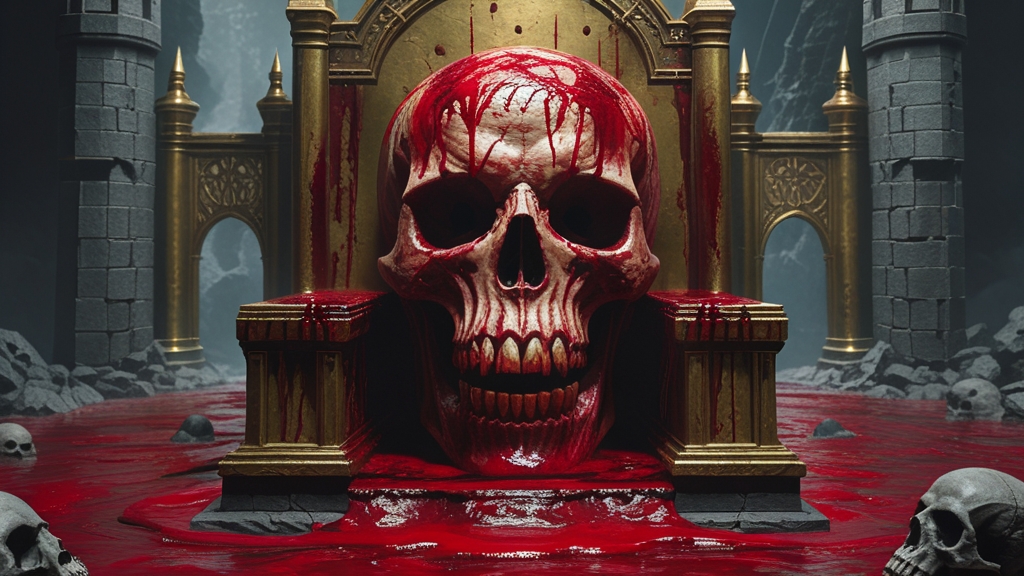
Khorne is the Chaos God of war, rage, and bloodshed. He cares not from whence the blood flows, only that it flows. His domain is martial honour, violence, and hatred — and he is the mightiest of the four Chaos Gods.
In the vast and terrible pantheon of the Chaos Gods, Khorne occupies a position of brutal supremacy. He is the Blood God, the Lord of Skulls, the embodiment of every act of violence ever committed across every world and every age. Where other Chaos Gods scheme, seduce, or corrupt through subtle means, Khorne is direct. His demands are simple: kill. Fight. Bleed. Offer every skull to his throne and every drop of blood to his realm. There is no deception in Khorne’s service — only the honest, primal truth of combat.
Khorne is fed by every act of killing, whether performed in his name or not. Every war, every murder, every battlefield death across the galaxy and the Mortal Realms strengthens him. This makes Khorne arguably the most powerful of the Chaos Gods, for violence is the one constant in both the Warhammer 40,000 and Age of Sigmar universes. As long as blood is shed, Khorne endures.
What Is Khorne’s Domain and Personality?
Khorne embodies rage, hatred, martial pride, and the desire for dominance through strength. He is the Chaos God most associated with war itself — not as a strategic exercise, but as a visceral, personal experience. Every swing of a blade, every crunch of bone, every scream of a dying enemy feeds his insatiable hunger.
Despite being a god of slaughter, Khorne possesses a twisted sense of honour. He despises sorcery and psychic trickery, viewing them as the weapons of cowards. He values martial skill and physical prowess above all else. A warrior who faces overwhelming odds and fights to the death earns Khorne’s respect far more than one who massacres the helpless — though Khorne will accept their skulls all the same.
Khorne’s personality is one of eternal, volcanic fury. He does not speak in measured tones or weave careful plans. He roars. He rages. He sits upon his Skull Throne atop a mountain of bones and demands more. His anger is not the cold, calculated variety — it is the white-hot fury of a berserker in the grip of bloodlust, magnified to cosmic proportions.
The key paradox of Khorne is that he draws power from all violence, not merely violence committed in his name. A soldier defending their family feeds Khorne just as surely as a crazed cultist sacrificing innocents. This makes Khorne uniquely inescapable among the Chaos Gods — to fight against him is still to serve him.
Khorne at a Glance: The Blood God
Khorne is the Chaos God of war, rage and bloodshed in Warhammer 40,000 and Age of Sigmar, often called the mightiest of the four Chaos Gods. He is fed by every act of killing, whoever commits it, which is why his followers cry “Blood for the Blood God! Skulls for the Skull Throne!” His symbol is the skull rune, a stylised skull shaped like the letter K.
| Field | Detail |
|---|---|
| Titles | The Blood God, the Lord of Skulls |
| Domain | War, rage, hatred, martial honour and bloodshed |
| Symbol | The skull rune |
| Colours | Red (blood) and brass (the metal of warfare) |
| Sacred number | Eight |
| Realm | The Brass Citadel and Skull Throne, surrounded by the Blood Plains |
| Daemons | Bloodthirsters (Greater Daemons), Bloodletters, Flesh Hounds, Bloodcrushers, Skull Cannons |
| Mortal armies | World Eaters (40k), Blades of Khorne (Age of Sigmar) |
| Notable servants | Angron, Skarbrand, Ka’Bandha, Valkia the Bloody, Korghos Khul |
| Greatest rival | Slaanesh; he also hates psykers and sorcery |
On the tabletop, Khorne armies are aggressive, melee-focused forces that win by reaching combat fast.
Blood for the Blood God, Skulls for the Skull Throne
No battle cry in Warhammer is more iconic than “Blood for the Blood God! Skulls for the Skull Throne!” This war cry encapsulates everything Khorne represents and has become one of the most recognisable phrases in all of Warhammer culture.
The phrase is not merely a rallying cry — it is a literal offering. Followers of Khorne collect the skulls of those they slay and dedicate them to Khorne’s throne. The blood they spill is considered a sacrament, flowing through the immaterium to swell the rivers of gore that course through Khorne’s realm. Every kill is an act of worship, every death a prayer.
The Skull Throne itself is one of the most terrifying artefacts in Warhammer lore. It sits at the heart of the Brass Citadel, a fortress of impossible scale forged from blood-red metal and bone. The throne is built from the skulls of the greatest warriors ever slain — mortal champions, Space Marine heroes, rival daemons, and even other gods’ servants. It grows constantly, an ever-expanding monument to carnage that towers over the battlefield of eternity.
Warriors who prove themselves particularly worthy may have their skulls placed at the very apex of the throne — a dubious honour that represents the highest recognition Khorne can bestow upon a mortal.
What Are Khorne’s Daemons?
Khorne’s daemonic legions are the most martially devastating of any Chaos God’s forces. They are pure violence given form, each one a manifestation of rage and bloodshed that exists only to kill.
Bloodthirsters are the Greater Daemons of Khorne and among the most terrifying beings in either the 40k or Age of Sigmar settings. These colossal winged monstrosities stand as tall as buildings, wielding massive axes and whips of living fire. A single Bloodthirster can lay waste to entire armies, and their arrival on a battlefield typically signals the beginning of a massacre. They are Khorne’s generals, his champions, and his instruments of absolute destruction. The most powerful Bloodthirsters have names that echo across millennia — Skarbrand the Exiled, An’ggrath the Unbound, and Ka’Bandha, the ancient enemy of the Blood Angels.
Bloodletters are the foot soldiers of Khorne’s legions. These lean, crimson-skinned daemons carry Hellblades — swords forged in the fury of Khorne’s own rage that can cut through nearly any armour. Bloodletters fight with mechanical precision, forming disciplined ranks that march relentlessly toward the enemy. Unlike many daemons, they do not toy with their prey. They kill efficiently and move on to the next target, each skull claimed adding to their tally.
Flesh Hounds are Khorne’s hunters — daemonic beasts that track their quarry across dimensions. They are especially dangerous to psykers and sorcerers, as they carry a collar of Khorne that renders them highly resistant to psychic powers. Flesh Hounds are relentless trackers, and once set upon a target’s scent, they will pursue it across worlds and through the Warp itself until the prey is caught and torn apart.
Bloodcrushers combine Bloodletters with Juggernauts of Khorne — massive brass-and-blood daemonic steeds that crash through enemy lines like living battering rams. A charge of Bloodcrushers is one of the most devastating cavalry attacks in the Warhammer universe, combining the killing power of the Bloodletter rider with the crushing mass of the Juggernaut.
Skull Cannons are daemonic war engines that collect the skulls of the fallen and fire them back at the enemy in blazing fusillades. They represent one of the few ranged weapons associated with Khorne, who generally favours close combat above all else.
Who Are Khorne’s Mortal Followers?
Khorne’s mortal followers span both the Warhammer 40,000 and Age of Sigmar settings, united by their devotion to martial violence and their hunger for blood and skulls.
In Warhammer 40,000, the World Eaters are the most prominent mortal servants of Khorne. Originally the XII Legion of Space Marines led by the Primarch Angron, the World Eaters fell to Khorne’s worship during the Horus Heresy. Angron himself was transformed into a Daemon Prince of Khorne — a Bloodthirster-like entity of pure rage. The World Eaters are infamous for their use of the Butcher’s Nails, cortical implants that amplify aggression to psychotic levels. They fight in a perpetual state of berserk fury, caring nothing for tactics or self-preservation, only for the next kill.
Beyond the World Eaters, countless Khornate warbands roam the galaxy. Khorne Berzerkers can be found in many Chaos Space Marine forces, their red-and-brass armour marking them as devoted servants of the Blood God. Mortal cultists of Khorne exist on thousands of worlds, often forming blood cults that practise ritual combat and human sacrifice.
In Age of Sigmar, the Blades of Khorne represent the Blood God’s mortal armies in the Mortal Realms. These forces include Bloodbound warriors — mortal champions who have earned Khorne’s favour through countless acts of slaughter — and the daemonic legions that fight alongside them. The Blades of Khorne were among the dominant forces during the Age of Chaos, when Khorne’s armies carved bloody paths across every Mortal Realm.
Notable mortal champions of Khorne include Valkia the Bloody, a warrior queen who was elevated to daemonhood after offering her own death to Khorne, and Korghos Khul, a Mighty Lord of Khorne whose rampage across the Mortal Realms has left entire civilisations in ruin.
What Is the Brass Citadel and Khorne’s Realm?
Khorne’s domain in the Realm of Chaos — sometimes called the Blood God’s Domain or the Kingdom of Rage — is a nightmarish landscape of eternal warfare. It is not a place of subtle corruption or creeping horror. It is war itself, rendered as a physical realm.
At the centre sits the Brass Citadel, a fortress of incomprehensible scale. Its walls are forged from a metal that bleeds, its towers are topped with forests of impaled warriors, and its gates are guarded by the mightiest Bloodthirsters in existence. The Citadel contains Khorne’s Skull Throne, from which the Blood God surveys his domain and judges the worthiness of those who fight in his name.
Surrounding the Citadel are the Blood Plains — endless battlefields where daemonic armies clash in perpetual combat. Rivers of blood wind between mountains of skulls, and the ground itself is made of compressed bone and ash. The battles here never end; slain daemons simply reform and rejoin the fighting, ensuring that the violence continues for eternity.
Beyond the Blood Plains lie the Bone Forests, where skeletal trees grow from the remains of fallen warriors, and the Lake of Blood, a vast ocean of gore where sea-daemons battle endlessly beneath the crimson waves. The entire realm pulses with Khorne’s rage, and any being that enters it — mortal or daemon — feels an overwhelming compulsion to fight and kill.
What Is Khorne’s Sacred Number and Symbolism?
Khorne’s sacred number is eight. This number appears throughout his worship and imagery. His daemonic legions are typically organised in groups of eight or multiples thereof — eight Bloodletters form a core unit, eight Bloodthirsters comprise his greatest hosts, and the rituals used to summon his daemons often require eight sacrifices or eight points of a ritual circle.
The number eight’s significance is debated even within Warhammer lore. Some scholars suggest it represents the eight points of the Chaos Star, while others point to the infinite loop of the figure eight as representing the eternal cycle of violence and death.
Khorne’s primary symbol is the skull rune — a stylised skull that also resembles the letter “K.” This symbol is branded, carved, or painted on everything associated with Khorne, from daemon flesh to mortal armour to the very walls of his fortresses. His colours are red and brass — red for blood, brass for the metal of warfare. His followers wear these colours proudly, often dipping their armour in the blood of their victims to maintain the crimson hue.
Why Does Khorne Hate Slaanesh?
Of all the rivalries between the Chaos Gods, the enmity between Khorne and Slaanesh is the most intense and fundamental. Khorne despises Slaanesh with a fury that transcends even his usual state of rage, and the feeling is mutual — though Slaanesh expresses it through cruel mockery rather than open warfare.
The core of this rivalry lies in their fundamentally opposed philosophies. Khorne values martial strength, directness, and the honest brutality of combat. Slaanesh represents excess, sensation, indulgence, and the pursuit of pleasure in all its forms. To Khorne, Slaanesh’s followers are decadent weaklings who pursue sensation rather than strength. They fight not for the glory of combat but for the thrill it provides — a distinction that Khorne finds utterly contemptible.
Slaanesh, for their part, views Khorne as a crude, unsophisticated brute — all power and no finesse, all rage and no artistry. Where Khorne sees honest combat, Slaanesh sees a lack of imagination. Where Khorne sees weakness in pleasure-seeking, Slaanesh sees cowardice in Khorne’s refusal to explore sensation beyond pain and death.
This rivalry plays out across both settings. In the Warp, Khorne’s and Slaanesh’s daemonic legions clash constantly along their shared borders. On the mortal plane, followers of the two gods are natural enemies, and mixed Chaos warbands containing devotees of both powers are virtually unheard of.
How Does Khorne Play on the Tabletop?
On the tabletop, Khorne’s forces reflect his lore perfectly — they are aggressive, melee-focused armies that want to close with the enemy as quickly as possible and destroy them in close combat.
In Warhammer 40,000, the World Eaters are the primary Khorne army. They feature powerful melee units like Khorne Berzerkers, who can fight with incredible fury in the combat phase, and characters like Angron himself, who is one of the most devastating melee combatants in the entire game. The army has very limited shooting but compensates with extreme close-combat power and abilities that let them charge more effectively. World Eaters reward aggressive play — sitting back and shooting is not an option, so players must master the art of the charge.
In Age of Sigmar, the Blades of Khorne operate on a unique Blood Tithe mechanic. Every unit destroyed — friendly or enemy — generates Blood Tithe points, which can be spent on powerful abilities ranging from summoning daemons to granting army-wide buffs. This creates interesting tactical decisions: sometimes it is worth sacrificing your own units to generate enough Blood Tithe to unleash devastating effects. The army combines mortal Bloodbound warriors with daemonic units, allowing for varied list-building around either mortal or daemon themes.
Both armies share a common play philosophy: get into combat, hit hard, and overwhelm the opponent through sheer martial violence. They tend to struggle against highly mobile shooting armies that can kite them, but when they reach combat, few forces in either game can match their destructive output.
Frequently Asked Questions
Is Khorne the strongest Chaos God?
Khorne is often considered the mightiest of the four Chaos Gods in terms of raw power, as he is fuelled by all violence across the universe. However, the balance of power between the Chaos Gods constantly shifts. Nurgle’s plagues, Tzeentch’s schemes, and Slaanesh’s seduction all challenge Khorne’s dominance. In terms of pure martial strength, Khorne is supreme, but the Great Game is fought on many fronts, and brute force alone cannot win it.
Does Khorne care who spills the blood?
No. Khorne’s most famous tenet is “Khorne cares not from whence the blood flows, only that it flows.” This means that even those fighting against Khorne’s forces are inadvertently feeding his power. Every act of violence, regardless of intent or allegiance, strengthens the Blood God. This makes Khorne uniquely difficult to oppose — the very act of fighting his followers serves him.
Why does Khorne hate psykers?
Khorne views psychic powers and sorcery as dishonest, cowardly forms of warfare. He believes that true strength comes from physical prowess and martial skill, not from manipulating the Warp through mental trickery. This is why his followers rarely include psykers, and why his daemons — particularly Flesh Hounds — are often equipped with anti-psychic abilities. His rivalry with Tzeentch, the god of sorcery, further reinforces this hatred.
Can Khorne’s followers use ranged weapons?
While Khorne strongly prefers close combat, his followers are not strictly forbidden from using ranged weapons. However, most devoted Khornate warriors view ranged combat as inferior to melee and will close to hand-to-hand range at every opportunity. Some units like Skull Cannons provide ranged support, but these are exceptions rather than the rule. The most favoured warriors of Khorne are always those who kill with blade, axe, and fist.
What is Khorne’s relationship with the other Chaos Gods?
Khorne despises all the other Chaos Gods to varying degrees. His greatest hatred is reserved for Slaanesh, whose pursuit of pleasure he views as weak and contemptible. He also hates Tzeentch for relying on sorcery instead of honest combat. His relationship with Nurgle is the least hostile of the three, as both gods appreciate a certain directness in their approach — but they are still rivals in the Great Game, the eternal contest for supremacy among the Chaos Gods.
Which Space Marine Legion follows Khorne?
The World Eaters, the former XII Legion led by Angron, are the Traitor Legion wholly devoted to Khorne. Khorne Berzerkers and other Khornate warbands also appear in other Chaos Space Marine forces, but Legions such as the Night Lords do not worship him; they fight for terror and vengeance rather than for any Chaos God.
Are the Blood Angels connected to Khorne?
No. The Blood Angels are a loyal Chapter, and despite their Red Thirst they do not serve the Blood God. Their link to Khorne is enmity: the Bloodthirster Ka’Bandha fought their Primarch Sanguinius during the Horus Heresy and has hunted the Blood Angels ever since, making Khorne’s daemons some of their most hated foes.
What does Khorne look like?
Khorne is usually depicted as a colossal armoured warrior with a snarling, bestial face, seated on his Skull Throne atop a mountain of skulls in the Brass Citadel. As a god, his true form is beyond mortal understanding, so these images show how his followers and daemons perceive him rather than a literal body.