
Is the Emperor of Mankind Alive or Dead?
The Emperor of Mankind is neither fully alive nor fully dead. For over ten thousand years, he has been sustained on the Golden Throne in a state between life and death — his physical body a withered husk, but his psychic presence more powerful than ever. This paradox sits at the heart of Warhammer 40k’s central mystery and defines the entire setting.
Understanding the Emperor’s current condition requires examining both his biological and psychic status, the mechanisms keeping him in this state, and the catastrophic implications of any change. It is a question that has fascinated fans for decades and one that Games Workshop has deliberately left unresolved.
What Is the Emperor’s Physical Condition?
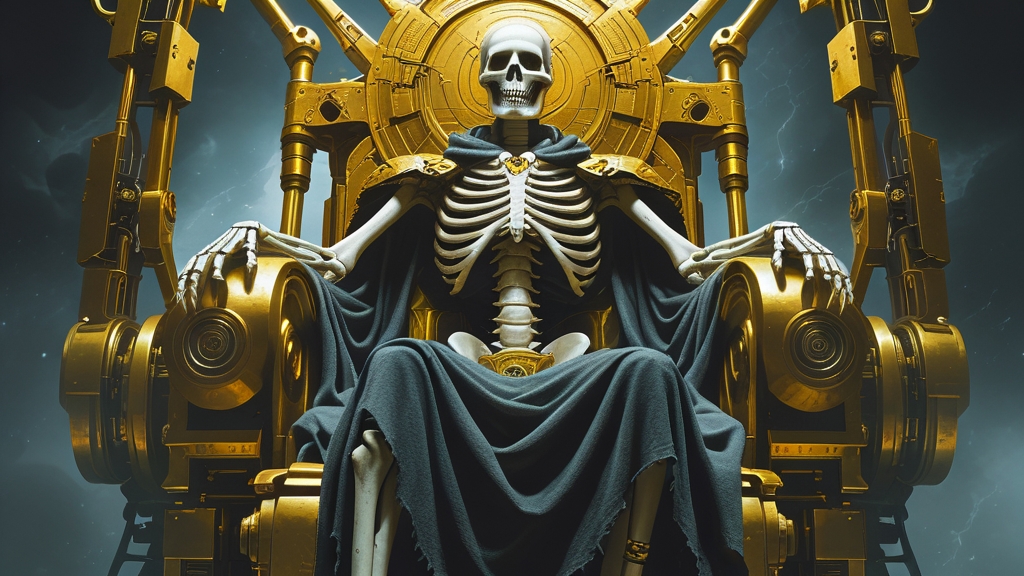
The Emperor’s physical body is, by any conventional medical standard, a corpse. After his climactic battle with the Chaos-corrupted Warmaster Horus at the end of the Horus Heresy approximately ten thousand years before the current setting, the Emperor was mortally wounded. His body was recovered by Rogal Dorn, Primarch of the Imperial Fists, and interred upon the Golden Throne — a vast psychic amplification device originally designed for an entirely different purpose.
Over the millennia, the Emperor’s physical form has deteriorated to little more than a skeleton held together by the arcane machinery of the Throne. He cannot speak, move, or interact with the physical world in any conventional sense. Around a thousand psykers are sacrificed daily to sustain the Throne’s function, their life force consumed to maintain the barrier between realspace and the Warp that the Emperor’s presence reinforces.
The Adeptus Custodes, the Emperor’s personal bodyguard, maintain a constant vigil over his remains. The Adeptus Mechanicus tends to the Golden Throne’s failing mechanisms — a terrifying reality, as the Throne is slowly breaking down and no one fully understands the technology well enough to repair it properly. Some sources suggest the Throne has been in a state of gradual deterioration for centuries, and the tech-priests can only slow, not stop, this decay.
Is the Emperor Still Psychically Active?
While the Emperor’s body is essentially dead, his psychic presence remains staggeringly powerful — arguably more powerful than it was when he walked among humanity. The Emperor’s mind continues to function on a level that defies mortal comprehension. He maintains the Astronomican, the psychic beacon that allows Imperial ships to navigate the Warp and without which interstellar travel would become virtually impossible. He holds shut the gateway to the Warp beneath the Imperial Palace on Terra, preventing a daemonic incursion that would consume Earth itself. And according to some sources, he actively fights the Chaos Gods within the Warp, engaging in an endless psychic battle on a plane of existence humans cannot perceive.
The Emperor’s psychic activity manifests in several observable ways. He occasionally communicates through the Emperor’s Tarot, a divination tool used by Imperial agents. He has been known to send visions and dreams to certain individuals, though these communications are fragmented and often difficult to interpret. The Living Saints — miraculous warriors like Saint Celestine who return from death wreathed in golden light — are believed to be direct manifestations of the Emperor’s will, though whether this represents conscious action or an automatic psychic response remains debated.
In more recent lore, particularly following the events of the Gathering Storm and the return of Roboute Guilliman, the Emperor’s psychic activity appears to have increased. Guilliman himself spoke with the Emperor upon his return to Terra, though the Primarch was deeply disturbed by the experience, reportedly perceiving the Emperor as cold, calculating, and viewing humanity primarily as a tool rather than something to be cherished.
What Is the Golden Throne and How Does It Work?
The Golden Throne is one of the most important and least understood devices in the Imperium. Originally, it was not designed as a life-support system at all. The Emperor created it — or possibly discovered and modified it — as a key component of the Imperial Webway Project, his grand plan to create a human-controlled network of Warp tunnels that would have allowed instantaneous travel across the galaxy without exposure to the dangers of the Warp.
When Magnus the Red, Primarch of the Thousand Sons, inadvertently breached the Webway’s protections with his psychic warning about Horus’s betrayal, the Emperor was forced to abandon the project and use the Throne to hold shut the breach. After the Heresy, the mortally wounded Emperor was placed upon the Throne permanently, and it was modified to serve as both a life-support system and a psychic amplifier.
The Throne requires a constant supply of psychic energy to function. Each day, approximately one thousand psykers are brought before it and sacrificed, their souls consumed to power the device. This process has continued for ten millennia, representing an almost incomprehensible toll of human life — billions of psykers over the millennia, all fed to the Throne to keep the Emperor’s shattered body functioning and the Warp breach sealed.
The most terrifying aspect of the Golden Throne is that it is failing. The Adeptus Mechanicus has reported increasing difficulty maintaining its systems, and certain components are beyond their ability to replicate or repair. The question of what happens when the Throne finally fails is one of the most consequential unanswered questions in the entire setting.
What Is the Astronomican and Why Does It Matter?
The Astronomican is a psychic lighthouse of immense power, projected by the Emperor’s mind and amplified by the choir of ten thousand psykers known as the Adeptus Astronomica. It serves as the primary navigation aid for Imperial starships travelling through the Warp, providing a fixed reference point that Navigators — mutant humans with a third eye capable of perceiving the Warp — use to chart their courses.
Without the Astronomican, Warp travel would become extraordinarily dangerous and limited. Ships would be unable to make long-distance jumps with any reliability, effectively shattering the Imperium into isolated fragments. Short-range Warp jumps would still be possible, but the galaxy-spanning civilisation that is the Imperium of Man would cease to function as a coherent entity.
The Astronomican has a range of approximately fifty thousand light-years, covering most but not all of the galaxy. Regions beyond its reach, such as the Eastern Fringe and areas on the far side of the galactic core, are notoriously difficult to navigate and often poorly connected to the wider Imperium. The creation of the Great Rift — a galaxy-spanning Warp storm that tore reality in half following the Fall of Cadia — has further complicated the Astronomican’s reach, leaving the half of the Imperium on the far side of the Rift (known as Imperium Nihilus or the Dark Imperium) largely cut off from its light.
What Happens If the Emperor Actually Dies?
This is perhaps the most debated question in Warhammer 40k lore, and multiple catastrophic outcomes have been suggested across various sources. The most commonly cited consequences include the immediate collapse of the Astronomican, which would strand or destroy countless ships in the Warp. The breach beneath the Imperial Palace would tear open, allowing a daemonic incursion directly onto Terra that would potentially consume the planet. The Imperium would fragment as interstellar communication and travel became unreliable or impossible.
Some sources suggest even more dramatic outcomes. One theory holds that the Emperor’s death would trigger a psychic shockwave that would devastate every psyker in the galaxy simultaneously. Another suggests that the Warp breach on Terra would expand into a second Eye of Terror — a permanent tear in reality connecting the material universe to the Realm of Chaos. The most extreme theory proposes that the Emperor’s death would actually allow him to be reborn as a fully realised god of the Warp, a being of such power that he could challenge the Chaos Gods directly.
The Chaos Gods themselves appear to have a complex relationship with this possibility. On one hand, the Emperor’s death would remove their greatest psychic opponent. On the other, the Emperor’s potential apotheosis into a true god of Order might represent an even greater threat to their dominion. This paradox may explain why the forces of Chaos seem simultaneously driven to destroy the Emperor and reluctant to actually succeed.
What Is the Star Child Theory?
The Star Child theory is one of the oldest and most enduring pieces of Warhammer 40k lore, dating back to early editions of the game. It proposes that the Emperor’s soul, or a significant fragment of it, exists independently in the Warp as a nascent entity known as the Star Child. According to this theory, the Emperor deliberately allowed his physical body to be destroyed, knowing that his psychic essence would be released into the Warp where it could gestate and eventually be reborn as a being of immense power.
In earlier editions, there was an entire faction — the Illuminati — dedicated to this theory. These were individuals who had been possessed by daemons and subsequently freed, gaining a unique resistance to Chaos corruption. They believed they could facilitate the Emperor’s rebirth by gathering together the Sensei, immortal descendants of the Emperor who possessed a unique blank presence in the Warp.
While the Star Child theory has been somewhat de-emphasised in more recent lore, it has never been explicitly contradicted. Elements of it continue to surface, particularly the notion that the Emperor’s death might not be an ending but a transformation. The concept resonates with the Emperor’s suspected nature as a Perpetual — a being capable of returning from death.
Was the Emperor a Perpetual?
The Horus Heresy novel series introduced and developed the concept of Perpetuals — immortal beings who can regenerate from virtually any injury, including death itself. Several characters in the series are identified as Perpetuals, including Vulkan, Primarch of the Salamanders, and Ollanius Pius, one of the Emperor’s oldest companions.
Strong evidence suggests the Emperor himself was a Perpetual, possibly the oldest and most powerful of them all. If this is the case, it raises the tantalising possibility that the Emperor could regenerate if freed from the Golden Throne — that his current state is not a natural consequence of his injuries but rather an artificial suspension imposed by the Throne’s machinery, which keeps him in a state between life and death and prevents the natural Perpetual regeneration process from occurring.
This theory is supported by Vulkan’s own experiences. Despite being killed multiple times during the Heresy, Vulkan always returned. If the Emperor shares this ability, then the Golden Throne might actually be preventing his recovery rather than enabling it. However, disconnecting the Emperor from the Throne would also mean opening the Warp breach and losing the Astronomican — a price the Imperium cannot afford to pay, even for the possibility of their god’s return.
How Has the Emperor’s Status Changed in Recent Lore?
The return of Roboute Guilliman during the Gathering Storm narrative marked the most significant development in the Emperor’s story in decades. Guilliman, resurrected through a combination of Eldar technology and the power of the Emperor himself, travelled to Terra and was granted an audience with his father. What he experienced was profoundly disturbing.
According to Guilliman’s account, the Emperor communicated not in words but in raw concepts and emotions of staggering intensity. The Primarch perceived his father not as the benevolent ruler he remembered, but as something vast, inhuman, and terrifyingly powerful. Some interpretations suggest Guilliman realised the Emperor now viewed humanity with cold pragmatism rather than love — seeing them as tools to be used in his war against Chaos rather than children to be protected.
Other recent developments include the growing phenomenon of the Emperor manifesting his power through Living Saints and other miraculous events with increasing frequency since the opening of the Great Rift. Some within the Imperium interpret this as evidence that the Emperor is growing stronger, perhaps approaching some kind of apotheosis. Others worry that these manifestations represent the Emperor’s power becoming unstable, potentially presaging a catastrophic event.
The Psychic Awakening narrative further explored this theme, with psychic phenomena intensifying across the galaxy and more humans manifesting psychic abilities than ever before. Whether this is connected to the Emperor’s evolving state remains unclear, but it suggests that the psychic landscape of the galaxy is shifting in ways that may be connected to the figure on the Golden Throne.
What Do the Factions Believe About the Emperor?
Different factions within the Imperium hold radically different views on the Emperor’s nature and status. The Ecclesiarchy — the Imperial Church — venerates the Emperor as a living god and teaches that he watches over humanity from the Golden Throne, actively protecting his people through divine intervention. They view the Living Saints and miraculous events as proof of his divinity and conscious benevolence.
The Adeptus Mechanicus has a different perspective entirely. They worship the Emperor as the Omnissiah, the physical manifestation of the Machine God. To them, his current state on the Golden Throne represents a form of sacred communion with the machine, and his eventual merger with the Throne’s technology is seen as a divine process rather than a tragedy.
The Adeptus Custodes, who stand closest to the Emperor and know more of the truth than perhaps any other faction, are characteristically silent on the matter. They guard the Emperor with absolute devotion but rarely share their observations about his condition with outsiders. What they know — or suspect — about the Emperor’s true state remains one of the Imperium’s most closely guarded secrets.
Among the forces of Chaos, the Emperor is viewed as a corpse-god whose power is fading. The Traitor Legions mock the Imperium for worshipping a dead man, though their very obsession with destroying the Imperium suggests they know the Emperor is more than a simple corpse. The Chaos Gods themselves treat the Emperor as a genuine threat, which speaks volumes about his continued power.
The Bottom Line: Alive, Dead, or Something Else Entirely?
The most accurate answer to the question of whether the Emperor is alive or dead is that he has transcended those categories entirely. His physical body is dead by any biological standard. His mind remains active on a level that dwarfs any other psychic entity in the galaxy. His will continues to shape the fate of trillions. And his power appears to be growing rather than diminishing.
Whether the Emperor is a god sustained by faith, a Perpetual trapped by the very device meant to save him, a psychic entity evolving beyond mortal comprehension, or some combination of all three remains deliberately unanswered. Games Workshop has maintained this ambiguity as one of the core mysteries of the setting, and it is unlikely to be definitively resolved — because the uncertainty itself is essential to what makes Warhammer 40k compelling.
What we can say with certainty is this: the Emperor endures. In whatever state, through whatever means, the figure on the Golden Throne continues to hold back the darkness. Whether that constitutes life is a question that may have no answer — at least not one that mortals can understand.
Frequently Asked Questions
Is the Emperor conscious in 40k?
Not in any normal sense, but his mind is still active. He cannot move or speak, yet he powers the Astronomican, holds shut the Warp breach beneath the Imperial Palace and occasionally reaches individuals through visions, the Emperor’s Tarot and Living Saints. Guilliman’s audience with him after the Gathering Storm suggests some awareness remains, but Games Workshop deliberately leaves how much unclear.
How long has the Emperor been on the Golden Throne?
Just over ten thousand years. The Emperor was interred on the Golden Throne at the end of the Horus Heresy, after his duel with Horus aboard the Vengeful Spirit, and has remained there ever since. For the entire span of the Imperium’s history after the Heresy, he has been a silent, withered figure sustained by the Throne and daily psyker sacrifices.
Where do the psykers sacrificed to the Golden Throne come from?
They are gathered from across the Imperium by the Black Ships of the Adeptus Astra Telepathica, which collect psykers as a form of tithe. The strongest and most stable may be trained as Astropaths, sanctioned psykers or members of the Astronomican choir, while many of the rest are fed to the Golden Throne to sustain the Emperor.
Can the Emperor be healed or taken off the Golden Throne?
Not without catastrophe. Removing him would end the Throne’s protection over the Warp breach beneath Terra and risk the collapse of the Astronomican. The Perpetual theory suggests he might regenerate if freed, but no faction is willing to gamble the Imperium on it, and the Throne’s failing machinery makes any intervention even more dangerous.
Related Content
- What Is the Golden Throne Made Of? — Learn about the device sustaining the Emperor
- Will the Emperor of Mankind Ever Wake Up? — Explore theories about the Emperor’s return
- Why Didn’t the Emperor Kill Horus Immediately? — Discover the battle that nearly killed the Emperor
- What Is the Astronomican? — Understand the Emperor’s psychic beacon