
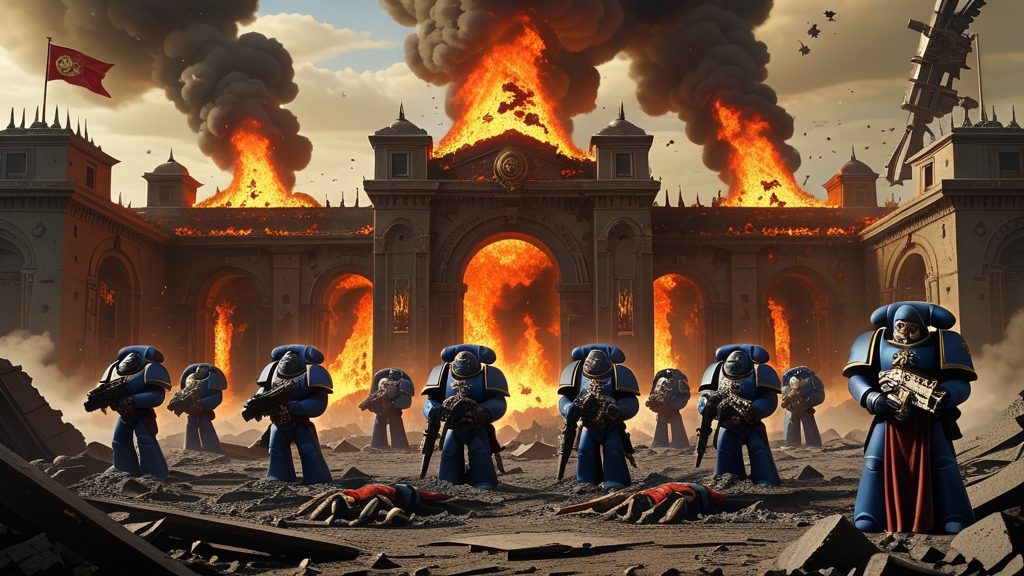
Monarchia was the perfect city — a sprawling metropolis on the world of Khur that the Word Bearers Space Marine Legion built as the ultimate expression of their devotion to the Emperor of Mankind. Every building was a temple, every wall bore scripture, every citizen a devoted worshipper. It was, in the Word Bearers’ estimation, the finest achievement of the Great Crusade: a world not merely conquered but spiritually transformed. The Emperor destroyed it. He ordered the Ultramarines to raze Monarchia to the ground, then forced the entire Word Bearers Legion — all hundred thousand of them — to kneel in the ashes of their masterpiece while He told them that everything they believed was wrong. This act of humiliation directly led Lorgar Aurelian, Primarch of the Word Bearers, to seek new gods worthy of his worship. He found them in the Chaos Gods of the Warp.
The Destruction of Monarchia is one of the most pivotal events in the entire Warhammer 40,000 timeline. It is the moment that set in motion the Word Bearers’ fall to Chaos, which in turn enabled the corruption of Horus, which in turn caused the Horus Heresy, which in turn created the grimdark Imperium of the 41st Millennium. Every horror of the current setting — the stagnation, the fanaticism, the endless war — can be traced back, through a chain of cause and effect, to the day the Emperor destroyed a city built in His name.
Why Did the Word Bearers Build Monarchia?
To understand Monarchia, you must first understand the Word Bearers. The Word Bearers were unique among the Space Marine Legions in that they were defined not by their combat specialty but by their faith. While other legions excelled at siege warfare (Imperial Fists), rapid assault (White Scars), or armoured warfare (Iron Hands), the Word Bearers’ defining characteristic was their religious devotion to the Emperor.
Lorgar Aurelian, the Word Bearers’ Primarch, was the most spiritually inclined of the Emperor’s sons. He genuinely believed that the Emperor was a god — the one true god of humanity — and that the Great Crusade was not merely a military campaign to unify the galaxy but a sacred mission to bring the Emperor’s divine light to every world. For Lorgar, conquering a planet was only the beginning. The true work was converting its population to the worship of the Emperor, building churches and temples, establishing a priesthood, and creating a genuinely devout society.
Monarchia was the culmination of this vision. On the world of Khur, the Word Bearers created their ideal: a city where every aspect of life was devoted to the Emperor. The architecture was sacred, the government was theocratic, the culture was liturgical. The people of Monarchia didn’t merely acknowledge the Emperor’s authority — they worshipped Him with a fervour that Lorgar considered the highest achievement of the Great Crusade. Monarchia was proof, in Lorgar’s mind, that his approach to the Crusade was correct — that lasting victory came not from conquest alone but from faith.
Why Did the Emperor Destroy Monarchia?
The Emperor destroyed Monarchia because He was not a god and He did not want to be worshipped. This is one of the great tragic ironies of the Warhammer 40,000 setting: the Emperor, who would eventually be worshipped by trillions across the galaxy through the Imperial Creed, explicitly and violently rejected worship during the Great Crusade. He considered Himself a man — an extraordinarily powerful man, but a man nonetheless — and He viewed religious devotion as a dangerous force that led to ignorance, superstition, and vulnerability to Chaos.
The Emperor’s vision for humanity was rational, scientific, and secular. The Great Crusade was meant to unite humanity under the banner of the Imperial Truth — the doctrine that there were no gods, no supernatural forces, and no value in worship. By building Monarchia and spreading religious devotion, Lorgar was not merely disobeying the Emperor’s wishes — he was actively undermining the philosophical foundation of the Imperium. Every temple Lorgar built was a repudiation of everything the Emperor was trying to achieve.
The Emperor’s response was severe because He felt severity was necessary. The Word Bearers had been building religious civilisations for decades, and gentle corrections had failed. Lorgar had been warned. Malcador the Sigillite had expressed concerns. Other Primarchs had noted the Word Bearers’ slow pace of conquest (they spent years on each world, building religious infrastructure rather than moving on to the next campaign). The Emperor decided that only a dramatic, unmistakable demonstration would break Lorgar of his religious obsession.
He sent Roboute Guilliman and the Ultramarines to Khur. The Ultramarines destroyed Monarchia — not in battle, but methodically and completely, demolishing every building, tearing down every monument, and reducing the perfect city to rubble and ash. The citizens were evacuated (the Emperor’s anger was directed at the city, not its people), and when nothing remained but ruins, the Emperor arrived in person.
What Happened When the Word Bearers Knelt?
The scene of the Word Bearers kneeling in the ashes of Monarchia is one of the most powerful and emotionally complex moments in the Horus Heresy novels. One hundred thousand Space Marines — the entire Word Bearers Legion — were forced to their knees in the ruins of their greatest achievement while the Emperor stood before them and told them they had failed.
The Emperor’s words were devastating. He told Lorgar that his worship was wrong. That there were no gods. That the Word Bearers’ religious devotion was not merely misguided but dangerous. That their approach to the Great Crusade had wasted time, resources, and the potential of every world they had touched. He compared the Word Bearers unfavourably to other legions — particularly Guilliman’s Ultramarines, who had conquered hundreds of worlds in the time the Word Bearers had been building temples on a handful.
For Lorgar, the humiliation was absolute. He had built Monarchia as an offering to his father-god, and his father-god had not merely rejected it — He had destroyed it and forced Lorgar to kneel in the destruction. Everything Lorgar believed, everything he had worked for, everything that gave his existence meaning was declared wrong by the one being whose opinion mattered most to him.
The psychological impact on the legion was profound. The Word Bearers were not merely embarrassed — they were broken. Their entire identity was built on devotion to the Emperor, and the Emperor had told them their devotion was worthless. Some Word Bearers responded with shame and redoubled their efforts to please the Emperor through conventional military achievement. Others responded with quiet rage, feeling betrayed by the very being they had dedicated their lives to serving. And some — guided by Erebus and Kor Phaeron — began to wonder whether there might be other gods out there, gods who would actually welcome their worship.
How Did Lorgar Respond?
Lorgar’s response to Monarchia unfolded in stages, each bringing him closer to the Chaos Gods.
The immediate response was despair. Lorgar withdrew from his legion and his brothers, consumed by an existential crisis. If the Emperor was not a god, then what was the purpose of the Great Crusade? If worship was wrong, then what was Lorgar’s role? He had been created to be a prophet, a spiritual leader, a bringer of faith — and the being who created him had told him that faith was worthless. Lorgar’s identity collapsed.
The second stage was questioning. Guided by Erebus and Kor Phaeron, Lorgar began to ask dangerous questions. If the Emperor was not a god, were there real gods somewhere? The Emperor had said there were no supernatural forces — but Lorgar could feel the Warp, could sense presences within it, could detect intelligences that defied the Emperor’s secular explanations. If the Emperor was lying about the gods, what else was He lying about?
The third stage was the Pilgrimage. Lorgar embarked on a journey into the Eye of Terror — the great Warp rift in the Segmentum Obscurus — to find the truth for himself. What he found there shattered the last of his loyalty to the Emperor. The Chaos Gods were real. They were powerful. And unlike the Emperor, they welcomed worship. They did not merely tolerate devotion — they demanded it, rewarded it, and responded to it with genuine power. For Lorgar, this was the answer to his existential crisis: the gods he had always sought existed after all. They simply were not who he had originally believed them to be.
The final stage was conversion. Lorgar returned from his Pilgrimage a changed being — a devoted servant of the Chaos Gods who now dedicated his considerable abilities to spreading their worship with the same zeal he had once dedicated to the Emperor. The Word Bearers followed their Primarch into damnation, becoming the first Space Marine Legion to worship the Ruinous Powers and the architects of the corruption that would eventually bring half the legions to Chaos.
Was the Emperor Wrong to Destroy Monarchia?
This is one of the most debated questions in Warhammer 40,000 lore, and the answer depends entirely on one’s perspective.
The case that the Emperor was right: Religious devotion is a vector for Chaos corruption. The Chaos Gods feed on worship, and a galaxy-spanning religion centred on the Emperor would have attracted their attention and provided them with an enormous reservoir of psychic energy. The Emperor’s secular Imperial Truth was, from this perspective, a deliberate strategy to starve Chaos of the belief-energy it needed to grow. By building temples and spreading worship, Lorgar was — however unintentionally — playing directly into the Chaos Gods’ hands. The destruction of Monarchia was harsh but necessary.
The case that the Emperor was wrong: The Emperor’s method was catastrophic. By humiliating Lorgar so thoroughly, the Emperor pushed his most devout son directly into the arms of the Chaos Gods. A gentler approach — a private conversation, a gradual redirection, an acknowledgement of Lorgar’s genuine spiritual needs — might have preserved Lorgar’s loyalty while steering him away from religious extremism. Instead, the Emperor chose the most psychologically devastating option and created the very outcome he was trying to prevent. The destruction of Monarchia is the Emperor’s greatest failure of empathy and leadership.
The tragic truth: Both perspectives contain valid elements, which is what makes the Monarchia narrative so compelling. The Emperor was right that worship was dangerous. He was wrong in how he addressed it. Lorgar was right that the Warp contained real entities worthy of awe. He was wrong to worship them. Both father and son made decisions that were rational by their own logic but catastrophic in combination. The Destruction of Monarchia is a tragedy in the classical sense — a disaster born not from malice but from the fatal flaws of well-intentioned beings.
How Does Monarchia Connect to the Horus Heresy?
The destruction of Monarchia is the first domino in the chain of events that produces the Horus Heresy. The causal sequence runs as follows:
The Emperor destroys Monarchia and humiliates the Word Bearers. Lorgar, shattered by the rejection, undertakes his Pilgrimage into the Eye of Terror and discovers the Chaos Gods. The Word Bearers become the first legion to turn to Chaos worship. Erebus and Kor Phaeron, now openly serving the Chaos Gods, implement a long-term plan to spread corruption across the other legions. Erebus engineers the corruption of Horus on Davin using the Anathame. Horus falls, rallies the traitor legions, and launches the Heresy.
Without Monarchia, there is no Word Bearers conversion. Without the Word Bearers conversion, there is no Erebus operating as a Chaos agent. Without Erebus, there is no Anathame on Davin. Without Davin, there may be no fall of Horus. The entire Heresy rests on a foundation built from the ashes of a single city.
This is what makes the Monarchia story so powerful from a narrative perspective. The Emperor destroyed one city to prevent the spread of religion. That act of destruction created the conditions for a galactic civil war that killed billions, entombed the Emperor on the Golden Throne, and — most ironically of all — led to the creation of the Imperial Creed: the galaxy-spanning religion of Emperor-worship that Lorgar had originally tried to build. In the cruelest twist of 40k’s many cruel twists, the Imperium of the 41st Millennium is exactly what Lorgar wanted Monarchia to be — a civilisation built on the worship of the Emperor. The Emperor destroyed Monarchia to prevent this future and, in doing so, guaranteed it.
Monarchia in the Novels
The Destruction of Monarchia is depicted in several Horus Heresy novels, most notably The First Heretic by Aaron Dembski-Bowden. This novel is widely considered one of the best books in the entire Horus Heresy series, and its depiction of Monarchia’s destruction and Lorgar’s subsequent fall is emotionally devastating and narratively brilliant.
Dembski-Bowden’s portrayal of Lorgar is particularly notable. Rather than presenting the Primarch as a straightforward villain or a weakling manipulated by Chaos, the novel shows Lorgar as a genuinely sympathetic figure — a being driven by a sincere need for spiritual meaning in a universe that has told him spiritual meaning does not exist. The reader understands why Lorgar falls, even while recognising the catastrophic consequences of that fall.
The kneeling scene — the Word Bearers on their knees in the ashes — is rendered with a power that has made it one of the most discussed and quoted scenes in Black Library fiction. It captures the horror, the humiliation, and the slow-burning rage that would eventually consume an entire legion and, through them, half the galaxy.
Frequently Asked Questions
Was Monarchia a real city or just a metaphor?
Monarchia was a real city in the lore — a physical metropolis on the world of Khur that was built by the Word Bearers and destroyed on the Emperor’s orders. It is not a metaphor, though it serves as a powerful symbol of the conflict between faith and reason that defines the Warhammer 40,000 setting.
Did the people of Monarchia survive?
The civilian population of Monarchia was evacuated before the city was destroyed. The Emperor’s anger was directed at the Word Bearers and their religious project, not at the innocent population of Khur. What happened to these civilians afterwards is not extensively covered in the lore.
Could Lorgar have been saved?
Possibly. If the Emperor had handled the situation differently — with more empathy and less humiliation — Lorgar might have redirected his spiritual energy in a less destructive direction. However, Lorgar’s fundamental nature (his need to worship something) meant that he was always vulnerable to Chaos, which offers exactly the divine relationship that Lorgar craved.
Why did the Emperor send Guilliman to do it?
Guilliman and the Ultramarines were chosen specifically because they represented everything the Word Bearers were not — efficient, secular, and pragmatic. Having the Ultramarines destroy Monarchia was a deliberate insult, a demonstration that the Emperor valued Guilliman’s approach over Lorgar’s. This choice deepened Lorgar’s humiliation and his resentment of Guilliman, a rivalry that persists in the current 40k timeline.
Is “The First Heretic” a good starting point for the Horus Heresy?
While it is one of the best books in the series, it works better after reading the opening trilogy (Horus Rising, False Gods, Galaxy in Flames), which establishes the setting and characters. With that context, The First Heretic is a powerful exploration of how the Heresy began — not with Horus’s fall, but with the destruction of a single perfect city.
Who were Erebus and Kor Phaeron?
Kor Phaeron was Lorgar’s mentor from his youth on Colchis and later Master of the Faith of the Word Bearers. Erebus was the Legion’s First Chaplain. Both were secretly Chaos worshippers, and after Monarchia they steered Lorgar towards the Ruinous Powers. Erebus went on to orchestrate Horus’s fall on Davin.
What is the Word Bearers’ homeworld?
The Word Bearers’ homeworld is Colchis, a theocratic desert world where Lorgar grew up as a preacher before the Emperor found him. Colchis’s religious culture shaped Lorgar’s faith in the Emperor as a god, and that belief led straight to Monarchia.
What happened to Lorgar after the Horus Heresy?
After the Heresy, Lorgar was raised to daemonhood as a Daemon Prince of Chaos Undivided and withdrew into the Eye of Terror, where he is said to spend his time in meditation and contemplation. His Word Bearers remain the most zealous of the Chaos Legions, spreading the worship of the Dark Gods.
Related Content
- What Is the Necroquake? — Nagash’s Great Ritual — related lore topic
- Best Warhammer Books to Read — Fiction Guide — top-rated Warhammer novels and books
- All Warhammer 40k Factions — The Complete Guide — overview of all Warhammer 40K factions
- What Is Stormcast Reforging? — The Cost of Immortality — related content on a similar topic