
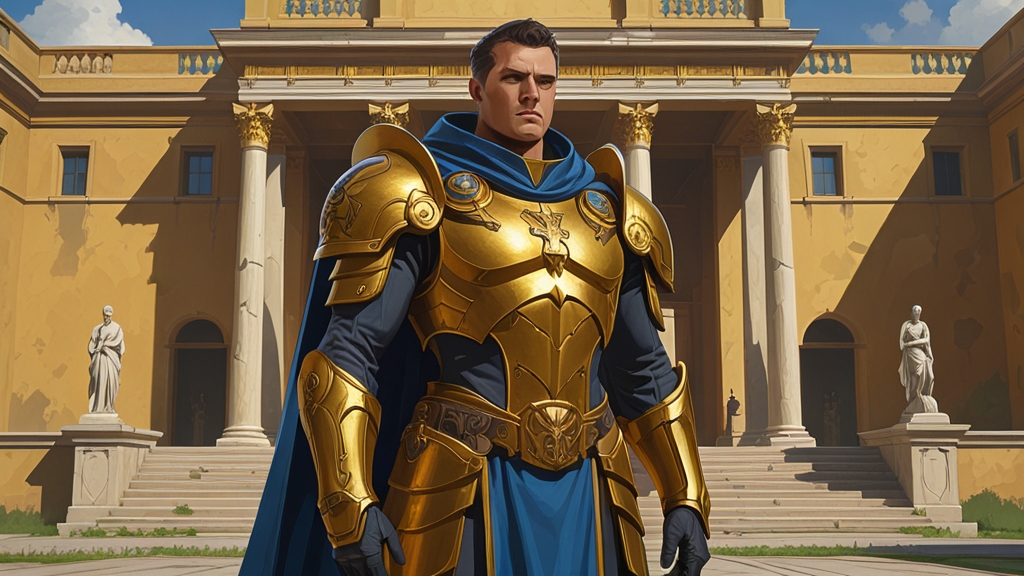
Who Is Roboute Guilliman?
Roboute Guilliman is the Primarch of the Ultramarines, one of the twenty gene-sons created by the Emperor of Mankind, and the only loyal Primarch currently active in the Warhammer 40,000 setting. He serves as the Lord Commander of the Imperium, effectively ruling humanity’s vast galactic empire in the Emperor’s name. Guilliman is renowned as both a peerless statesman and a formidable warrior, and his greatest literary contribution to the Imperium — the Codex Astartes — reshaped the entire structure of the Space Marines after the Horus Heresy.
Among the twenty Primarchs, Guilliman stands out not for raw martial prowess or psychic might, but for his extraordinary vision of governance, logistics, and civilisation. Where other Primarchs were conquerors, Guilliman was a builder. His return to the 41st Millennium after ten thousand years of near-death stasis has fundamentally altered the balance of power in the galaxy, giving the beleaguered Imperium of Man a leader it has desperately needed since the Emperor was interred upon the Golden Throne.
Origins and Early Life
Roboute Guilliman’s origins begin with the Emperor’s Primarch Project, a monumental genetic engineering endeavour undertaken in secret laboratories beneath the Himalayan mountains of Terra. The Emperor created twenty superhuman beings — the Primarchs — to serve as his generals in the Great Crusade to reunite scattered humanity across the stars. However, the Chaos Gods intervened, scattering the infant Primarchs through the Warp to distant worlds across the galaxy.
Guilliman’s gestation pod landed on Macragge, a prosperous and well-ordered world in the galactic east of the Ultima Segmentum. He was discovered by Konor Guilliman, one of two consuls who jointly ruled the planet. Konor adopted the infant Primarch and raised him as his own son, providing the young superhuman with an education in statecraft, philosophy, military strategy, and governance that would profoundly shape his character.
Even as a child, Guilliman displayed abilities far beyond any normal human. He grew at an astonishing rate, and his intellect was so vast that he mastered subjects in days that took scholars lifetimes to comprehend. By the time he reached adolescence, Guilliman was already advising his father on matters of state and military strategy. His mind was a weapon as sharp as any blade, capable of processing vast quantities of information and devising optimal solutions to complex problems.
Tragedy struck when Konor was assassinated by his co-consul, Gallan, who had allied with a cabal of corrupt nobles opposed to Konor’s reforms. The young Guilliman responded with decisive force, crushing the rebellion, executing the traitors, and assuming control of Macragge. Under his sole leadership, the world flourished as never before. He reformed Macragge’s military, overhauled its bureaucracy, expanded its agricultural output, and established trade agreements with neighbouring systems. By the time the Emperor arrived to reclaim His lost son, Guilliman had already built a small but efficient stellar empire known as the Five Hundred Worlds of Ultramar — a realm that stood as a beacon of order and prosperity in a galaxy plagued by darkness.
The Great Crusade
The Great Crusade was the Emperor’s galaxy-spanning military campaign to reunite humanity under a single banner, and Guilliman’s Ultramarines became one of its most effective instruments. Given command of the XIII Legion, Guilliman applied his genius for logistics, organisation, and combined-arms warfare to bring hundreds of worlds into compliance with Imperial rule.
Unlike some of his brothers, who favoured overwhelming force or terror tactics, Guilliman preferred a methodical approach. He studied each target world carefully, identified optimal strategies for compliance, and whenever possible sought to integrate newly conquered populations into the Imperium as productive citizens rather than subjugated peoples. His campaigns were characterised by efficiency, low casualty rates, and rapid post-conquest stabilisation — qualities that earned the Ultramarines the reputation as the most reliable and well-rounded Legion.
The XIII Legion grew to become the largest of all the Space Marine Legions, numbering an estimated 250,000 Astartes at its peak. This was no accident — Guilliman’s efficient recruitment practices, superior gene-seed management, and strategic planning allowed the Ultramarines to sustain a pace of expansion that few other Legions could match. The worlds Guilliman conquered were quickly brought up to Ultramar’s standards of governance, creating a self-reinforcing cycle of stability and recruitment.
During the Great Crusade, Guilliman also began working on what would eventually become his masterwork: the Codex Astartes. He observed the strengths and weaknesses of each Legion, studied countless battles, and began formulating theories on optimal military organisation. Though the document would not be completed until after the Heresy, its intellectual foundations were laid during this period of relentless campaigning and careful observation.
The Horus Heresy
The Horus Heresy was the galaxy-shattering civil war in which the Warmaster Horus, the Emperor’s most trusted son, turned half the Space Marine Legions against their creator. Guilliman and the Ultramarines were deliberately kept out of the early stages of the conflict by a cunning trap orchestrated by the traitors.
The Word Bearers Legion, secretly sworn to Chaos, launched a devastating surprise attack on the Ultramarines at the Battle of Calth. This assault, known as the Calth Atrocity, killed tens of thousands of Ultramarines and poisoned the star of the Calth system with a Warp rift that persists to this day. The attack was designed to pin the Ultramarines in place, preventing them from reinforcing the Emperor on Terra. In this, it partially succeeded — though Guilliman survived and eventually fought his way free, the delay cost precious time.
Unable to reach Terra in time to defend the Emperor directly, Guilliman instead formed the Imperium Secundus — a contingency government based on Macragge, intended to preserve the Imperium should Terra fall. This controversial decision saw Guilliman, Lion El’Jonson, and Sanguinius come together on Macragge, with Sanguinius reluctantly accepting the title of Emperor Secundus. When Guilliman eventually learned that Terra still stood, he dissolved Imperium Secundus and raced toward the Throneworld, but he arrived too late — the Siege of Terra was already over, the Emperor was broken, and Horus was slain.
The Heresy scarred Guilliman deeply. He had lost brothers to treachery, witnessed the near-destruction of everything the Emperor had built, and carried the burden of having been unable to reach Terra in time. These experiences would profoundly shape his post-Heresy decisions, particularly his insistence on implementing the Codex Astartes to prevent any single commander from ever again wielding the power that Horus had abused.
Death and Stasis
Guilliman’s near-death came during the aftermath of the Heresy, in the period known as the Scouring, when loyalist forces hunted down the scattered traitor Legions. During a confrontation with his traitorous brother Fulgrim, Primarch of the Emperor’s Children, Guilliman was struck by a poisoned blade. The venom was no ordinary toxin but a Chaos-tainted weapon that even a Primarch’s superhuman physiology could not overcome.
As the poison slowly killed him, Guilliman was placed in a stasis field within the Temple of Correction on Macragge. For ten thousand years, he remained frozen at the moment of death — his body preserved but his life slowly ebbing away. He became a relic, a shrine, a symbol for the Ultramarines and the Imperium at large. Pilgrims travelled from across the galaxy to gaze upon the fallen Primarch, and many Ultramarines reported that his expression seemed to change over the millennia, though whether this was wishful thinking or genuine micro-movements within the stasis field remains debated.
Resurrection and the Indomitus Crusade
Roboute Guilliman was resurrected in the closing days of the 41st Millennium through a daring alliance between the Eldar faction known as the Ynnari and the Archmagos Dominus Belisarius Cawl. The Ynnari, followers of the newly awakened Eldar god of the dead Ynnead, possessed the ability to manipulate the energies of life and death, while Cawl had spent ten millennia developing the technology needed to save the Primarch.
The resurrection was a traumatic experience for Guilliman. He awoke to find the Imperium he had helped build reduced to a crumbling, superstitious theocracy that worshipped the Emperor as a god — the very opposite of the secular, rational civilisation the Emperor had envisioned. The Astronomican was flickering, the Great Rift had torn the galaxy in two, and humanity was beset on all sides by xenos, heretics, and daemons.
Guilliman’s response was immediate and characteristically methodical. He declared the Indomitus Crusade, a massive military campaign to stabilise the Imperium and reinforce beleaguered worlds cut off by the Great Rift. He also deployed Cawl’s greatest creation: the Primaris Space Marines, a new generation of Astartes engineered with superior gene-seed and equipped with advanced wargear. The introduction of Primaris Marines was met with suspicion by many existing Chapters, but Guilliman’s authority as a Primarch silenced most objections.
The Indomitus Crusade lasted over a century and saw Guilliman personally lead forces across the galaxy, reclaiming lost worlds, establishing new supply lines, and fending off threats ranging from the resurgent forces of Chaos to the awakening Necron dynasties. By its conclusion, the Imperium had been stabilised — though hardly restored to its former strength.
Guilliman in the 41st Millennium
As the sole active loyal Primarch in the current Warhammer 40,000 setting, Guilliman occupies a unique and often lonely position. He is the Lord Commander of the Imperium, wielding political and military authority second only to the Emperor Himself, yet he is constantly frustrated by the Imperium’s bureaucratic inertia, religious fanaticism, and institutional decay.
Guilliman has a deeply conflicted relationship with the modern Imperium. He recognises that the Ecclesiarchy’s worship of the Emperor as a god — something the Emperor Himself explicitly forbade — has become so deeply embedded in Imperial culture that attempting to dismantle it would cause more harm than good. He works within the system while quietly pushing for reform, a pragmatic compromise that satisfies neither the religious zealots nor those who share his more secular vision.
His relationship with the Emperor is equally complex. Guilliman is one of the few beings who has spoken with the Emperor since His internment on the Golden Throne, and the experience left him shaken. The novels suggest that what Guilliman encountered was not the warm, paternal figure he remembered, but something vast, alien, and terrifyingly powerful — a being that may no longer be entirely human, if it ever was. This encounter has left Guilliman questioning whether his father ever truly loved his sons, or whether the Primarchs were always simply tools to be used and discarded.
Despite these doubts, Guilliman continues to serve. He manages the day-to-day governance of the Imperium, adjudicates disputes between its myriad factions, commands its military forces, and personally leads campaigns when the situation demands. He is a figure of hope for many Imperial citizens — living proof that the heroes of legend were real and that the Imperium’s greatest days need not be behind it.
The Codex Astartes
The Codex Astartes is Guilliman’s most enduring and controversial legacy — a vast military treatise that reformed the entire structure of the Space Marines after the Horus Heresy. The Codex mandated the division of the massive Space Marine Legions into smaller, independent Chapters of approximately one thousand warriors each, ensuring that no single commander could ever again wield the military might that Horus had turned against the Emperor.
The Codex Astartes is far more than a simple organisational chart. It is a comprehensive guide to warfare covering tactics, strategy, logistics, force organisation, Chapter management, recruitment, and every other aspect of Space Marine operations. It established standard company structures, defined the roles of different squads and specialists, and laid out tactical doctrines for virtually every conceivable combat scenario. For ten thousand years, it has served as the foundational text for the majority of Space Marine Chapters.
The implementation of the Codex was not without resistance. Rogal Dorn of the Imperial Fists initially refused to divide his Legion, viewing the Codex as an insult to his warriors’ loyalty. Leman Russ and Vulkan also expressed reservations. It was only after the near-disastrous Iron Cage incident, in which Dorn’s undivided Legion was lured into a trap by the Iron Warriors, that the remaining resistant Primarchs accepted the Codex’s wisdom — though the Space Wolves notably maintained many of their own traditions alongside nominal Codex compliance.
Upon his return, Guilliman has shown a more flexible attitude toward his own creation. He has acknowledged that the Codex was never meant to be treated as holy scripture but as a living document to be adapted and updated as circumstances demanded. The introduction of Primaris Marines and new organisational structures like Vanguard units represent Guilliman’s willingness to evolve the Codex to meet the challenges of a galaxy far more dangerous than the one he left behind.
Guilliman on the Tabletop
On the Warhammer 40,000 tabletop, Roboute Guilliman is one of the most powerful and expensive single models available to Space Marine players. He functions as a supreme commander for any Imperium force, providing powerful aura abilities that enhance nearby units while also being a devastating combatant in his own right.
Guilliman wields the Emperor’s Sword, a master-crafted blade of extraordinary power, and the Hand of Dominion, a massive gauntlet that also incorporates a bolter weapon. His rules typically reflect his dual nature as both a warrior and a leader — he buffs surrounding units significantly while also being capable of cutting through enemy characters and heavy infantry with ease. His resurrection ability on the tabletop, where he can return from death once per game, mirrors his lore narrative of having been brought back from the brink.
In competitive play, Guilliman has gone through various phases of power depending on the edition and current rules. He is typically fielded in Ultramarines lists but can be included in any Space Marine army. His high points cost means that including him is a significant investment that shapes the rest of the list-building process. For players interested in fielding the Lord Commander, he pairs well with large blocks of infantry who can benefit from his aura abilities, particularly Intercessors and Hellblasters. Check out our Ultramarines army guide and our broader Space Marines guide for tips on building lists around the Primarch.
Frequently Asked Questions
Is Roboute Guilliman the strongest Primarch?
Guilliman is not generally considered the strongest Primarch in terms of raw combat ability. Brothers like Sanguinius, Horus, the Lion, and Leman Russ are typically ranked higher as warriors. However, Guilliman’s true strength lies in his strategic mind, organisational genius, and political acumen. His ability to build and sustain civilisations — not just conquer them — arguably makes him the most valuable Primarch to the Imperium overall, which is precisely why he was the one the Emperor needed back.
Why is Guilliman the only Primarch who came back?
Guilliman was the first loyal Primarch to return, though Lion El’Jonson has since also returned to the setting. Guilliman’s resurrection was made possible by a unique convergence of factors: the Ynnari’s mastery of soul-energy, Belisarius Cawl’s ten-thousand-year research project, and the desperate need of the Imperium as the Great Rift tore the galaxy apart. His return was a narrative device by Games Workshop to give the Imperium a central protagonist and to advance the 40K storyline past its long-standing status quo.
What is Guilliman’s relationship with the Emperor?
Guilliman’s relationship with the Emperor is complex and troubled. Before the Heresy, Guilliman admired and loved his father, though he sometimes chafed at the Emperor’s secrecy. After his resurrection, Guilliman visited the Emperor on the Golden Throne and found the experience deeply disturbing. The Emperor appeared less as a father and more as an unfathomable, perhaps inhuman, intelligence. Guilliman now serves the Imperium out of duty and a sense of responsibility rather than filial devotion, and he harbours deep doubts about his father’s true nature and intentions.
Did Guilliman really have a relationship with an Eldar?
The novels depict a close political and personal alliance between Guilliman and Yvraine, leader of the Ynnari, who was instrumental in his resurrection. While Games Workshop has kept the exact nature of their relationship ambiguous, the implications have generated significant community discussion. Their alliance represents one of the most significant human-xenos partnerships in the setting’s history and has drawn suspicion from many Imperial factions, particularly the more puritanical elements of the Inquisition.
How does Guilliman feel about the Imperium worshipping the Emperor as a god?
Guilliman is deeply uncomfortable with the Imperial Cult. The Emperor explicitly forbade religious worship during the Great Crusade, and the Imperium’s transformation into a theocracy represents everything the Emperor fought against. However, Guilliman is pragmatic enough to recognise that dismantling the Ecclesiarchy would cause civil war and leave the Imperium even more vulnerable to its enemies. He therefore works within the existing system while quietly pushing for reform — a source of constant personal frustration.
Book review: Dark Imperium Review — our review of his return and the Plague Wars.
Book review: Avenging Son Review — our review of the Indomitus Crusade’s opening.