
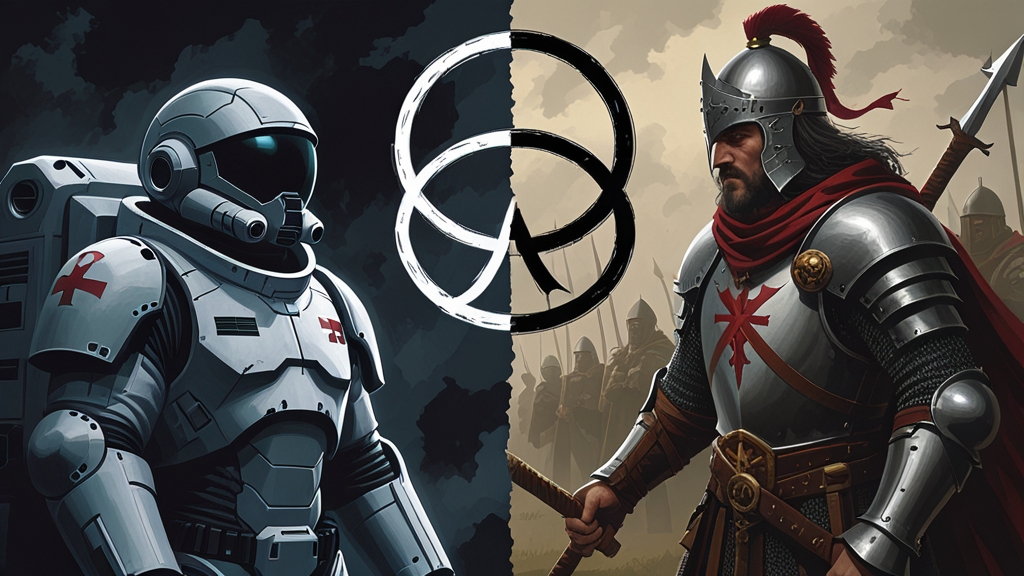
How Are Warhammer 40k and Warhammer Fantasy Connected?
Warhammer 40,000 and Warhammer Fantasy are separate settings created by Games Workshop that share several key elements — most notably the Chaos Gods (Khorne, Nurgle, Tzeentch, and Slaanesh), thematic parallels between factions, and a shared creative DNA. However, they take place in different universes and are not directly linked by any in-universe connection. Warhammer Fantasy was discontinued in 2015 when its setting was destroyed in the End Times event and reborn as Warhammer Age of Sigmar, though the original Fantasy setting has since been revived as Warhammer: The Old World.
The relationship between these settings is one of the most frequently asked questions in the Warhammer community, especially for newcomers trying to understand Games Workshop’s sprawling range of games and settings. The short answer is: they share a creator, a set of Chaos Gods, and many thematic elements, but they are not the same universe and events in one do not directly affect the other.
What Do They Share?
The most significant shared element between Warhammer 40k and Warhammer Fantasy is the Chaos Gods. Khorne, Nurgle, Tzeentch, and Slaanesh exist in both settings with essentially identical characteristics, motivations, and aesthetics. In both universes, these four entities dwell in the Warp (called the Realm of Chaos in Fantasy) and corrupt mortals, spawn daemons, and wage eternal war against each other and against the mortal realm.
Daemons — the servants of the Chaos Gods — are also identical across both settings. The same daemonic entities (Bloodletters of Khorne, Plaguebearers of Nurgle, Horrors of Tzeentch, Daemonettes of Slaanesh) appear in both 40k and Fantasy/Age of Sigmar. This shared daemon range has practical implications for the tabletop hobby: daemon models can be used in both game systems, making them a versatile purchase for players who enjoy multiple Games Workshop games.
Thematic parallels abound between the two settings. Both present grim, war-torn worlds where morality is ambiguous, survival is precarious, and hope is scarce. Both feature a central human civilisation (the Imperium in 40k, the Empire/Order in Fantasy/AoS) besieged by external threats and internal corruption. Both explore the tension between order and chaos, faith and reason, individual heroism and institutional brutality.
What Are the Key Differences?
Despite their shared elements, the two settings are fundamentally different in genre, scale, and tone.
Genre: Warhammer 40k is science fiction — a setting of interstellar empires, genetically engineered super-soldiers, alien civilisations, and technology that borders on magic. Warhammer Fantasy was classic high fantasy — a setting of knights, wizards, orcs, elves, and dwarfs in a world roughly analogous to medieval and Renaissance Europe.
Scale: Warhammer 40k is galactic in scope, spanning millions of worlds across the Milky Way galaxy. Warhammer Fantasy was set on a single world — the Warhammer World — roughly equivalent in size and geography to Earth. This difference in scale affects everything from the types of stories told to the nature of the conflicts depicted.
Technology: 40k features power armour, bolters, plasma weapons, starships, and technology so advanced it is indistinguishable from magic. Fantasy featured swords, bows, cannons (in the Empire and Dwarf ranges), and magic powered by the Winds of Magic rather than technology.
Tone: While both settings are “grimdark,” they express this darkness differently. 40k’s darkness is industrial, institutional, and cosmic — the horror of a galaxy-spanning bureaucracy that grinds billions of lives to dust. Fantasy’s darkness was more personal and mythological — the horror of a world where Chaos corruption could turn your neighbour into a mutant and where the forces of destruction were always pressing against civilisation’s fragile borders.
What Are the Parallel Factions?
Games Workshop has drawn deliberate parallels between factions across their settings, though each faction has its own distinct identity.
Space Marines / Stormcast Eternals: Both are elite, superhuman warriors in distinctive armour who serve as the poster-boy faction for their respective games. Space Marines are genetically modified humans; Stormcast Eternals are mortal souls reforged by the god Sigmar in divine lightning. Both are presented as humanity’s greatest defenders, and both carry the narrative weight of being the most recognisable and marketable faction.
Imperial Guard / Empire: The regular human soldiers of each setting. The Imperial Guard (Astra Militarum) fights with tanks, lasguns, and overwhelming numbers in 40k, while the Empire fielded pike blocks, handgunners, and cannons in Fantasy. Both represent ordinary humans struggling against threats that massively outclass them.
Aeldari / High Elves: Both are ancient, declining civilisations of graceful warriors with advanced technology/magic and a tragic history of catastrophic loss. The Aeldari lost their empire to Slaanesh’s birth; the High Elves lost their homeland to civil war and daemonic invasion.
Orks / Orcs and Goblins: Brutal, warlike greenskins in both settings, though 40k Orks have a unique comedic quality and gestalt psychic field (their collective belief that “red ones go faster” actually makes red vehicles faster) that distinguishes them from their Fantasy counterparts.
Necrons / Tomb Kings: Undead civilisations awakening from millennia of slumber. The Necrons are mechanical beings in 40k; the Tomb Kings were mummified rulers of an ancient human civilisation in Fantasy. The Tomb Kings were discontinued with the End Times, though their aesthetic influence persists in Age of Sigmar’s Ossiarch Bonereapers.
What Were the End Times?
The End Times was a series of narrative campaign books and supplements published by Games Workshop in 2014-2015 that depicted the apocalyptic destruction of the Warhammer Fantasy world. Over the course of several releases, the forces of Chaos — led by the Everchosen Archaon — overwhelmed the world’s defenders, major characters died or were transformed, and the Warhammer World was literally destroyed.
The End Times were enormously controversial among Warhammer Fantasy players. Many felt that the destruction of the setting they had loved for decades was unnecessary and disrespectful to the game’s legacy. The narrative itself was criticised for its pacing and for the handling of certain beloved characters. However, it also produced some genuinely dramatic moments and gave the old setting a definitive conclusion rather than an indefinite fade into obscurity.
From Games Workshop’s perspective, the End Times served a commercial purpose: Warhammer Fantasy Battle had been struggling commercially for years, and the company determined that a clean break was necessary to revitalise the franchise. The destruction of the old world created narrative space for its successor, Warhammer Age of Sigmar.
What Is Warhammer Age of Sigmar?
Warhammer Age of Sigmar (AoS) is the successor to Warhammer Fantasy, launched in 2015 after the End Times destroyed the old world. Age of Sigmar is set in the Mortal Realms — a collection of eight interconnected dimensional planes, each aligned with a different magical wind. The setting is deliberately more fantastical and high-concept than the relatively grounded Warhammer Fantasy world, featuring floating islands, realm-spanning conflicts, and a mythology centred on the god-king Sigmar.
Age of Sigmar retains many Fantasy factions in updated forms — the Stormcast Eternals serve as the new poster faction (drawing heavy parallels with Space Marines), while updated versions of Chaos Warriors, Skaven, Undead, Orruks (Orcs), and other classic factions populate the Mortal Realms. The game system was also redesigned from the ground up, replacing Fantasy’s rank-and-file regiment system with a more skirmish-oriented, round-based approach.
Age of Sigmar has been commercially successful for Games Workshop, revitalising the fantasy side of their business. However, it remains divisive among long-time fans, with some preferring the new setting’s expansive mythology and others longing for the more grounded, historically influenced Warhammer World.
What Is Warhammer: The Old World?
Warhammer: The Old World is Games Workshop’s revival of the original Warhammer Fantasy setting, launched in 2024. Set during an earlier period of the Warhammer World’s history (before the End Times), The Old World allows players to once again field armies of Empire knights, Bretonnian lords, High Elves, and other classic Fantasy factions using a rules system inspired by earlier editions of Warhammer Fantasy Battle.
The Old World’s release was a direct response to the enduring demand from fans who wanted to return to the classic setting. It coexists alongside Age of Sigmar rather than replacing it — Games Workshop now supports both fantasy settings simultaneously, much as they support both Warhammer 40k and the Horus Heresy.
This dual approach allows Games Workshop to serve both audiences: fans who prefer the high-concept, realm-hopping mythology of Age of Sigmar and those who prefer the grounded, historically flavoured warfare of the Old World. It also allows them to sell models to both player bases, maximising the commercial value of their fantasy intellectual property.
Were 40k and Fantasy Ever the Same Universe?
In the earliest days of Warhammer (the late 1980s), there were hints that the Warhammer Fantasy world might exist somewhere within the Warhammer 40,000 galaxy — perhaps as a feudal world isolated from the wider Imperium. This idea was never fully developed and was gradually abandoned as both settings matured and developed their own distinct identities.
The shared Chaos Gods represent the strongest remaining link between the settings, but even this connection is not explicitly confirmed as meaning the settings share a universe. Games Workshop’s official position is deliberately ambiguous — they have never categorically stated that the settings are connected or that they are separate. This ambiguity allows the shared elements to exist without requiring narrative consistency between the two universes.
For practical purposes, players and fans should treat 40k and Fantasy/AoS as separate settings that happen to share certain creative elements, much as different mythological traditions share similar archetypes without being the “same” mythology.
Frequently Asked Questions
Are the Chaos Gods the same in both settings?
The Chaos Gods (Khorne, Nurgle, Tzeentch, Slaanesh) appear in both settings with essentially identical characteristics. Whether they are literally the same entities existing across multiple realities or simply parallel manifestations of the same archetypes is deliberately left ambiguous by Games Workshop. Daemons are identical across both settings and can use the same models.
Can I use the same models in both games?
Daemon models can be used in both Warhammer 40k and Age of Sigmar. Some other models have crossover potential (Chaos Warriors, for example, could be used in both settings with appropriate basing). However, most faction-specific models are designed for one game system and would look out of place in the other.
Which setting came first?
Warhammer Fantasy came first, launching in 1983. Warhammer 40,000 (originally “Warhammer 40,000: Rogue Trader”) followed in 1987. 40k was initially conceived as “Warhammer in space” and drew heavily on Fantasy’s aesthetic and thematic foundations, which is why the two settings share so many elements.
Should I start with 40k or Age of Sigmar?
This depends entirely on your aesthetic and thematic preferences. If you prefer science fiction, grimdark atmosphere, and galactic-scale conflicts, start with 40k. If you prefer fantasy, mythological settings, and realm-spanning adventures, start with Age of Sigmar. Both games are well-supported with regular releases, and both have thriving competitive and narrative communities.
Is the Warhammer Fantasy world coming back?
Yes — Warhammer: The Old World relaunched the classic Fantasy setting in 2024. It coexists with Age of Sigmar as a separate game line. However, The Old World is set in an earlier historical period and does not “undo” the End Times. The original Warhammer World was still destroyed in the End Times narrative; The Old World simply tells stories from before that event.
Is Warhammer the same as Warhammer 40k?
Not exactly. “Warhammer” is Games Workshop’s overall brand, and it originally meant the fantasy wargame Warhammer Fantasy Battle. Warhammer 40,000 is the science-fiction setting set in the 41st millennium. Today the brand also covers Age of Sigmar, The Old World, the Horus Heresy and many spin-off games, so it is worth checking which one people mean.
Is the Horus Heresy part of Warhammer 40k?
Yes. The Horus Heresy is the backstory of Warhammer 40,000, a civil war set roughly ten thousand years before the main 40k timeline, in the 31st millennium. It has its own Black Library novel series and its own tabletop game, Warhammer: The Horus Heresy, but its events shape almost everything in the 40k setting.
Is Total War: Warhammer set in 40k or Fantasy?
Total War: Warhammer is set in the Warhammer Fantasy world, the same setting that Warhammer: The Old World revives on the tabletop. The trilogy features factions such as the Empire, Dwarfs, Vampire Counts, High Elves and Warriors of Chaos. It is not connected to Warhammer 40,000 or to Age of Sigmar’s Mortal Realms.