
What Is a Dreadnought? — Space Marine Walkers Explained
What Is a Dreadnought?
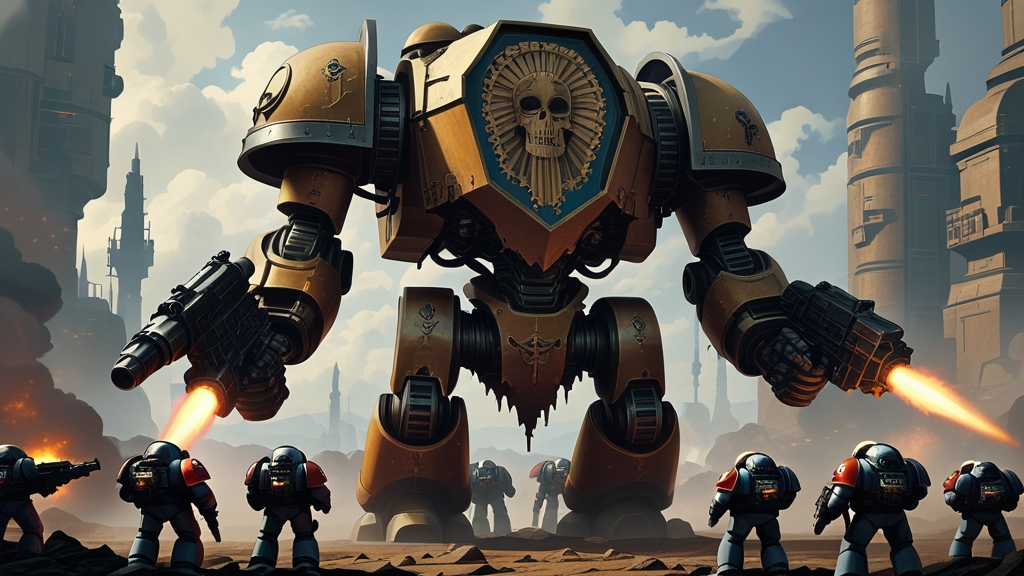
A Dreadnought is a walking war machine piloted by a mortally wounded Space Marine entombed within its armoured sarcophagus. They are revered as living relics — ancient warriors preserved in a state between life and death, continuing to serve their Chapter long after their bodies have failed them. The Dreadnought is one of the most iconic units in Warhammer 40,000 and represents the Imperium’s refusal to let its greatest heroes die.
When a Space Marine suffers wounds so grievous that even the advanced medical technology of the Adeptus Astartes cannot restore him, he may be granted the honour of interment within a Dreadnought chassis. The warrior’s broken body is placed inside an amniotic sarcophagus — a life-support coffin that sustains his vital functions and connects his nervous system to the walker’s controls. From that point forward, the Dreadnought becomes the Marine’s body, his weapons become his fists, and his armoured hull becomes his skin.
Dreadnoughts are among the most venerated members of any Space Marine Chapter. Some have served for thousands of years, carrying memories of battles and strategies from ages long past. Between engagements, they are placed into a dreamless sleep, only awakened when the Chapter has need of their wisdom or their firepower. This cycle of waking and sleeping means that ancient Dreadnoughts may have fought alongside Primarchs during the Great Crusade, making them living links to the Imperium’s mythic past.
How Does a Space Marine Become a Dreadnought?
The process of entombing a Space Marine within a Dreadnought is neither simple nor common. Not every fallen Marine is granted this honour — the candidate must have shown exceptional valour, possess vital tactical knowledge, or hold such a revered position within the Chapter that allowing him to die would be an unacceptable loss. Chapter Masters, veteran Captains, legendary warriors, and irreplaceable specialists are the most common candidates.
The physical process involves removing the Marine’s ruined body from his power armour and placing what remains — often little more than a torso and head — into the amniotic sarcophagus. This coffin-like container is filled with a nutrient-rich fluid that sustains the Marine’s remaining organs and prevents further deterioration. Neural connectors are hardwired into the Marine’s spine and brain, allowing him to control the Dreadnought chassis as though it were his own body.
The sarcophagus is then sealed within the Dreadnought’s armoured torso, protected by layers of ceramite and adamantium. From the outside, the sarcophagus appears as a distinctive rectangular panel on the walker’s front — a feature that marks every Dreadnought pattern. The entombed Marine can see through the Dreadnought’s optical sensors, speak through its vox systems, and fight with its weapon systems as naturally as he once wielded a bolter and chainsword.
However, the process is imperfect. Over centuries, the entombed Marine’s mind can deteriorate. Some become confused, conflating memories from different millennia. Others grow increasingly wrathful, their frustration at being trapped in a metal shell manifesting as barely controlled rage on the battlefield. The oldest Dreadnoughts are treated with a mixture of reverence and caution — they are honoured ancestors, but also unpredictable forces of destruction.
What Are the Different Dreadnought Variants?
The Space Marines field numerous Dreadnought variants, each designed for specific battlefield roles. The design has evolved over ten thousand years, resulting in a family of walkers ranging from ancient relics to modern war machines.
Castraferrum Dreadnought (Standard)
The Castraferrum pattern is the most common Dreadnought variant in the 41st Millennium. This is the classic box-shaped walker that most players picture when they think of Dreadnoughts. Armed with a combination of ranged and melee weapons — typically a multi-melta or assault cannon paired with a close combat fist — the Castraferrum is a versatile fire support and assault platform. Its compact design makes it easy to transport and deploy, and it remains a staple of Space Marine armies across the galaxy.
Redemptor Dreadnought
The Redemptor is a larger, more heavily armed Primaris Dreadnought introduced alongside the Primaris Space Marines. Standing taller than the Castraferrum and mounting heavier weapons including the macro plasma incinerator and Redemptor fist, the Redemptor is a significant step up in firepower. However, it comes at a terrible cost — the Redemptor’s systems place enormous strain on the entombed Marine, burning through pilots far faster than older patterns. Where a Castraferrum Dreadnought might serve for millennia, Redemptor pilots rarely last more than a few centuries before their bodies give out entirely.
Venerable Dreadnought
The Venerable Dreadnought is not a distinct chassis but rather a designation given to the oldest and most revered Dreadnoughts in a Chapter’s armoury. These ancient warriors have served for thousands of years and accumulated a wealth of combat experience that makes them more skilled than younger pilots. On the tabletop, Venerable Dreadnoughts typically have improved characteristics reflecting their superior pilot skill and the reverence their Chapters show in maintaining their chassis.
Contemptor Dreadnought
The Contemptor is a pre-Heresy design that represents the pinnacle of Dreadnought technology from the Great Crusade era. Larger and more sophisticated than the Castraferrum, the Contemptor features an atomantic shielding system that provides an energy field similar to an invulnerable save, a more fluid range of motion that allows for more natural combat movements, and superior reactor systems. Contemptors are incredibly rare in the 41st Millennium, as the knowledge to build new ones has been largely lost. Each surviving Contemptor is treated as an irreplaceable relic.
Leviathan Dreadnought
The Leviathan is a siege Dreadnought — a massive, heavily armoured variant designed to breach fortifications and destroy heavy armour. Armed with weapons like the storm cannon array, grav-flux bombard, or siege drill, the Leviathan brings overwhelming firepower to bear. However, its systems are even more punishing to the pilot than the Redemptor, often driving the entombed Marine into fits of madness. Many Leviathan pilots must be kept in chemical restraint between battles to prevent them from tearing apart everything around them.
Brutalis Dreadnought
The Brutalis is a Primaris close-combat specialist Dreadnought, armed with twin Brutalis fists or Brutalis talons that tear through armour with terrifying efficiency. Designed for aggressive assault operations, the Brutalis charges into enemy lines at speed, using its massive melee weapons to destroy vehicles and infantry alike. It represents the modern Imperium’s answer to the need for a dedicated melee Dreadnought platform.
Ballistus Dreadnought
The Ballistus is the ranged-warfare counterpart to the Brutalis, focusing on long-range firepower with twin lascannons and missile launchers. Where the Brutalis closes to melee range, the Ballistus provides heavy fire support from the backlines, engaging enemy armour and monsters at distance. Together, the Brutalis and Ballistus represent the two extremes of modern Primaris Dreadnought design philosophy.
What Is It Like Inside a Dreadnought?
Life inside a Dreadnought is a subject of profound horror and reverence in Warhammer 40k lore. The entombed Marine exists in a state that is neither truly alive nor dead — a twilight existence sustained by machines, cut off from almost all physical sensation except the feedback from the walker’s systems.
The Marine cannot feel the sun on his skin, taste food, or embrace a battle-brother. His world is reduced to sensor feeds, targeting data, and the voices of those who speak to him through the vox. Some Dreadnought pilots maintain their sanity and personality for centuries, holding onto their identity through sheer willpower and devotion to duty. Others gradually lose themselves, their minds fragmenting under the strain of millennia spent in isolation.
Between battles, Dreadnoughts are placed into a state of suspended animation. They do not dream. When awakened, they may not know how much time has passed — days, years, or centuries can blur together. Ancient Dreadnoughts like Bjorn the Fell-Handed of the Space Wolves, who fought alongside Leman Russ himself, wake to find themselves in a galaxy that has changed beyond recognition since they last opened their eyes.
This temporal dislocation can be deeply disorienting. A Dreadnought awakened for a crucial battle might begin issuing orders to Marines who died a thousand years ago, or reference strategies developed for enemies long since extinct. Chapter serfs and Techmarines learn to gently orient their venerable warriors, reminding them of the current date, the current enemy, and the current battle plan before committing them to the fight.
What Role Do Dreadnoughts Play in a Chapter?
Dreadnoughts serve a dual role within a Space Marine Chapter — they are both devastating war assets and living repositories of the Chapter’s history and traditions. This makes them uniquely valuable beyond their considerable battlefield capabilities.
As warriors, Dreadnoughts provide heavy fire support and armoured close-combat capability that complements the Chapter’s infantry. A single Dreadnought can hold a position against overwhelming odds, its heavy armour shrugging off small-arms fire while its weapons systematically destroy threats that would overwhelm ordinary Marines. In siege warfare, Dreadnoughts are particularly valuable, their ability to weather heavy fire while advancing on fortified positions making them ideal spearhead units.
As repositories of wisdom, Dreadnoughts are consulted by Chapter leadership on matters of strategy, tradition, and history. A Dreadnought who fought in a particular campaign centuries ago can provide first-hand tactical intelligence about the enemy, the terrain, and the strategies that worked or failed. This institutional memory is invaluable, especially for Chapters that have suffered devastating losses and lost their written records.
The Chaplains and Librarians of a Chapter often have special relationships with their Dreadnoughts. Chaplains lead the rites of awakening and sleeping, treating these ceremonies with deep solemnity. Librarians monitor the mental health of entombed Marines, watching for signs of deterioration that could make a Dreadnought dangerous to friend and foe alike. In some Chapters, the most ancient Dreadnoughts are effectively granted the authority of Chapter elders, their counsel sought on matters of governance as well as warfare.
Famous Dreadnoughts in Warhammer 40k Lore
Several Dreadnoughts have become legendary figures in the Warhammer 40,000 universe, their stories illustrating the heroism and horror of entombment.
Bjorn the Fell-Handed is perhaps the most famous Dreadnought in all of 40k. A Space Wolf who served as Leman Russ’s Great Champion during the Horus Heresy, Bjorn was mortally wounded and entombed in a Dreadnought chassis over ten thousand years ago. He is the oldest living loyalist Space Marine and is awakened only for the most critical battles or the most important Chapter ceremonies. His memories of the Primarchs and the Great Crusade make him an irreplaceable link to the Imperium’s founding era.
Rylanor the Unyielding, an Emperor’s Children Dreadnought, remained loyal to the Emperor even as his entire Legion fell to Slaanesh. He survived on the virus-bombed world of Isstvan III for ten thousand years, waiting for the chance to strike at his traitorous Primarch, Fulgrim. His story is one of the most celebrated tales of loyalty and defiance in the entire setting.
Tankred of the Black Templars became famous through the Dawn of War video games, where his battlecry “TANKRED ENDURES” became a fan-favourite. He exemplifies the furious, relentless aggression that defines Black Templar Dreadnoughts.
Chaos Dreadnoughts — The Hellbrute
The forces of Chaos also field Dreadnought-type walkers, though their version — the Hellbrute — is a far more horrific creation. Where loyalist Dreadnoughts are treated with reverence, Chaos Dreadnoughts are objects of pity and horror. The entombed Marine is not honoured but tormented, the daemon-infused systems of the Hellbrute feeding on his pain and rage to power its weapons.
Chaos Dreadnoughts are driven insane by millennia of suffering within their corrupted sarcophagi. They are kept in chains between battles and released like attack animals when combat begins. Many have lost all semblance of rational thought, reduced to howling, berserk killing machines that lash out at anything nearby — friend or foe. Their Chaos Marine handlers must use sorcery, chains, and careful positioning to aim these living weapons at the enemy rather than their own allies.
The Hellbrute variant specifically represents a Dreadnought that has been further mutated by the Warp, its metal hull fusing with daemonic flesh to create a grotesque hybrid of machine and daemon. Hellbrutes are covered in fleshy growths, warp-mutated limbs, and screaming faces that hint at the tormented soul trapped within. They are among the most disturbing creations in the Chaos arsenal.
Dreadnoughts on the Tabletop
In the Warhammer 40,000 game, Dreadnoughts serve as versatile heavy-infantry platforms that bridge the gap between infantry and vehicles. They offer a combination of toughness, firepower, and melee capability that makes them useful in virtually any Space Marine army list.
The current edition offers Space Marine players a wide selection of Dreadnought variants, each filling a specific niche. The Redemptor Dreadnought is the most popular competitive choice, offering excellent firepower and durability at a reasonable points cost. The Brutalis and Ballistus Dreadnoughts provide specialised options for melee and ranged builds respectively. The classic Castraferrum pattern remains available for players who prefer the traditional aesthetic.
When building a list, consider what role you need your Dreadnought to fill. A Redemptor with macro plasma incinerator provides excellent anti-elite firepower, while a Brutalis with twin fists excels at cracking open vehicles and monsters. Multiple Dreadnoughts can form the armoured backbone of an army, providing a resilient firebase or an unstoppable assault force depending on the variants chosen.
Frequently Asked Questions
Can a Dreadnought pilot ever leave the sarcophagus?
No. Once a Space Marine is entombed within a Dreadnought, the process is permanent. The Marine’s body is too damaged to survive outside the life-support systems of the sarcophagus, and the neural connections become so integrated with the chassis that separation would be fatal. The Dreadnought becomes the Marine’s permanent body for the rest of his existence.
How long can a Dreadnought pilot survive?
Theoretically, a Dreadnought pilot can survive indefinitely if the sarcophagus systems are maintained. Bjorn the Fell-Handed has survived for over 10,000 years. However, mental deterioration is a constant risk — most pilots experience increasing confusion, memory loss, and personality changes over the millennia, eventually becoming more machine than man in their thinking.
Are Dreadnoughts stronger than Space Marines in power armour?
Yes, significantly. A Dreadnought is far tougher, stronger, and more heavily armed than a Space Marine in standard power armour or even Terminator armour. A Dreadnought can shrug off weapons that would kill a regular Marine instantly and mount weapons systems too large for infantry to carry. However, they sacrifice the mobility and tactical flexibility of a Marine on foot.
Do all Space Marine Chapters use Dreadnoughts?
Yes, virtually every Space Marine Chapter fields Dreadnoughts, though the number available varies greatly. Some Chapters possess dozens of Dreadnought chassis, while others may have only a handful. First Founding Chapters and their oldest successors tend to have the most Dreadnoughts, including irreplaceable ancient patterns like the Contemptor and Leviathan.
What is the difference between a Dreadnought and a Knight?
While both are piloted walkers, they are fundamentally different. A Dreadnought is piloted by a mortally wounded Space Marine permanently entombed within it, while an Imperial Knight is piloted by a living Noble who sits in a cockpit called a Throne Mechanicum. Knights are also significantly larger than Dreadnoughts, standing several times taller, and are classified as super-heavy units rather than infantry-support walkers.
Related Content
- Dreadnought Guide — See all Dreadnought variants compared on the tabletop
- Space Marines — Build a Space Marine army with Dreadnoughts
- Space Marine Biology — Learn about the warriors entombed in Dreadnoughts
- The Horus Heresy Explained — Discover the era of the oldest Dreadnought patterns