
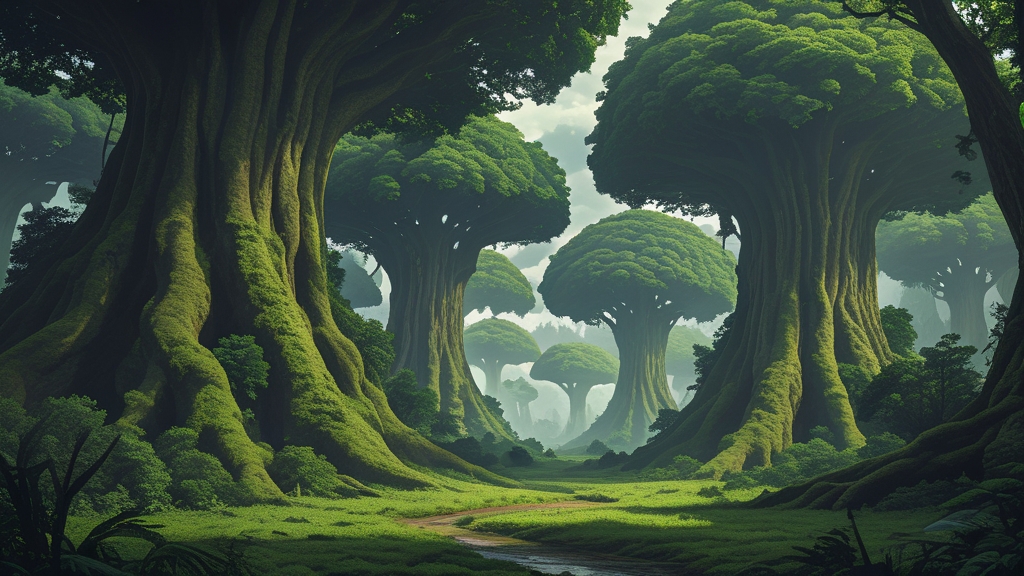
Ghyran is the Realm of Life — a verdant, overgrown realm of endless growth ruled by Alarielle the Everqueen. It is the most fertile of the Mortal Realms but also endlessly contested, as Nurgle’s forces constantly seek to corrupt its vitality. Every plant, river, and creature in Ghyran is steeped in the magic of life itself, making it both one of the most beautiful and one of the most dangerous of the Mortal Realms.
To walk through Ghyran is to be overwhelmed by the sheer intensity of nature. Forests grow to colossal size, the wilds reclaim cleared land with startling speed, and the realm’s waters and soil are charged with life magic. This is a realm where life doesn’t just exist — it dominates.
What Does Ghyran Look Like?
Ghyran’s landscape is defined by growth and change. Its terrain shifts with the seasons, the ebb and flow of life magic, and the long war between growth and corruption.
In its uncorrupted regions, Ghyran is breathtaking: vast forests whose canopies leave the ground below in twilight, fertile plains, great rivers and swamps teeming with life. Where Nurgle’s influence has taken hold, the same abundance is twisted into bloated, pestilent mockeries of natural life — rotting marshes and diseased forests that still grow, but grow wrong.
The realm’s named regions include the Jade Kingdoms, long associated with Alarielle’s power, and the Everspring Swathe, the region where Sigmar’s Living City was raised. Like all the Mortal Realms, Ghyran is vast, and much of it remains wild or contested.
In many accounts the wilds of Ghyran seem to respond to those who walk in them. Travellers who respect the land may find their way eased, while those who come to exploit or destroy it face thorns, mire and predatory plants — and, more often than not, the Sylvaneth.
Who Rules Ghyran?
Ghyran’s supreme ruler is Alarielle the Everqueen, goddess of life and queen of the Sylvaneth. Alarielle is bound to the realm far more deeply than a mortal ruler; her fortunes and Ghyran’s are closely linked. When she was reborn as a war goddess during the Realmgate Wars, it marked a turning point for the whole realm. Read more in our profile Who Is Alarielle?
During the Age of Chaos, Alarielle withdrew to the Athelwyrd, a hidden vale where she sheltered from Nurgle’s forces. From her realm she commands the Sylvaneth — the tree-spirits who are Ghyran’s native children and most devoted defenders. The Sylvaneth act almost like the realm’s immune system, fighting off corruption and invasion with tireless persistence.
But Alarielle’s authority is not absolute. Ghyran is vast, and other powers hold territory within it. Sigmar’s Stormcast Eternals garrison key cities, and human settlements farm its fertile soil — an alliance of convenience that the Sylvaneth tolerate rather than embrace.
Why Does Nurgle Want Ghyran?
The conflict between Ghyran and Nurgle is one of the defining struggles of the Age of Sigmar, and understanding it requires understanding what Nurgle represents.
Nurgle is the Chaos God of plague, decay, and entropy — but also, paradoxically, of life. His domain is the cycle of growth and decay: every living thing eventually dies and rots, and from that rot new life springs. Nurgle sees himself as the ultimate expression of this cycle, and he genuinely loves every disease, every plague, and every putrid creature that carries his blessings.
Ghyran, as the Realm of Life, represents the purest concentration of life magic in the Mortal Realms. For Nurgle, it is irresistible. Turning it into his garden would be his ultimate triumph — taking the purest expression of life and proving that all life ultimately serves decay.
During the Age of Chaos, Nurgle launched his greatest campaign against Ghyran. His forces — led by the Glottkin and made up of Rotbringers, plague daemons and corrupted mortals — swept across the realm in a tide of pestilence, poisoning waterways and soil and transforming forests into fetid swamps. At the campaign’s height, Nurgle controlled vast swathes of Ghyran, and Alarielle herself was driven into hiding, her power diminished to the point where many believed her lost.
The turning point came with the Stormcast Eternals’ arrival during the Realmgate Wars. Sigmar’s forces fought to reach Alarielle and break Nurgle’s grip on the realm. This led to the Everqueen’s rebirth as a war goddess — no longer the gentle nature spirit of old, but a vengeful deity determined to purge Nurgle’s corruption from her realm.
What Lives in Ghyran?
Ghyran’s intense life magic supports an astonishing diversity of creatures.
The Sylvaneth are Ghyran’s most prominent inhabitants. These tree-spirits range from the mighty Treelords — ancient beings who remember the Age of Myth — to the Dryads who form the bulk of Alarielle’s armies. The Sylvaneth are bound to Ghyran’s soil and feel the realm’s pain when it is corrupted. For more, see our Sylvaneth lore deep dive.
Beyond the Sylvaneth, Ghyran hosts countless beasts and monstrous plants sustained by the ambient life magic, and the line between plant and predator can blur in its deepest wilds.
Human civilisations exist in Ghyran, though they live at the mercy of its nature. Crops grow with remarkable abundance, but so do weeds, pests and predatory plants, and settlements must be defended not just against enemy armies but against the jungle itself.
The realm also hosts darker inhabitants. Nurgle’s forces maintain a lasting presence, and corrupted regions teem with plague-bearing creatures and daemons. These blighted zones exist in a constant state of war with the healthy realm around them. On the tabletop, these invaders are the Maggotkin of Nurgle.
How Does Life Magic Work in Ghyran?
Life magic — often called Jade magic — is the fundamental force that defines the realm. It is the magical expression of vitality, growth, healing, and renewal. In Ghyran it saturates everything, which is why the realm is so fertile.
For wizards and spellcasters, Ghyran is a natural home for healing and nature magic. Like every realm, Ghyran’s magic can also crystallise into realmstone, which is prized by wizards and alchemists — and which the Sylvaneth regard as part of the realm’s own body.
The abundance of life is also what makes Ghyran so attractive to Nurgle. Nurgle doesn’t suppress life; he redirects it, turning healthy growth into diseased proliferation. A Nurgle-corrupted forest doesn’t die — it keeps growing, but everything it produces is bloated, putrid and pestilent.
What Are Ghyran’s Most Important Locations?
Several locations within Ghyran hold particular significance for the story of Age of Sigmar.
The Athelwyrd is the hidden vale where Alarielle took refuge during the Age of Chaos. Its location was a closely guarded secret, and reaching it was a key goal of Sigmar’s forces in the Realmgate Wars.
The Living City is one of the great Cities of Sigmar, founded in the Everspring Swathe as a symbol of the alliance between Sigmar and Alarielle. It is famous for blending civilisation and nature, with living wood woven into its defences, and it is home to Wanderers and Sylvaneth as well as humans.
Hammerhal Ghyra is the Ghyranic half of the twin city of Hammerhal, linked by a Realmgate to Hammerhal Aqsha in Aqshy. Together they form one of the greatest cities of the Mortal Realms.
Ghyran’s Realmgates were vital battlegrounds during the Realmgate Wars, because whoever held them controlled the routes into and out of the realm.
How Does Ghyran Connect to the Wider Age of Sigmar Story?
Ghyran has been central to several major narrative arcs in Age of Sigmar’s evolving story.
During the Realmgate Wars, the liberation of Ghyran was one of the Stormcast Eternals’ primary objectives. The campaign to reach Alarielle, bring her back into the war, and break Nurgle’s grip on the realm formed one of the most memorable storylines in Age of Sigmar’s early narrative. Alarielle’s transformation from a broken, hiding goddess to a wrathful war deity remains one of the setting’s most powerful character arcs.
The Soul Wars saw Nagash’s Necroquake send death magic surging across every realm, Ghyran included — a force antithetical to everything the Realm of Life represents.
Since then, Ghyran has remained contested but resilient. Alarielle and her allies have reclaimed much of the realm, but the war is far from over, and Nurgle’s patient, relentless assault on the realm’s vitality never truly ends. If you want to field Ghyran’s defenders, our Sylvaneth army list guide is a good place to start.
Frequently Asked Questions
Is Ghyran the same as the Realm of Life?
Yes — Ghyran and the Realm of Life are the same place. “Ghyran” is the realm’s proper name, while “Realm of Life” is the descriptive title. All eight Mortal Realms have both a proper name and a descriptive title: Aqshy (Fire), Shyish (Death), Hysh (Light), Ulgu (Shadow), Chamon (Metal), Ghur (Beasts), and Azyr (Heavens).
Can Ghyran heal injuries?
Ghyran’s life magic is closely associated with healing and renewal, and its healing magic is among the strongest in the Mortal Realms. Exactly how this affects ordinary people varies from story to story, so treat any specific claims about miraculous cures as flavour rather than fixed canon.
What happens if you drink Ghyran’s water?
Ghyran’s waters are rich in life magic, and the realm’s rivers and springs are among the things Nurgle’s forces most like to poison. Beyond that, the lore gives no single fixed rule for what drinking them does, so beware of detailed claims you see repeated online.
Why can’t Alarielle just purge all of Nurgle’s corruption?
Alarielle’s power, while immense, has limits. Ghyran is vast, and Nurgle is a Chaos God with seemingly limitless resources. Purging corruption from one region often means Nurgle establishes a foothold elsewhere. It is a long war of attrition, and Alarielle must also balance her campaigns against the need to nurture and protect the healthy regions of her realm.
Is Ghyran safe for normal humans?
Relatively safe in protected cities like the Living City, but dangerous in the wild. Ghyran’s wilderness is filled with predatory plants, monstrous beasts and Nurgle’s corruption. Human settlements survive by constant vigilance against the encroaching wilderness and by staying on good terms with the local Sylvaneth.
Which Nurgle warlords invaded Ghyran?
The best known are the Glottkin, the three brothers Otto, Ghurk and Ethrac. They led Nurgle’s war in Ghyran during the Age of Chaos and the Realmgate Wars, and they were Alarielle’s great enemies in the early story of the Realm of Life. Nurgle’s Rotbringers and plague daemons have attacked the realm ever since.
Which Age of Sigmar armies come from Ghyran?
The Sylvaneth are Ghyran’s native army and Alarielle’s own people. The realm is also home to Cities of Sigmar settlements such as the Living City and Hammerhal Ghyra. Nurgle’s Maggotkin have the strongest foothold among the invaders, and many other factions fight across Ghyran’s forests.